The Japanese emperor’s voice crackled over the radio, and the Second World War in Asia was over. But for Indonesian nationalists, the end of one war only signaled the beginning of another. The Dutch were preparing to reclaim their colony, and the Republic of Indonesia had just declared independence on August 17th, 1945. With no standing army, no central command, and almost no weapons, the young nation had to build a fighting force from scratch, enlisting former soldiers, callow youths, and ordinary villagers willing to risk everything.
The first attempt at a national army was called the People’s Security Army, founded on October 5th, 1945. In theory, it was a unified force with a clear chain of command, dividing Java into three territorial commands with ten divisions, while Sumatra formed its own command with six divisions. But in reality, this structure barely held together. The authority of regional commanders was frequently ignored, and central appointments to lead divisions were routinely rejected.
The entire organization was chaotic, reflecting the improvised nature of the revolution itself. On November 12th, 1945, the army commander, Raden Sudirman, was elected supreme commander by a group of regional officers, a decision that bypassed the fledgling government’s authority. This created a rift that would plague the military for years. A few months later, on January 26th, 1946, the force was reorganized into the Army of the Republic of Indonesia, but the reorganization only made things worse.
It created two rival chains of command: one under Defense Minister Syafruddin Prawiranegara, who advocated for an army that was strong but obedient to the civilian government, and another under General Sudirman, who saw himself as an equal to any politician. Sudirman also opposed the government’s willingness to negotiate with the Dutch, setting the stage for a prolonged power struggle. In May 1947, the army was renamed the Tentara Nasional Indonesia, or TNI, with the goal of merging various non-state militias into a single national force. But two months later, the Dutch launched Operation Product and seized the upper hand.
Under the harsh terms of the Renville Agreement, TNI forces were forced to withdraw from West and East Java into a much smaller zone in Central Java, which lacked the resources to sustain them. Desperate, the military leadership turned to a man named Colonel Abdul Haris Nasution, a former officer trained by the Dutch colonial army, to rethink their strategy. Nasution proposed abandoning conventional warfare entirely. Instead, he advocated for a full guerrilla campaign based on Maoist principles: first, defensive survival and securing logistics; second, growing the guerrilla units and launching targeted attacks on Dutch convoys and positions to capture weapons; and third, transitioning into a regular army capable of a conventional victory once a stalemate was achieved.
He divided the TNI into territorial units, which would embed themselves in villages and maintain a parallel Republican government in Dutch-occupied regions, and mobile units, which would conduct hit-and-run attacks on economic and military targets. This approach was radical, but it was born of necessity, as the TNI lacked virtually everything a modern army needs to fight a conventional war. The officer corps was drawn primarily from former Indonesian soldiers who had served under the Japanese occupation. These men were trained for small-unit operations, usually at the company or battalion level, and lacked experience in large-scale coordination.
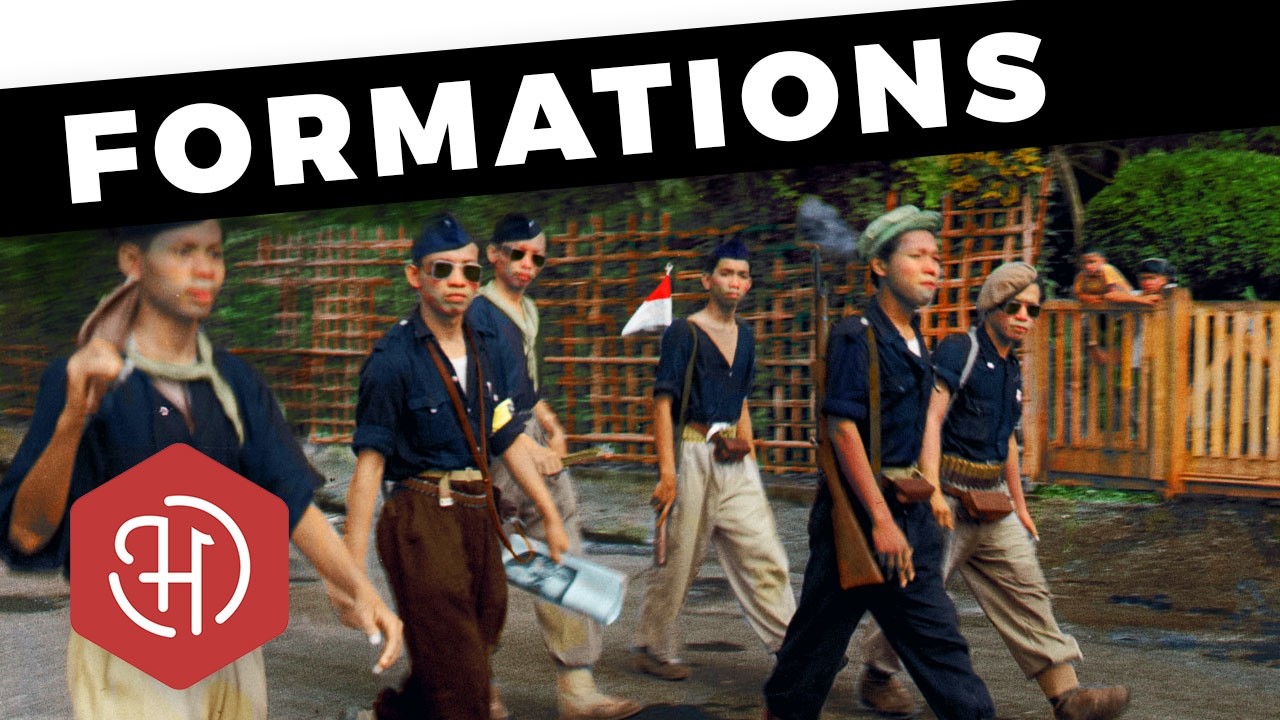
The few who had advanced military education, mostly former colonial officers, deepened the divide between the high command and the local field commanders. The men on the ground were even worse off. Uniforms were scarce, and the fighters wore whatever they could find, Japanese boots, Dutch puttees, or nothing at all. Their weapons were equally haphazard: Japanese Type 89 machine guns, Type 92 heavy machine guns, Arisaka rifles, Nambu pistols, and military swords, alongside pre-war stockpiles of Dutch equipment that the Japanese had seized years earlier.
At the start of the revolution, these captured stocks even included some artillery pieces and light armored vehicles, but most of these heavier assets were lost by late 1946. With no consistent foreign supplier, the nationalists depended on capturing weapons from the Dutch, which happened only sporadically. The shortages were devastating. According to Dutch intelligence in December 1948, only 40 to 50% of the TNI forces on Java were armed.
On Sumatra, a battalion of 800 to 900 men might have only 100 to 200 rifles, a few light machine guns, and one or two mortars. Artillery was nearly non-existent, and communication relied on civilian telephone lines or couriers. Combat training was rudimentary at best, and the Dutch viewed the Republican Army with open contempt, seeing it not as a real military force but as a loose network of armed gangs. Despite these staggering limitations, the TNI numbered around 118,000 troops on Java and about 41,800 on Sumatra, with thousands more in separate militias.
And, surprisingly, the Republic also had a small air force and navy. The air force began with a handful of captured Japanese aircraft: two fighter planes, three light bombers, four transports, and a few trainers. It was officially established in April 1946, but it suffered from a lack of pilots, mechanics, and spare parts. The Dutch destroyed 24 of its aircraft on the ground during Operation Product.
The navy was similarly modest, a few small vessels and several battalions fighting on land, totaling an estimated 15,000 personnel. The war ground on for years. The Dutch repeatedly underestimated the resilience of the Indonesian fighters, and their own political leaders grew weary of the cost. In 1949, the Dutch finally transferred sovereignty to the Republic of Indonesia.
The victory was not won on the battlefield alone. It was achieved through guerrilla warfare, political maneuvering, and the sheer determination of a people who refused to be colonized again. Some claim the Dutch could have won if not for their politicians, but the truth remains that the Indonesians were never truly defeated, despite being outgunned, outnumbered, and at times, nearly out of options.