The snow fell without malice, a young Belgian soldier once wrote in his diary, describing how it drifted down over the frozen Ukrainian steppe unlike anything he had known at home. He noticed that detail in the quiet hours before a battle, when the eastern front in winter was less a landscape than a kind of suspended silence. That fragment of his diary survives. His grave does not.
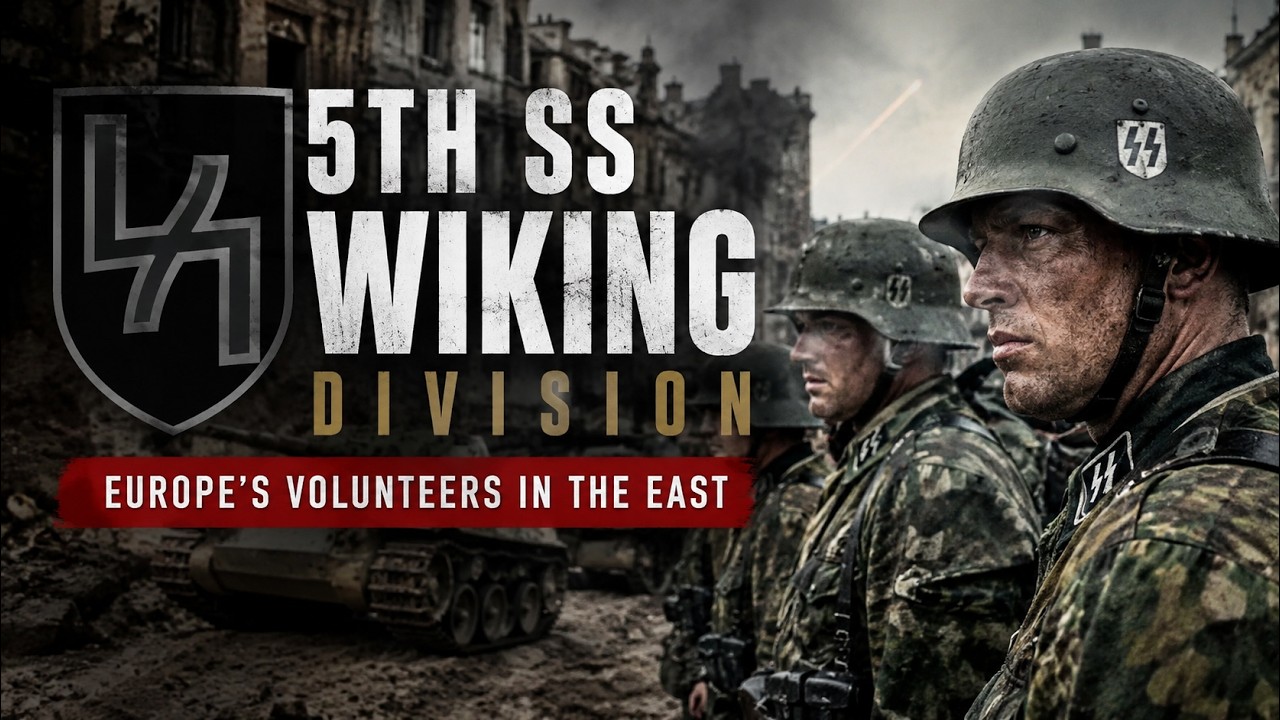
Such is the nature of memory when it concerns the men of the 5th SS Panzer Division Wiking, thousands of volunteers from Denmark, Norway, Belgium, the Netherlands, and even Sweden, who came to fight in a war not of their own making, under an insignia that history would ultimately condemn. They arrived by different paths. Some came through recruitment offices in Copenhagen and Brussels and Oslo, drawn by promises of brotherhood and a crusade against Bolshevism. Others were caught up in the machinery of occupation, or enlisted for reasons that seemed simple at the time: the pay, the adventure, the pressure of family or friends.
A Dutch volunteer later wrote that he could no longer recall the names of all his friends who had died, that they had blurred into a single absence. A Swede and a Fleming, separated by language and a thousand miles of home, could become as close as brothers because they shared the same tent and the same knowledge that their survival depended on the man beside them. That camaraderie was genuine. So was the ideology that bound them, though its precise hold on each man varied in ways impossible to measure.
In the beginning there was momentum. The formation was still being built in the early months of 1941, still drawing men from across the northern and western reaches of occupied Europe. Trainers drilled them in the cold, teaching them to move across the frozen terrain, to keep their weapons from seizing, to trust the men beside them. The snow lay deep across the steps of their training grounds, carved into dark pathways by the passage of boots and machines.
In the distance the land rolled on, flat and merciless, toward horizons that seemed to swallow time itself. They told themselves they were part of something larger, something that would purify and renew the continent. This was the story their officers told them, and many believed it. But the eastern front had a way of stripping stories down to their bones.
As the war deepened, the division was drawn into the brutal campaigns of the Soviet Union. The temperature fell to levels that seemed beyond the range of human engineering. Tanks froze solid. Engines had to be kept running through the night or they would never start again.
Frostbite took fingers and toes, and men learned to check each other’s faces for the telltale white patches that meant death or amputation. They fought at places that would become graveyards for entire units, against an enemy that seemed to have an endless supply of men and machines. The idealism that had brought some of them to the eastern front began to erode, replaced by the simple calculus of survival. Letters from home grew harder to write.
Some men stopped writing altogether. Others wrote the same things over and over, descriptions of the cold, requests for warm clothing and food, small fragments of ordinary life that felt increasingly distant from the reality around them. The division saw heavy action throughout the war, from the early advances into Soviet territory to the long, grinding retreats that followed. The names of the battles are recorded in military histories, but the texture of those engagements was different for the men who lived through them.
A Norwegian volunteer described the sound of the eastern front as a kind of constant pressure, a low rumble that never stopped, punctuated by the sharp crack of artillery and the screams of horses that had been caught in the open. The cruelty of that landscape was not merely physical. Men saw things that would stay with them for the rest of their lives, and some of them did things that would weigh on their consciences long after the guns fell silent. Not every man in the division participated in atrocities, but many witnessed them, and some were complicit.
The eastern front was a war of annihilation, and the men of Wiking were part of that war. They were not bystanders. By 1944, the mathematics had become brutally clear. The division was being ground down, its ranks depleted by casualties and disease, its survivors aged far beyond their years.
Replacements arrived, but they were younger, less trained, and increasingly desperate. The morale that had sustained the early volunteers was replaced by a grim determination to survive. Some men deserted, slipping away into the vastness of the Soviet landscape, hoping to make their way back to Germany or home, though few succeeded. Others stayed, bound by loyalty to their comrades and the fear of what would happen if they were caught.
The winter of 1944–45 was the worst. The supply lines were cut more often than not, and the men were reduced to eating whatever they could find. Horse meat, frozen potatoes, the last of their rations. They were no longer the elite formation that had marched east in 1941.
They were a collection of broken men, held together by exhaustion and the fading hope that the war would end before they did. The end came in Austria in May 1945. The remaining members of the division surrendered to American forces, and those who had survived the final months of the war were processed through prisoner-of-war camps. Some were tried for war crimes.
Some were sentenced to prison. Some were acquitted. Others simply disappeared into the chaos of post-war Europe. The division as an institution ceased to exist, but the men who had served in it carried the weight of that service with them for the rest of their lives.
Some returned home to faces of shame and silence. The Danish government chose a path of modest acknowledgement, neither grand memorials nor sweeping condemnations. The Dutch were characteristically pragmatic, preferring to focus on the broader themes of sacrifice rather than the specific ideological commitments of those who had served. The Norwegians, who had produced their own SS formations, faced a more fraught reckoning with their national narrative of resistance.
The Belgians, with their history of linguistic and cultural divisions, were especially cautious about how these histories were remembered. In Germany, the postwar reckoning was the most radical. Museums opened, documents were declassified, and historians catalogued the crimes of the regime. But the question of how to remember the foreign volunteers remained delicate.
Were they primarily victims of propaganda and circumstance, or active perpetrators? The answer was almost always both, in proportions that varied from man to man, impossible to measure with any precision. As the decades passed, the survivors aged and died. The photographs that remain show faces we might pass on any street in Amsterdam or Copenhagen, young men whose letters home speak of cold and hunger and the strange fraternity of the trenches.
The memorial stones in the cemeteries of Eastern Europe bear their names, some tended by descendants, others reclaimed by forest and weather. The monuments that were erected across Europe tend toward the understated, dedicated to broader themes of suffering rather than specific formations. But the history itself remains, stored in archives and museums, in the memories of descendants, in the documents that record the choices men made and the consequences they faced. The insignia, when we look upon it now, is a kind of mirror.
It reflects back at us the organization and efficiency of the military machine, but also the human faces behind the symbolism. Young men with names and families and futures that were interrupted, men who marched and fought and died in service to a cause that the world eventually judged abhorrent. Men who were at once agents of history and victims of it, perpetrators and casualties simultaneously.
Understanding that paradox, holding it gently and honestly, without either glorifying it or dismissing it entirely, is the only way to truly grasp what they were and what they became.