Most Dutch people couldn’t tell you which countries the Netherlands colonized. Those who paid attention in school might say Suriname or Indonesia. But almost no one learns that the Dutch once ruled a huge stretch of Brazil in the 17th century, under a man named Johan Maurits van Nassau-Siegen. Johan Maurits wasn’t even Dutch by birth.
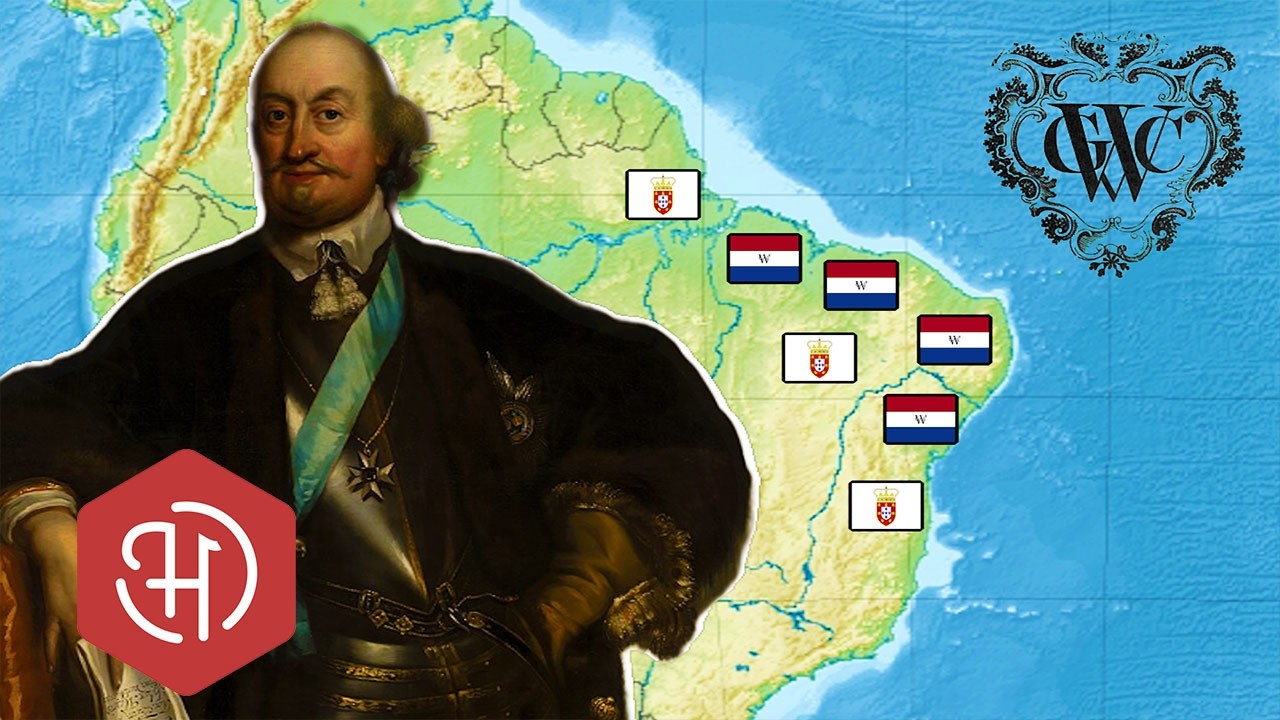
He came from a German branch of the Nassau family, a distant cousin of the famous Maurits of Orange. He was born in 1604 at Dillenburg Castle, one of 25 children. His parents had money problems, so while his older brothers got to study and travel, Johan Maurits had to make his own way. At 16, he joined the Dutch States Army during the Eighty Years’ War against Spain.
He proved himself in battle, rising quickly to captain, and spent his winters in The Hague mingling with the elite. In 1632, he bought land next to the government buildings and built a palace that would later become the Mauritshuis. But his biggest adventure was still ahead. The Dutch West India Company, or WIC, wanted a governor for their new Brazilian colony.
They had captured a long strip of land along Brazil’s northeast coast between 1630 and 1635, taking cities like Olinda and Recife from the Portuguese. The main prize was sugar, which until then had been controlled by Portugal. Since Portugal was under Spanish rule, and the Dutch were at war with Spain, attacking Portuguese colonies was fair game. The conquest wasn’t easy.
The Portuguese fought back hard, burning sugar mills as they retreated. But the Dutch pushed through, and the captured territory was named New Holland. The WIC was flush with cash, partly thanks to Piet Hein’s capture of the Spanish silver fleet, which funded the entire operation. In 1636, Johan Maurits was appointed governor-general.
He got a high salary and a share of the spoils. That October, he sailed for Brazil, bringing along artists and scientists to document everything they found. When he arrived, he threw himself into the work. He won military victories, expanded the territory, and brought order to a chaotic colony.
He cracked down on crime and corruption, set up courts, and introduced Amsterdam’s standard weights and measures. He fortified Recife and built a brand new city called Mauritsstad, right across the river. His palace there, Vrijburg, was something out of a dream. One room was entirely furnished in ivory, tables, chairs, even candlesticks.
Around it stretched a park with vineyards and fountains. The city itself had straight streets crossing at right angles, a hospital, and an orphanage. It looked like a piece of modern Europe dropped into the tropics. To connect the new city with old Recife, they needed a bridge over the river.
The current was so strong that the chief engineer said a stone bridge was impossible. Johan Maurits, who liked designing things himself, came up with a wooden central section instead. The bridge got built, and today the Ponte Maurício de Nassau still stands in roughly the same spot, still bearing his name. In Brazil, they know him as Maurício de Nassau.
Schools, a bridge, and a university carry his name. His bust stands by the governor’s house. Brazilian children learn about him in school, while in the Netherlands, almost no one knows who he is. His secret was tolerance.
He knew he couldn’t defeat the Portuguese outright, so he needed them on his side. He gave them equal rights and let them participate in city governance. In 1640, he convened a meeting of Dutch and Portuguese representatives, which is sometimes called the first parliament on the American continent. He allowed Catholics to practice their faith openly.
He even let Jews build the first synagogue in South America, which still exists today as a museum. But he also relied on slavery. Since few Dutch colonists were willing to move to Brazil, the colony depended on enslaved labor. Johan Maurits strengthened the Dutch slave trade by sending a fleet to Fort Elmina on the African coast.
The scientists and artists he brought with him produced important work on tropical diseases, biology, and astronomy. But the WIC board back in the Netherlands was not impressed. They cared about profit, not culture. Once peace was made between Portugal and the Republic in 1643, they saw no need for a fancy governor and his expensive projects.
They recalled him. Johan Maurits was furious. He complained about lack of support and unrealistic expectations. On May 11, 1644, he left Brazil.
Large crowds came to see him off. After he left, everything fell apart. His successors couldn’t keep the peace. During the defense of Recife, Mauritsstad was destroyed.
In 1654, the Dutch lost Brazil for good. Johan Maurits went back to The Hague and filled his palace with Brazilian objects, stuffed animals, and paintings. He hosted parties with exotic drinks and Brazilian performers. He stayed in the army until 1675, becoming commander-in-chief, then retired from public life.
He never married and had no legitimate children. He died in 1679 near Kleve, in Germany, where he was buried. In Germany, he’s remembered for his parks and buildings. In Brazil, he’s celebrated as one of the best colonial administrators ever.
In the Netherlands, he’s barely remembered at all, except through the Mauritshuis museum, and even then, most people confuse him with his famous cousin, Prince Maurits of Orange. So here’s a man who built cities, won wars, and ruled a colony with a level of tolerance rare for his time. A man celebrated in Brazil and largely forgotten in his own country.
Maybe it’s time his story got told more often.


