For nearly three decades, Jennifer Gwynne kept a small birthday card from an old college boyfriend.
There was nothing luxurious about it.
No famous logo. No historic announcement. No billion-dollar business plan hidden inside.
Just a little card covered with the words “Love You,” signed by the young man she had dated at the University of Pennsylvania.
Inside, he had written:
“Happy Birthday, Jennifer (aka, Boo-Boo), Love, Elon.”
Twenty-seven years later, someone paid $16,643 for it.
And that wasn’t even the most expensive thing she had kept.
A gold necklace the same boyfriend gave her sold for $51,008.
A photograph of him fooling around upside down in her dorm room sold for $21,889.
Another photo—just a 23-year-old college student wearing a Judge Dredd T-shirt—sold for $9,375.
By the time the auction ended in September 2022, Jennifer’s box of memories from a one-year college relationship had generated more than $165,000.
Of course, there was one reason those ordinary objects had become extraordinary.
The boyfriend was Elon Musk.
But the strangest part of the story isn’t that people paid thousands of dollars for photographs of one of the world’s most famous entrepreneurs.
It’s what those photographs captured.
Because before Tesla, before SpaceX, before rockets landing themselves, before the arguments, controversies and constant headlines, Jennifer Gwynne knew a version of Elon Musk almost nobody else remembers.
He was simply the quiet guy down the hall.
And she was his girlfriend.
They met in the fall of 1994.
Jennifer was a student at the University of Pennsylvania, and Musk was finishing his studies there. Both were resident advisers in the Spruce Street section of Penn’s Quadrangle dormitories.
There were no private jets waiting outside.
No security teams.
No shareholders watching every move.
No millions of social-media followers analyzing every sentence.
According to Jennifer, Musk was shy, intensely focused and unusually serious.
That was part of what attracted her to him.
He wasn’t the loudest man in the room.
He didn’t need to be.
She remembered him as someone whose mind always seemed to be working on something.
School.
Technology.
The future.
Electric cars.
Years before Tesla would make him synonymous with EVs, Jennifer recalled Musk speaking about electric vehicles as though their arrival wasn’t speculation but inevitability.
In one auction description, she remembered him talking about electric cars in 1994 and being completely certain they were coming.
At the time, however, there was nothing glamorous about watching the future billionaire think.
Sometimes he was simply sitting at Jennifer’s desk doing schoolwork.
Sometimes he was eating with friends.
Sometimes he was driving an old BMW through Philadelphia.
Sometimes he was being ridiculous in a dorm room.
Those were the moments Jennifer photographed.
One picture captured Musk driving his BMW as they headed to see Pulp Fiction on an early date.
They arrived to find the theater so crowded that they had to sit in the front row.
Decades later, that slightly blurry photograph sold for $1,155.
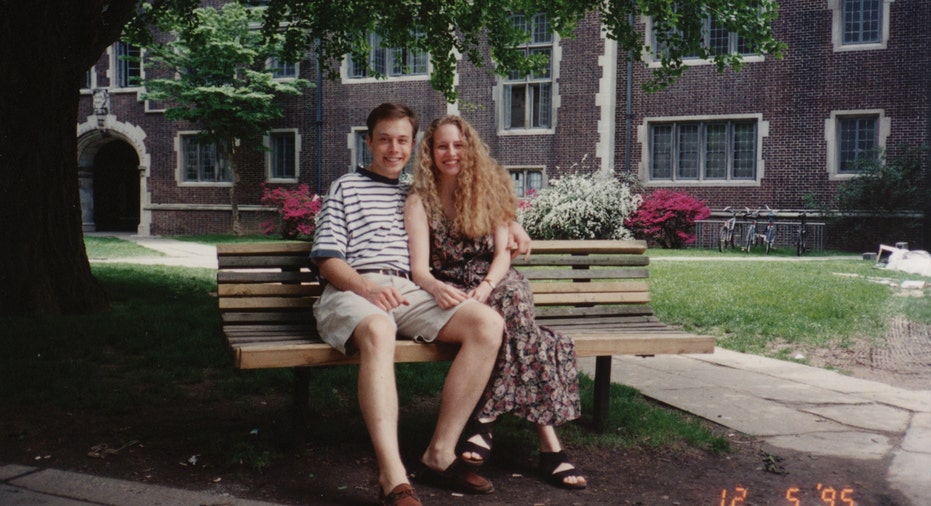
Another picture showed the couple sitting together on a bench at Penn.
There is no SpaceX logo.
No Tesla.
No stage.
No cameras from the world’s press.
Just a young couple smiling.
According to Jennifer, Musk’s mother, Maye, took the picture while visiting Philadelphia. They were planning to drive to New York to see the musical Tommy.
Before they could leave, something went wrong with Musk’s car.
Instead of abandoning the trip, Jennifer recalled spending hours at an auto-parts store while Elon repaired the problem himself.
He eventually got the car running.
They made it to New York.
That simple bench photograph later sold for $2,733.
But Jennifer’s collection contained something more revealing than posed photographs.
It contained Elon Musk being silly.
That sounds insignificant until you consider the public image that would later surround him.
The CEO.
The engineer.
The man sleeping at factories.
The entrepreneur discussing Mars, artificial intelligence, manufacturing, satellites and the survival of civilization.
Jennifer remembered something much smaller.
She said Musk was usually reserved.
But every once in a while, the serious expression disappeared.
In one photo, he was upside down on the floor of her dorm room, apparently trying to make her laugh.
She took the picture because she wanted to capture that side of him.
Someone eventually paid $21,889 for that single photograph.
Think about that number.
More than many people pay for a used car.
For a college snapshot.
But at the time the shutter clicked, neither of them could possibly have known what the picture would become.
To Jennifer, it wasn’t “Elon Musk, future billionaire.”
It was Elon.
Her boyfriend.
The person whose behavior she understood well enough to notice when he was unusually playful.
That is what fame does to ordinary objects.
It changes them retroactively.
A handwritten note stops being a note.
A photograph stops being a photograph.
A necklace stops being jewelry.
Suddenly, everything becomes an artifact from the years before history happened.
And Jennifer had kept almost all of it.
In late 1994, Musk gave her a 14-karat gold necklace featuring a small green emerald.
Jennifer wore it on and off for years.
Eventually it spent most of its time in her jewelry box.
Decades passed.
She got married.
Built another life.
Musk moved to California and entered the internet boom.
Their relationship ended.
“We broke up just before he started conquering the world,” she later said.
That description was unusually accurate.
Musk went on to co-found Zip2.
Then came X.com and PayPal.
Then SpaceX.
Then Tesla became central to his public identity.
The quiet college student Jennifer remembered slowly became one of the most recognizable businessmen on Earth.
Meanwhile, the photographs stayed where old photographs usually stay.
Stored away.
Private.
Worth something emotionally, perhaps.
But not financially.
Until Jennifer read about another Elon Musk auction.
Someone had sold university papers that Musk had graded and initialed while at Penn.
They brought thousands of dollars.
Jennifer saw the story and had an immediate thought.
What did she still have?
The answer was sitting in storage.
Not a few initials on a paper.
Actual photographs.
Personal photographs.
A signed birthday card.
The necklace.
Memories from a period of Musk’s life that had almost completely disappeared from public view.
Jennifer contacted Boston-based RR Auction.
And soon, the private box became a public catalog.
That was when the judgment began.
To some people, there was something uncomfortable about it.
Selling photographs of your ex?
Auctioning a birthday card?
Turning a former relationship into cash?
The easiest interpretation practically wrote itself:
A woman who had once dated a future billionaire was finally cashing in.
It was the kind of framing that spreads quickly online because it requires no context.
Just a famous name and a dollar figure.
But Jennifer’s reason for selling complicated that narrative.
She was living in South Carolina, married, and helping raise a stepson.
She said she wanted the proceeds in part to help pay for his future college education. She also discussed directing some money toward an animal-rescue organization.
The old relationship wasn’t coming back.
But perhaps the memories could now do something practical for the family she had built afterward.
Then the bidding started.
The estimates suddenly looked almost meaningless.
The “Boo-Boo” birthday card had been estimated at $10,000 or more.
It sold for $16,643.
The Judge Dredd photograph had an estimate beginning at only $100.
It sold for $9,375.
The upside-down dorm-room photo had also carried a $100-plus estimate.
It reached $21,889.
Then came the necklace.
A small 14-karat gold chain with a green emerald, accompanied by photographs of Musk and Jennifer.
The estimate began at $500.
The final price:
$51,008.
By the end, the collection had brought more than $165,000.
Photographs that had once lived quietly in an album were now collectibles.
A private nickname had become auction-house copy.
A college gift had become the most valuable item in the sale.
But then something happened that changed the tone of the entire story.
In the middle of all the publicity, Elon Musk changed his Twitter profile picture.
The new image?
One of Jennifer’s college photographs being offered in the auction.
It was the picture of 23-year-old Musk wearing the Judge Dredd T-shirt.
The same photograph bidders would eventually push to $9,375. Associated Press coverage noted the profile-picture change while reporting the auction’s results.
Jennifer and Musk had not been in regular contact for decades.
There was no public reunion.
No dramatic message.
No angry legal letter demanding the photographs disappear.
No public fight over the sale.
Just Musk choosing, at the exact moment his old college pictures were spreading around the world, to make one of them his own profile image.
Nobody outside Musk can say with certainty what he intended by it.
Maybe he found the picture funny.
Maybe he enjoyed seeing a forgotten version of himself.
Maybe it was simply typical Musk internet humor.
But it made one thing much harder to argue:
These photographs were not inherently humiliating.
They showed a young man before the mythology.
And perhaps that is why people wanted them.
Look again at what collectors were actually buying.
Not Tesla stock certificates.
Not a SpaceX engine component.
Not a document from a billion-dollar acquisition.
They were paying thousands of dollars to see Elon Musk sitting in a dorm room.
Driving to the movies.
Eating dinner.
Smiling with his girlfriend.
Goofing around.
Wearing a T-shirt.
Existing before everyone knew what came next.
That is the real plot twist hiding inside Jennifer Gwynne’s auction.
The objects became valuable precisely because they were once worthless.
When Jennifer took those photographs, there was no guarantee she was documenting anyone important.
She wasn’t standing beside “the future richest man in the world.”
She was standing beside a college boyfriend who talked obsessively about the future.
When Musk gave her the necklace, nobody knew that collectors would one day compete to own something he had touched.
When he wrote “Boo-Boo” inside a birthday card, he wasn’t writing for an auction house.
He was writing for one person.
That private context disappeared the moment history caught up with the young man in the pictures.
And suddenly strangers wanted access to the ordinary life that fame had erased.
Perhaps that is why the photograph of Musk upside down sold for more than $21,000.
There are millions of polished photographs of Elon Musk today.
Photos at product launches.
Photos beside rockets.
Photos with politicians.
Photos at factories.
Photos designed to be seen.
Jennifer’s pictures were different.
They were taken before anyone thought they mattered.
There was no brand strategy.
No press team.
No billionaire persona.
The camera caught moments rather than messages.
And decades later, those unguarded moments became rarer than the polished ones.
Jennifer never claimed that their college relationship was some lost epic romance.
Her descriptions were almost the opposite.
She remembered a sweet but reserved boyfriend who could be intensely focused and not particularly demonstrative.
She remembered a young man who already talked about enormous ideas.
She remembered being attracted to his intelligence and certainty.
And she remembered knowing, long before the rest of the world did, that he was probably going somewhere.
But they still broke up.
Musk left.
Life moved on.
That is what usually happens to college relationships.
Two people share a year that feels enormous at the time.
Then careers begin.
Cities change.
Phone calls become less frequent.
New partners arrive.
Eventually an entire life grows between the present and that old photograph.
Most people can open a box twenty-seven years later and recognize the faces without feeling any obligation to return to the relationship.
Jennifer’s situation was different only because the face beside hers became globally famous.
In September 2022, the market placed a price on that accident of history.
$1,155 for a trip to the movies.
$2,733 for a bench outside the dorm.
$9,375 for a Judge Dredd shirt.
$16,643 for “Boo-Boo.”
$21,889 for a goofy moment on the floor.
$51,008 for a necklace.
More than $165,000 for a collection of memories that, for most of their existence, had no meaningful resale value at all.
And the money had somewhere to go.
A relationship that ended before Jennifer’s current family existed could now help the next generation of that family prepare for college.
There is something strangely fitting about that.
Elon Musk left university and raced toward Silicon Valley.
Jennifer kept the photographs.
Twenty-seven years later, those photographs could help another young person head toward an education of his own.
The past did not need to be revived.
It simply needed to be opened one last time.
That may be the most human part of the entire story.
We spend years throwing ordinary moments away because we assume important moments will announce themselves.
Usually they don’t.
The photograph you almost didn’t take.
The birthday card at the bottom of a drawer.
The cheap date.
The broken car.
The embarrassing T-shirt.
The afternoon when someone you love is acting ridiculous just to make you laugh.
None of it feels historic while it is happening.
History arrives later.
Sometimes twenty-seven years later.
And by then, the people in the photographs may barely recognize the lives they once thought would last forever.
Jennifer Gwynne didn’t keep a billionaire’s memorabilia in 1994.
She kept a boyfriend’s memories.
Only time turned one into the other.