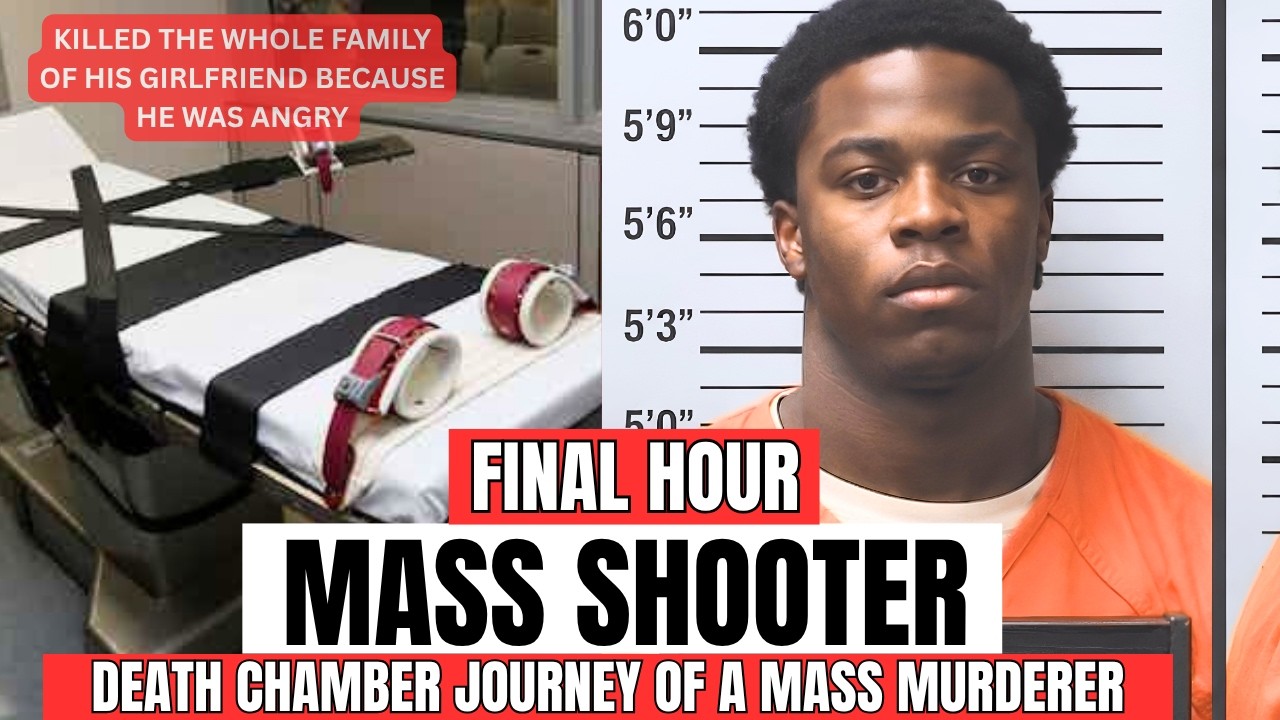
The final witness has spoken. The jury has returned. And now, after more than two decades of legal maneuvering, the state of Alabama is set to carry out the execution of Wesley Devon Harris, the 22-year-old man convicted of the brutal massacre of six members of his girlfriend’s family in a rural farming community known as Moody’s Crossroads.
The execution, scheduled for tonight at the Holman Correctional Facility, brings a somber conclusion to a case that has haunted Crenshaw County since the morning of August 26, 2002. Harris is set to die by lethal injection for the systematic shooting deaths of his girlfriend’s grandmother, parents, and three brothers—a rampage that began with a knock on a kitchen door and ended only days later with his arrest at a roadside bar, a survivor and a toddler clinging to her memory of a family erased in a single day.
 For the family of the victims, the date marks the end of a relentless pursuit for justice. “We are finally at peace,” a spokesman for the family read from a prepared statement outside the prison gates. “The memories are still raw, the pain is still there, but the debt is finally being paid.
Wesley Harris tore our lives apart. We will never get Janice’s grandparents, her mother, father, or her brothers back, but we can now say that the man who took them away is gone.”
The night leans heavy with the weight of a brutal narrative that began not with violence, but with a teenage romance. Janice Paull was just 14 years old when she met Harris, a 19-year-old drifter who quickly became a fixture in her life. Within months, she was pregnant.
The resulting relationship played out against a backdrop of domestic instability that the family desperately tried to manage. By August of 2002, the connection between the girl and the older man was a succession of breakups and reconciliations, marked by disputes and threats of violence.
On the evening of Friday, August 23, the volatility of the situation reached a breaking point. A fight over money for diapers ended with Harris being slapped by Janice, who then demanded he leave. The dispute spilled out into the yard.
Janice’s older brother, Jerry, backed his sister up with a gun, a display of force that briefly pushed Harris away. The family’s intervention didn’t end the conflict, it merely postponed it. Harris left property for the night, but he did not vanish from the picture.
Over the weekend, he called the home twice, asking if charges were going to be pressed against his girlfriend. The answer was silence.
By Sunday evening, Harris was back at the farmhouse, looking for a confrontation with his girlfriend’s grandmother, Ruth Pruitt. She faced him with the threat of police. Harris retreated, but she had already called her daughter’s name.
Her mother, Wil, arrived armed with his sons. Harris was ordered off the property a third time under threat of deadly force. As he walked into the darkness that night, he did not leave alone.
 He carried with him a gun. He no longer carried the intention to be chased away.
On Monday, that intention became a reality. The serene morning shattered at 8:30 AM when Janice felt her bed shake. She woke to see her grandmother, Ruth, standing beside her bed.
Behind her, Harris aimed a shotgun at her grandmother’s stomach. He forced her to tie her grandmother’s hands. He taped them again, forcing her to the floor, forcing her to pray.
Then he pulled the trigger and fired at her grandmother. The whole family was in that kitchen. His voice demanded to know when her brother would come home.
When he got the answer, he left the room. A single shot echoed from the trailer outside.
He had killed who she was. The entire day was a systematic march through the family’s property. He moved from the farmhouse to the trailer, killing his girlfriend and her brothers as they came back.
He forced her to stay in a room, tied to a bed, while he executed her family one man at a time. When Jerry, the elder, came home with car, he was shot and killed. When Willie, the father, returned from work, he was ambushed and shot in the face.
Joanne, the mother, came home looking, was told to kneel and was killed with a gunshot to the back of her head.
 He spared the 2-year-old child, his own daughter. He forced Janice and Shae into a car and left as a fugitive. The investigation across 3 states, but he was arrested two weeks later in Montgomery with his daughter and girlfriend alive.
On June 11, 2005, a jury convicted him of six counts of capital murder. The prosecution argued that the murders were committed in a single continuous act and involved six victims for the purpose of the death penalty.
The jury was then charged with deciding between life without parole and death. They came back with a divided verdict. They recommended death, but not by a unanimous vote.
The vote was 7-5. Under Alabama law at the time, that recommendation did not carry the final word. The presiding judge, Ed, had the sole authority to override the jury’s recommendation.
In a decision that would afterwards split the state, the judge overrode the jury’s recommendation of life without parole and sentenced Harris to death.
The judge noted evidence of statutory aggravating circumstances, including the fact the murders were committed during the commission of a robbery and that they were particularly heinous, atrocious, or cruel. The judge argued the jury’s seven-five vote was swayed by emotion. The law has since changed.
In 2017, Alabama abolished judicial override, making jury sentencing the final decision in all capital cases. The change was not applied retroactively to those who had already been sentenced under the old system.
Harris’s appeals were exhausted on Thursday. The Supreme Court declined to hear the case. The only final mercy was a temporary stay that was lifted late Friday.
 Tonight, at the state’s execution chamber at the Holman facility, they went through the process of testing the straps and the IV line. He was asked if he wished to make a final. Harris closed his eyes and then, in a low voice, he refused.
He invoked a final but did not speak. The last utterance he made was a nod of the head.
After the lethal injection began, the executioner who had to administer the drugs reported that Harris’s final breath was a long, shuddering one, but his heart monitor soon showed a flat line. The time of would be 6:32 PM. A moment of silence hung in the room, broken only by the involuntary sob of one of the state’s witnesses.
Harris was declared dead at 9:09. He was pronounced dead 20 minutes after the lethal dose began.
He leaves behind a daughter, now a woman in her 20s, who will grow up without having seen the inside of a childhood home. The landscape of that farm is bare. Her mother’s house is vacant.
The trailer is gone, only a dirt lane remains. The entire family, a sprawling, multi-generational rural, has been reduced to a memory. The vigilance of the state was the only comfort its residents.
The trial attorney for the defense, who fought against the death sentence, had no comment directly but issued a statement that the appeals process was fulfilled but the ultimate moral weight of the state executing a man for a murder he obvious committed should always be weighed against the pain of the victim’s voice, which cannot be heard.
The morning after the execution, the weather is clear and dry. A new dawn breaks, uninvited, upon the empty farm. No one puts a dog out.
No father walks to the hog farm. No grandmother in the kitchen offers a plate of food. It is a empty silence.
The farm waits, the trajectory of a life extinguished. It was a final tamping down of the dirt over the graves of the six and the one man who brought them, all done in the name of the state’s justice. The case remains closed.