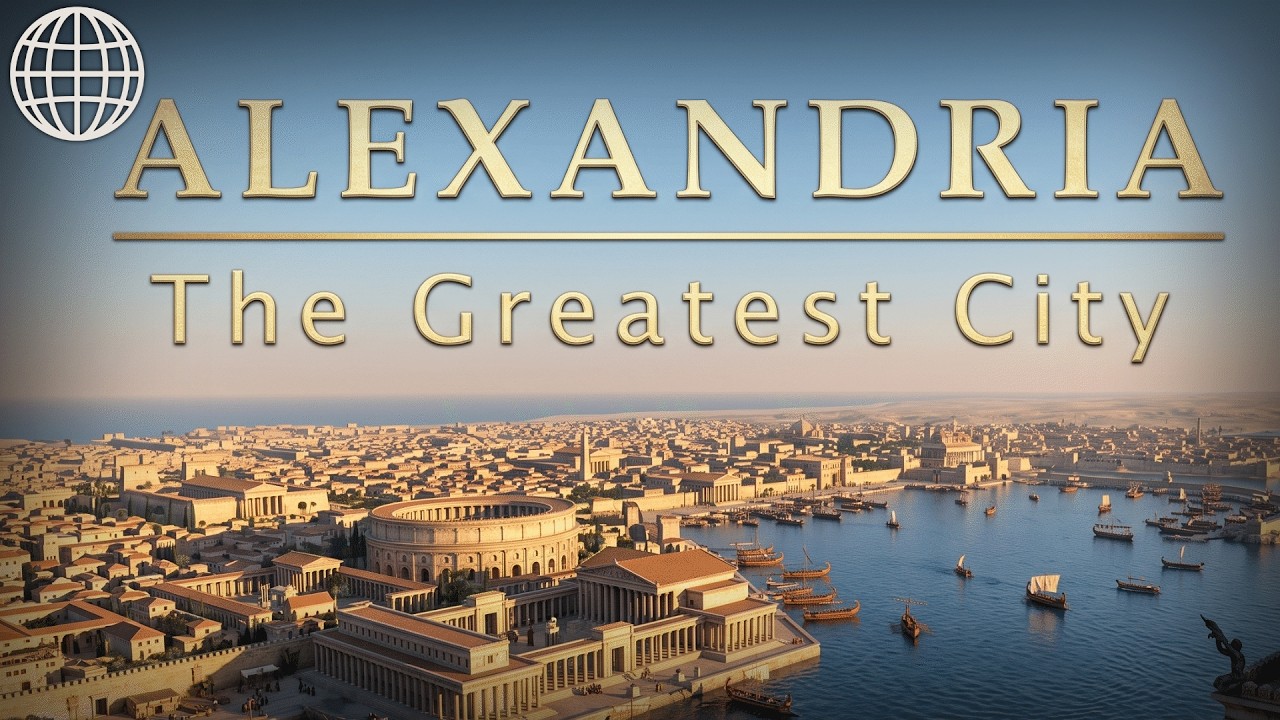
Halfway in time between the pyramids and us, there was a city that put absolute value on wisdom. Its monuments were as grand as anywhere in the ancient world, but its real power wasn’t built on walls or armies. It was built on ideas. This is the city of Alexandria, and this is its extraordinary story.
In the 4th century BC, Egypt was one of the most admired and envied countries in the whole of antiquity. A culture that not only believed in life on Earth, but was obsessed with life after death. I had no idea this was this size. No, it actually is a bull burial, because this was a sacred incarnation of one of the Egyptian gods, and so he was buried here after his death.
I mean, instead of coming in and saying, “Woof, you all are fools,” he accepted the local beliefs. But even that wasn’t enough for Alexander. He built a causeway running all the way across, almost a mile long. No bodies were ever found.
The tomb robbers got here long before the archaeologists did. They might not have left any bodies, but they’ve got some pretty lifelike guardians for the tomb. Oh, it’s not particularly well done, no, but that’s part of the charm of this place. Alexandria was a new town, and it had to create its own legitimacy.
And by doing that, it draped itself in the mantle of Egypt, but at the same time brought with it its Greek notions. A Polish team have been working on a discovery which reveals exactly where Alexander’s ideas were played out. If I was sitting here as the teacher very comfortably on your steps and then the student would be there giving their paper or presentation. We don’t have any indication but probably the auditorium could be high as up to 5.
5 meters as the level of the columns. Its rulers had wanted to acquire the intellectual tools to unlock the mysteries of the universe to allow them to rule the world. We align these two holes pointing to a star. When we align these two holes like this pointing, we get a reading with the pointer right here.
So, each hour is 15 degrees. It’s a very powerful instrument because it allows you to do all kinds of things. Alexander had created a unique city, a central point between east and west, where the greatest thinkers not only explored pure thought, but applied their ideas to become real players on the world stage. The scale of Alexandria’s intellectual ambition was immense, to house within its walls all knowledge, and with that knowledge, make its rulers the most powerful people on earth.
I’ll tell you what is very exciting. Because the modern city is laid out on the ancient grid plan, when you walk down these streets, you are physically walking in the footsteps of Hypatia and all those other fantastic philosophers. So, what are these treasures that you’re removing from the tell city? He had to use animals like these.
And this was much easier in Egypt because the Egyptians had much more of a tradition, partly because of mummification, of dealing with parts of dead human people and then perhaps not worrying about it so much. He said, for example, here’s the cerebrum at the front with all its folds and here’s the cerebellum at the back with all its even finer folds. The other thing he noticed was that if you look at the brain, it has the senses attached to it. This is a sheep brain with the eyes still attached.
And so, he demonstrated that not only does the brain receive all the sensory information, but also he showed it’s where all the nerves radiate out to the body to move the body. These thinkers weren’t working in isolation. Like so much of ancient Alexandria, its libraries have long since disappeared, but modern Alexandrians have begun to acknowledge their amazing heritage with a new state-of-the-art library capturing its predecessor’s spirit. And so a copy of every single book in the world was to be stored here.
Each work existed as a handwritten papyrus, and that scroll might be the only copy of that papyrus in the whole world. Today, the majority of the few fragments that remain now survive not in Alexandria, but another bastion of learning, Oxford University. But if you’ve got this massive volume of work, how are they keeping tabs on it all? The Alexandrian scholar Callimachus invented the first book catalog which simply had an entry for author, title, genre, type of work, in this case comedy, and also the total for the number of lines at the end.
Scribes were paid by the number of lines they copied. This is a copy of Plato’s Republic in which a tiny hand has been writing a marginal commentary into the margin explaining and correcting the text. So you’ve got the genius of Plato, then you’ve got somebody else centuries later adding their own ideas. It was in Alexandria that the Hebrew Bible was first translated into Greek.
They were so intent on obtaining all the knowledge in the world that laws were passed so that no book could leave the city, and even ships entering its harbor were searched to see if new texts could be found to be added to its famous library. The modern library of Alexandria’s got over half a million books, which is actually almost exactly the same number as they had in the ancient library. And tragically, that’s exactly what happened in Alexandria. And for the ancient world, Alexandria, its libraries, and for Hypatia herself, the result would be catastrophic.
It was an immensely powerful city, second only to Rome in might, yet its power wasn’t built on military force, but on the strength of ideas and the ambition to house all the knowledge in the world. So, it should be no surprise that from the 1st century AD, the key leaders of a new religion should want to come here to play out their ideas. Only a few years after Christ’s ascension, the gospel writer Mark came to Alexandria to spread the news, bringing Christianity into Africa. For instance, one of the most prolific early church fathers who lived in Alexandria said that the works of Plato and Aristotle and the Stoics were science tinged with piety as long as they were righteous.
And then all that tolerance and piety becomes muddied with power politicking. Cyril not only wanted spiritual authority, but power on earth. Clearly, they’re used for divination. They pulled her into the Caesareum, which had been a temple and then recently converted to a church.
There are a few lines, desperately sad, written by a pagan who was wandering through the streets of Alexandria watching the world he knew crumble around him. After centuries of onslaught, only 1% of Alexandria’s vast book collection has survived into the modern world. We should bear that in mind because it is of course a very modern dream. After all, that is what the World Wide Web does.
And so, when we know that Alexandria failed, and as a result, a whole epoch failed, we should take a very careful note.