The War Ended. The SS Didn’t Disappear. They Changed Clothes.
In the spring of 1945, one of the most feared organizations in Europe began to vanish.
Not slowly.
Almost overnight.
Men who had spent years wearing black uniforms or SS runes suddenly became ordinary soldiers, clerks, mechanics, refugees, husbands, fathers. Papers disappeared into fireplaces. Insignia were torn from uniforms. Units dissolved into columns of defeated troops and displaced civilians moving through a continent that no longer had functioning borders.
Some surrendered.
Some were captured.
Some killed themselves.
Some were executed after trial.
But thousands understood something before the victorious Allies had even finished counting the dead:
Surviving the Third Reich would depend on becoming someone else.
And for many of them, it worked.
That is the uncomfortable answer to the question people still ask more than eighty years later:
What actually happened to the SS after World War II?
Because the popular version of history creates a reassuring picture.
Hitler dies.
Germany surrenders.
The Allies discover the camps.
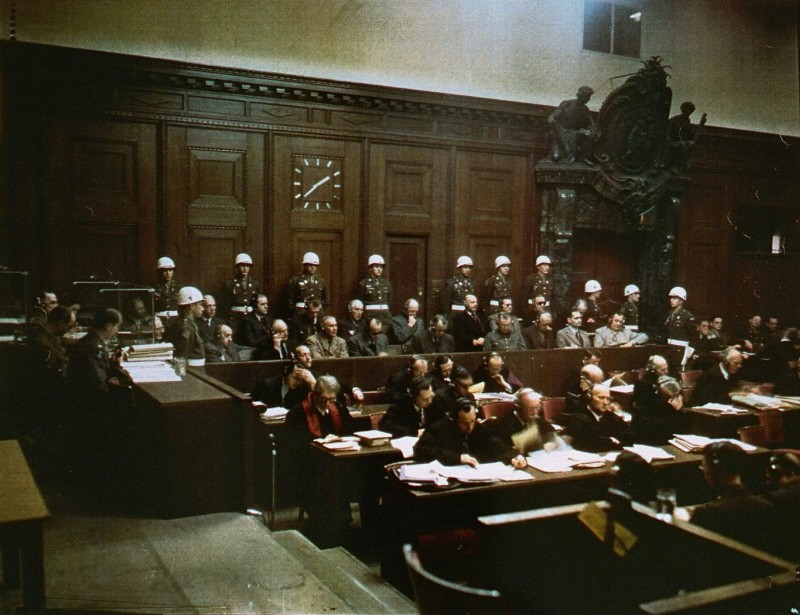
Nuremberg begins.
The criminals are tried.
Justice is done.
Except history did not end when the courtroom lights came on.
By 1944, the SS and its branches had reached roughly 800,000 men, although the organization included very different categories of personnel, from Waffen-SS combat troops to members of the concentration-camp system and other SS institutions. Contemporary figures introduced at Nuremberg put the SS at about 794,000 members in June 1944. (Avalon Project)
There was no courtroom on earth large enough to put an organization of that scale into a single defendant’s dock.
And that was the first problem.
The second was worse.
The SS had not merely been an army inside an army.
It had become part of the machinery that guarded concentration camps, ran security services, hunted resistance networks, organized deportations, murdered civilians, carried out mass shootings, and helped administer a racial state stretching across occupied Europe.
In October 1946, the International Military Tribunal at Nuremberg formally declared the SS a criminal organization, while establishing important limitations concerning categories such as conscripted members and questions of knowledge and participation. The judgment was devastating to the organization’s legitimacy.
On paper, it looked like the net had closed. (Bảo tàng Nuremberg)
But declaring an organization criminal was one thing.
Proving individual criminal responsibility against hundreds of thousands of people was something else entirely.
That distinction would become an escape hatch large enough for an astonishing number of men to walk through.
At the end of the war, Allied investigators faced a continent overflowing with evidence and almost collapsing under its own destruction.
There were captured files stacked in buildings.
Witnesses scattered across dozens of countries.
Survivors trying to find relatives.
Millions of prisoners of war.
Millions more displaced civilians.
Mass graves still being discovered.
Entire towns without functioning governments.
And everywhere investigators looked, somebody had a story about what he had not done.
He had only driven the truck.
He had only guarded the gate.
He had only processed papers.
He had only followed military orders.
He had only joined for career reasons.
He had been transferred.
He had not known.
He had never personally killed anyone.
That last defense would become especially important.
For decades, many German prosecutions of lower-level camp personnel encountered a fundamental problem: courts often sought proof connecting an individual defendant to a specific killing or act of assistance.
Imagine trying to reconstruct that evidence twenty years later.
Or thirty.
The prisoner who witnessed it might be dead.
The guard roster might have been burned.
The commanding officer might have disappeared.
The victim had no grave.
The accused could sit in court and say:
“Prove what I did.”
And sometimes, the state could not.
So the first great twist in the story of postwar justice was this:
The Nazis had constructed one of history’s most bureaucratic systems of mass murder.
But the division of responsibility inside that system sometimes made individual prosecutions extraordinarily difficult afterward.
Everyone had been a cog.
And every cog could argue that the machine belonged to someone else.
The famous trials created another illusion.
People saw Göring, Ribbentrop, Kaltenbrunner and other senior Nazi figures in the dock at Nuremberg and naturally assumed that the hierarchy beneath them would follow.
Some did.
There were subsequent Nuremberg proceedings. Military tribunals prosecuted camp personnel. Trials took place in Poland, West Germany, East Germany and other countries. Commandants, doctors, guards and administrators were convicted.
But the universe of perpetrators and accomplices was vastly larger than the group that ever faced serious criminal judgment.
Even within individual camps, the gap could be staggering.
At Majdanek, for example, more than a thousand SS personnel served at the camp, yet only a fraction were prosecuted across the postwar trials. At Bergen-Belsen, denazification proceedings were opened against former camp personnel, but many were discontinued. (Wikipedia)
Then time began working for the defendants.
Witnesses aged.
Memories weakened.
Governments changed.
The Cold War began.
And suddenly, Europe had a new enemy.
That changed almost everything.
The Soviet Union was no longer merely the Allied power whose soldiers had helped destroy Nazi Germany.
It was now Washington’s strategic rival.
Communist governments took control across Eastern Europe. Intelligence services were desperate for information about Soviet military strength, political networks, agents, communications and intentions.
And who knew the Soviet Union?
Who had files on Communist organizations?
Who spoke the languages?
Who had spent years operating intelligence networks in Eastern Europe?
Some of the very men who had worked for Nazi Germany.
The moral equation should have been simple.
It wasn’t.
American intelligence officers began recruiting former German intelligence personnel and, in certain cases, men with Nazi or SS backgrounds because they were considered useful against Communism. U.S. National Archives material on postwar intelligence acknowledges that involved Nazis—and specifically SS men—were among those recruited. (National Archives)
And then there was Klaus Barbie.
His story sounds like someone deliberately wrote it to make the postwar world look hypocritical.
But nobody needed to invent it.
Nikolaus “Klaus” Barbie had joined the SS in 1935 and later became notorious for his role as a Gestapo official in occupied Lyon, where prisoners were tortured, resistance members hunted and Jews deported.
After Germany’s defeat, you might expect one of France’s most wanted German officials to have spent his remaining years trying to avoid Allied intelligence.
Instead, American intelligence recruited him.
The U.S. Army Counter Intelligence Corps used Barbie after the war as an informant against Communist targets.
When French authorities wanted him, American officers protected him.
And when his continued presence in Europe became increasingly dangerous, the solution was not to deliver him to France.
It was to get him out.
The U.S. National Archives summarizes the historical record plainly: the Army’s Counter Intelligence Corps protected Barbie from French prosecution and helped him reach South America. A later Justice Department investigation concluded that CIC personnel had facilitated his escape. (National Archives)
Read that again.
The postwar system created to hunt Nazi criminals became, in this case, part of the reason one escaped.
And there was another detail.
Barbie did not simply walk from Germany to Bolivia.
He traveled through what became known as a ratline.
The word has acquired an almost mythical sound, as if there were one secret organization with one headquarters and one mastermind.
Reality was messier.
There were multiple escape networks.
Some routes moved fugitives south through Austria and Italy, where new identities and travel documents could be obtained before ships carried them across the Atlantic.
Individual Catholic clergymen were involved in some of those networks, including figures associated with church institutions in Rome. American archival material concerning Barbie’s escape specifically records assistance involving a Croatian priest in the Vatican milieu. That is different from proving that every such escape was ordered or centrally directed by the Vatican itself, a distinction often lost in sensational retellings. (National Archives)
For the men passing through those routes, however, institutional definitions probably mattered less than the next piece of paper.
A new passport.
A new spelling.
A new nationality.
A ship ticket.
A border crossed.
A name left behind.
South America became home to some of the Third Reich’s most notorious fugitives.
Adolf Eichmann built a life in Argentina until Israeli agents captured him in 1960.
Josef Mengele escaped to South America and evaded trial entirely, eventually dying in Brazil in 1979.
Franz Stangl, commandant of Sobibor and later Treblinka, reached Syria and then Brazil before he was eventually arrested and extradited to West Germany.
Klaus Barbie lived in Bolivia under the name Klaus Altmann.
The transformation was almost obscene in its simplicity.
A man could have possessed power over prisoners, deportations or life and death in Europe.
Then a border closed behind him.
A new document was stamped.
And suddenly he was a businessman.
A technician.
An adviser.
A neighbor.
A father whose children might know almost nothing about the uniform he once wore.
But here comes the next twist.
The most successful fugitives were so spectacular that they distorted our understanding of what happened after the war.
They make us imagine SS men hiding in jungle houses, moving between safe apartments, staring nervously at strangers in cafés.
Many former Nazis did not need anything that dramatic.
They stayed in Germany.
And they went back to work.
That may be the more disturbing story.
Postwar denazification began ambitiously.
The Allies removed Nazi officials, banned organizations, interrogated suspects and tried to classify millions of Germans according to their involvement with the regime.
But rebuilding a modern country required judges, teachers, engineers, administrators, police officers, diplomats and civil servants.
And a terrible practical question emerged:
How do you rebuild a state when huge sections of its educated professional class had spent twelve years functioning inside a dictatorship?
West Germany’s answer increasingly became reintegration.
A 1951 law implementing constitutional provisions concerning former public servants helped restore employment and benefit rights to large numbers of career officials displaced after 1945, although important exclusions applied, including to categories connected with organizations judged criminal at Nuremberg. Historians have documented how this process allowed many officials with compromised Nazi-era careers to construct successful “second careers” in the Federal Republic. (CNRS Editions)
The judiciary showed how deep the continuity could run.
Research into West German courts found that in 1954, large proportions of judicial personnel had already served professionally during the Nazi period—including 88.3 percent at the higher regional courts and nearly three quarters at the Federal Court of Justice. These numbers do not mean every such jurist was an SS man or a criminal, but they reveal why the idea of a total post-1945 purge is historically false. (IdW – Informationsdienst Wissenschaft)
For survivors, the contrast could be unbearable.
A person who had lost parents, brothers, sisters and children might spend years trying to document what happened to them.
Across town, someone who had served the regime might be filling out paperwork for a promotion.
One life remained permanently divided into “before the camp” and “after the camp.”
Another slowly became respectable again.
There were marriages.
Mortgages.
Careers.
Pensions.
Retirement parties.
Family photographs.
Silence did the rest.
And even the issue of state benefits became a decades-long controversy.
In 1998, Germany amended its war-victim compensation law so benefits could be denied or withdrawn from people who had violated principles of humanity or the rule of law during the Nazi period. Researchers later examined more than 70,000 names flagged by the Simon Wiesenthal Center as potentially warranting review.
Only 99 war-victim pensions had ultimately been withdrawn under the provision by the period examined in the official study.
That does not mean all 70,000 people were proven war criminals, nor that all were SS members. The list identified cases for investigation.
But the enormous difference between the numbers illustrates something much larger:
Even half a century after Hitler’s death, Germany was still trying to determine who had benefited after participating in his system. (BMAS)
By then, another kind of person had entered the story.
The hunter.
Simon Wiesenthal had survived the Nazi camps and was liberated from Mauthausen in 1945.
He could have tried to spend the rest of his life forgetting names.
Instead, he began collecting them.
After liberation, Wiesenthal worked with the U.S. Army’s War Crimes Section. In 1947 he opened a documentation center in Austria. For decades afterward, he pushed governments to find men who had learned that democratic bureaucracy could sometimes be slower than a fugitive with a passport.
His work generated leads connected with fugitives including Adolf Eichmann and Franz Stangl. He also helped bring attention to Hermine Braunsteiner Ryan, a former concentration-camp guard who was living in New York as an apparently ordinary housewife and eventually became the first Nazi criminal extradited from the United States. (Bách khoa toàn thư Holocaust)
Think about what Nazi hunting actually required in those years.
There was no searchable global database.
No facial-recognition software.
No instant airline record.
No social media.
Sometimes there was only a photograph.
A remembered surname.
An immigration form.
A postmark.
A survivor’s testimony.
A rumor that a German-speaking man in a particular South American city looked remarkably like someone who had disappeared in 1945.
A hunter could spend months chasing a lead and discover nothing.
A fugitive needed only one sympathetic official, one bureaucratic mistake or one country unwilling to extradite him.
Justice was running a marathon against men who needed to win only one race.
Franz Stangl was eventually arrested in Brazil in 1967 and extradited to West Germany. He received a life sentence in 1970 for his role in the murder of hundreds of thousands at Treblinka.
Eichmann was captured and tried in Israel.
But Mengele never entered a courtroom.
Others died unidentified, died protected, or died before prosecutors could assemble a case.
And Klaus Barbie?
For more than three decades, the man once hunted by France lived in Bolivia.
Then the protection around him finally cracked.
In 1983, he was expelled to France.
The cameras were waiting.
So were the survivors.
So were the files.
And so was a question that had been waiting since 1945:
What happens when a man has successfully outlived the political reasons people once had for protecting him?
Four years later, in 1987, Klaus Barbie stood trial in Lyon for crimes against humanity.
This time there was no useful intelligence he could trade for safety.
No Cold War calculation powerful enough to make the courtroom disappear.
No ratline waiting outside.
He was convicted and sentenced to life imprisonment. (Bách khoa toàn thư Holocaust)
But the truly explosive revelation was no longer only what Barbie had done during the war.
It was what had been done for him afterward.
The United States was forced to investigate itself.
A Justice Department inquiry documented the Army’s use and protection of Barbie, and the U.S. government apologized to France for its role.
That is one of the darkest plot twists of the entire postwar period.
The question was no longer simply:
“How did Nazi criminals escape?”
It became:
“Who decided they were useful enough to save?”
And Barbie was not the end of the reckoning.
Because while Nazi hunters pursued fugitives, another clock was running.
The defendants were getting old.
By the 1990s and 2000s, prosecutors confronted men in their eighties and nineties.
Courtrooms now contained wheelchairs.
Doctors evaluated whether defendants could sit through ninety-minute sessions.
Defense attorneys argued about memory, identification, illness and the fairness of trying someone for crimes committed more than sixty years earlier.
To some observers, prosecuting an elderly man appeared almost pointless.
To survivors, the response was devastatingly simple:
Their murdered relatives had never been allowed to grow old.
Then, in 2011, a German courtroom changed the legal landscape.
The defendant was John Demjanjuk.
He was not an SS member; he had been a Soviet prisoner of war who, according to the German court, served as a Trawniki-trained guard at Sobibor.
That distinction matters.
But what happened in his case would eventually affect the prosecution of former SS camp personnel.
For decades, a lower-level guard could benefit from the argument that prosecutors could not identify a particular victim he personally killed.
The Demjanjuk prosecution attacked that logic.
Sobibor was not an ordinary prison where murder occasionally occurred.
It was a killing center.
Its purpose was extermination.
So prosecutors argued that a guard who knowingly helped keep such a facility operating was assisting the murderous enterprise even if no witness could point to one particular person and say:
“I saw him kill that victim.”
In May 2011, the Munich court convicted Demjanjuk as an accessory to the murder of at least 28,000 Jews at Sobibor and sentenced him to five years.
There is an important legal footnote: he died in 2012 while his appeal was pending, so the conviction never became final under German law.
But the prosecutorial theory outlived him. (Bách khoa toàn thư Holocaust)
And suddenly old files looked different.
A guard did not necessarily have to be photographed pulling a trigger.
A clerk did not necessarily have to be seen pouring poison gas.
A man positioned inside a dedicated machinery of extermination could potentially be prosecuted for helping that machinery function.
The word cog stopped sounding like a defense.
It began to sound like evidence.
That shift helped open the door to later cases.
In 2015, former SS man Oskar Gröning—the so-called “bookkeeper of Auschwitz”—was convicted as an accessory to the murder of 300,000 people.
Gröning had not spent the previous decades hiding in Bolivia.
He had lived in Germany.
He had worked.
Retired.
Grown old.
Then, at ninety-three, he entered court with a walking frame.
And something happened there that no denazification questionnaire could capture.
No historian had to interpret his body language.
No novelist needed to invent remorse for him.
He spoke.
Gröning acknowledged that he shared moral guilt for what happened at Auschwitz and asked the judges to decide his criminal culpability. He was later sentenced to four years. (ABC News)
One year later came another courtroom.
Another wheelchair.
Another former SS guard.
Reinhold Hanning had served at Auschwitz.
He was ninety-four years old when he finally broke his silence.
Survivors were sitting in the room.
For twelve court sessions he had said little.
Then he addressed them.
His voice was weak.
He admitted that he had been part of a criminal organization.
He said he had seen injustice and done nothing.
He said he was ashamed.
He apologized.
For survivors listening only a few meters away, this was not the clean catharsis a movie would have given them.
Leon Schwarzbaum, an Auschwitz survivor and co-plaintiff, could accept that the words had finally been spoken.
Forgiveness was another matter.
Hanning was convicted in 2016 as an accessory to murder and sentenced to five years. (The Guardian)
And there, seventy-one years after Nazi Germany collapsed, was the moment of recognition that had been missing from so many postwar stories.
No black uniform.
No polished boots.
No salute.
Just an old man in a German courtroom confronting survivors who had also become old.
Except they had spent those seventy-one years carrying memories of what men wearing his uniform had guarded.
He had spent much of that time silent.
That was the final reversal.
For decades, age had protected former perpetrators because evidence weakened as time passed.
Now age itself was exposing something.
The defendants looked harmless.
Their bodies were frail.
Some could barely hear.
Some required wheelchairs.
Some needed medical breaks.
And that forced the public to confront a disturbing truth about evil.
The people who participate in monstrous systems do not remain frozen in photographs.
They age.
They become grandfathers.
Their hands shake.
Their voices soften.
Their neighbors may describe them as polite.
Their grandchildren may love them.
None of that changes what happened when those hands were young.
None of it resurrects the people who never received seventy extra years.
So what happened to the SS after World War II?
There is no single answer.
Some died in the war.
Some killed themselves during the collapse.
Some were captured and prosecuted.
Some were executed.
Some served prison sentences and were later released.
Some escaped through clandestine routes to South America or elsewhere.
Some were protected because intelligence services believed their knowledge was useful in the emerging Cold War.
Some quietly returned to civilian life.
Some benefited from a West German society that, while becoming a successful democracy, reintegrated large numbers of people who had built careers under the dictatorship.
Some were exposed by Nazi hunters decades later.
Some finally entered courtrooms as old men.
And many were never held criminally accountable at all.
That last category is probably the largest shadow hanging over the story.
The United States Holocaust Memorial Museum notes that despite investigative efforts continuing into the twenty-first century, the majority of people who assisted in Holocaust crimes would never be brought to justice. (Bách khoa toàn thư Holocaust)
That does not mean Nuremberg failed.
Nuremberg established principles that changed international law.
It documented crimes that perpetrators desperately wanted buried.
It destroyed the argument that state officials could hide completely behind orders.
It created a record powerful enough to survive generations of denial.
But Nuremberg was never the mass cleansing that popular memory sometimes imagines.
There were simply too many perpetrators.
Too many accomplices.
Too many destroyed records.
Too many altered names.
Too many governments with changing priorities.
Too many institutions eager to rebuild.
Too many people willing to stop asking questions once the man next door had a respectable job and stopped mentioning the war.
And perhaps that is why this history still feels unfinished.
Because the most frightening part is not that every SS member became a hunted fugitive.
The frightening part is that many did not have to.
History usually teaches us to look for monsters at the edge of society.
The aftermath of Nazi Germany teaches the opposite lesson.
Some monsters escaped on ships.
Some were hidden by networks.
Some became intelligence assets.
But others simply waited until the world needed accountants, judges, officials, technicians, informants, fathers and neighbors again.
Then they stepped back into ordinary life.
The uniform disappeared.
The biography became shorter.
The inconvenient years were left out.
And the world moved forward.
Survivors did not have that luxury.
That is why men like Simon Wiesenthal kept opening files when governments wanted to close them.
Why prosecutors returned to seventy-year-old evidence.
Why survivors entered courtrooms in their eighties and nineties to look across the room at defendants who had also grown old.
They were not pretending that one late conviction could balance millions of deaths.
It could not.
They were defending a simpler principle:
Time can make a criminal old. It cannot make the crime innocent.
And perhaps that is the real answer to what happened to the SS after World War II.
The organization was destroyed.
Its members scattered.
Its symbols were outlawed.
Its surviving leaders lost their empire.
But accountability never arrived in one dramatic moment in 1945.
It came unevenly—through courtrooms, archives, extraditions, accidental discoveries, persistent investigators and survivors who refused to let disappearance become absolution.
Some perpetrators faced justice immediately.
Some heard a verdict seventy years later.
Some died before anyone reached their door.
And far too many never heard a knock at all.
The war ended in 1945. The argument over who was allowed to escape its consequences lasted for generations—and that may be the part of the story we should be least willing to forget.