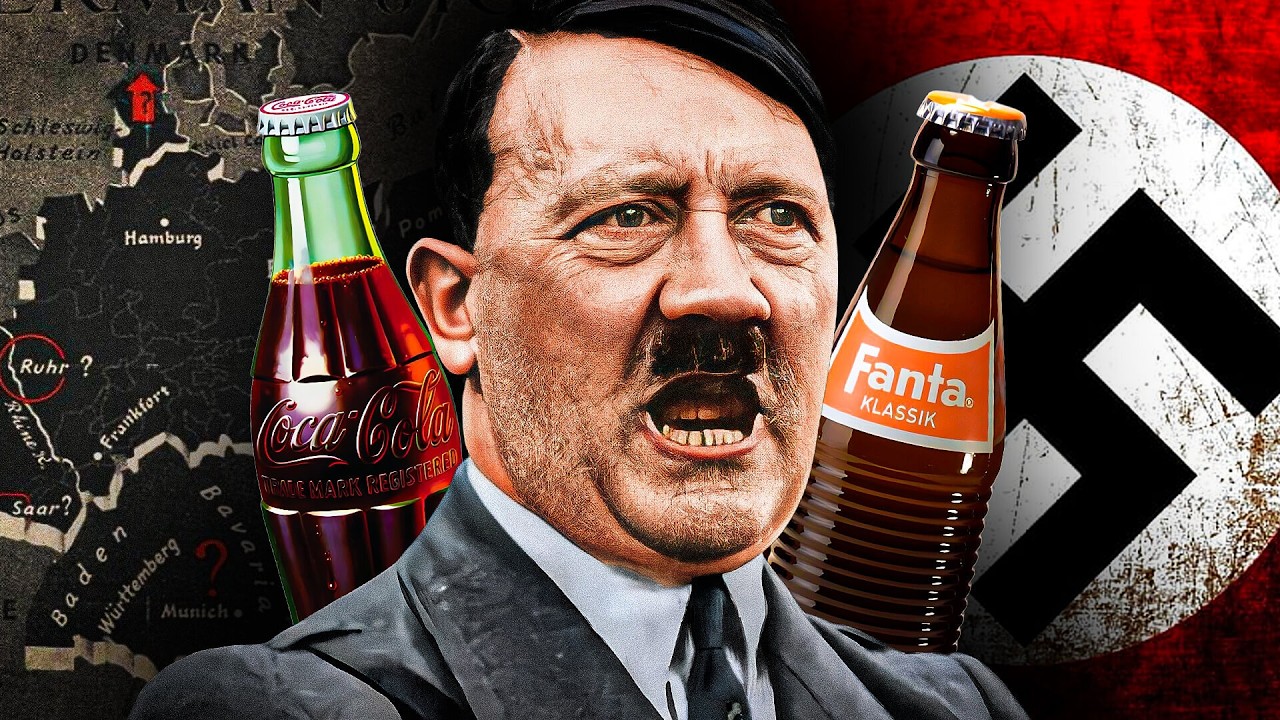
In the spring of 1945, Germany was collapsing.
Cities were burning. Rail lines had been torn apart. Factories stood roofless under gray skies. The government that had promised a thousand-year Reich was disappearing in a matter of weeks, leaving behind millions of dead, displaced families, concentration camps, ruined towns, and a continent trying to understand how civilized institutions had learned to function inside a machine of mass murder.
Yet amid all that destruction, one familiar American business had somehow survived.
Its bottles were still there.
Its machinery was still there.
Its trademarks had been protected.
And the German executive responsible for preserving them was preparing to tell headquarters in Atlanta that the operation was alive.
That company was Coca-Cola.
The drink that helped keep its German business alive was not Coca-Cola.
It was something improvised from the scraps of a collapsing wartime economy: apple residue, whey from cheese production, beet sugar, and whatever ingredients could still be obtained.
They called it Fanta.
Yes.
That Fanta.
But the strangest part of the story is not that one of the world’s most famous soft drinks was born in Nazi Germany.
The strangest part is what had to happen before it could be born.
Because years before American soldiers were fighting their way into Germany, Coca-Cola’s German operation had already learned one of the most uncomfortable lessons in corporate history:
A company does not necessarily have to believe in a dictatorship to become very good at doing business inside one.
And sometimes, survival can become almost indistinguishable from cooperation.
When Adolf Hitler became chancellor of Germany in January 1933, Coca-Cola was still a relatively young player in the German market.
Germans drank beer, mineral water and traditional beverages. An aggressively American, sugary, carbonated drink was hardly guaranteed to conquer the country.
But Coca-Cola saw opportunity.
And opportunity was something Max Keith understood very well.
Keith joined the German Coca-Cola organization in 1933. He was ambitious, disciplined and intensely devoted to the company. Historical accounts generally do not describe him as a Nazi ideologue, and historian Mark Pendergrast has argued that Keith was not a member of the Nazi Party.
That distinction would later become crucial.
Because Keith’s loyalty appears to have been directed somewhere else.
Not primarily toward Hitler.
Toward Coca-Cola.
And over the next decade, that loyalty would take him into increasingly uncomfortable territory.
The German Coca-Cola business expanded dramatically during the Nazi years. By the eve of World War II, sales had climbed into the millions of cases annually. The brand that had once seemed foreign was becoming familiar to ordinary Germans.
That did not happen in isolation from the political world around it.
It could not.
The Nazi government was not simply another administration setting tax policy.
Beginning in 1933, Germany was transformed into a racial dictatorship.
Political opponents were imprisoned. Independent institutions were destroyed. Jews were pushed out of professions and businesses, stripped of rights and progressively excluded from German public life. Roma, disabled people, homosexuals and others were targeted. Concentration camps expanded. Racial laws became state policy.
Business existed inside this system.
Advertising existed inside this system.
Sport existed inside this system.
Everything did.
And Coca-Cola wanted Germans to keep drinking Coke.
The contradiction became spectacularly visible in 1936.
Berlin hosted the Summer Olympics.
To foreign visitors, the city was polished, decorated and carefully staged. Nazi authorities temporarily softened some of the most obvious public signs of antisemitism. Streets filled with flags. Athletic imagery was used to project strength, order and national confidence.
Behind the spectacle, persecution continued.
The United States Holocaust Memorial Museum describes the Berlin Games as a propaganda triumph for the Nazi regime—a moment when Germany presented a sanitized image to the world while concealing the dictatorship’s racist and militaristic character.
Businesses participated in the commercial opportunity surrounding that spectacle.
Coca-Cola was there too.
That alone would not make the company unique. Many foreign companies continued conducting business in Germany during the 1930s. Governments, sports organizations and corporations across the world maintained relationships with the Reich.
But Coca-Cola’s German operation was not simply selling bottles in silence.
It was learning how to make an American brand appear compatible with Nazi Germany.
And that required adaptation.
In the years that followed, Coca-Cola advertising appeared in publications associated with the Nazi movement. German economic historian Uwe Spiekermann has documented pro-regime public messaging by the company and has reproduced a 1935 advertisement connected with the virulently antisemitic newspaper Der Stürmer. He also notes Coca-Cola advertising in leading Nazi publications including the Völkischer Beobachter and Illustrierter Beobachter.
That detail matters.
Der Stürmer was not an ordinary newspaper.
It was infamous even by the standards of Nazi propaganda.
It specialized in grotesque antisemitic lies and caricatures, depicting Jews as criminals, parasites and conspirators. Copies were displayed publicly in glass cases. Its publisher, Julius Streicher, would later be convicted of crimes against humanity at Nuremberg.
And in this environment, Coca-Cola’s German operation worked to reassure the public that it belonged.
The message was not:
“We oppose this regime.”
The commercial message was essentially:
We fit here.
We are German enough.
Keep buying.
Then came a scene that sounds almost too cinematic to be real.
March 1938.
German troops entered Austria.
Hitler’s annexation of the country was celebrated throughout the Reich.
Around the same period, Coca-Cola’s German organization held a major convention attended by roughly 1,500 people. Historical accounts drawing on Pendergrast’s research describe Keith addressing the gathering beneath Nazi symbols and encouraging the organization to continue its commercial march forward.
The event reportedly concluded with a “Sieg Heil” salute to Hitler.
Imagine the room.
A brand born in Atlanta.
An American trademark.
A German sales organization.
Swastikas.
Hundreds upon hundreds of employees and bottlers.
And a ritual salute to the dictator who would soon plunge Europe into war.
There is a temptation, looking backward, to search for a single moment when everyone should have understood exactly what they were participating in.
But history is rarely so clean.
Most compromises do not arrive with a document titled MORAL SURRENDER.
They arrive as practical decisions.
A permit.
An advertisement.
A slogan.
A meeting.
A salute everyone else is doing.
A government official you need to keep happy.
A newspaper you would rather not offend.
A market too valuable to abandon.
One concession becomes the justification for the next.
And every time nothing immediately terrible happens to the company, the new boundary begins to feel normal.
By 1939, the boundary was about to move again.
Germany invaded Poland.
Britain and France declared war.
Europe began burning.
For Coca-Cola headquarters in the United States, the German operation became an increasingly complicated asset.
For Max Keith, the problem was more immediate.
He had factories.
He had bottlers.
He had employees.
He had customers.
He had a brand.
And now he was operating inside a country at war.
At first, Coca-Cola could still be produced.
The critical flavoring concentrate came from outside Germany, however, and wartime restrictions increasingly threatened supplies.
Keith needed connections.
He needed bureaucratic approval.
He needed access to ingredients that were becoming strategically important.
He needed the Nazi state to allow his organization to function.
And the Nazi state controlled almost everything that mattered.
Imports.
Sugar.
Transportation.
Fuel.
Labor.
Foreign property.
Commercial licenses.
If the government decided Coca-Cola was an enemy asset, the business could be confiscated.
If officials decided Keith was unreliable, he could be replaced.
So Keith did what effective corporate managers often do in hostile environments.
He made himself useful.
Then Europe fell with frightening speed.
Denmark.
Norway.
The Netherlands.
Belgium.
France.
Country after country came under German domination.
And here came another twist.
For most people, Nazi expansion meant occupation, fear, arrest, shortages and death.
For certain businesses operating inside the Reich, conquest also created administrative opportunities.
Keith acquired responsibility for Coca-Cola interests in territories occupied or controlled by Germany. Historical accounts describe him working with German bureaucracy to safeguard Coca-Cola properties across parts of Europe.
That is where the story becomes morally harder than the simple phrase “Coca-Cola invented Fanta for the Nazis.”
Because the German Coca-Cola organization was not merely trapped in a basement waiting for the war to end.
Keith was maneuvering.
Protecting assets.
Extending oversight.
Keeping an international corporate network intact while the map of Europe was being redrawn by military conquest.
To him, the mission appears to have remained remarkably consistent:
Protect the business.
Protect the bottlers.
Protect the trademarks.
Keep the system operating.
Whatever government happened to control the territory.
And for a while, it worked.
Then December 1941 changed everything.
Japan attacked Pearl Harbor on December 7, 1941.
The United States entered the war.
Days later, Germany declared war on the United States.
Suddenly the relationship between Coca-Cola headquarters in Atlanta and Coca-Cola’s German organization was no longer merely inconvenient.
They were on opposite sides of a world war.
The supply line broke.
No regular shipment of Coca-Cola concentrate could simply move from the American company’s network into Nazi Germany as before.
For Keith, this was an existential problem.
A Coca-Cola bottling business without Coca-Cola syrup had roughly the same problem as a gasoline station without gasoline.
The factories could exist.
The bottles could exist.
The trucks could exist.
The employees could show up.
But the product at the center of the entire enterprise could disappear.
Keith faced a choice.
Close.
Wait.
Watch years of expansion collapse.
Watch bottlers lose their businesses.
Risk having the German government absorb the organization.
Or invent something else.
He chose something else.
The order went out inside Coca-Cola Germany:
Find a drink we can make with what Germany still has.
Not imported citrus concentrate.
Not the protected Coca-Cola formula.
Not ingredients that existed only in theory.
Something available now.
The result was hardly glamorous.
Whey.
The watery by-product left after milk is curdled during cheese production.
Apple fiber and pomace.
Residue left after fruit had been pressed.
Beet sugar where it could be obtained.
Various available fruit components.
Materials later described as little more than the leftovers of other food industries.
The modern Coca-Cola company itself acknowledges the basic story: in 1940, with Coca-Cola concentrate becoming unavailable in wartime Germany, Keith’s organization developed an alternative drink in Essen based on whey and apple pulp.
It needed a name.
According to the often-repeated account, Keith told his employees to use their imagination—”Fantasie” in German.
A salesman named Joe Knipp answered:
Fanta.
Short.
Easy.
Memorable.
The name stayed.
And one of the strangest products in corporate history was born.
Not the bright orange Fanta people recognize today.
Not a sunny citrus soda associated with beaches, teenagers and colorful commercials.
The wartime Fanta could vary depending on available ingredients.
It was a survival drink.
A beverage created because an American company’s German subsidiary could no longer make the American product that justified its existence.
At first glance, that seems like the big twist.
It isn’t.
The bigger twist is what happened next.
Fanta became successful.
Very successful.
Germany was deep in wartime rationing.
Ordinary households faced shortages of almost everything.
Meat.
Butter.
Coffee.
Fuel.
Clothing.
Sugar.
People learned to substitute, stretch, reuse and improvise.
And Fanta had something valuable.
Sweetness.
That made it more than a drink.
Some consumers reportedly used it in cooking because it could provide sweetness when ordinary sugar was difficult to obtain. Fanta became useful in soups, stews and other recipes.
What had begun as an emergency substitute became a wartime commodity.
By 1943, roughly three million cases were being sold in Germany.
Three million.
Think about what that means.
The original Coca-Cola concentrate had vanished.
Germany was fighting a catastrophic multi-front war.
Cities were increasingly being bombed.
Transportation networks were under pressure.
Millions of men had been mobilized.
Raw materials were controlled.
And yet the Coca-Cola organization had found a way not merely to remain legally alive but to sell millions of cases of a new product.
The drink born from scarcity had become the machine that preserved the business.
Fanta was not a quirky side experiment.
It was a corporate lifeboat.
And Max Keith had built it while the ship around him was on fire.
But survival came with another uncomfortable question.
Who was keeping German industry running while millions of German men were at the front?
Across the Reich, the answer increasingly included forced labor.
Millions of foreign civilians, prisoners of war and concentration-camp prisoners were compelled to work throughout the German war economy under vastly different but frequently brutal conditions.
Factories depended on them.
Farms depended on them.
Construction projects depended on them.
Some foreign-owned or formerly foreign-controlled businesses operating in Germany also benefited from this labor system.
Historical scholarship discussing American corporate subsidiaries in wartime Germany has cited Coca-Cola’s German operations as benefiting from foreign laborers and prisoners of war in Fanta production. The documentary record available publicly is less extensive than for industrial giants such as Ford or General Motors, so sweeping claims about the exact scale should be treated carefully.
But the allegation is not merely an internet rumor.
It appears in academic discussion of forced labor under the Nazi economy, drawing in part on Pendergrast’s history of Coca-Cola.
That changes the flavor of the story completely.
Suddenly, the clever tale about executives improvising soda from apple scraps is no longer merely a story about innovation during shortages.
It is taking place inside a labor system built on coercion.
And this is where corporate storytelling often becomes dangerous.
Because “resilience” sounds admirable.
“Adaptability” sounds admirable.
“Protecting jobs” sounds admirable.
“Keeping factories operating” sounds admirable.
Until someone asks:
Operating under what system?
With whose permission?
Using whose labor?
And at what moral price?
Meanwhile, Coca-Cola was living an astonishing double life.
On one side of the Atlantic, the company was becoming deeply associated with the American war effort.
Coca-Cola president Robert Woodruff famously committed the company to making Coke available to American servicemen for five cents a bottle wherever possible.
American soldiers drank Coca-Cola in military theaters around the world.
Bottling plants followed Allied forces overseas.
General Dwight Eisenhower requested equipment and millions of bottles for troops in North Africa.
By Coca-Cola’s own account, more than five billion bottles were consumed by military personnel during the war.
Picture the contradiction.
An American soldier opens a Coke thousands of miles from home.
The bottle tastes like Georgia, baseball, movie theaters and ordinary life.
Across enemy lines, the company’s former German network cannot get that same syrup.
So it sells Fanta.
Coca-Cola becomes part of Allied morale.
Fanta keeps Coca-Cola’s German assets alive inside the Reich.
Same corporate family.
Same war.
Opposite sides.
Few images better capture the strange international reality of multinational business during total war.
And by this point, Atlanta’s direct ability to control day-to-day German operations had been severed.
That matters.
It would be misleading to imagine executives in Atlanta telephoning Keith every morning during the war and instructing him how to cooperate with Nazi officials.
They could not operate normally across enemy lines.
Keith was increasingly on his own.
But that does not erase what came before the break.
The German organization had spent years learning how to operate comfortably enough within Nazi public life to protect its commercial position.
By the time the supply line disappeared, the relationships, habits and compromises were already there.
The corporation did not wake up in 1942 and suddenly discover it had become entangled with a dictatorship.
The entanglement had been built one practical decision at a time.
Then the war turned.
Stalingrad.
North Africa.
Italy.
Normandy.
Soviet armies advancing from the east.
American, British and Allied troops advancing from the west.
German cities came under increasingly devastating bombardment.
Factories were damaged.
Railways were destroyed.
Fuel became precious.
The regime became more desperate.
So did ordinary civilians.
Yet Keith kept trying to preserve Coca-Cola’s organization.
There is something almost frightening about the consistency of his mission.
Governments could fall.
Borders could move.
Armies could disappear.
Buildings could be bombed into rubble.
But the company must survive.
This was not ideological fanaticism.
It was corporate fanaticism.
And strangely, that is part of what makes the story so disturbing.
It would be easier if Keith were simply a cartoon villain in a Nazi uniform.
Then there would be no uncomfortable lesson.
You could look at him and say:
He was evil. We are different.
But historical accounts complicate that picture.
Keith reportedly resisted joining the Nazi Party despite pressure.
He was not primarily motivated by devotion to Hitler.
He appears to have viewed himself as the guardian of Coca-Cola’s business.
Historian Mark Pendergrast’s assessment, quoted in later reporting, is especially revealing: Keith collaborated with the Nazi system because doing significant business inside Germany required collaboration, yet his central allegiance was to Coca-Cola rather than Nazi ideology.
That is the real horror.
You do not have to love an immoral system to help make it function.
Sometimes ambition is enough.
Sometimes fear is enough.
Sometimes careerism is enough.
Sometimes protecting shareholder value is enough.
Sometimes telling yourself, “I’m just keeping the company alive,” is enough.
By early 1945, there was almost no illusion left about how the war would end.
Germany was being crushed.
Hitler retreated into the Führerbunker.
The regime issued increasingly irrational orders as armies disintegrated.
One by one, cities surrendered.
Then Hitler killed himself.
Berlin fell.
The Third Reich ceased to exist.
And soon Allied authorities began examining what remained of German companies.
Executives faced uncomfortable questions.
Who had joined the Party?
Who had profited?
Who had used forced labor?
Who had stolen Jewish property?
Who had cooperated voluntarily?
Who had merely tried to survive?
Who was lying?
Who could prove it?
For a manager of an American-owned company that had operated throughout the Nazi period, Max Keith might have expected a very difficult future.
Instead, he had something extraordinary to present.
An intact business.
He had preserved Coca-Cola’s German corporate structure through dictatorship, sanctions, war and collapse.
The machinery had survived.
The trademark had survived.
The bottling network had survived.
And there was even a new brand.
Fanta.
This is where the final reversal begins.
Because the man who had navigated Coca-Cola through Nazi Germany was not discarded as an embarrassing relic.
He became valuable.
Very valuable.
After Germany’s defeat, Coca-Cola regained control over its German operation.
And according to accounts of Keith’s postwar career, the company rewarded his stewardship rather than punishing it.
McGill University’s Office for Science and Society summarizes the remarkable outcome bluntly: after headquarters recognized that Keith had kept the company operating and protected its interests during the war, he was elevated to head Coca-Cola’s European operations.
Read that again.
A manager spends the Nazi years keeping an American soft-drink company alive inside Hitler’s Germany.
The regime collapses.
The parent company returns.
And the manager’s career continues upward.
From a narrow corporate perspective, the logic is obvious.
Keith had done his job spectacularly well.
That is precisely why the story refuses to sit comfortably.
Because what counts as excellent performance inside a corporation can look very different when measured against history.
Keith protected assets.
He maintained bottlers.
He improvised around embargoes.
He worked the bureaucracy.
He navigated occupation economies.
He kept competitors away.
He developed a replacement product.
He preserved Coca-Cola’s ability to return to one of Europe’s largest markets after the war.
On a balance sheet, that looks like extraordinary management.
But a balance sheet has no column marked:
Moral proximity to dictatorship.
No line marked:
Advertising beside antisemitic propaganda.
No line marked:
Public rituals of loyalty.
No line marked:
Benefits obtained from a coercive wartime labor system.
No line marked:
Things everyone knew but found commercially inconvenient to confront.
Profit and loss statements are remarkably bad at recording shame.
And then history performed one more trick.
The original German Fanta disappeared.
The Fanta most people know today is not simply the wartime formula preserved unchanged for generations.
After the war, production of the German wartime version ended.
In the 1950s, Coca-Cola revived the Fanta name for a new fruit-flavored beverage. The familiar orange version emerged in Italy and spread internationally.
Whey and wartime apple residue became citrus imagery.
Scarcity became abundance.
Gray Germany became bright orange advertising.
A drink created because a company had been cut off from its flagship product became a global brand associated with fun.
The name survived.
The context faded.
That may be the most successful transformation of all.
Today, millions of people can recognize a Fanta bottle instantly without having the slightest idea why the word “Fanta” exists.
The brand escaped its birthplace.
History did not.
And here is the twist people often miss when this story goes viral.
It is inaccurate to reduce the entire episode to a sentence like:
“The Nazis invented Fanta.”
They did not.
Nor is there good reason to claim that the modern orange Fanta recipe was personally designed by Hitler’s government.
Fanta was created by Coca-Cola’s German subsidiary as a substitute after wartime conditions severed access to Coca-Cola concentrate. The modern orange drink was developed later.
But saying, “So the Nazi connection is fake,” would be equally misleading.
Because the disturbing part is not that Nazi officials sat in a laboratory inventing soda.
The disturbing part is that a multinational corporation’s German operation became skilled at surviving under dictatorship.
It adapted its messaging.
It participated in public rituals.
It cultivated relationships.
It operated in conquered Europe.
It benefited from access to a heavily controlled wartime economy.
Its factories were reported to have used coerced foreign labor and prisoners of war.
Then, when everything collapsed, the assets returned to the parent company.
And the executive who had preserved them remained useful.
That story is harder than a meme.
It is also more important.
Because this was never really a story about orange soda.
It was about the word “survival.”
Corporations love that word.
Business schools love it.
Executives love it.
“Survival” makes compromise sound heroic.
Survival justifies the midnight meeting.
The uncomfortable partnership.
The government connection.
The public statement nobody really believes.
The supplier everyone knows is questionable.
The labor practice no one wants examined too closely.
The advertisement placed where it should never have appeared.
The salute performed because refusing would create problems.
Each individual decision can be defended.
We had employees to protect.
We had investors.
We had factories.
We had contracts.
We could not change the government.
If we had left, someone else would have taken our place.
We were not political.
We were only doing business.
Those arguments did not die in 1945.
They are still used.
That is why the story matters.
Imagine being a Coca-Cola employee in Germany in 1938.
You are not sitting in Hitler’s inner circle.
You are not designing racial laws.
You are not running a concentration camp.
You sell beverages.
Your manager tells you the convention is important.
The government is powerful.
The room is decorated with symbols you see everywhere.
Everyone stands.
Everyone salutes.
What do you do?
Now imagine it is 1941.
The country is at war.
Your ingredients are disappearing.
Thousands of livelihoods depend on keeping the business functioning.
Government officials can close you tomorrow.
Someone proposes working more closely with the bureaucracy.
What do you do?
Now imagine it is 1943.
Labor is scarce.
The state provides foreign workers or prisoners.
Your production targets remain.
Your factory needs hands.
The war economy has normalized coercion.
What do you do?
History becomes frightening when you stop imagining villains as people who wake each morning excited to do evil.
Most systems survive because ordinary incentives keep ordinary people moving in the same direction.
A promotion.
A contract.
A quota.
A fear of unemployment.
A desire to protect the organization.
An unwillingness to be the difficult person in the room.
The words change.
The mechanism does not.
Max Keith’s moment of recognition, if there was one, did not happen beneath a dramatic courtroom spotlight.
That is another uncomfortable fact.
There was no cinematic scene in which he stood before millions and confessed what corporate survival had required.
No great public collapse.
No famous photograph of him lowering his head while victims watched.
History gave him something much less satisfying.
Continuation.
The Nazi symbols disappeared.
American Coca-Cola returned.
Germany rebuilt.
Business expanded.
Consumers came back.
The man who had protected the system during the dictatorship helped operate in the world that followed it.
And perhaps that is why the story provokes such a strong reaction today.
We expect history to provide moral endings.
We want the collaborators exposed.
The righteous vindicated.
The guilty punished.
The company forced to choose a side.
But institutions are extraordinarily good at carrying useful people from one era into the next.
Yesterday’s compromise becomes tomorrow’s résumé bullet.
“I maintained operations during extraordinary conditions.”
“I preserved key assets.”
“I protected market share.”
“I demonstrated crisis leadership.”
All of those statements can be true.
And still leave out the most important part.
There is another reason the Coca-Cola story is so haunting.
Coca-Cola itself became one of the great symbols of postwar America.
After 1945, American products flooded Europe.
Coca-Cola came to represent consumer abundance, youth, capitalism and American cultural power.
In West Germany, the contrast was especially dramatic.
One decade, Coca-Cola’s German organization had been operating under Hitler.
The next, Coke was part of the new Western consumer culture rising from the ruins.
The bottle had crossed regimes more easily than millions of people could cross borders.
The trademark survived fascism.
Then it survived defeat.
Then it thrived in democracy.
That durability is impressive.
It is also revealing.
Corporations are designed to survive political change.
That can be a strength when governments are unstable.
It can also become a moral weakness when survival itself becomes the highest value.
If a company believes its first responsibility is always to continue existing, almost anything can eventually be rationalized as temporary necessity.
And temporary necessity has a strange habit of lasting for years.
None of this means Coca-Cola was uniquely evil.
That would be too easy.
Many German corporations collaborated far more deeply with the Nazi regime.
Foreign companies faced their own compromises.
Banks processed transactions.
Industrial manufacturers produced equipment.
Automobile companies used forced labor.
Technology firms sold machines.
Oil businesses negotiated access.
Media organizations adapted coverage.
Sports organizations participated in Nazi spectacle.
Governments themselves made concessions long after the dictatorship’s violence was obvious.
Coca-Cola belongs to a much larger story.
That is precisely why it is worth studying.
A soda company makes the moral problem recognizable.
Most people have never managed an arms factory.
Almost everyone has held a soft drink.
The familiar bottle makes the uncomfortable question impossible to keep at a safe distance.
How much compromise is too much?
At what point does adapting to evil become helping evil?
When does protecting employees become protecting the system employing them?
When does neutrality become cooperation?
When does “just business” stop being a defense?
There is no accounting formula for answering those questions.
That is what makes them dangerous.
And there is one final irony.
Fanta exists because Max Keith refused to let Coca-Cola Germany die.
Had he closed the factories when the syrup disappeared, there might have been no wartime Fanta.
Had the German operation collapsed, there might have been fewer assets waiting for Coca-Cola after 1945.
Had he been less effective at navigating Nazi bureaucracy, his corporate career might have ended very differently.
In other words, everything that makes Keith impressive as a crisis manager is entangled with everything that makes the story morally uncomfortable.
His ingenuity cannot be separated from the environment in which it was used.
His loyalty cannot be separated from what the company was willing to tolerate in order to survive.
His success cannot be separated from the regime whose permissions made that success possible.
That is the paradox.
Fanta was born from imagination.
But imagination was not the only thing keeping those factories alive.
Power was.
Compromise was.
Access was.
Adaptation was.
And behind all of it stood a dictatorship deciding who could work, who could own property, who could eat, who could travel, who could live freely—and eventually, who would be allowed to live at all.
So the next time you see the bright orange bottle, remember what makes this story truly disturbing.
It is not that drinking Fanta somehow connects a modern consumer to Nazism.
It does not.
Today’s product is not the original wartime recipe, and buying a bottle today is not a political act.
The lesson is bigger than the beverage.
Fanta is an accidental monument to a question every powerful institution eventually faces:
What are you willing to become in order to survive?
Coca-Cola Germany survived.
Its assets survived.
Its brand survived.
Max Keith’s career survived.
And even the emergency drink created when everything else was disappearing ultimately survived—its name reborn and sold around the world.
That is an extraordinary business achievement.
But history forces us to ask whether survival alone is enough to call something a success.
Because sometimes the most dangerous corporate decision is not openly choosing evil.
It is deciding, one small compromise at a time, that morality is somebody else’s department.
And by the time everyone finally looks up, the company may still be standing—
while the world around it has become unrecognizable.


