What Happened to Germany’s Top Luftwaffe Field Marshals After World War II?
Historical note: the officer sometimes mistakenly called “Walther von Richthofen” in accounts of this group was Wolfram von Richthofen. And Erhard Milch did not actually serve fifteen years: his life sentence was reduced to fifteen years, but he was released early in June 1954. (Deutsche Biographie)


In the spring of 1945, the uniforms still carried gold braid.
The batons still existed. The medals still hung from tunics. Men who only months earlier had commanded thousands of aircraft, controlled entire air fleets and received orders personally from Adolf Hitler still carried titles that sounded almost imperial: Generalfeldmarschall. Field Marshal.
But the empire those titles belonged to was vanishing around them.
German cities were ruins. Fuel dumps were empty. Airfields were cratered. Pilots who had once crossed Europe behind waves of bombers were being ordered into the sky with barely trained replacements and aircraft that could not always be fueled. The Luftwaffe—the service that had helped make Hitler’s early victories appear unstoppable—had been crushed by Allied industrial power, attrition, strategic bombing and catastrophic decisions at the highest level.
And now its most powerful surviving commanders faced a question none of them had seriously expected to answer during the years of triumph:
What happened when the war ended and the field marshal’s baton no longer protected the man carrying it?
The answers were astonishingly different.
One would be condemned to hang and kill himself only hours before the execution.
Another would receive a death sentence, see it reduced, walk out of prison seven years after the war and become a prominent defender of the reputation of Germany’s old military establishment.
One would stand before American judges, be convicted of war crimes and crimes against humanity, receive life imprisonment—and eventually return to civilian life.
Another would walk out of a Nuremberg courtroom acquitted.
A fifth would never reach a courtroom at all because a brain tumor was already killing him when the Allies captured him.
And Hitler’s final commander of the Luftwaffe would survive the collapse of Berlin only to poison himself less than three weeks after Germany surrendered.
Their names were Hermann Göring, Erhard Milch, Albert Kesselring, Hugo Sperrle, Wolfram von Richthofen and Robert Ritter von Greim.
Technically, Göring occupied an even higher rank than the others. Hitler had created the unique title of Reichsmarschall for him in 1940, placing him above Germany’s field marshals. But no examination of the fate of the Luftwaffe’s senior leadership can begin anywhere else.
Because by 1945, Göring embodied almost everything that had happened to Hitler’s air force.
Its rise.
Its arrogance.
Its enormous power.
And its destruction.
THE MAN WHO ONCE EXPECTED TO INHERIT HITLER’S EMPIRE
There had been a time when Hermann Göring appeared untouchable.
He was not merely commander-in-chief of the Luftwaffe. He had been one of the most powerful officials in Nazi Germany, deeply involved in the regime’s economic policies, preparations for aggressive war, persecution of Jews and the machinery that developed into the Holocaust. Hitler had once publicly designated him as his successor. (Bách khoa toàn thư về Holocaust)
Yet by April 1945, Göring was watching the Reich collapse from a distance while Hitler remained trapped beneath Berlin.
The transformation was extraordinary.
Only five years earlier, Göring’s Luftwaffe had helped destroy Polish resistance, supported Germany’s lightning victory in the West and appeared to dominate continental Europe.
Then came Britain.
Then the Soviet Union.
Then the expanding Allied bombing offensive.
Then the enormous American air fleets.
The Luftwaffe increasingly became a force fighting a war of exhaustion it could not win.
By 1945, Göring himself had lost much of Hitler’s confidence.
On April 23, with Berlin surrounded and communications deteriorating, Göring sent Hitler a telegram asking whether, under the succession arrangements previously established, he should assume leadership if Hitler had lost his freedom to act.
Inside the bunker, the message was interpreted as betrayal.
Hitler stripped Göring of his offices and ordered his arrest. (Bách khoa toàn thư về Holocaust)
The man who had once stood immediately beneath Hitler had been discarded in the final days of the regime.
But Göring survived Berlin.
That mattered.
Because unlike Hitler, Himmler and Goebbels, he would have to answer questions in public.
On May 7, 1945, Göring surrendered to American forces.
Soon he was no longer being photographed beneath the wings of Luftwaffe aircraft or surrounded by decorated officers.
He was sitting in the defendants’ dock at Nuremberg.
And Göring understood something immediately: if he could not restore his political power, he could still fight for control of the story.
He became the most prominent defendant at the International Military Tribunal.
Twenty-two major defendants ultimately stood trial, and Göring was the highest-ranking Nazi official among them. The charges encompassed conspiracy, crimes against peace, war crimes and crimes against humanity. (Bách khoa toàn thư về Holocaust)
He did not behave like a broken man.
He argued.
He challenged prosecutors.
He defended the regime.
He attempted to present himself not as a criminal but as a statesman who had fought and lost a great historical struggle.
That courtroom performance has sometimes overshadowed something much more important.
The evidence did not.
The judges found him guilty on all four counts.
On October 1, 1946, Hermann Göring was sentenced to death by hanging. (Bách khoa toàn thư về Holocaust)
For the man who had delighted in rank and ceremony, hanging was especially humiliating. It was not the death traditionally associated with a defeated soldier or officer. It was the punishment of a condemned criminal.
His appeals failed.
The executions were scheduled for October 16.
Guards watched the prisoners carefully.
Yet Göring had prepared one final act of control.
On the night of October 15, only hours before he was supposed to walk to the gallows, he swallowed cyanide.
By the time guards discovered what had happened, Hitler’s former designated successor was dying.
The hangman never received him.
Ten other condemned defendants were executed the following morning. Göring escaped the noose, but not the judgment that had preceded it. (Bách khoa toàn thư về Holocaust)
For Germany’s most famous air leader, the story ended in a prison cell.
For his former deputy, however, the postwar drama was only beginning.
ERHARD MILCH — THE FIELD MARSHAL WHOSE BATON WAS BROKEN
When British troops caught Erhard Milch in northern Germany in May 1945, he still possessed one of the most recognizable symbols of military prestige in the Third Reich.
A field marshal’s baton.
Milch had occupied a very different position from the glamorous fighter aces celebrated by German propaganda.
He was an administrator.
An organizer.
A builder of institutions.
Before and during the war he became one of the central figures responsible for German aviation administration and aircraft production. He rose until he stood directly beneath Göring inside the Luftwaffe hierarchy.
And when the Reich collapsed, his capture produced one of the strangest episodes involving any German field marshal.
On May 4, 1945, British commandos took Milch prisoner near the Baltic coast. Brigadier Derek Mills-Roberts, commander of 1 Commando Brigade, accepted his surrender at Neustadt. Archival summaries from the Liddell Hart Centre confirm that Mills-Roberts accepted Milch’s surrender there. (AIM25 Archive)
What happened next has been retold repeatedly.
Mills-Roberts had recently encountered the horrors left behind by Nazi concentration camps. Later accounts—including reporting surrounding the eventual auction of Milch’s baton—describe the brigadier striking the captured field marshal with the baton until it broke. (Upi)
The image was almost impossibly symbolic.
A weaponless field marshal.
A shattered Reich.
And the ornate staff of office designed to represent supreme military dignity being broken over the head of the man who carried it.
But that was not Milch’s punishment.
His real reckoning would take place in court.
Unlike Göring, Milch was not tried in the original International Military Tribunal.
He became the sole defendant in United States v. Erhard Milch, the second of the twelve subsequent American Nuremberg proceedings.
His trial began on January 2, 1947.
The prosecution case was not principally about aerial combat.
It centered on forced labor and the use of prisoners and foreign civilians in the German war economy.
Milch faced three counts, including participation in the mistreatment and forced labor of prisoners of war and foreign civilians, involvement in criminal medical experiments and crimes against humanity. (Bách khoa toàn thư về Holocaust)
This distinction mattered.
At Nuremberg, prosecutors were trying to establish that war crimes were not committed only by guards pulling triggers or SS officers directing killing operations.
Modern industrial war required administrators.
Production managers.
Ministry officials.
Commanders who demanded labor.
Men who signed papers.
Men who sat behind desks.
Milch’s defense therefore confronted an uncomfortable question that would appear repeatedly in postwar trials:
How far could responsibility travel upward?
If prisoners had been forced into brutal labor programs, what responsibility belonged to the senior officials who required production but did not personally beat the workers?
If an enormous military bureaucracy participated in criminal exploitation, where did administration end and criminal responsibility begin?
Thirty-nine trial days followed.
Thirty-four witnesses testified.
Hundreds of exhibits were presented. (Bách khoa toàn thư về Holocaust)
Then came the judgment.
Milch was acquitted on the count dealing specifically with culpability for the medical experiments.
But he was convicted on the other two counts.
On April 17, 1947, the former field marshal was sentenced to life imprisonment. (Bách khoa toàn thư về Holocaust)
Had the story ended there, Milch might have died in prison.
It did not.
In January 1951, his sentence was reduced to fifteen years.
And this is where an often-repeated summary of his fate becomes misleading.
Milch did not spend fifteen years behind bars.
He was released early from Landsberg Prison on June 28, 1954. (Bavarikon)
The field marshal once beaten with his own baton had survived the courtroom, survived imprisonment and reentered civilian society.
He later worked in an advisory capacity connected with West German aviation industry and lived until 1972. (Bavarikon)
The contrast with Göring could hardly have been greater.
One man swallowed cyanide hours before execution.
Another was initially sentenced to spend the rest of his life in prison—and eventually went home.
But even that was not the greatest reversal.
For that, one had to look at Albert Kesselring.
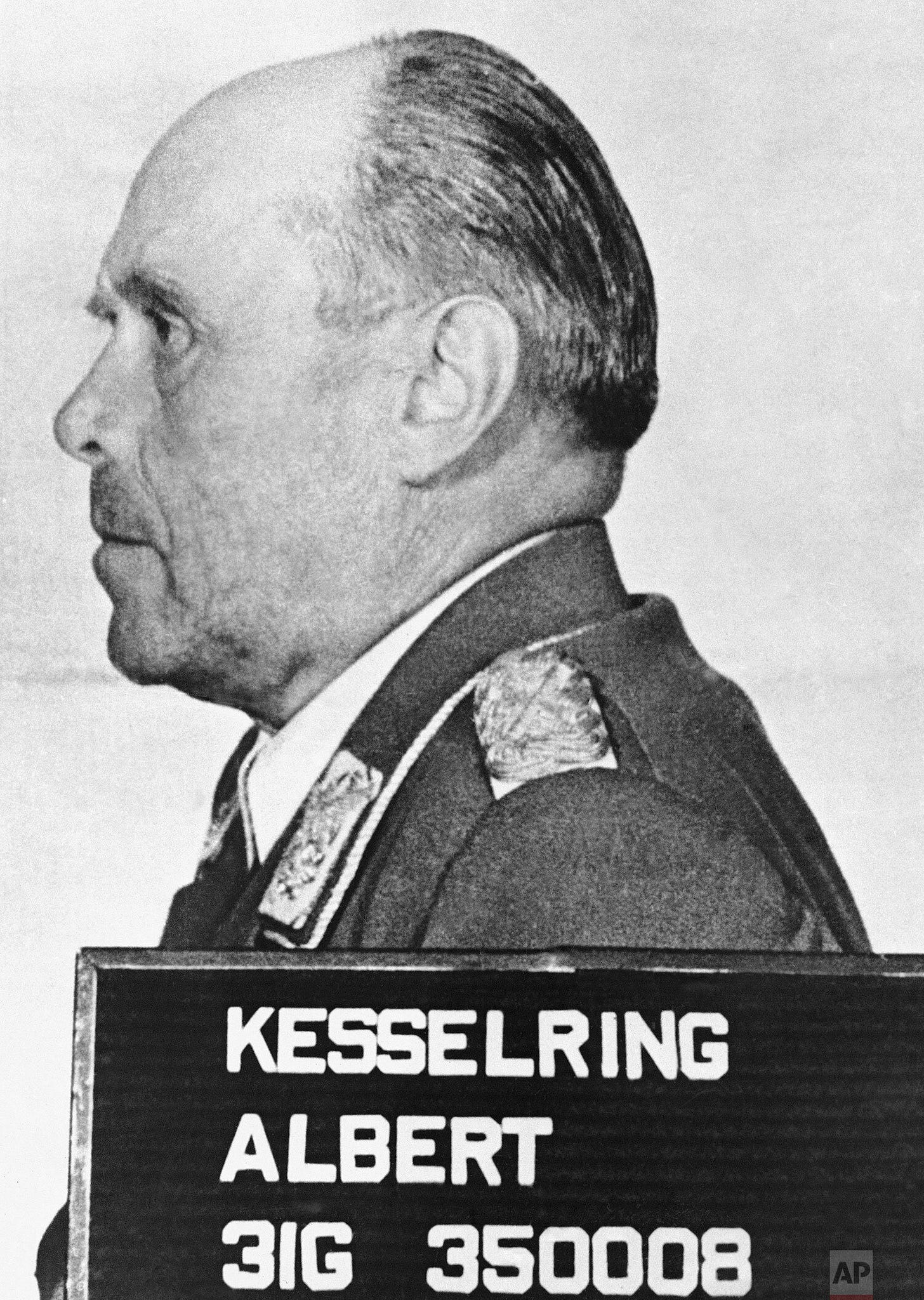
ALBERT KESSELRING — SENTENCED TO DEATH, THEN WALKING FREE
Albert Kesselring was technically an air force field marshal.
Yet by the end of the war, the description almost seems too narrow.
He had become one of Nazi Germany’s most important theater commanders.
He commanded major Luftwaffe formations early in the war, but his reputation was later built largely around the Mediterranean and Italy, where he directed German forces in a long defensive campaign against the Allies.
For German admirers after the war, Kesselring became the image of the brilliant professional soldier.
For prosecutors in 1947, there was another story.
It led to a cave outside Rome.
On March 23, 1944, Italian partisans attacked a German police unit in Rome’s Via Rasella.
The German response was immediate and murderous.
The following day, 335 Italian victims were taken to the Ardeatine Caves and killed.
The massacre became one of the most infamous atrocities committed during the German occupation of Italy. (Bách khoa toàn thư về Holocaust)
Kesselring was commander-in-chief of German forces in the Italian theater.
After the war, British authorities placed him on trial in Venice.
His trial lasted approximately sixty days and ended on May 6, 1947. British parliamentary records from the time confirm both the proceedings and the sentence then under review. (Hansard)
The charges concerned his responsibility for the killing of 335 Italians at the Ardeatine Caves and orders encouraging lethal reprisals against Italian civilians. The official United Nations war-crimes law report records both charges. (Thư viện Quốc hội)
Kesselring was found guilty.
The court sentenced him to death.
Not imprisonment.
Death.
For a moment, it appeared that another of Germany’s field marshals would be executed.
Then came the first reversal.
The death sentence was commuted to life imprisonment.
Later it was reduced again.
And by 1952, only five years after a court had sentenced him to die, Albert Kesselring was leaving prison.
British authorities described the release as an act of clemency and noted that the 66-year-old Kesselring had undergone an operation for cancer. (Hansard)
Think about the sequence.
1947: condemned to death.
Then: life imprisonment.
Then: a reduced sentence.
1952: freedom.
For survivors and families of victims, the speed of such transformations could look almost incomprehensible.
And Kesselring did not disappear quietly.
After his release, he became active in veterans’ circles and publicly championed the reputation of former German soldiers. Contemporary reporting noted his leadership role in the Stahlhelm veterans’ organization and his opposition to continued prosecutions of German servicemen. (Thời Báo Time)
It was part of a much larger postwar struggle over memory.
Who had been responsible for Nazi crimes?
Could the professional armed forces portray themselves as separate from Hitler and the Nazi regime?
Could senior commanders claim they had merely performed conventional military duties while crimes happened around them?
In later decades, historians would challenge the comforting myth of a broadly “clean” German armed forces supposedly detached from Nazi criminality.
Kesselring’s postwar fate illustrates how such narratives gained room to grow.
A death sentence suggested overwhelming condemnation.
His freedom five years later communicated something far more ambiguous.
He lived until 1960. (Bách Khoa Toàn Thư)
Yet while Kesselring was convicted and nearly executed, another Luftwaffe field marshal faced American judges and received the opposite verdict.
His name was Hugo Sperrle.
HUGO SPERRLE — THE FIELD MARSHAL WHO WALKED OUT ACQUITTED
Hugo Sperrle looked like the kind of man Allied prosecutors might have expected to imprison.
He had been a senior air commander long before the Second World War.
He had commanded the Condor Legion in Spain.
He later commanded Luftflotte 3 in the West and became one of the Luftwaffe’s field marshals after the victory over France.
His career placed him close to major episodes of German military expansion.
After Germany surrendered, Sperrle became one of the defendants in the High Command Case, the last of the twelve subsequent Nuremberg proceedings conducted by American military tribunals.
The trial examined the responsibility of senior Wehrmacht commanders for crimes committed under their authority.
The defendants included field marshals, generals and admirals.
It was precisely the kind of case that confronted the difficult boundary between criminal policy and military command.
Could an officer be convicted because units under his wider command committed crimes?
What evidence was needed to show knowledge?
What evidence demonstrated approval?
Could mere transmission of a criminal order create liability?
When did failure to stop crimes become criminal responsibility?
These were not abstract questions.
Men’s freedom depended upon the answers.
The High Command proceedings began in early 1948. One defendant, Johannes Blaskowitz, died by suicide on the opening day, leaving thirteen men to receive judgment. The tribunal ultimately convicted most of those remaining on at least some charges. (Bách khoa toàn thư về Holocaust)
But not Sperrle.
The tribunal acquitted him of all charges.
A later U.S. legal study summarizing the case stated that Sperrle was cleared because, regarding the order forming the foundation of the principal charge against him, the tribunal concluded that he had opposed it and attempted to make it ineffective. (Thư viện Quốc hội)
It is important not to confuse acquittal with a historical declaration that every element of an officer’s career had been morally innocent.
Courts decide specific charges using specific evidence and legal standards.
That distinction explains why postwar outcomes could differ so dramatically among officers who had occupied similarly impressive positions inside Hitler’s military structure.
Sperrle’s legal troubles did not end immediately.
A German denazification proceeding followed.
In June 1949, he was acquitted again.
He then largely withdrew from public life and died in Munich on April 2, 1953. (Wikipedia)
No firing squad.
No long imprisonment.
No cyanide capsule.
For Sperrle, the courtroom door opened—and he went home.
Then there was Wolfram von Richthofen.
His story never reached a verdict.
WOLFRAM VON RICHTHOFEN — THE FIELD MARSHAL THE COURTS NEVER REACHED
The surname carried extraordinary prestige in German aviation.
Wolfram Freiherr von Richthofen was a cousin of Manfred von Richthofen, the famous First World War “Red Baron.”
But Wolfram’s career belonged to a very different era of air warfare.
He rose through the rebuilt German air arm, served prominently with the Condor Legion during the Spanish Civil War, commanded major Luftwaffe formations during the Second World War and developed a reputation as an aggressive commander skilled in close cooperation between aircraft and ground forces.
His career took him through Poland, the Western campaigns, the Soviet Union and the Mediterranean.
In February 1943, with the war already beginning to turn decisively against Germany, he was promoted to field marshal. (Deutsche Biographie)
But Richthofen’s eventual enemy was not an Allied prosecutor.
It was inside his skull.
During 1944 he suffered worsening health problems.
Doctors diagnosed a brain tumor.
By October he had been removed from active command, and surgery followed.
The operation could not stop the disease.
While Germany entered its final catastrophic months, Richthofen was already gravely ill.
Then the Reich surrendered.
American forces took control of the hospital at Bad Ischl in Austria where he was being treated.
The Luftwaffe field marshal became an American prisoner of war.
But there would be no interrogation leading to years of litigation.
No Nuremberg dock.
No verdict.
No sentencing hearing.
His condition continued to deteriorate.
On July 12, 1945—barely two months after Germany surrendered—Wolfram von Richthofen died in American captivity at Bad Ischl. (Wikipedia)
This is why saying he was “acquitted” or even definitively that he “escaped justice” goes too far.
There was no postwar judgment of his individual criminal liability.
Death simply arrived before a court could.
That distinction is important.
A man dying before trial is not the same thing as a man being found innocent.
It means the legal question was never resolved.
Richthofen’s postwar life lasted roughly nine weeks.
Robert Ritter von Greim’s lasted even less.
And his story began with perhaps the strangest promotion in Luftwaffe history.
ROBERT VON GREIM — HITLER’S LAST FIELD MARSHAL
By April 1945, becoming commander of the Luftwaffe was almost an absurd honor.
The air force barely existed as the instrument it had once been.
Its airfields were being overrun.
Its fuel supply was collapsing.
Allied aircraft dominated much of German airspace.
Berlin was surrounded.
Yet Adolf Hitler still needed a commander.
After denouncing Göring as a traitor, Hitler summoned Generaloberst Robert Ritter von Greim to Berlin.
The journey itself bordered on suicidal.
Greim flew into the encircled capital with famous test pilot Hanna Reitsch.
During the approach, Greim was wounded in the foot.
He nevertheless reached Hitler’s bunker.
And there, amid the collapse of the regime, Hitler performed one of his final acts of military promotion.
Greim became Generalfeldmarschall and commander-in-chief of the Luftwaffe.
Bavarian biographical records place the appointment at the end of April 1945; he would be the last man promoted to field marshal in Nazi Germany. (Haus der Bayerischen Geschichte)
Imagine what the title meant at that moment.
A field marshal without meaningful control of the air.
Commander of aircraft that could barely operate.
Head of an organization being destroyed around him.
Greim and Reitsch later escaped Berlin by aircraft.
Hitler killed himself on April 30.
Germany surrendered in early May.
Greim entered American captivity.
According to a later U.S. Air Force historical study, he could not face the capitulation and took his own life on May 24, 1945. (Daf History)
Reports describe cyanide as the method. German biographical sources record the place of death as Salzburg and the cause as suicide. (Haus der Bayerischen Geschichte)
His reign as commander-in-chief of the Luftwaffe had lasted only weeks.
There would be no trial.
No defense.
No memoir campaign.
No debate over parole.
Just a poisoned prisoner in Salzburg and another field marshal gone.
The bizarre ending contained a grim symmetry.
Göring, the man Greim replaced, would also die by cyanide.
The first great master of Hitler’s Luftwaffe and its final commander both avoided the final judgment that captivity threatened to impose upon them.
But they did so more than a year apart.
Between those two suicides, the Allies were building an unprecedented system of postwar justice.
And that system would expose why the six men could end in six radically different places.
WHY DID THEIR FATES DIFFER SO MUCH?
From a distance, it can look inconsistent.
Göring: death sentence.
Milch: life imprisonment, later reduced and followed by release.
Kesselring: death sentence, commuted, then freedom.
Sperrle: acquittal.
Richthofen: death before trial.
Greim: suicide before trial.
All had held enormously senior ranks.
All served the same dictatorship.
Several had worked together.
So why wasn’t there one common fate?
Because there was never one single “Nuremberg process.”
The International Military Tribunal that tried Göring was only the most famous court.
After it came twelve additional American military proceedings in Nuremberg, including Milch’s case and the High Command Case involving Sperrle.
Elsewhere, British courts conducted other trials—including Kesselring’s in Venice.
Different courts addressed different charges.
Different evidence.
Different chains of command.
Different events.
Different legal theories.
And different standards of individual responsibility.
Across the Nuremberg proceedings as a whole, 199 defendants were tried; 161 were convicted and 37 received death sentences. Yet large numbers of perpetrators and participants in Nazi crimes were never prosecuted. (Bách khoa toàn thư về Holocaust)
The tribunals were attempting something enormously difficult.
They were not simply deciding whether Nazi Germany had committed crimes.
By then the evidence of mass murder, forced labor, deportation and atrocities was overwhelming.
The harder question was:
Which individual could legally be held responsible for which crime?
A commander might be morally implicated in a criminal system but still be acquitted if prosecutors could not prove the particular offense charged.
Another might never personally shoot anyone yet be convicted because documentary evidence connected him to forced labor or criminal policy.
Another might be sentenced to death by one Allied power while a comparable officer was acquitted by a different tribunal hearing a different set of facts.
This produces uncomfortable results when history is compressed into a list.
But courts do not sentence uniforms.
They sentence individuals on evidence.
At least, that was the principle the postwar tribunals attempted to establish.
And there was another complication.
Time.
THE POLITICAL WORLD CHANGED WHILE THE PRISONERS WERE STILL IN THEIR CELLS
In 1945, the immediate priority was defeating Nazism and prosecuting its leaders.
Within only a few years, the strategic map of Europe had changed.
The Soviet Union, once Britain’s and America’s indispensable wartime ally, had become the principal rival of the Western powers.
Germany itself was divided.
In 1949 the Federal Republic of Germany emerged in the West while the German Democratic Republic appeared in the Soviet zone.
Western Europe now faced a new security problem.
The question was no longer merely what to do to Germany.
It was increasingly what to do with West Germany.
This changing environment formed the political background in which war-criminal sentences were reviewed, reduced or subjected to clemency.
That does not mean the original verdicts were simply political theater, nor does it mean every release resulted from Cold War strategy.
The individual cases had distinct legal and medical explanations.
Kesselring’s 1952 release, for example, was officially described by the British government as an act of clemency, with his recent cancer operation specifically mentioned. (Hansard)
Milch’s life sentence was formally reduced to fifteen years in 1951, and he was released early in 1954. (Bavarikon)
But the pattern produced a powerful public impression.
Men who in 1946 and 1947 seemed destined to spend the rest of their lives behind bars were appearing again in civilian Germany.
Kesselring had once been awaiting death.
By 1953 he was participating prominently in veterans’ politics.
This transformation helped create one of the great memory battles of postwar Europe.
Former officers increasingly presented a picture in which the Wehrmacht had been an essentially honorable military institution manipulated by Hitler and corrupted principally by the Nazi Party and SS.
Reality was far more complicated.
The armed forces had participated deeply in Hitler’s wars of aggression, occupation policies, exploitation and numerous criminal actions.
The postwar careers of generals therefore became part of the argument over how Germany would remember the war.
A man could lose a courtroom battle and later win part of the battle over public memory.
And sometimes the latter battle lasted much longer.
GÖRING AND MILCH: TWO DIFFERENT KINDS OF RESPONSIBILITY
The contrast between Göring and Milch reveals another important feature of the trials.
Göring represented political authority at the very top.
He was not merely an air commander.
He helped shape the Nazi state.
He participated in economic plunder and anti-Jewish policy and authorized Reinhard Heydrich in 1941 to prepare plans for what became the “Final Solution.” (Bách khoa toàn thư về Holocaust)
His prosecution therefore encompassed the enormous political and criminal project of the Third Reich.
Milch’s case was narrower.
His trial asked how a military-industrial administrator should be judged for forced labor and exploitation inside the war economy.
The courtroom drama was less famous.
But the principle was enormously important.
The Third Reich could not have functioned through Hitler and Himmler alone.
It required ministries.
Factories.
Accountants.
Procurement systems.
Aircraft programs.
Rail schedules.
Labor allocation.
Signatures.
The machinery of crime often looked bureaucratic from the top.
Milch’s conviction demonstrated that administrative distance did not automatically eliminate criminal responsibility.
Yet his acquittal on the medical-experiment count also demonstrated that the tribunal was prepared to separate charges rather than simply declare him guilty of everything associated with the regime. (Bách khoa toàn thư về Holocaust)
That distinction helps explain the broader postwar picture.
The Luftwaffe leadership was not collectively placed into one legal box.
Individual conduct had to be proved.
Sometimes prosecutors succeeded.
Sometimes they did not.
And sometimes the defendant died before anyone could try.
KESSELRING AND THE QUESTION OF COMMAND
Kesselring’s case posed perhaps the most emotionally explosive question of all.
What is a commander’s responsibility for reprisals carried out by forces beneath him?
The Ardeatine killings were not an accidental battlefield tragedy.
Three hundred thirty-five people were killed as a reprisal.
The victims were taken to the caves and murdered in groups.
The massacre remained a wound in Italian memory long after the war. (Bách khoa toàn thư về Holocaust)
Kesselring’s defense operated within the grim world of wartime occupation orders, partisan warfare and German reprisal policy.
The British court rejected his position and convicted him.
Yet the reduction of his sentence produced another question.
What did a death sentence mean if, five years later, the condemned commander was free?
For some former Allied officers and German veterans, Kesselring was an accomplished military professional whose continued imprisonment had become unnecessary.
For many victims and critics, releasing such senior commanders risked reducing accountability precisely when the evidence of occupation crimes was still fresh.
The argument was never only about Kesselring.
It was about what postwar justice was supposed to accomplish.
Punishment?
Deterrence?
Historical truth?
Reconciliation?
Political stabilization?
Could all of those goals coexist?
The answer was rarely comfortable.
SPERRLE’S ACQUITTAL WAS EQUALLY IMPORTANT
It is tempting to treat acquittals at Nuremberg as failures.
That misses one of the most important principles the tribunals were supposed to demonstrate.
If the trials were to be courts rather than ceremonies of revenge, acquittal had to be possible.
At the original International Military Tribunal, three defendants were acquitted.
At the High Command Trial, Sperrle was cleared completely. (Bách khoa toàn thư về Holocaust)
That did not erase his service to Hitler’s Germany.
It meant prosecutors had failed to establish the charged criminal responsibility to the tribunal’s satisfaction.
The distinction between historical judgment and criminal conviction remains essential.
History asks broad questions.
What did a commander know?
What institution did he help build?
What wars did he enable?
What moral choices were available?
Criminal law asks narrower ones.
What offense is charged?
What elements must be proved?
What evidence links this defendant to that offense?
What level of knowledge or intent is required?
Two men can emerge from history looking similar and from a courtroom looking completely different.
Sperrle and Kesselring prove it.
THE TWO MEN WHO NEVER REACHED JUDGMENT
Richthofen and Greim reveal the opposite problem.
Courts require living defendants.
Greim killed himself before any postwar prosecution could be constructed.
Richthofen died of illness while still a prisoner.
Neither man received the judicial examination that Göring, Milch, Kesselring or Sperrle experienced.
Their absence created historical blank spaces.
We can reconstruct orders.
Campaigns.
Political loyalties.
Operational decisions.
But we cannot replace a trial that never happened with an imaginary verdict.
This is particularly important when discussing Richthofen.
His death in July 1945 did not amount to legal exoneration.
Nor can historians simply announce what sentence an unheld tribunal “would” have imposed.
He died before the question could be tested.
Greim’s case was even more abrupt.
A month earlier Hitler had elevated him to the highest military rank.
By May 24 he was dead.
The final commander of the Luftwaffe had held his new title for less time than many modern criminal trials require to select a jury.
Such was the speed of the Third Reich’s collapse.
SIX MARSHALS, SIX ENDINGS
By the middle of the 1950s, the extraordinary dispersal of their fates was complete.
Robert Ritter von Greim had committed suicide in Salzburg on May 24, 1945, only weeks after Hitler made him commander-in-chief of the Luftwaffe. (Daf History)
Wolfram von Richthofen, already gravely ill with a brain tumor, died as an American prisoner at Bad Ischl on July 12, 1945. (Wikipedia)
Hermann Göring faced the most famous international war-crimes tribunal in history, was convicted on all four counts and sentenced to hanging, then swallowed cyanide on October 15, 1946. (Bách khoa toàn thư về Holocaust)
Erhard Milch was convicted in 1947 on two counts involving forced labor and crimes against humanity, sentenced to life, had the sentence commuted to fifteen years and was released in June 1954. (Bách khoa toàn thư về Holocaust)
Albert Kesselring was condemned to death by a British military court for his responsibility connected with the Ardeatine massacre and anti-partisan reprisal orders, saw the death sentence become imprisonment and was released in 1952. (Bách khoa toàn thư về Holocaust)
Hugo Sperrle stood trial in the High Command Case and was acquitted. A later German proceeding also ended in acquittal. He lived quietly until his death in 1953. (Thư viện Quốc hội)
They had worn similar insignia.
They had served the same dictatorship.
They had occupied the summit of the same air force.
Yet one died in a hospital.
Two poisoned themselves.
One escaped conviction altogether.
And two convicted field marshals eventually returned to civilian life.
THE FINAL IRONY OF THE LUFTWAFFE MARSHALS
There is a photograph from the Nuremberg era that captures the transformation better than almost any written description.
The men are seated.
Headphones cover their ears.
Papers lie on wooden tables.
American guards stand nearby.
There are no maps showing arrows advancing toward Moscow.
No staff cars waiting outside headquarters.
No adjutants snapping to attention.
No squadrons taking off.
The entire visual language of military power has vanished.
The men who once issued orders across continents are being required to listen while someone else speaks.
That may have been the deepest reversal of all.
During the war, Hitler’s field marshals occupied a system built on hierarchy.
Orders moved downward.
Responsibility often seemed to disappear upward.
When atrocities occurred, subordinates could claim orders.
Commanders could claim ignorance.
Ministers could claim administrative distance.
Political leaders could claim wartime necessity.
Nuremberg and the other postwar courts attempted—imperfectly, unevenly and sometimes controversially—to reverse that direction.
Responsibility could travel upward too.
That idea was more important than the fate of any single field marshal.
The record also prevents an overly simple conclusion.
Postwar justice was neither a flawless sweep in which every guilty man was punished nor merely an arbitrary theater in which verdicts meant nothing.
It was a collection of courts working with different evidence, jurisdictions and legal theories while Europe itself was rapidly changing.
Some defendants were convicted.
Some were acquitted.
Some sentences were reduced.
Some men died before they could be tried.
Many perpetrators elsewhere were never brought before any court at all. (Bách khoa toàn thư về Holocaust)
And that is why the fate of the Luftwaffe field marshals remains so revealing.
Their stories destroy the comforting idea that the end of the war produced a single clean moment of justice.
There was no single ending.
For Göring, the end was a cyanide capsule in a Nuremberg cell.
For Greim, another dose of poison in Salzburg.
For Richthofen, it was a hospital bed and an advancing brain tumor.
For Sperrle, it was acquittal.
For Milch, prison doors that eventually opened.
For Kesselring, it was the extraordinary journey from a death sentence to freedom.
The Luftwaffe had been created as one of the great instruments of Hitler’s power.
Its commanders had flown through the years when Germany appeared capable of dominating Europe.
By 1945, the aircraft were shattered, the airfields occupied and the regime that had decorated these men no longer existed.
What remained were prisoners, documents, witnesses and questions.
Questions about command.
Questions about obedience.
Questions about individual guilt inside a criminal state.
Questions about whether professional military prestige could be separated from the system it served.
And perhaps the most unsettling question of all:
When a war ends, how much justice is enough—and what happens when politics, illness, death and the passage of time begin changing the answer?