The commander woke in near darkness, his body folded into the gunner’s position. It had been a mistake to sleep there, but the tank offered no better option. His neck was stiff, his back clenched from hours of bad rest, and the cold of a 1943 Eastern Front morning had worked its way through the steel hull and into his bones. Around him the crew stirred without ceremony.
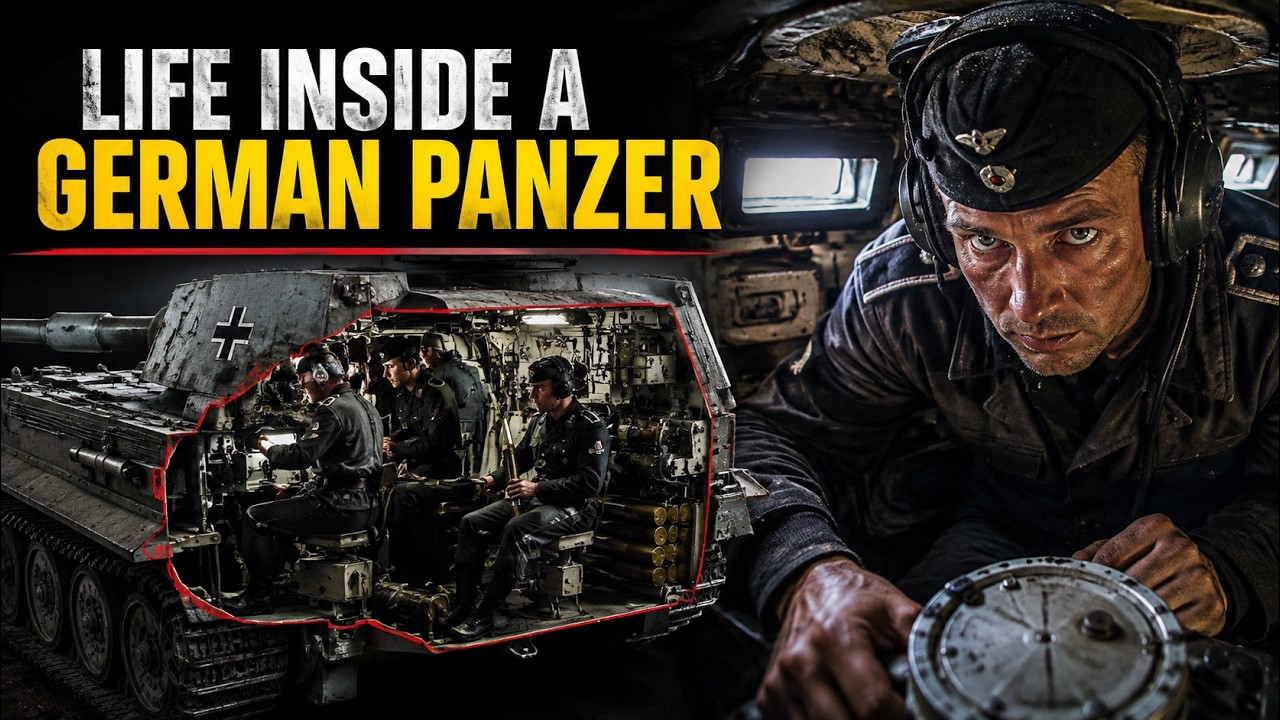
The driver ran his hands over the instruments in a ritual so practiced he could have done it blind. The loader was already counting ammunition in his head. The radio operator sat with the headset resting on his neck, waiting. The gunner was the last to move, stretching fingers that would soon be wrapped around triggers and traverse controls.
No one spoke much. There was a heaviness that came with knowing what the day might bring. The commander climbed out first, a brief exposure to sky and distance and the sharp bite of open air. He scanned the enemy positions, the weather, the visibility, the terrain.
This was the mental load of command, a constant calculation of threats and options that would determine whether four other men lived or died. When he dropped back inside and sealed the hatch, he brought the outside world with him in compressed form. The orders were passed down. The crew nodded.
No one looked frightened. They had learned not to show it. The engine caught with a roar that filled the entire acoustic world. The Maybach was not background noise; it was a wall of sound so complete that conversation became impossible.
The men communicated through hand signals, through the feel of the vehicle, through the intuitive understanding that developed after weeks and months of shared confinement. The tank rolled forward, and the day began. What they ate was never the food you might imagine. The rations, designated for field use, included tinned meat, usually pork or beef, dense and salty enough that a small portion could sustain a man for hours.
There were hard biscuits, almost geological in their density, that required real effort to break. Salt, margarine or lard wrapped in paper when they were fortunate, and a coffee substitute made from roasted grain or chicory that could be heated over a small spirit lamp. The water supply was strictly limited. Each man carried a canteen, but it never lasted as long as it needed to.
Crews learned to ration sips rather than drink deeply, to wet the lips instead of quench the thirst. Some kept small pebbles or bits of candy in their pockets to suck on, a folk remedy that provided psychological relief if nothing else. Eating inside a tank was not a social affair. It was refueling, nothing more.
The loader might eat with one hand while the other remained ready to grab the next shell. The gunner, facing his optics, would consume his food in fragments between scans of the horizon. The driver ate during momentary pauses in movement, never during active maneuvers. The commander, who had the most spatial freedom in the turret, was also the most likely to miss meals entirely because his attention never left the panorama beyond the tank and the crackle of the radio.
Conversation during meals was rare. Attention remained fixed outward on the world beyond the steel hull. The interior of the Panzer was a universe unto itself. Five men shared a space smaller than a modern bedroom.
The tank measured roughly 24 to 26 feet in length and nearly 10 feet in width, but the actual space available to the crew was dramatically less. The walls were thick. The mechanisms of the turret and gun took up considerable volume. Ammunition was stored everywhere a human was not expected to sit.
The loader, typically the youngest crew member, occupied the most physically demanding position. He crouched on the left side of the turret, surrounded by racks holding between 70 and 90 rounds. Each shell weighed anywhere from 30 to 40 pounds. His job was to grab them, often blindly in darkness filled with cordite smoke, feed them into the breach of the cannon, and then clear the spent casing after each shot.
In combat, this meant repeating the sequence eight to twelve times per minute. The physical toll accumulated not just from the weight but from the contorted postures demanded by the cramped space. The gunner, positioned to the right of the main gun, had a somewhat better view through his optics, but his world was narrow, magnified, and unstable as the tank lurched across rough ground. He spent his hours scanning through the telescopic sight, making minute adjustments, his hands resting on the elevation wheel and traverse control, his right foot hovering over the firing pedal.
His role demanded precision, calm nerves, and an almost meditative focus, all while the tank bounced and the compartment grew hotter with each passing minute. His eyes burned from the strain, and instead of finding relief, he pressed them harder against the rubber cup of the sight. The commander occupied the cupola atop the turret. Through his periscope, he could see perhaps ninety degrees around the tank, but magnification was limited, and details at distance became hazy.
Many commanders learned to expose themselves partially from the cupola, standing on the edge of danger to see what lay ahead. This made them among the most frequently killed crew members, precisely because of the need to see. The psychological weight of that responsibility, carried within a space barely larger than a closet, was immense. Below the turret, in the forward hull, sat the driver.
His position was the most isolated of all. He peered out through a narrow slit or a periscope that gave him perhaps twenty degrees of visibility. His hands gripped the steering levers, mechanical controls that required significant physical force to operate. There was no power steering.
Every course correction demanded genuine effort, and after three or four hours of continuous driving, his shoulders and forearms ached as though he had spent the day wrestling. His world compressed to a ribbon of landscape rushing toward him, with the constant knowledge that a single error could send the tank into a ditch or expose its flank to enemy fire. The radio operator, squeezed into the remaining space, managed communications while serving as an additional gun operator for the hull machine gun. His workspace was the most cramped of all.
He described it later as like being buried alive, able to move his arms and head but little else. The headset pressed against his skull for hours, leaving grooves in his scalp and raw patches of skin that festered in the heat. Yet the headset was a lifeline. Through it flowed the voices of battalion command, the check-ins from neighboring tanks, the urgent orders that could reshape the next few minutes of everyone’s existence.
The rubber cups collected sweat, and his ears burned from the constant crackle and static, but deafness was a luxury no one could afford. The noise inside the tank was catastrophic. The engine, producing anywhere from three hundred to six hundred horsepower under the hood, created a roar so total that unassisted voices would have been entirely drowned out. Even with headsets, shouting was often necessary.
For hours on end, day after day, tankers endured that acoustic assault, and many who survived the war reported permanent hearing loss. The vibration from the engine and transmission was equally relentless, a constant tremor that permeated every part of the tank’s interior and every bone in a crew member’s body. It traveled through the steering mechanism into the driver’s arms, through the gun’s recoil system into the gunner’s spine, through the floor into every muscle and joint. This noise and vibration did not just tire the body.
It affected cognition itself. Crews working long hours reported difficulty concentrating, slower reaction times, and a mental fatigue that made simple decisions feel impossibly complicated. The air inside the tank grew thick with a composite of diesel exhaust, cordite residue, sweat, and the stale moisture of recycled breath. Ventilation systems were minimal.
There were no powered fans forcing fresh air through the compartment. Ventilation relied almost entirely on whatever natural air circulation occurred through small louvers and the hatches themselves. During stationary operations or low speeds, the internal atmosphere became progressively more stagnant. Carbon monoxide seeped in through imperfect seals.
The smell, something the historical record captures only obliquely in memoirs and interviews, became overwhelming. Burnt fuel, hot metal, engine oil, human sweat, and the metallic tang of spent ammunition all accumulated into a miasma that assaulted the senses and, more insidiously, began to affect cognitive function. The heat was its own enemy. In summer, with the engine running and the hatches sealed, the interior temperature could climb past one hundred degrees Fahrenheit.
The metal walls absorbed sunlight and radiated it back onto the men. The engine compartment, mounted directly behind the crew, was a furnace that never cooled. A man’s uniform would be soaked through within an hour of active operations. The loader, working hardest, bore the worst of it.
His face flushed, sweat pooling along his collar and soaking through his padded jacket. Yet he could not simply remove layers, because the moment the tank fell silent or moved into a night operation, the heat would vanish and the cold would return with startling intensity. In winter, arctic air rushed in through the same vents, and temperatures inside could drop to dangerous lows. The crew had to balance the need for ventilation against the need for survival in conditions that could reach twenty, thirty, even forty degrees below freezing.
Frostbite was a constant risk, particularly for the driver in his exposed forward compartment. By mid-morning, the initial anxiety of the day had settled into something more routine. The crew had found their rhythms within the constraints of their positions. The loader had developed a numbness in his fingertips from the constant vibration of the turret, a sensation that would linger for hours after he climbed out.
The commander, scanning the landscape with his binoculars, felt his neck ache from the constant swiveling. He checked his wristwatch, calculated fuel consumption, estimated the position of the platoon ahead. These quiet mathematical moments, performed almost without conscious thought, were a form of anxiety management as much as practical necessity. The psychological toll of confinement began to layer on top of the physical.
Five men, breathing the same recycled air, rationing the same small supplies, locked together in an environment so constrained they could barely move without permission or necessity. They existed in a state of alert numbness. They remained ready to respond to any emergency with drilled-in training, yet their minds had begun to wander into memories and half-formed thoughts. Time became unstable.
A minute could stretch like an hour; an hour could compress into what felt like minutes. The isolation of being sealed inside a moving vehicle created a strange distortion of temporal perception. Hunger had transformed by afternoon into something else entirely. The sharp, demanding sensation of the early hours had faded into a duller, more philosophical awareness.
After a certain threshold, the body’s craving itself began to subside, replaced by a hollow exhaustion that somehow felt less demanding than active hunger. The stomach still sent signals, but they arrived muted, almost distant, as though the body had accepted its own irrelevance and moved on to more urgent calculations. What the crew craved instead was water. Thirst became the dominant physical sensation.
The limited supply was rationed with almost miserly precision. A man had to be careful about drinking too much, because there was no privacy in a tank, and the need to urinate was a logistical nightmare no one wanted to confront. Better to endure the thirst, to take only small sips, just enough to keep the throat from becoming unbearably dry. Crews developed small strategies for coping.
The driver would recite conversations from before the war, or run through the mechanical sequences of the transmission, or mentally reconstruct familiar places, his mother’s kitchen, the street where he grew up. The radio operator might hum fragments of popular songs from home, a barely audible vibration of melody that made the hours pass more gently. The loader would sometimes mentally rehearse the motion of loading a shell, reach, grasp, slot, push, retract, repeating the phantom sequence again and again to keep his reflexes sharp. These were small adjustments made by human nervous systems attempting to maintain psychological equilibrium under conditions that had never evolved to house human beings.
The relationship between the gunner and the loader developed a peculiar intimacy, forged not through friendship alone but through the rhythmic dance of ammunition, traverse, and fire. They were separated by mere inches of turret wall, their hands sometimes brushing as shells were chambered and ejected in the terrible percussion of combat. The loader’s responsibility was enormous. A tired loader meant a slower rate of fire.
A careless loader meant a jammed gun at the precise moment when responsiveness meant survival. Some crews developed such synchronicity that they could fire eight or even ten rounds per minute, a rhythm so practiced it became almost meditative even in the presence of exploding shells. The radio operator, meanwhile, inhabited a realm entirely his own. His ears, pressed against the earpieces, grew to know the voices of the officers so thoroughly that he could hear tension, fear, or confidence in the modulation of their tone.
He learned to encode meaning in shorthand, to hear entire situational pictures in a sentence or two, to understand through inflection and silence what words did not convey. The quiet stretches between transmissions became a peculiar form of tension. Was the silence a good sign, an indication that the unit was not engaged, or a sign that something had gone wrong with the broader operation? The uncertainty had no luxury of questions.
He simply maintained his readiness, alert to any crackle of static that might herald urgent orders. By the middle of the operation, the commander had settled into the rhythm that defined his role. His voice, thin over the intercom, carried the weight of decision. He was the one interpreting the messages from higher command, understanding the broader tactical picture, knowing that his tank was not an isolated machine but part of a formation moving across enemy ground.
The responsibility weighed on him in a way that was difficult to articulate. He was not merely commanding a vehicle. He was managing the survival of four other human beings, reading terrain, predicting enemy movement, and making calculations that took seconds but carried weight measured in lives. Some commanders developed a ritual around cigarettes, a way of managing time, of creating small moments of apparent control.
The smoke mixed with all the other toxins in the tank’s air, adding another layer of discomfort, but for many men this was preferable to confronting the yawning emptiness of unstructured fear. As the afternoon wore on, the physical environment of the tank continued to assert itself. The vibrations from the engine and transmission ran through the entire chassis, and after a certain number of hours, crews reported a strange sensation as though the tank itself was not moving through the landscape so much as the landscape was moving through them. A slow undulation that tilted perception.
The noise became so constant that the crew no longer quite heard it consciously; it had become part of the fabric of their physical being. Yet the moment an engine sound changed, even fractionally, the commander would tense. Engines were voices. Every fluctuation in tone could signal mechanical failure, overheating, or damage from enemy fire.
A commander who had survived long enough to develop genuine experience learned to interpret these sounds the way a musician might interpret an off-note in an orchestra. By the eighth hour, the psychological weight of absolute commitment had settled over the crew. Every man inside knew that his exit from the tank would only come under very specific circumstances: mission completion, mechanical failure, or catastrophic damage to the vehicle. There was no stepping out for a moment of fresh air, no quick break to stretch, no temporary escape.
This knowledge created a subtle but persistent pressure in the mind. It was not panic, not yet, but something like the awareness of one’s own confinement that accompanies a long ordeal, multiplied by the knowledge that life itself depended on the continued functioning of this metal vessel and the coordinated effort of everyone inside it. The bonds that formed between these men under such conditions carried an intensity that set them apart from ordinary friendship. Five men breathing the same scorched air, chewing the same hard bread, feeling the vibration of the engine through their bones for hours that stretched like days.
They were intimate through proximity rather than through emotional expression, aware of each other’s breathing, the subtle shifts in weight, the moment when fatigue began to blur the edges of focus. A handler would sometimes be responsible for seeing that his fellow crewmen had something to eat. Officers understood that a crew operating in a state of exhaustion became a liability rather than an asset, and the best commanders made certain their crews had water before they ordered another hour of movement. By late afternoon, when the sun began its descent, a different kind of exhaustion settled over the crew.
It was not the sharp alertness of combat readiness, nor the dull ache of morning hunger. It was something deeper, more pervasive. The air inside the tank had grown thick and stale. The crew had largely acclimated to it, though the acclimation was more a matter of surrender than adaptation.
The men’s uniforms clung to them, sweat drying and being replaced in a nearly continuous cycle. The temperature, whether freezing or stifling, had been absorbed into the baseline of their experience. They had entered a state of semi-acceptance, a physiological resignation to the contaminated air. The headaches that had begun as sharp pains had dulled into a constant ache at the back of each man’s skull.
The aches in the shoulders and spine, the raw patches of skin from the headset, the burning eyes strained through optics and viewports, all had been folded into the background of consciousness. The body learned to register familiar discomforts as something other than emergencies, incorporating them into a new baseline of normalcy. The evening brought its own peculiar rhythm. As darkness fell, the turret hatches were sealed tight against the cold.
The loader would prepare what passed for supper, heating whatever ration had been set aside over a small spirit lamp. The acrid smell of the fuel mixed with the metallic taste that seemed to coat everything inside the tank. The commander would review the next day’s orders on a map propped against his knees. The gunner would clean the firing mechanisms of his gun with meticulous care, an almost meditative work that allowed the mind to wander while the hands performed their familiar dance.
The driver might stretch his neck, work his shoulders in small circles, warm his hands. These small rituals, repeated night after night, became a kind of anchor point in the crew’s shared experience. Night operations were different, but not easier. Less visibility meant fewer opportunities for anti-tank guns to acquire a target, fewer threats from aircraft.
The darkness became almost protective, a temporary suspension of the intensity of daylight. But the threat of ambush always lingered. The crew could not see the enemy any better than the enemy could see them, and the uncertainty created its own flavor of tension. The crew moved at reduced speed, unable to engage effective combat, and for some, the tank felt less like a combat vehicle and more like a slowly moving shelter.
Sleep, when it came, was fragmented and light, never truly restorative. The gunner might manage an hour or two of fitful rest with his head tilted back against the breach, while the loader maintained a drowsy vigilance. The commander, when he even attempted rest, found himself nodding off only to jerk awake, convinced something had been missed. By the time the first hints of the next dawn began to appear on the horizon, the crew had been inside the tank for nearly twenty-four hours.
The distinction between hunger and exhaustion had blurred into something else entirely. What sustained them through those final hours was often not nutrition at all, but ritual. The gunner might unwrap a piece of chocolate from his pocket and allow it to soften on his tongue. The driver would sip water from his canteen, rationing it with the knowledge that the next resupply might be hours away or might never come at all.
The commander would pull a cigarette from a dented pack and inhale as though drawing in the only real thing left in the world. These small gestures, repeated without much thought, were moments to reset the mind, to remind the body that it still existed. When the order finally came to stand down, when the tank rolled into a position where the enemy was no longer immediately present, the crew climbed out into the open air. The contrast was almost shocking.
The first breath of outside air after hours sealed inside the metal box was something men remembered for years afterward. The air was cooler, fresher, free of the taste of diesel and metal and burnt propellant. The wind, which they had not truly felt beyond faint whispers through viewports, was cool against their faces. The landscape, which had been fragmented into small portions visible through narrow openings, was suddenly complete and three-dimensional.
And yet the transition was oddly jarring. Men reported a peculiar stiffness in their joints, a weakness in the legs that took several minutes to resolve. Some experienced a temporary blindness, their eyes having adapted so completely to the dimness that the actual world seemed impossibly bright and almost aggressive in its clarity. There was a ringing in the ears that persisted for hours, not from noise alone but from the sudden absence of it, the auditory system confused and overcompensating with its own internal sounds.
They had spent a day sealed inside a machine, navigating not only the external terror of combat but the interior struggle of hunger, thirst, fatigue, disorientation, and the peculiar kind of isolation that comes from being buried alive inside machinery. The tank was not merely a weapon. It was a container for human experience at its most extreme. The commander, the gunner, the loader, the driver, the radio operator, five men whose roles meant nothing without each other, bound together by proximity and necessity, leaning on one another simply to get through.
They made jokes. They shared cigarettes. They developed routines and small rituals that made their metal world slightly less alien. They existed in a state that was neither truly comfortable nor truly unbearable, but rather a sustained endurance of specific conditions that the human body could manage for hours if required, though at a cost to the mind and the sense of being a person rather than a component of a machine.
What remains when you close the hatch on that steel chamber and let the roar of the diesel fade into silence is not the thunder of battle or the precision of machinery, but something far more human and infinitely more fragile. The panzer, in the end, was a stage on which human beings performed the most fundamental of all acts. The act of persisting, of enduring, of maintaining one’s function even when circumstance and history have placed you in the midst of something vast and terrible and largely beyond your control. The hatch closes.
The engine quiets.