In the blackness of the North Atlantic, nearly five hundred miles west of Ireland, Kapitänleutnant Otto Keller raised his binoculars and saw the faint line of smoke. Then another. Then another. An Allied convoy, nearly forty merchant ships escorted by destroyers, was moving slowly through the darkness toward Britain.
For weeks his crew had searched these waters without success. Tonight everything changed. Keller knew exactly what Admiral Karl Dönitz expected of him. Not an attack, not yet.
He reached for the radio, and within moments his wireless operator began transmitting a short coded message: convoy sighted, estimated course, estimated speed, position. The entire transmission lasted barely twenty seconds, then the radio fell silent. To Keller it was perfect discipline. Every U-boat commander had been taught the same rule: never stay on the air longer than necessary.
Short transmissions could not be located. Satisfied, Keller ordered the submarine beneath the waves. The diesel engines stopped. Electric motors took over.
The sea closed above them. He believed he had disappeared. Yet nearly two hundred miles away, a British operator wearing headphones watched a thin green line flash across his screen. He smiled.
Within minutes the bearing was passed to an escort commander protecting the convoy. No one had read the German message. No one knew what it said. They didn’t need to.
They already knew exactly where the submarine was. By dawn, destroyers were racing toward Keller’s position. Hours later, depth charges exploded around his boat. The captain could not understand it.
He had followed every rule. His message was brief. His code was unbreakable. No one should have found him.
Yet Britain seemed to know where every shadowing U-boat waited. Many German officers began whispering the same explanation: there had to be a spy. Someone, somewhere, was betraying them. They were completely wrong.
The greatest secret of the Battle of the Atlantic was not hidden inside the message. It was hidden inside the radio wave itself. Before the war, Dönitz had been convinced he had found the perfect way to starve Britain into surrender. His theory was simple.
One submarine could sink a ship. Ten submarines could destroy an entire convoy. But only if they hunted together. The Germans called the tactic Rudeltaktik.
The Allies gave it a name that would become legendary: the wolf pack. Imagine standing alone in the middle of the Atlantic. The ocean stretches in every direction. A convoy might pass fifty miles away and you would never know it existed.
A single U-boat simply could not cover enough water. So Dönitz scattered dozens of submarines across enormous patrol lines stretching hundreds of miles. Most found nothing. But eventually, one captain would spot smoke on the horizon.
That submarine became the shadow. Its mission was no longer to attack. Its mission was to watch. Hour after hour, sometimes all night, it followed the convoy just beyond sight, quietly reporting every change in course and speed back to headquarters in occupied France.
There, inside a crowded operations room lined with enormous maps of the Atlantic, naval officers moved colored markers across the board. Each marker represented another U-boat. Every fresh radio report allowed them to calculate where the convoy would be by morning. Orders were sent back across the ocean.
One submarine approached from the north, another from the west, another from the convoy’s rear. Slowly, almost invisibly, the trap closed. When darkness finally arrived, the convoy was surrounded. Merchant captains often had no idea they were being hunted until torpedoes suddenly erupted from every direction.
For nearly two years, the tactic worked frighteningly well. Entire convoys disappeared beneath the Atlantic. Britain lost food, fuel, ammunition, and thousands of merchant sailors. It seemed only a matter of time before the island was starved into submission.
Yet hidden inside the wolf pack strategy was a weakness so dangerous that almost no German commander recognized it. The pack could not exist without communication. Every movement depended on radio messages. Every attack depended on radio messages.
Every submarine depended on radio messages. Without them, each U-boat became blind and alone. German commanders knew transmitting was risky. That was why every wireless operator practiced sending messages with incredible speed.
Reports were compressed into short groups of coded characters. Experienced operators could finish an entire contact report in less than twenty seconds. According to everything the Kriegsmarine understood about radio direction finding, that should have been safe. The technology they feared relied on rotating antennas by hand.
Finding the exact direction of a signal often took far longer than the message itself. If the transmission ended before the enemy finished turning his equipment, there was nothing left to find. The Germans trusted that logic. It wasn’t careless.
It wasn’t foolish. It matched everything they knew. What they didn’t know was that while they were perfecting shorter transmissions, Britain had quietly reinvented the game. The old rules no longer applied.
Across the Atlantic, scientists had built a machine that no longer needed long radio messages. It didn’t wait. It didn’t search. The instant a German operator pressed his Morse key, the answer appeared.
And from that moment onward, every contact report carried something far more dangerous than coordinates. It carried the U-boat’s own location. Spring 1943, Britain’s southern coast. While German submariners believed the Atlantic belonged to whoever fired the first torpedo, another battle was unfolding hundreds of miles away.
It was fought in quiet rooms. No explosions. No gunfire. Only headphones, glowing screens, and men who rarely left their desks.
Every time a U-boat operator touched his Morse key, an invisible wave raced across the Atlantic at the speed of light. The Germans believed those signals vanished into the darkness. They didn’t. Someone was always listening.
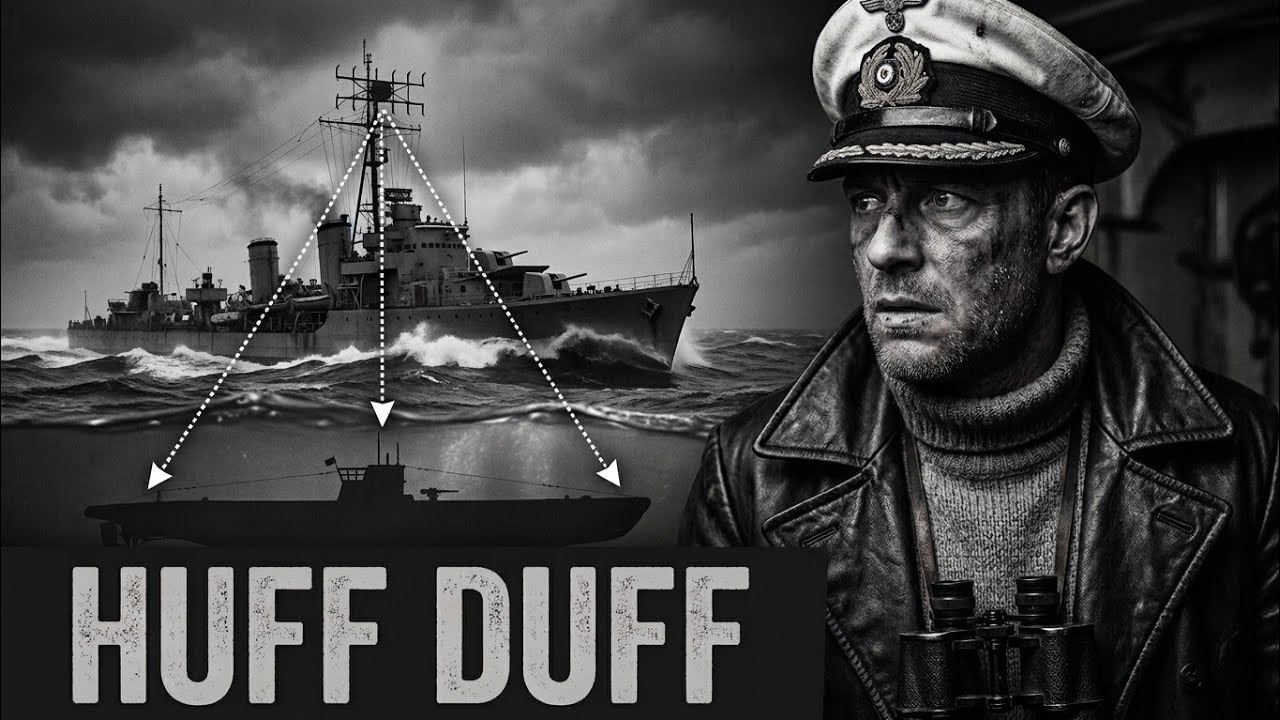
By 1943, Britain had built a growing network of high-frequency direction-finding stations, better known by the nickname every sailor remembered: Huff-Duff. Unlike older direction-finding equipment, these new sets didn’t require an operator to slowly rotate an antenna and hunt for the strongest signal. The moment a transmission arrived, its direction appeared almost instantly. The message itself didn’t matter.
It could be encrypted. It could be meaningless. It could last only a few seconds. The equipment wasn’t interested in the words.
It only cared where the signal came from. Imagine hearing someone shout in complete darkness. You don’t understand what they said, but you immediately know which direction the voice came from. That was Huff-Duff.
The German Navy had spent years making its messages shorter. Britain had built a machine that no longer cared how short they were. But one bearing alone wasn’t enough. A single line across the ocean could stretch for hundreds of miles.
To pinpoint a submarine, Britain needed several listeners. So every time a U-boat transmitted, multiple coastal stations and increasingly escort ships at sea captured the same signal. Each station reported its bearing. When those bearings crossed on a plotting table, they revealed something extraordinary: a position.
Sometimes within only a few dozen miles, close enough for an escort group to investigate. Even more dangerous for the Germans, Huff-Duff wasn’t limited to land. British destroyers, corvettes, and sloops gradually received their own shipborne sets. Now the hunters were sailing alongside the convoys.
A shadowing U-boat had only one job: keep reporting, keep headquarters informed. But every report gave the escorts another bearing, another direction, another chance. The convoy commander didn’t need to know what the Germans were planning. He only needed to know where the shadow was.
Destroyers would immediately break away from the convoy and charge toward the signal at full speed. For the U-boat commander, the result was almost always the same. A lookout spotted an escort racing directly toward them. There was no time to attack.
No time to continue shadowing. Only one option remained: crash dive. Within seconds, crewmen slammed shut hatches. Ballast tanks flooded.
The submarine slipped beneath the surface. For a moment it was safe. But it had failed. A submerged Type VII U-boat was painfully slow.
It could no longer keep pace with a convoy steaming across the Atlantic. By the time it surfaced again, the merchant ships were often over the horizon. The wolf pack had lost its guide. Sometimes the British never dropped a single depth charge.
They didn’t need to. Simply forcing the shadow underwater was enough. Without continuous radio reports, the rest of the wolf pack wandered blindly across thousands of square miles of ocean. The carefully planned ambush dissolved before it had even begun.
German commanders noticed something strange. Convoys that should have sailed directly into waiting submarines suddenly changed course. Escort groups appeared with almost impossible accuracy. Again and again, the same impossible coincidence.
The captains argued among themselves. Had someone betrayed them? Were their headquarters leaking information? Was there a spy inside occupied France?
The answers seemed logical. Because the real explanation was almost unbelievable. Britain wasn’t chasing submarines. The submarines were unknowingly leading Britain straight to themselves.
And as the spring of 1943 turned into early summer, the consequences would become impossible to ignore. The Atlantic, once the hunting ground of the wolf packs, was about to become the graveyard of Germany’s U-boat force. May 1943, North Atlantic. For nearly four years, German submariners had believed time was on their side.
Every convoy sunk meant less food reaching Britain, less fuel, less ammunition, less hope. Dönitz remained convinced that if enough merchant ships could be destroyed quickly enough, Britain would eventually be forced to negotiate. It had almost happened. Convoys had vanished beneath freezing Atlantic waters.
Entire crews had disappeared without leaving so much as a floating lifeboat behind. To many observers in early 1943, Germany still seemed frighteningly close to winning the Battle of the Atlantic. Then everything changed. Not because the Germans became less skilled, not because their commanders suddenly made mistakes, but because every advantage they had built their strategy around was quietly disappearing.
Long-range Allied aircraft now covered parts of the Atlantic that had once been beyond their reach. Escort carriers sailed with convoys, bringing fighter planes and anti-submarine aircraft directly into the battle. Radar improved. Sonar became more reliable.
Depth charge tactics grew deadlier. And hidden behind all of it, Huff-Duff kept listening. Every radio report, every contact message, every request for reinforcements, every attempt to organize another wolf pack, one transmission after another. The Germans were still following the same doctrine that had brought them success, but the battlefield had changed around them.
The escorts no longer waited for submarines to attack. They hunted first. One convoy in particular showed just how dramatically the balance had shifted. In late April and early May 1943, more than forty German U-boats converged on convoy ONS 5.
It should have been another overwhelming wolf pack victory. Instead, the Atlantic erupted into one of the fiercest convoy battles of the entire war. For days, freezing storms battered both sides. Visibility collapsed.
Towering waves swallowed destroyers and submarines alike. Merchant ships disappeared into walls of rain. German commanders believed the weather finally favored them, but even in darkness, even through the storms, the escorts kept finding them. Again and again, U-boats attempting to shadow the convoy were intercepted before the main attack could fully develop.
Some were forced underwater, others never surfaced again. The convoy suffered losses. War offered no perfect victories. But when the battle ended, the German Navy had paid a far heavier price.
Boat after boat failed to return. Experienced commanders, men who had survived years of Atlantic warfare, simply vanished. Their replacements lacked experience. Their crews lacked confidence.
And perhaps most damaging of all, the aura of invincibility surrounding the U-boat arm began to disappear. Throughout May 1943, disaster followed disaster. The operational reports arriving on Dönitz’s desk became impossible to ignore. Another submarine overdue, another lost, another crew missing, another veteran commander gone forever.
By the end of the month, roughly forty U-boats had been destroyed, about a quarter of Germany’s operational submarine force. Losses on that scale could not be replaced quickly. Neither could the men. Training a submariner took months.
Training a successful commander took years. Those years were running out. Finally, Dönitz faced the conclusion he had resisted for months. The Atlantic was no longer a battlefield where wolf packs could operate as they once had.
On the twenty-fourth of May 1943, he ordered many of his U-boats to withdraw from the North Atlantic. It was not an admission that submarines were useless. It was an acknowledgement that the old strategy no longer worked. The radio network that had once allowed dozens of submarines to strike as one had become an invisible chain leading Allied escorts directly toward them.
The hunters were now being hunted. But even then, many German officers still refused to believe radio direction finding was the true reason. Instead, they searched for traitors. They questioned intelligence officers.
They suspected spies. They even blamed their own allies. Almost anything seemed more believable than accepting a simple devastating truth. The enemy wasn’t reading their secrets.
The enemy was listening to their signals. Let’s return to that cold night where we began. March 8th, 1943, somewhere in the North Atlantic. Deep beneath the waves, Kapitänleutnant Otto Keller sits silently inside his U-boat.
The lights are dim. The air smells of diesel fuel, battery acid, and sweat. Around him, his crew waits without speaking. Then the first explosion arrives.
A violent concussion shakes the hull. Dust falls from the overhead pipes. The lights flicker. No one says a word.
Another explosion follows, closer. The destroyer above cannot see the submarine. It cannot hear the crew. It has never read a single Enigma message from Keller’s radio.
Yet somehow it knows exactly where to search. Inside the control room, Keller replays the previous hours over and over in his mind. He had followed every regulation. His contact report was perfectly encrypted.
His transmission lasted barely twenty seconds. His crew had maintained strict radio discipline. According to everything the Kriegsmarine had taught him, he had done nothing wrong. And that was the tragedy.
The fatal mistake wasn’t made by Otto Keller. It had been made years earlier, when Germany built an entire naval strategy around a single assumption: that a short radio transmission could never betray its sender. For years that assumption had seemed true, until technology quietly moved on. Britain never needed to crack every message to defeat the wolf packs.
Every time a submarine called headquarters, every time it reported a convoy, every time it requested reinforcements, it announced its own presence. The words remained secret. The location did not. That simple difference slowly changed the Battle of the Atlantic.
The British learned that sometimes the most valuable intelligence wasn’t hidden inside a message. It was the fact that someone had spoken at all. History often celebrates dramatic inventions: the atomic bomb, the jet engine, the aircraft carrier. But some of the war’s greatest victories came from quieter ideas.
A better antenna, a faster direction finder, a patient operator wearing headphones in a dark operations room. None of those men fired a torpedo. None commanded a convoy. Most would never become famous.
Yet together they helped protect the shipping lanes that kept Britain alive. By the summer of 1943, the balance of the Atlantic had shifted beyond recovery. German submarines remained dangerous until the war’s final months. They continued sinking ships.
They continued fighting with remarkable courage. But they never again controlled the Atlantic the way they had during the dark years of 1941 and early 1942. The wolf pack had been built around constant communication. And once communication became a weakness instead of a strength, the entire system began to collapse.
Perhaps that’s the lasting lesson of this story. Wars are not always decided by the biggest guns or the fastest ships. Sometimes they are decided by invisible signals, by assumptions that go unchallenged, by one side adapting just a little faster than the other. For the men aboard those German submarines, the ocean never betrayed them.
Their own radios did. Every transmission they believed made them stronger quietly made them easier to find. And somewhere beyond the horizon, a British operator watched another thin line appear on his screen, waited a few seconds, picked up the telephone, and sent another escort racing toward a submarine whose crew still believed they had vanished into the darkness.