The mist lay low over the railyard in the spring of 1944, clinging to the gravel and softening the edges of everything. And there, emerging from that haze like something from an older age, sat a King Tiger. The turret was enormous. The sloped armor caught what little light existed, creating shadows that made the machine appear to shift even in stillness.
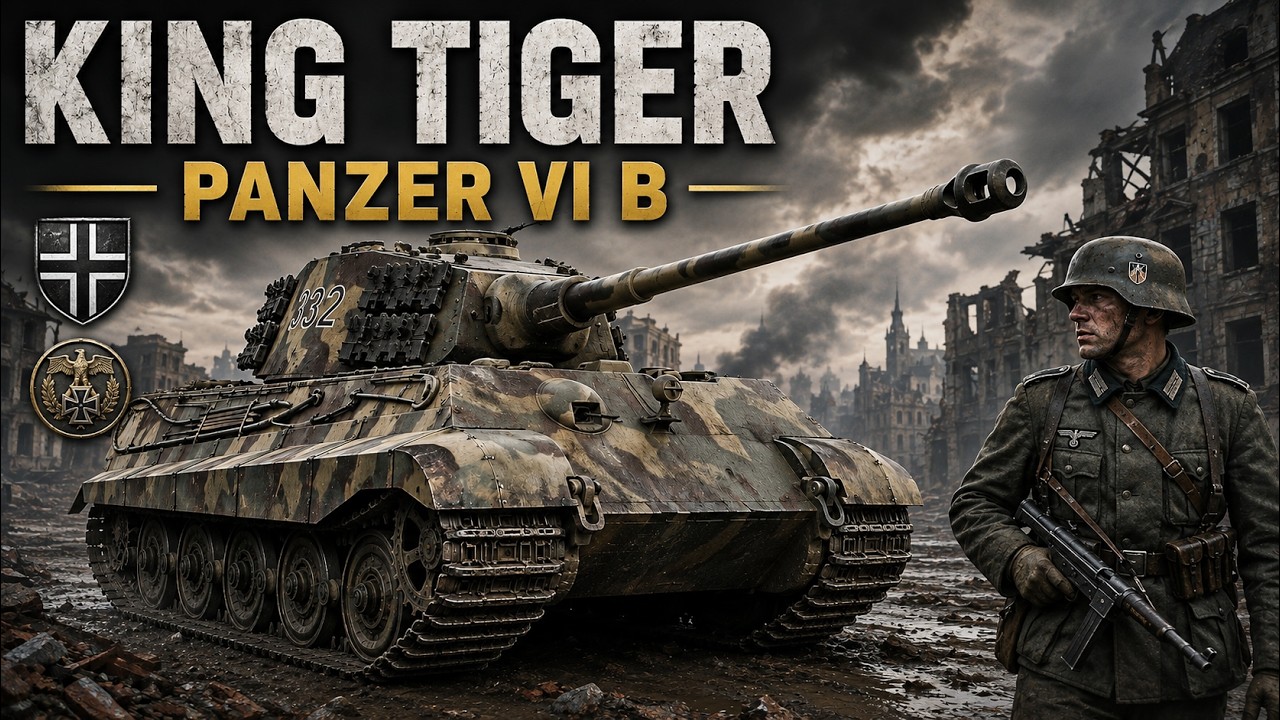
The gun barrel extended forward with a kind of patient menace. Nearly fourteen meters long from tip to rear deck, weighing almost seventy tons, it was a machine that seemed to defy the very infrastructure that was meant to carry it. The paint was fresh. The metal was clean.
Everything was precise. Everything was new. And this very ordinary moment, a machine resting on rails before deployment, carried within it all the contradictions that historians still puzzle over. How could Germany, a nation that had built its early tank doctrine on mobility and rapid breakthrough, create a machine of such devastating power that it could scarcely traverse the infrastructure of its own realm?
The answer lies not in a single moment of madness, but in a slow accumulation of decisions. Each one logical in its context. Each one driven by genuine tactical lessons learned on the battlefields of Russia and North Africa. The King Tiger emerged from these decisions the way a crystal grows from a supersaturated solution, inevitable and beautiful and ultimately rigid.
To understand why Germany pursued this path, you must drift back through the corridors of the early 1940s, to a moment when German tank doctrine was still being shaped by the spectacular victories of the Blitzkrieg campaigns. In the opening campaigns against Poland and France, German armor had proven itself agile and coordinated. These early tanks were not particularly large or heavily armored, but they were mobile, relatively easy to produce, and supported by a doctrine that emphasized speed, tactics, and surprise. The tank was a tool of swift maneuver.
But something changed in the summer of 1941, when German forces crossed into the Soviet Union. The sheer scale of that conflict and the shocking resilience of Soviet armor introduced a new calculus. The T-34, with its sloped armor and respectable gun, represented a different approach to the tank problem, one that prioritized protection and firepower over speed. The encounter proved to be a watershed moment.
German designers began to believe that bigger guns and thicker armor might be the answer to the Soviet challenge. The psychology of this escalation is worth considering, for there is something deeply seductive about the logic of bigger and heavier. The belief that if a good solution is made larger and more extreme, it becomes proportionally better. A thicker plate stops more rounds.
A larger gun fires heavier projectiles. And surely, if thirty tons of tank is good, seventy tons is better. By 1943, as the war shifted increasingly to a defensive posture for Germany, this philosophy crystallized into formal doctrine. The Tiger I had arrived on the Eastern Front in 1942 like a revelation wrapped in armor plate.
Its 88 mm gun could reach out across the steppe and destroy T-34s from distances where those Soviet tanks could barely scratch its frontal slope. Soviet tankers began to whisper stories of invincible German beasts that shrugged off shellfire and turned battles by their mere presence. Yet even as these legends took root, German maintenance crews were learning a deeper, more sobering lesson. The Tiger I was a machine of relentless mechanical complexity, and the Eastern Front was precisely the wrong theater in which to maintain such complexity.
The vast distances meant that breakdowns often stranded crews far from repair facilities. The mud of the rasputitsa clogged differentials and transmissions. Fuel consumption figures looked troubling on a quartermaster’s clipboard and became truly nightmarish when translated into the reality of a thousand-kilometer supply line. There were engagements where German Tigers had to hold their ground, not because of enemy firepower, but because they were simply too low on fuel to maneuver.
The transmission was another point of deep frustration, sensitive, prone to overheating, and difficult to replace in field conditions. Yet despite these vulnerabilities, when properly deployed, when given the advantage of terrain or used in ambush, the Tiger I could achieve casualty ratios against Soviet armor that seemed almost obscene. One Tiger, well hidden and expertly handled, could account for five or six Soviet tanks in an afternoon. This asymmetry fascinated German armor doctrine.
It suggested that the answer to Soviet numerical superiority wasn’t to match quantity, but to multiply quality. And if one Tiger could do such extraordinary damage, what might a heavier Tiger do? The Battle of Kursk in the summer of 1943 shifted something in the German high command’s understanding of mechanized warfare. The Soviet defenses were deeper than intelligence had suggested.
The new T-34/85s were proving more formidable than expected. And perhaps most troubling, the margin of German superiority was narrowing. The Tiger I was no longer the unquestioned master of the battlefield. The realization arrived not as a single dramatic moment, but as a slow, deepening anxiety.
Germany had paid dearly at Kursk, not in some trivial accounting of losses, but in the psychological recognition that their tank designs, however formidable, might no longer guarantee victory. There had to be a response. What followed was a surge of demand, almost frantic in its urgency, for a new heavy tank. The specifications began to take shape in the autumn of 1943.
The new tank must carry a gun powerful enough to penetrate any existing Soviet or Allied armor. Its own hull must be protected by thicker plate, arranged at sloping angles to maximize deflection. It should be heavier, more formidable in every dimension. Two design teams were set to work almost simultaneously.
Henschel approached the problem with conservative pragmatism, taking proven elements and enlarging them. Porsche favored a more radical approach, proposing innovations in suspension and even an electric transmission system. Neither team knew they were racing against time itself. By early 1944, the decision began to crystallize.
Henschel would be the primary producer. Their design would go forward. Yet Porsche’s turret design was judged to be superior, and so the machine that emerged was a hybrid. It carried Henschel’s hull and transmission, but wore a turret that reflected Porsche’s vision, larger, more heavily armored, more powerfully armed.
It was a practical synthesis of two different approaches to the problem of building a more formidable tank than the world had yet seen. When the engineers sat down to translate the demand for absolute superiority into steel and geometry, they faced a question that would define the entire machine. What does invulnerability actually look like? The answer wasn’t simply to pile armor thicker and thicker.
The design team understood that the angle at which armor meets a projectile matters as profoundly as the thickness of the plate itself. The sloped armor of the King Tiger’s hull was not mere decoration. The glacis plate was angled at roughly fifty degrees from vertical. A shell that would penetrate thirty millimeters of vertical steel might struggle to perforate sixty millimeters of sloped armor, because the effective thickness increases dramatically with the angle of approach.
The turret face, particularly around the gun mantlet, achieved thicknesses of well over one hundred fifty millimeters in critical areas. This layered approach to protection represented the accumulated wisdom of three years of armored warfare translated into a single design. And therein lay both its triumph and its tragedy. The 8.
8 cm KwK 43 gun mounted in that turret was the distilled expression of German ballistic ambition. The 88 had proved itself years earlier as an anti-aircraft weapon, but soldiers had noticed something curious. When Allied tanks approached those gun positions, the crews simply lowered the barrel and fired. The results were catastrophic.
The KwK 43 variant was an evolution, refined from years of understanding how to translate raw velocity into penetrating power. When a round was loaded, that projectile weighed nearly ten kilograms and traveled at speeds approaching one thousand meters per second. At ranges of one thousand meters, this gun could punch through nearly two hundred millimeters of homogeneous armor plate. The armor of a Sherman tank typically measured around fifty to seventy millimeters at its thickest points.
A single round from the KwK 43, landing almost anywhere on the hull, would not merely dent or gouge. It would perforate. This weapon combined tremendous penetrating power with good accuracy and a flat trajectory. Most tanks had to choose between those two attributes.
The German designers achieved both. The King Tiger in its final form weighed 68. 5 metric tons. To hold that number in your mind for a moment is to begin understanding the fundamental crisis that engineers and commanders alike grappled with throughout its brief service life.
The ground pressure, the force exerted by its tracks upon the earth, was extraordinarily high. A Sherman tank weighing roughly thirty-five tons would leave shallow impressions in soft soil. A King Tiger would sink noticeably deeper. The Maybach HL230 engine producing 720 horsepower was required to move this burden.
The power-to-weight ratio hovered around 10. 3 horsepower per ton. A Sherman achieved approximately thirteen to fourteen. This means the Maybach engine was perpetually laboring, perpetually straining to overcome the massive inertia of the steel hull surrounding it.
The transmission became a constant source of difficulty. Field crews spoke of transmission breakdowns becoming routine. The sheer weight also created practical difficulties in deployment. A single King Tiger required reinforced railway cars to transport it from factory to front.
The logistics of simply moving one tank became a chess game of route planning and constant calculations about which bridges could bear the weight and which would collapse. The bridge problem was so fundamental that no amount of engineering brilliance could entirely solve it. A bridge rated for a standard military load could typically bear perhaps forty tons. But the King Tiger pushed beyond these orderly calculations.
Where a standard Tiger I at fifty-five tons could cross certain bridges with careful restriction, its successor could not. The Germans developed a technique called deep wading. The tank would be sealed completely. Rubber seals were applied around every hatch and joint.
A breathing tube, or snorkel, rose above the turret to draw air from the surface. The tank would approach the water’s edge at a carefully controlled pace, the driver essentially piloting blind, guided by landmarks memorized beforehand. The psychological weight of such an operation must have been immense. When a King Tiger became stuck or damaged during a crossing, recovery was a monumental undertaking.
In a mobile warfare situation, the days required for such recovery represented an eternity. The fuel consumption shaped German armored doctrine more decisively than any enemy tank. The King Tiger demanded roughly one liter of fuel for every kilometer traveled across flat terrain. A single company of four or five tanks might require two or three thousand liters of fuel daily.
By the waning months of 1944, fuel shortages had become a fundamental constraint. Some King Tigers sat immobilized, not from mechanical failure, but from simple fuel poverty. A lighter tank might possess greater range and more flexibility. The King Tiger, magnificent in defense, was increasingly locked into defensive desperation.
In early July 1944, King Tigers were first committed to combat in Normandy, near the town of Saint-Lô. The machine’s arrival at the bocage, those dense Norman hedgerows, occurred under circumstances quite different from what the high command had anticipated. In those first engagements, the King Tiger’s sloped armor proved extraordinarily difficult for standard Allied anti-tank guns to penetrate. But the reality of warfare began to diverge from the clean calculations of the design bureau.
The lanes between hedgerows were barely wide enough for the tank’s hull. Turning required immense effort. The terrain compressed engagement distances to mere dozens of yards, where the King Tiger’s gun could not be brought to bear and its great height made it a visible target. The first King Tigers lost to Allied forces were often abandoned rather than destroyed in combat, casualties to mechanical failure, fuel starvation, or the impossible task of recovery when the line was collapsing.
The very qualities that made it terrifying in open terrain worked against it in the complex geography of the Norman countryside. When the German high command conceived its final massive offensive through the Ardennes in December 1944, the King Tiger was envisioned as the cutting edge of the assault. On paper, the plan possessed a certain elegance. But the narrow roads of the Ardennes were too narrow for what was being asked of them.
A King Tiger filled the entire roadway. If a vehicle ahead broke down, the entire column backed up. Most of the existing stone bridges in the region had been built to carry the heaviest vehicles of an earlier century. The advance became a grinding frustration of movement constrained and slowed.
A King Tiger might advance perhaps ten or fifteen kilometers in a day, not because American resistance was particularly fierce, but because the vehicle itself allowed nothing faster. There were instances in which King Tigers had to be held in place not because the enemy was preventing their advance, but because there was simply no fuel to move them. The mechanical life of a King Tiger was in many ways a descent into perpetual crisis management. The engine ran hot and unreliable under the constant demands of seventy tons of steel.
The transmission was utterly unforgiving. A driver who mishandled a gear shift could strip teeth from the gears with a sound like the shattering of iron. Once those teeth were gone, the tank became immobile. The final drives suffered similar indignities.
The suspension was intricate and sensitive. In muddy terrain, when one track bogged down, the strain on the differential was immense. Crews found themselves spending far more time in maintenance than in combat. And when a King Tiger broke down, recovery was an epic undertaking.
In the best scenarios, it took hours under enemy fire. More often, the crew would attempt repairs in the field, or if that was impossible, set demolition charges and walk away. What began to emerge was a pattern that mechanical failure was in many tactical situations a more effective enemy than any Allied armor. A tank crew dealing with a transmission failure was a crew that could not maneuver, could not advance, could not retreat.
The psychological impact on those who faced it was profound. American tank crews encountered a machine that seemed to belong to an entirely different order of warfare. A shell from a Sherman’s 76 mm gun would strike the glacis plate of a King Tiger and sometimes fail to penetrate, the impact leaving only a bright scar of exposed metal. Crews reported that even a solid hit might not produce the catastrophic destruction they had come to expect.
This phenomenon created a kind of psychological inversion. American crews had been trained to believe that velocity and mass would solve most problems. The King Tiger suggested otherwise. Yet the machine’s rarity amplified its effect.
If a Sherman company moved through a sector for a week and saw no German armor, and then suddenly a King Tiger emerged from a woodline, the psychological impact of that single encounter would dominate the crew’s memory. There was also a grudging recognition of the German engineering achievement itself. American crews understood that somewhere across the lines there were welders and engineers who had solved problems that seemed genuinely difficult. By February 1945, the King Tiger fleet had ceased to exist as an organized force.
The bridges of Germany, once part of the infrastructure of conquest, had become barriers that could not be crossed by these massive machines. German engineers often destroyed their own bridges to delay the enemy advance, and the King Tigers could not follow. When a bridge could not bear the weight, or was simply gone, the tank became immobilized not by enemy action, but by the simple physics of its own existence. Many were destroyed by their own crews.
Demolition charges were installed. Engines were disabled. The machines that had cost enormous resources to build were reduced to twisted metal and ash. The tank did not fail because its design was fundamentally flawed.
It failed because the nation that built it could no longer supply it with fuel, could no longer move it across the terrain it encountered, could no longer protect the factories where new ones were assembled. Today, fewer than a dozen intact King Tigers remain in the world. They sit in museums across Europe and beyond, behind velvet ropes and under explanatory plaques. Visitors walk around these steel giants in silence, often struck by their sheer presence.
When you stand before these tanks, you are looking at something more than metal and ammunition. You are looking at the frozen moment of a nation’s desperation crystallized into seventy tons of steel. The King Tiger stands as a triumph of engineering and a monument to futility. It was a machine that terrified men who faced it and a machine that broke down with frustrating regularity.
It was the product of brilliant minds and a failed state. It is perhaps one of history’s most eloquent statements about the limitations of technology to determine outcomes, about the way even the most sophisticated machine remains bound by the constraints of physics, logistics, and the simple fact that you cannot make up for strategic collapse through mechanical superiority alone. The men who built it created something that was in nearly every measurable way a marvel of engineering. But they built it in a war that was ending, using resources that were dwindling, and deploying it in circumstances where its greatest strengths could be negated by factors as simple as timing, terrain, and the willingness of those facing it to refuse direct contest.
The King Tiger’s story is ultimately a human story. It is the story of engineers who wanted to build something magnificent. It is the story of workers who wanted to do good work. It is the story of crews who wanted to survive.
And it is the story of a nation that wanted to win a war it could not win, and chose, in that wanting, to create something beautiful and terrible in equal measure. The factories are long gone now, or converted to other purposes. The men who worked in them are aging or departed.
But the machines that remain, in their restored silence, continue to ask us what we are capable of creating, what it costs to build it, and whether brilliance without wisdom is not, in the end, a kind of sadness.