The moment I opened my bedroom drawer, I knew someone had been inside my apartment. Grandma Evelyn’s spare house keys were gone. Why would anyone steal keys to a house that had been sitting empty for weeks? And why did my security camera suddenly show my parents pulling into Grandma’s driveway with my brother Eric and a moving truck?
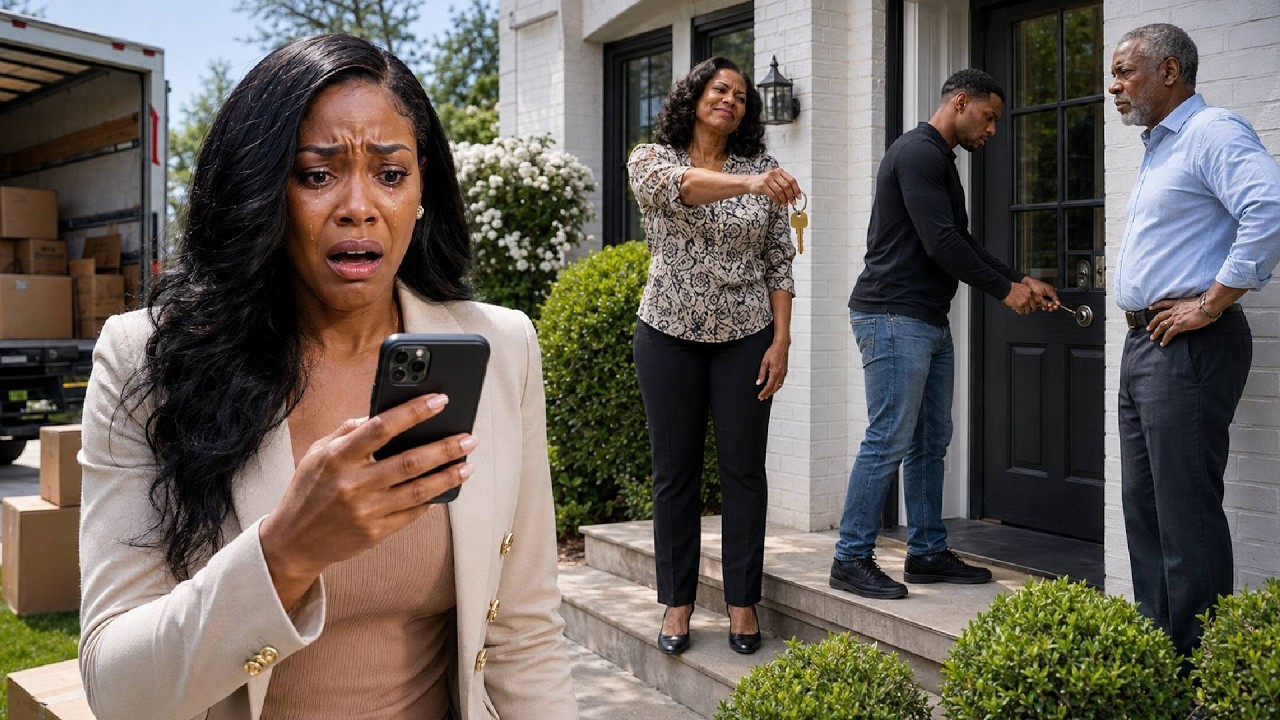
My mother smiled as she handed him the stolen key, but the lock never turned. Then my phone buzzed with a voicemail from my father. Joyce, you’ll understand once we’re inside. What they didn’t know was that Grandma had warned me this day might come.
Six months before my parents stood on Grandma Evelyn’s front porch with a moving truck, life still felt predictable. Busy, sometimes exhausting, but predictable. I managed a portfolio of commercial office buildings in Charlotte, North Carolina. Most days were filled with lease negotiations, contractor meetings, insurance inspections, and the occasional emergency call about a burst pipe or a broken elevator.
My job had taught me that buildings were surprisingly easy to understand. Every problem had a cause. Every repair left a paper trail. Every disagreement could usually be resolved if you had the right documentation.
People weren’t nearly as straightforward. My family certainly wasn’t. I had always been the dependable one. If Mom needed someone to drive her to an appointment, she called me.
If Dad couldn’t figure out a confusing insurance letter, he handed it to me. When Grandma Evelyn’s roof developed a leak after a summer storm, I was the one climbing into the attic with a contractor, while my brother Eric texted that he was caught up with work. He always seemed caught up with something. The strange part was that nobody in the family expected much from Eric anymore.
They talked about his disappointments as though they were unfortunate weather conditions that simply happened to him. His restaurant partnership failed because of bad timing. His landscaping company failed because the economy slowed down. His online retail business failed because of shipping costs.
There was always another explanation, another excuse, another fresh start. My parents never described him as irresponsible. They described him as unlucky. Whenever I questioned another loan or another rescue plan, Mom would smile patiently and say, Joyce, people need different kinds of support.
What she never seemed to notice was that I was always the one expected to provide it. Grandma Evelyn noticed. She had lived in the same white brick house for nearly forty years. It wasn’t a mansion.
It sat on a quiet treelined street where neighbors still waved from their front porches and children rode bicycles after school. Grandpa planted the maple tree in the front yard when my mother was in high school. Grandma loved reminding everyone that the tree had grown straighter than most people in the family. I visited every Saturday.
Sometimes I fixed loose cabinet hinges. Sometimes I organized her medications. Sometimes we simply drank tea while she complained about television game shows becoming louder every year. She never asked me to come.
She just always knew I would. As her health gradually declined, she moved into a nearby assisted living community. She hated leaving the house, but admitted she needed more help than she wanted to accept. I’ve spent my whole life taking care of everyone else, she told me while we packed framed photographs into storage boxes.
Learning to let someone take care of me feels like homework I never wanted. I laughed. So fail the assignment, I teased. She smiled.
Oh, I plan to argue with the nurses every chance I get. She did exactly that. Even after moving, she insisted on knowing whether someone checked the gutters after heavy rain or whether the heating system had been serviced before winter. Every few weeks, I stopped by the house to collect the mail, water a few plants she refused to throw away, and make sure everything remained in good condition.
She trusted me with every detail. Not because I was perfect, but because she knew I would actually do it. Eric visited her occasionally, usually when Mom suggested it. His visits rarely lasted long.
He always seemed distracted, checking his phone or talking about another business opportunity that only needed a little help to succeed. Grandma never criticized him in front of anyone, but after one visit, she quietly looked out the window for a long moment before speaking. Your brother has a good heart, she said softly. I waited.
He just keeps looking for shortcuts that don’t exist. That sounded exactly like Grandma. She never insulted people. She simply described them honestly.
A few weeks later, Melissa, the attorney who had helped Grandma with her estate planning years earlier, called me. Your grandmother would like you to attend a meeting, she said. Is everything okay? She’d rather explain it herself.
When I arrived at the assisted living facility, Grandma was sitting near the library with a folder resting on her lap. She looked smaller than I remembered, older, but her eyes were exactly the same, sharp enough to notice everything. I hope this isn’t about your health, I said as I sat beside her. It isn’t.
She gently pushed the folder toward me. It’s about my house. I immediately tried to hand it back. I don’t need to know any of this.
Actually, she replied, you’re exactly the person who does. Melissa joined us a few minutes later. She explained that Grandma had recently reviewed every document in her estate plan one final time. Everything was current.
Everything was legally sound. Grandma looked directly at me. I’ve decided the house will belong only to you. I stared at her.
What? She nodded calmly. I’ve already signed everything. I opened my mouth, then closed it again.
Mom’s going to be furious. Grandma almost smiled. Yes. And Dad, he’ll tell everyone we should avoid conflict.
And Eric? She finished my sentence before I could. He’ll believe someone else deserves to solve another problem for him. The room became quiet.
I wasn’t thinking about the house. I was thinking about Thanksgiving dinners, Christmas mornings, birthdays, everything this decision might change. I don’t want anyone believing I influenced you. You didn’t.
I don’t want the family torn apart. My dear, Grandma said gently. A family isn’t held together because everyone receives equal property. She leaned forward.
It’s held together because people respect one another. I looked down at the folder. I don’t understand why me. She reached across the table and placed her hand over mine.
Because every repair invoice, every doctor’s appointment, every grocery receipt, every insurance renewal, every broken faucet, every winter storm, you handled them without asking what you’d receive in return. She squeezed my hand. You already cared for that house like it mattered. I felt tears gathering before I even realized I was crying.
It isn’t about rewarding you, she continued. It’s about trusting the person who understands responsibility. Melissa quietly slid another envelope across the table. This will stay with the probate documents.
I looked at Grandma. What’s inside? A personal letter for me, for anyone who ever questions why I made this decision. I nodded slowly.
For the first time, I realized she hadn’t simply written a will. She had anticipated resistance. As we prepared to leave, Grandma asked Melissa for a few private minutes with me. Once we were alone, she waited until the hallway outside had grown completely quiet.
Then she lowered her voice. Joyce. Yes. When everything is finished.
She paused long enough that I instinctively leaned closer. Promise me you’ll replace every single lock on that house. I blinked. Every lock?
She nodded once. Immediately. I searched her face, expecting an explanation. Instead, she looked toward the window with an expression I had never seen before.
It wasn’t fear. It was certainty. I didn’t ask Grandma why she wanted every lock replaced, at least not right away. For most of my life, she’d never made dramatic statements.
She wasn’t the kind of woman who believed everyone was out to get her. If anything, she gave people too many chances. So when she looked me in the eye and told me to change every lock the moment probate was over, I knew she wasn’t speaking from suspicion. She was speaking from experience.
Unfortunately, I never got the chance to ask another question. Three weeks later, Grandma Evelyn passed away peacefully in her sleep. The funeral was simple, just as she had requested. No elaborate flowers, no expensive reception.
She wanted donations made to the neighborhood literacy program instead of buying wreaths that would wilt within days. People filled the chapel. Neighbors she’d known for decades, former church members, old co-workers, even people I barely recognized stopped me afterward to tell stories about how Grandma had quietly helped them years earlier. She had paid one neighbor’s electric bill after her husband lost his job.
She had driven another woman’s son to community college every morning for almost a semester because his car had broken down. Most of us never knew those stories until after she was gone. That was who Grandma was. She believed generosity counted more when nobody applauded it.
My parents cried throughout the service. Eric cried too. Watching him stand beside Grandma’s casket, I wanted to believe things might be different now. Grief has a way of making people seem softer, more honest.
For a brief moment, I hoped losing Grandma might remind all of us what really mattered. That hope lasted less than forty-eight hours. Melissa called to schedule the first probate meeting. The will is straightforward, she explained over the phone.
There shouldn’t be many complications. There shouldn’t be, I agreed. She hesitated. But your parents asked whether the family could meet before we distribute copies.
I frowned. Did they say why? They said they wanted everyone on the same page. That sounded harmless enough.
Still, something about the timing bothered me. We met three days later in Melissa’s conference room. Mom smiled when I walked in. Dad poured coffee for everyone.
Eric joked about how Grandma would probably complain about the office chairs being uncomfortable. For a few minutes, it almost felt normal. Then Melissa opened the estate file. She reviewed Grandma’s savings, investments, charitable gifts, and personal belongings one section at a time.
No one interrupted. No one objected. Finally, she reached the house. As outlined in Mrs.
Evelyn Carter’s will, Melissa said, the residential property located on Ashford Lane transfers solely to Joyce Snider. Silence. Not shocked silence. Measured silence.
The kind people use when they’re calculating their next move. Mom spoke first. Only Joyce. Melissa nodded.
Correct. Dad leaned back slowly. I thought Evelyn wanted the house to stay in the family. It is staying in the family, Melissa replied calmly.
It belongs to Joyce. Eric forced a small laugh. Well, technically, I guess. Nobody joined him.
Mom folded her hands together. There must be some misunderstanding. There isn’t. Maybe Mother forgot to update something.
Melissa slid a certified copy of the will across the table. It was updated less than a year ago. Mom looked toward me. You knew?
I answered honestly. She told me a few months ago. And you didn’t think to tell us? She asked me not to.
Mom’s expression changed so quickly it almost made me dizzy. Only seconds earlier she’d looked hurt. Now she looked disappointed. The difference mattered.
Disappointment carried blame. I wish you’d trusted us enough to have a conversation, she said quietly. I almost apologized. Almost.
Then I remembered something. Grandma had expected this conversation. She had known exactly how it would begin. Melissa continued reviewing the remaining paperwork before ending the meeting.
No one argued. No one raised their voice. My parents hugged me before leaving. Mom even kissed my cheek.
If your grandmother trusted you, she whispered, we’ll respect her wishes. I wanted to believe her. Driving home, I kept replaying those words. We’ll respect her wishes.
At the time, I had no reason not to. Probate officially closed about seven weeks later. Melissa called me that morning. Congratulations, she said warmly.
The property has officially transferred. I thanked her. Before hanging up, she reminded me about property taxes, insurance updates, and utility transfers. Then she added one more sentence.
Joyce, your grandmother left instructions for you to read after probate closed. I drove straight to her office. Inside the sealed envelope was Grandma’s handwritten letter. The first page wasn’t about the house.
It was about me. She thanked me for never making her feel like a burden. She apologized for knowing the inheritance might create distance inside the family. She reminded me that kindness without boundaries eventually becomes permission.
I had to stop reading twice because my eyes kept filling with tears. Near the end of the letter, her handwriting became firmer, almost urgent. Joyce, if you’re reading this, the house is finally yours. I need you to do something before you clean a single room or hang a single picture.
Replace every exterior lock. Do not wait. Do not discuss it. Do not ask anyone’s opinion.
Then install security cameras. Update the insurance policy. Keep copies of every receipt. One day you’ll understand why I insisted.
Trust your instincts the way I trusted mine. I lowered the letter into my lap. Grandma hadn’t simply suggested changing the locks. She had given me instructions, detailed instructions, almost like a checklist.
I called Daniel Brooks that afternoon. He owned a locksmith company my commercial clients had used for years. Joyce, he answered cheerfully. What’s going on?
I need every exterior lock replaced. Moving into a new place, in a way. When? Tomorrow morning, no problem.
The next day, Daniel arrived with two technicians. They replaced the front door deadbolt, the back door, the garage entry, every side entrance, even the lock on the detached storage shed. Daniel handed me every old cylinder in a plastic bag. You want to keep these?
Yes. He smiled. Most people throw them away. I’m not most people.
He laughed. No argument there. When they finished, he gave me a detailed invoice listing every lock that had been replaced, each new key code, and the installation time. I folded the paperwork carefully into a property binder.
Then I called Karen Mitchell, the insurance representative who handled several commercial accounts for my company. I recently inherited a home, I explained. I’d like to update the policy. She walked me through every change.
Ownership, emergency contacts, authorized occupants, mailing address. Finally, she asked a question most people probably answered without thinking. Is anyone besides you authorized to access the property? I paused.
No. I’ll note that. Next came the security system. I installed exterior cameras covering every entrance, a smart doorbell camera, motion sensors, cloud recording with thirty-day backups.
My co-workers joked that I’d protected Grandma’s quiet little house like it was a downtown bank. Maybe I had. But every time I questioned whether I was doing too much, I remembered Grandma’s handwriting. One day you’ll understand why.
Weeks passed. Life returned to normal. Or at least it seemed to. Then during a Sunday family dinner at my parents’ house, Mom casually reached across the table.
So, I looked up from my plate. What did you end up doing with Mom’s spare house keys? The question sounded almost accidental. Almost.
I have them. She smiled. Where? I smiled back.
Somewhere safe. She nodded thoughtfully. Oh. Dad changed the subject almost immediately.
Eric asked whether I’d started renovating anything. Later, he wondered if I planned to rent the place. Then he asked if anyone was staying there overnight. Three separate questions, all about access.
None about Grandma. Driving home that evening, I couldn’t shake the feeling that something had shifted. The next Sunday, my parents came over for dinner at my apartment. Everything seemed perfectly ordinary until I carried dessert into the dining room.
When I returned to the kitchen a minute later, my mother was gone. I heard a floorboard creak somewhere down the hallway. For a second, I simply stood there holding the pie server in my hand. Maybe Mom had gone to the bathroom.
Maybe she was answering a phone call somewhere quieter. There were perfectly reasonable explanations, but Grandma’s letter flashed through my mind before I could convince myself of any of them. Replace every exterior lock. Do not wait.
Do not discuss it. Trust your instincts. I walked into the hallway without making much noise. Mom wasn’t in the guest bathroom.
She wasn’t on the balcony either. Then I heard the soft sound of a drawer sliding closed. My bedroom door was open just a few inches. When I stepped closer, Mom emerged with a warm smile that appeared almost too quickly.
There you are, she said. I was looking for the restroom. I pointed toward the hallway behind her. The bathroom’s the other direction.
For the smallest fraction of a second, she froze. Then she laughed. Oh my goodness. You’re right.
I completely forgot. She brushed past me lightly, touching my arm as if nothing unusual had happened. I watched her disappear down the hallway. When I entered my bedroom, everything looked normal.
Nothing appeared disturbed. The bed was made. The dresser was exactly as I’d left it. The nightstand lamp hadn’t moved.
I opened the drawer where I kept important documents. The envelope containing Grandma’s spare keys was still there. At least it looked like it was. I didn’t touch it.
Not then. I simply closed the drawer and returned to dinner. Dad was telling Eric about an old fishing trip. Mom laughed at every story.
No one acted strangely. If I had trusted only what I saw with my own eyes that evening, I might have convinced myself I’d imagined the entire thing. The next morning, before leaving for work, I finally opened the envelope. The keys were still inside.
I actually laughed at myself. Maybe I really had become too suspicious. Maybe Mom honestly got lost looking for the bathroom. Feeling slightly embarrassed, I slid the envelope back into the drawer.
Then I locked the apartment and headed to the office. The week became unusually busy. A tenant threatened legal action over a roof leak. Another building needed emergency electrical repairs.
By Friday evening, I hadn’t thought about the keys once until Saturday morning. I had planned to stop by Grandma’s house to water the flowers she had planted along the front porch. Before leaving, I reached into the drawer for the spare keys. The envelope felt lighter.
That strange feeling hit before I even looked inside. I opened it. Empty. Every key was gone.
I checked every compartment inside the drawer. Nothing. I searched my bedroom. Nothing.
I searched my office. Nothing. I even checked my purse, though I knew I’d never moved them. The keys had disappeared.
I sat on the edge of my bed, trying to think logically. No signs of forced entry, no maintenance workers, no cleaners, no friends visiting. Only one thing stood out. My parents’ dinner.
More specifically, my mother walking out of my bedroom. I hated where my thoughts were leading. Accusing your own mother of stealing from you isn’t something your mind accepts easily. You look for alternative explanations.
You tell yourself you’re overreacting. You wonder whether stress is making you paranoid. Then I remembered something else. My apartment, unlike Grandma’s house, had cameras.
Not inside the bedrooms. I valued my privacy too much for that, but I had installed cameras covering the front door, hallway entrance, and living room after a package theft the previous year. One camera also captured the hallway leading toward the bedrooms. It wouldn’t show what happened inside my room, but it would show who entered it.
I opened the security app on my laptop. The recordings were stored in chronological order. Saturday, Sunday, Monday. I selected the evening my parents had visited.
The dining room conversation played normally. Then I watched myself carry dessert into the kitchen. Dad immediately stood up. That caught my attention.
He almost never volunteered to help clear dishes. Instead of following me, though, he stopped in the kitchen doorway. He began asking questions. Work.
My latest office renovation. Whether commercial rents were finally slowing down. Perfectly ordinary conversation, except he kept positioning himself between me and the hallway. I frowned.
At exactly the same moment, Mom quietly disappeared from the living room. The hallway camera picked her up seconds later. She walked directly toward my bedroom, not hesitating, not looking around. She knew exactly where she was going.
She entered, closed the door. Three minutes passed. Three full minutes. Then she emerged.
Her right hand slipped briefly into the pocket of her cardigan before she smiled and walked toward the kitchen. I replayed those three minutes again and again. Dad never stopped talking. Every time I tried stepping around him, he’d ask another question.
So, what are interest rates doing now? What did that new tenant finally decide? How’s your manager handling overtime? He wasn’t making conversation.
He was buying time. I skipped ahead. After dinner ended, another detail caught my eye. Mom hugged me longer than usual.
While hugging me, her hand briefly pressed against the back pocket of her cardigan, almost protectively. I froze the frame, zoomed in. It wasn’t perfectly clear, but there was a noticeable rectangular shape beneath the fabric, about the size of a small key envelope. My stomach turned.
I wasn’t imagining this. They had worked together. Mom retrieved something. Dad distracted me.
Neither of them looked nervous, which meant this probably wasn’t spontaneous. I opened the drawer beside my desk and took out Grandma’s letter. Reading it now felt completely different. She hadn’t feared strangers.
She had feared this. My phone buzzed. It was Mom. I let it ring.
A minute later, she left a cheerful voicemail. Hi, sweetheart. Just wanted to check in. Your father and I were thinking about driving by your grandmother’s house sometime next week just to make sure everything still looks okay.
Give me a call when you get a chance. Love you. I stared at my phone. Not once had I mentioned going there.
Not once had I asked anyone to check on it. Yet somehow, Mom suddenly seemed very interested in the house. I still didn’t call her. Instead, I copied the security footage onto two separate flash drives.
Then I uploaded another copy into secure cloud storage. Monday morning before work, I drove to Grandma’s house. Everything looked exactly as I’d left it. The new locks worked perfectly.
The alarm activated normally. Nothing appeared disturbed. Standing in the quiet living room, I finally understood why Grandma had insisted I install cameras and keep every receipt. She wasn’t asking me to prepare for an argument.
She was asking me to prepare for proof. I looked around the empty house, wondering what my parents believed those stolen keys would accomplish. The answer arrived sooner than I expected. Just after lunch, my phone vibrated with a calendar notification I didn’t remember creating.
Except I hadn’t created it. Someone else had. The event simply read, Moving day, Saturday, 9 a. m.
I stared at the calendar notification for several seconds before opening it. There was no description, no location, just four words. It hadn’t come from my work calendar. It had been added to my personal calendar through the shared family account my parents and I had used years ago to coordinate birthdays and holidays.
I had forgotten it was still connected. Someone in the family had created the event. Someone assumed everyone already knew the plan. I checked who had added it.
The organizer was Mom. She hadn’t even hidden it. I sat back in my office chair, feeling something shift inside me. Until then, I had still been searching for innocent explanations.
Maybe Mom thought she was only borrowing the keys. Maybe Dad intended to ask me first. Maybe Eric didn’t know anything. The calendar invitation erased every one of those possibilities.
This wasn’t an impulsive decision. This had been scheduled, planned, coordinated. I forwarded screenshots of the calendar entry to Melissa. Within fifteen minutes, she called.
Joyce, don’t contact them. I wasn’t planning to. Good. She paused.
If they actually attempt to enter the property, let your security cameras record everything. Should I call the police immediately? Only if they force entry or refuse to leave after you identify yourself as the owner. I hate that we’re even discussing this.
I know. Her voice softened. But remember something important. What?
You don’t have to prove they’re bad people. You only have to protect your property. That sentence stayed with me for the rest of the week. Protect your property.
Not punish anyone, not embarrass them, just protect what Grandma had entrusted to me. Friday evening arrived quietly. I drove past Grandma’s house one final time before going home. Everything looked peaceful.
The porch light turned on automatically as the sun disappeared. The maple tree swayed gently in the warm Carolina breeze. It still looked exactly like Grandma’s house. I whispered, I’ve got this.
Then I drove away. The next morning, I woke before sunrise. I made coffee but barely drank it. Instead, I opened the security camera app on my tablet.
8:17 a. m. Nothing. 8:31 a.
m. A delivery van drove past. 8:46 a. m.
A neighbor walked her golden retriever. Then 8:58 a. m. A white rental moving truck slowly turned onto Ashford Lane.
Behind it came Dad’s SUV. My chest tightened. They’re really doing it. The moving truck parked in front of the house.
Two uniformed movers climbed out first. They looked completely ordinary. Just men showing up for another Saturday job. A minute later, Eric stepped out of the SUV wearing jeans, work boots, and a baseball cap.
He wasn’t dressed like someone helping clean out a house. He was dressed like someone moving into one. Then Mom climbed out. She smiled.
Actually smiled. She opened her purse and removed a small envelope. Even through the camera, I recognized it immediately. My envelope.
The one that had been sitting in my bedroom drawer. She handed it to Eric. He confidently walked to the front door. One of the movers carried a mattress toward the porch.
Another wheeled boxes labeled kitchen. The move had already started before anyone entered the house. Eric inserted the key. Nothing.
He frowned, pulled it out, tried again. Nothing. He looked over his shoulder. It won’t turn.
Mom walked up beside him. Try the other one. He did. Nothing.
Dad took the keys. He tried all three. Each one slid into the lock. Each one refused to turn.
The mover stopped unloading. One of them scratched his head. You folks sure this is the right key? Dad forced a laugh.
They changed the lock. No one answered. I watched silently from my tablet, not angry, not satisfied, just strangely calm. Grandma had been right.
Every single word. My phone buzzed. Dad. I let it go to voicemail.
Seconds later, another call came. Mom. Ignored. Then another.
Eric. Ignored. I picked up my car keys instead. The drive across town felt much shorter than usual.
When I turned onto Ashford Lane, the moving truck was still sitting in front of the house. Furniture remained on the sidewalk. The movers stood together talking quietly. My parents were gathered near the porch.
Eric was pacing. I parked across the street for a moment, took one slow breath, then another. This wasn’t about winning. This was about remaining calm.
I crossed the street carrying a slim leather folder. Mom saw me first. Oh, Joyce. She sounded relieved.
There you are. Dad smiled awkwardly. We’ve been trying to reach you. I noticed.
Eric looked irritated. Your key doesn’t work. No, I replied. It doesn’t.
Mom blinked. What happened? I changed every lock. Silence.
The words seemed to land differently on each of them. Dad spoke first. When? Several weeks ago.
You didn’t tell us. I wasn’t required to. Mom folded her arms. You should have.
Why? She hesitated. So we’d know. I looked directly at her.
Know what? Neither of us spoke for several seconds. One of the movers finally cleared his throat. Excuse me.
Everyone turned toward him. I’m just trying to figure out whether we’re unloading or loading. Dad answered quickly. It’s a family misunderstanding.
The mover looked at me. Ma’am. I smiled politely. My name is Joyce Snider.
I removed a document from the folder. I’m the legal owner of this property. The moving supervisor walked closer. His expression immediately became more serious.
Do you have identification? I do. I handed him my driver’s license along with a certified copy of the recorded deed Melissa had prepared for me. He studied both carefully, then handed them back.
Everything matches. Eric looked stunned. Mom started to speak, then stopped herself. Mom interrupted.
This is still family property. No, I answered calmly. It became my property when probate closed. Dad stepped forward.
Joyce, we’re only trying to help your brother get back on his feet. By stealing keys from my apartment. His face immediately lost color. No one stole anything.
I reached into my folder again. This time, I removed a single sheet of paper. The locksmith’s invoice dated three weeks before. Every lock listed, every lock replaced, every lock paid for.
I held it where everyone could see. I changed every exterior lock exactly as the owner is entitled to do. The moving supervisor looked from me to my parents, then back again. His tone became noticeably firmer.
I’m sorry, folks. He folded his clipboard. We can’t move anyone into a property unless the owner authorizes it. No one argued with him.
Not immediately, because they couldn’t. The paperwork was sitting right in front of them. Then Eric looked at my mother, confused, almost frightened. You told me everything had already been worked out.
Mom opened her mouth, but nothing came out. Just then, my phone rang again. This time it wasn’t one of my parents. It was Melissa.
I answered and put the call on speaker. Joyce, she said. I’ve reviewed the courthouse records one more time. I thought you might.
I have something you need to hear before anyone says another word. Every person standing in that front yard fell completely silent. I held the phone where everyone could hear. You’re on speaker, I told Melissa.
That’s fine, she replied. Who is present? My parents, Eric, the moving supervisor, and his crew. Good.
Her voice remained calm, almost clinical. I’d like everyone to understand the legal situation before anyone makes another decision. The moving supervisor nodded slightly. We’re listening.
Melissa continued. The property located on Ashford Lane was transferred to Joyce Snider after probate closed. The deed was properly recorded with the county. There are no co-owners, no life estate, no outstanding claims, and no documents granting anyone else the right to occupy the home.
Mom folded her arms tighter. That’s just paperwork. Melissa didn’t react. No, Mrs.
Snider. It’s ownership. Dad finally spoke. We’re not trying to steal anything.
I didn’t say you were. You make it sound criminal. I’m explaining legal rights. The distinction mattered.
Melissa never accused them of a crime. She simply stated facts. Dad looked frustrated because facts were much harder to argue with than emotions. Mom stepped closer to my phone.
Evelyn always wanted this family together. Melissa answered immediately. I’ve read Mrs. Carter’s estate file several times.
So have I. Then you’ve also read the letter she left. Mom’s expression changed. What letter?
I slowly opened my leather folder. Inside was the envelope Grandma had told me never to lose. I had carried it with me all morning without planning to read it. Now I understood why.
Melissa said quietly. Joyce, I think this is the appropriate time. I removed the folded pages. The paper had already begun to soften from how many times I’d read it over the previous weeks.
I looked at the first paragraph. Then I looked at my parents. I don’t want to embarrass anyone. Mom immediately answered, Then don’t.
I don’t intend to. I took one slow breath. I’m reading Grandma’s own words. Nobody interrupted.
I began. If my family is hearing this, it means Joyce has probably been asked to justify why she received my home. I paused. The moving crew exchanged quick glances.
Even they understood this letter had been written for this exact moment. I continued. This decision was not made because I loved one grandchild more than another. My voice remained steady.
It was made because Joyce consistently protected what mattered without expecting ownership as payment. Dad looked down. Mom stared at the porch. Eric hadn’t moved.
I read the next paragraph. My children may sincerely believe the house should solve someone else’s financial problems. Mom suddenly spoke. That isn’t fair.
I looked at her. I’m still reading. She fell silent. I continued.
A home should never become a reward for poor decisions or a tool for avoiding responsibility. Eric’s shoulders slowly dropped. For the first time since I’d arrived, he looked less angry than confused, as though he was realizing Grandma had seen through all of us long before we realized it ourselves. The next lines were even more direct.
If anyone pressures Joyce by saying family comes first, remember this family also means respecting another person’s boundaries. I lowered the pages for a moment. Nobody spoke. Even the movers had stopped pretending they weren’t listening.
One of them quietly set down a box he’d still been holding. Melissa finally broke the silence. Mrs. Carter signed and notarized that letter on the same day she finalized the will.
Mom looked toward Dad. You knew about this? No. Dad sounded genuinely surprised.
I’ve never seen it. Melissa continued. It was placed inside the estate file with instructions that Joyce receive it after probate closed. Mom shook her head.
Mother must have misunderstood us. That sentence stayed with me. She didn’t say Grandma had changed her mind. She didn’t say the documents were wrong.
She said Grandma misunderstood. As though an eighty-two-year-old woman who managed her own finances until the last year of her life somehow couldn’t recognize what was happening inside her own family. I folded the letter carefully. Then I placed it back inside the envelope.
I never wanted this conversation. Mom’s eyes filled with tears. Neither did we. I believed that, just not for the same reason.
Dad rubbed both hands across his face. We weren’t trying to hurt you. Then help me understand. He hesitated.
Finally, he answered. Eric needed somewhere stable. I know. The rent on his apartment increased.
I know he couldn’t qualify for another mortgage. I know. Dad sighed deeply. We thought the house was sitting empty.
It was. So why not let him stay there? I answered quietly. Because no one asked.
He opened his mouth, closed it again. Mom immediately stepped in. We were going to explain after he moved in. I stared at her.
After. It would have been easier. For who? She didn’t answer because there wasn’t a good answer.
The moving supervisor finally spoke again. I don’t usually get involved in family matters. I understand. But I need to know whether we’re unloading anything today.
I looked at him. No. He nodded once. That’s all I needed.
He turned toward his crew. Guys, reload everything. The workers immediately began carrying furniture back toward the truck. No one complained.
No one argued. For them, it was simply another job. Eric watched them in disbelief. My lease already ended.
His voice was barely above a whisper. I looked at him. You already gave up your apartment. He nodded.
Mom said. He stopped, then looked directly at Mom. You said Joyce knew. Mom didn’t answer.
You said she’d agreed. Silence. You told me we’d only surprise her because she was busy with work. Still silence.
Eric’s face slowly changed. The confidence he’d arrived with disappeared. It wasn’t the expression of someone caught committing a theft. It was the expression of someone realizing he’d been told a story that wasn’t true.
Dad finally spoke. Linda. She turned toward him. You told him that?
She looked genuinely overwhelmed. I thought once everyone was here. You thought she’d give in, I finished quietly. Nobody denied it.
Melissa spoke again through the phone. There is one additional matter. Every head turned toward my phone. I reviewed several emails this morning after Joyce forwarded new information.
What information? I asked. The timeline. She paused.
Based on those dates, I believe planning for today’s move began before probate had officially closed. I frowned. What do you mean? I mean, someone started organizing Eric’s move into the house while ownership was still being settled.
Dad slowly lowered his head. Mom closed her eyes. I didn’t need either of them to answer. Their faces already had.
Nobody said anything for several seconds after Melissa’s last sentence. The movers continued loading furniture back onto the truck, their footsteps filling the silence that had settled over Grandma’s front yard. Finally, Dad spoke. We should go.
His voice sounded tired. Not defeated, just tired. Mom didn’t move. She kept staring at the front door as though it had personally betrayed her.
Eric climbed into the passenger seat of Dad’s SUV without another word. The moving truck pulled away first, then my parents followed. Within three minutes, the street looked exactly as it had before they arrived. Quiet.
Ordinary. As though nothing extraordinary had happened. I thanked Melissa before ending the call. She didn’t rush me off the phone.
Instead, she asked one question. How are you doing? I looked at Grandma’s front porch. I honestly don’t know.
That’s a perfectly reasonable answer. I keep waiting to feel relieved. You may not. Why?
Because protecting yourself and grieving your family can happen at the same time. That sentence stayed with me long after we hung up. I locked the front door, walked through every room one more time, and reset the alarm before driving home. I thought the worst part was over.
I couldn’t have been more wrong. Monday morning, I was reviewing maintenance proposals at work when my office phone rang. This is Joyce. Miss Snider.
Yes, my name is Karen Mitchell from Carolina Mutual Insurance. I immediately recognized her voice. She had helped me update Grandma’s homeowner’s policy after probate closed. I remember you.
I need to verify some information regarding your property on Ashford Lane. Of course. Karen hesitated. Has anyone besides you moved into the residence?
No. Has anyone been authorized to establish residency there? No. Has anyone been given permission to receive mail at that address?
No. There was another pause. Thank you. My stomach tightened.
Karen, what’s going on? We received paperwork requesting an occupancy update. I straightened in my chair. What kind of update?
The documents identify Eric Snider as the primary resident. For a moment, I wondered if I’d heard her correctly. I’m sorry. I know.
She sounded genuinely sympathetic. The request also asks us to revise liability coverage based on permanent occupancy. I never submitted anything. We know who did.
I can’t answer that over the phone until our verification process is complete. I leaned back slowly. When did you receive it? Last Thursday.
Three days before the moving truck had arrived. So someone filed paperwork, assuming he’d already be living there. I’m afraid that’s what the documents suggest. After ending the call, I immediately forwarded Karen’s email request to Melissa.
Less than an hour later, Melissa called. I’ve already started looking into it. Can they actually change my insurance without me? No.
So I submit the forms. Sometimes people assume paperwork will catch up later. Or they expect no one to question it. Exactly.
She paused. I’ve requested copies. How long? A day or two.
I tried returning to work. I couldn’t focus. Every lease agreement on my desk suddenly reminded me how carefully legitimate property transfers worked. Nothing happened automatically.
Everything required signatures, verification, documentation. Which meant someone had intentionally begun creating a paper trail before Eric ever stepped inside the house. By Wednesday afternoon, Melissa called again. I have the documents.
The insurance investigator moved quickly after I explained what happened Saturday. What did you find? The occupancy request wasn’t approved. Good.
But it was submitted. I waited. The listed future resident is Eric Snider. I expected that.
The mailing address is your grandmother’s house. I closed my eyes. What else? The contact person isn’t Eric.
I already knew the answer before she said it. It’s my father. Yes. Melissa’s voice remained calm.
Robert Snider listed himself as the individual coordinating occupancy. I rubbed my forehead. Did he sign it? He did.
Maybe Eric didn’t even know. That’s possible. But Dad definitely did. Yes.
I thanked her, then sat alone in my office for several minutes without moving. Dad had spent thirty-five years working as an insurance adjuster. He understood documentation better than almost anyone I knew. He knew exactly how ownership worked.
He knew signatures mattered. He knew authorization mattered. Which meant this wasn’t ignorance. It was a choice.
That evening, my phone rang. Dad. For the first time since Saturday, I answered. Hello.
He sounded relieved. I’m glad you picked up. What do you need? I wanted us to talk.
We are talking. I mean, in person. I don’t think that’s a good idea right now. He sighed.
I’ve made mistakes. I waited. But your mother was only trying to help your brother. There it is.
What? The word but. Silence. Every apology before that word loses something.
He spoke more quietly. I know you’re angry. I’m hurt. There’s a difference.
There is. He took a long breath. I didn’t know your mother took the keys. I thought carefully before answering.
I believe you. He sounded surprised. You do. I believe you didn’t physically take them.
Another silence. But you distracted me while she searched my bedroom. His breathing stopped for a second. You watched the video several times.
He didn’t deny it. Instead, he asked almost sadly, Was it that obvious? Yes. I kept hoping maybe it wasn’t.
Neither of us spoke. Finally, he said, I never imagined this would become this. No. We thought once Eric got settled, you’d calm down.
I almost laughed. Not because it was funny, but because it explained everything. You weren’t trying to solve his housing problem. What do you mean?
You were trying to make the decision irreversible. Dad didn’t answer because he couldn’t. If Eric had already moved in, if furniture filled every room, if neighbors believed he lived there, if changing course meant forcing family onto the street, then everyone would pressure me to be reasonable. Not because they owned the house, but because removing someone feels harder than preventing them from moving in.
That had been the plan all along. Quiet pressure. Manufactured guilt. Not legal ownership.
Emotional momentum. After we hung up, I called Melissa. I think I finally understand. I think you do too.
They weren’t relying on the keys. No. They were relying on me. Exactly.
The keys were only supposed to get them through the front door. The real strategy was to make Joyce Snider feel too guilty to ever ask them to leave. Before ending the call, Melissa said one more thing. I’ve requested records from the assisted living facility.
I frowned. What kind of records? The visitor logs from your grandmother’s final months. Why?
Because I have a feeling she saw this coming much earlier than any of us realized. Melissa called me two days later. I have the visitor records. She sounded unusually careful.
Not excited, not triumphant, just thoughtful. I’ve also spoken with the administrator. Should I come by your office? I think you should.
I drove there immediately after work. The late afternoon traffic crawled through Charlotte, giving me too much time to imagine what those records might contain. Part of me expected proof that Eric had been secretly asking Grandma for money. Another part expected nothing remarkable at all.
Maybe Melissa had simply wanted to be thorough. When I arrived, a thick folder was already waiting on the conference table. Melissa didn’t push it toward me immediately. Instead, she poured two cups of coffee.
I want to remind you of something before you read these. What? Visitor logs tell us who came. They don’t tell us everything that was said.
I understand. So don’t fill in gaps that aren’t there. I nodded. That was one of the things I appreciated about Melissa.
She never exaggerated evidence. She let documents speak for themselves. The first page listed every visitor during Grandma Evelyn’s final eight months. Name, date, arrival time, departure time.
At first, nothing stood out. I appeared almost every Saturday, sometimes Wednesday evenings if Grandma had a doctor’s appointment the next morning. Mom and Dad visited together about twice a month. Church friends stopped by regularly.
Neighbors came occasionally. Then I noticed Eric’s name. He had visited far more often than I remembered. Not every week, but enough to surprise me.
I looked closer. Most visits lasted less than twenty minutes. Some only twelve. One lasted nine.
I frowned. That’s strange. Melissa nodded. Keep reading.
The next pages included notes recorded by staff whenever residents requested assistance after family visits. Not every visit generated notes. Most didn’t. Then one entry caught my attention.
Resident requested that financial paperwork be returned to locked drawer after family visit. I looked up. Melissa remained silent. Another note.
Resident requested attorney contact information after discussion regarding home ownership. Another. Resident appeared anxious following conversation about property. Requested private meeting next week.
I slowly turned another page. This time the handwriting belonged to Monica Hayes, the assisted living administrator. Mrs. Carter stated she does not wish to discuss transferring ownership despite repeated requests from relatives.
My chest tightened. Repeated requests. Plural. Another entry.
Resident requested witness during future conversations involving family. I stopped reading. Melissa waited. I whispered.
They were already asking her for the house. I believe so. But she never mentioned that. Some people protect the people they love even while those people disappoint them.
I looked back down. The final staff note was dated only three weeks before Grandma passed away. Resident requested confirmation that estate attorney has current documents. Expressed concern that family may attempt to challenge Joyce after death.
Recommended attorney contact immediately if disputes arise. I couldn’t speak. Grandma hadn’t simply worried. She had documented her concerns quietly, carefully, without accusing anyone.
Just facts. Melissa reached across the table and handed me another sheet. This wasn’t in the official visitor log. What is it?
A statement Monica prepared after I contacted her. I recognized Monica’s signature at the bottom. The statement described one conversation she’d had with Grandma while helping her back to her room. According to Monica, Grandma had looked unusually tired after one of Eric’s visits.
When Monica asked whether everything was all right, Grandma smiled sadly and said, They keep asking me to solve problems that don’t belong to me anymore. I swallowed hard. The statement continued. Monica had suggested that Grandma simply change the subject whenever family discussed the house.
Grandma’s response made me stop reading. I’ve already made my decision. Now I have to make sure Joyce isn’t punished for respecting it. I closed my eyes.
For months, I had wondered why Grandma sounded so certain when she told me to replace every lock. Now I knew. She hadn’t been guessing. She had been preparing me.
Not because she distrusted everyone, but because she had already watched pressure begin while she was still alive. Melissa quietly broke the silence. I wanted you to see those records before mediation. Mediation?
Your parents contacted me yesterday. I looked up. They did? They’ve requested a voluntary family mediation.
I almost laughed. Now? They said everyone deserves a chance to move forward. I leaned back in my chair.
Did they mention apologizing? They mentioned healing. That wasn’t the same thing. Not even close.
Real healing usually starts with accountability. Not with asking everyone to pretend nothing happened. Melissa studied me carefully. You don’t have to agree.
No. But I think you should. I frowned. Why?
Because you’ve spent your entire life explaining yourself to your family. That’s true. This time you won’t have to explain anything. She gently tapped the folder.
The evidence will. I looked again at Grandma’s visitor records. Every page represented something she had quietly endured without turning family disagreements into public drama. She hadn’t yelled.
She hadn’t threatened anyone. She had simply made careful decisions, just like she always had. As I gathered the papers back into the folder, Melissa hesitated. There’s one more thing.
What? When I spoke with Monica, she remembered something else. What was it? The last week your grandmother was alive, she asked whether voicemail messages could be saved forever.
I frowned. Voicemails? Apparently, she’d accidentally overheard someone leaving a message on another resident’s phone, and she asked how long messages stayed available. I felt a chill run through me.
Grandma rarely asked random questions. If she asked something, there was usually a reason. Melissa continued. I don’t know whether it’s connected.
Neither did I. But suddenly, I remembered something I hadn’t listened to since the morning outside Grandma’s house. Dad’s voicemail. The one he’d left while standing on the front porch with the stolen keys.
The one I’d been too overwhelmed to think much about afterward. I pulled out my phone. The message was still there, saved untouched. My thumb hovered over the play button.
For some reason, I wasn’t afraid of hearing my father’s voice. I was afraid of what he might accidentally reveal. I didn’t press play right away. Instead, I locked my phone and slipped it back into my purse.
Melissa noticed. You changed your mind. Not exactly. What are you waiting for?
I don’t want to hear it for the first time while I’m emotional. She gave a small nod. Fair. I want to hear every word.
Then wait. Three days later, we met in a professional mediation office on the other side of Charlotte. The room looked intentionally neutral. Soft gray walls, round table, no family photographs, no distractions, just enough comfort to encourage people to talk.
The mediator introduced herself as Diane Foster. She had spent more than twenty years helping families resolve inheritance and property disputes. Before anyone spoke, she explained one important rule. This meeting is voluntary.
Everyone nodded. No one is required to agree with anyone else. Another round of nods. My role is not to decide who’s right.
She looked around the room. It’s to help everyone understand each other. Mom was the first to speak. She looked exhausted.
Not physically. Emotionally. Joyce. Her voice trembled.
I’m sorry things went so far. I waited. She continued. We’ve all suffered enough.
There it was. Not an apology. A request to end the conversation. Dad leaned forward.
We’re family. I know. We shouldn’t stay divided forever. I agree.
His face brightened slightly. I finished my sentence. But reconciliation and accountability aren’t the same thing. The room became quiet again.
Eric finally spoke. I need to tell you something. I turned toward him. I honestly believed you’d already agreed.
I know. He looked surprised. You do. I’ve had time to think.
He rubbed both hands together nervously. Mom told me she’d talk to you. Mom immediately looked down. She said you didn’t love the idea, but you’d come around.
I never had that conversation. I know that now. He looked embarrassed. I should have called you myself.
Yes. You should have. For the first time in months, I felt genuinely sorry for him. Not because of what had happened, but because I finally understood something.
Eric wasn’t the architect of the plan. He had become part of it. Dad cleared his throat. I owe you an apology.
I looked at him quietly. I shouldn’t have distracted you while your mother searched your room. Those words mattered because he finally admitted what had happened. I appreciate you saying that.
I was wrong. You were? He nodded slowly. I kept telling myself we were avoiding conflict.
What were you actually avoiding? The possibility that you’d say no. No one argued with him because everyone knew it was true. Mom wiped her eyes.
I never wanted to steal from you. I answered gently. But you did. I thought.
She stopped. I thought if Eric got settled first. You thought I’d never make him leave. A tear rolled down her cheek.
Yes. It was the first completely honest answer she’d given me. Not because she’d suddenly become truthful, but because she had run out of other explanations. The mediator looked toward me.
Joyce, you’ve listened carefully. I have. Is there anything you’d like your family to understand? I thought about Grandma.
About every Saturday we’d spent together. About the locks, the cameras, the visitor logs, the handwritten letter. Then I answered. This was never about a house.
Everyone looked at me. It was about believing I would eventually give away something that wasn’t yours simply because you made saying no uncomfortable. Nobody interrupted. I spent years believing being the dependable daughter meant fixing everyone else’s problems.
I looked at Mom. I don’t believe that anymore. Then I looked at Dad. I also don’t believe peace built on dishonesty is actually peace.
The mediator nodded thoughtfully. Is there anything else? I slowly removed my phone. Yes.
I looked around the table. I want everyone to hear something. Dad frowned. What is it?
The voicemail you left. His eyes widened slightly. I don’t remember exactly what I said. I do.
I pressed play. For the first few seconds, there was only wind. Then Dad’s voice. Joyce.
A pause. You’ll probably be upset. Another pause. But once Eric’s inside.
The room became completely silent. You won’t throw your own brother back out. Another breath. We’ll explain everything afterward.
The message continued. I know you’ll do the right thing. It ended there. No threats, no shouting, no insults.
Just quiet confidence that guilt would accomplish what permission never had. Nobody moved. Dad closed his eyes. I forgot I said that.
I don’t think you did. He looked at me. I was desperate. I believe you.
I wasn’t trying to hurt you. I believe that too. He seemed confused. You do?
Yes. I think you convinced yourself hurting me was the price of helping Eric. He slowly lowered his head. The mediator finally spoke.
That voicemail changes the context. It doesn’t change ownership. No. She looked toward my parents.
But it explains intent. Mom reached across the table, not far enough to touch me, just enough to show. What happens now? I had already spent weeks thinking about that question.
My answer isn’t punishment. She waited. But it’s also not pretending this never happened. I removed a folded piece of paper from my folder.
I wrote this after talking with Melissa. Dad looked confused. What is it? My boundaries.
I handed copies to everyone. The first point was simple. No one would receive keys to Grandma’s house. The second, visits would happen only by invitation.
The third, no discussions about transferring ownership. No requests for temporary occupancy. No surprise visits. The fourth, any future financial help would be considered individually and never because someone claimed family obligation.
Mom quietly read every line. Dad did the same. Eric folded his copy carefully before slipping it into his jacket pocket. No one argued.
No one called me selfish. No one said I was overreacting. For the first time in my life, they understood that my answer wasn’t going to change. The meeting ended peacefully.
Not happily. Peacefully. As I walked toward the parking lot, my phone buzzed. It was a text from Monica Hayes.
Melissa must have shared my number with her. The message was only one sentence. I think your grandmother would be very proud of how calmly you protected what she trusted you with. I smiled for the first time that day.
Then I unlocked my car. Tomorrow I was finally going back to Grandma Evelyn’s house. Not to defend it. To decide what kind of future it deserved.
The first Saturday after the mediation, I drove to Grandma Evelyn’s house with a notebook instead of a folder full of legal documents. For the first time in months, I wasn’t preparing for another argument. I was preparing for a future. The maple tree in the front yard had already begun turning shades of orange.
Leaves drifted across the walkway Grandma used to sweep every morning before breakfast. I stood there for a long moment, listening to the quiet. It finally sounded like home again. I unlocked the front door.
Not because I was checking whether anyone had tried to get inside. Simply because I was coming in. That difference mattered. The house still smelled faintly like cedar, old books, and the lavender sachets Grandma tucked into dresser drawers every spring.
Most of her furniture remained exactly where she’d left it. I had postponed making big decisions because every room had been overshadowed by the conflict surrounding it. Now I could finally see the house instead of the dispute. I walked through each room with my notebook.
The guest bedroom would stay a guest bedroom. The dining room would remain exactly as Grandma had arranged it. The sun room where she’d spent countless afternoons reading gave me an idea. Instead of turning it into another office or storage space, I wanted it to become a place where other people could enjoy what Grandma had always valued most.
Books, conversation, and community. It felt right. Over the next three months, I worked every weekend. Not because the house needed dramatic renovations.
It didn’t. It needed care. Fresh paint, refinished hardwood floors, updated lighting, a repaired porch railing, new landscaping around the flower beds Grandma loved. Several of my neighbors noticed what I was doing.
One afternoon, Mrs. Alvarez from across the street walked over carrying homemade lemonade. Your grandmother would approve, she said, handing me the glass. You think so?
I know so. She smiled toward the front porch. She always believed houses should be lived in, not fought over. That sentence stayed with me.
By early spring, the sun room looked completely different. Bookshelves lined two walls. Comfortable chairs sat beside the windows. A large wooden table filled the center of the room.
On Saturday mornings, neighborhood children gathered there for reading hours organized by retired teachers who volunteered their time. On Sunday afternoons, local gardening enthusiasts met in the backyard to maintain a community vegetable garden using Grandma’s old planting beds. No membership fees, no complicated rules. Just neighbors sharing the space the way Grandma had always shared her kindness.
We named it Evelyn’s Corner. Not because it belonged to the neighborhood, but because her generosity had inspired it. Life outside the house slowly changed too. Eric found steady work with a regional logistics company.
It wasn’t glamorous, but he called it the first job he’d kept for more than a year. One evening, he asked if we could meet for coffee, just the two of us. We sat at a small cafe downtown. He stirred his coffee for several minutes before speaking.
I owe you something. You don’t owe me money. He smiled weakly. I know.
I owe you honesty. I waited. I spent years believing someone would always rescue me. He looked down at the table.
When Mom and Dad said the house would solve everything, I wanted to believe them. I know. I should have called you. You should have.
I’m glad you didn’t let us move in. That surprised me. He laughed softly. I would have learned absolutely nothing.
We talked for another hour. Not about the house. About work, about starting over, about how uncomfortable responsibility feels when you’ve avoided it for years. When we left, he hugged me.
It wasn’t a magical reconciliation. It was something quieter. A beginning. My relationship with Mom and Dad changed too.
We still spoke. Birthdays, holidays, the occasional Sunday dinner at a restaurant instead of someone’s house. They no longer asked for keys. They never again suggested Eric should live in Grandma’s home.
The boundaries I’d written during mediation remained exactly as they were. No negotiations. No exceptions. To my surprise, respecting those boundaries eventually made our conversations easier.
Without constant pressure beneath every interaction, we could actually talk about ordinary things again. Not everything healed. Trust doesn’t return because time passes. It returns when behavior changes consistently.
That takes much longer. One afternoon, nearly a year after everything happened, Mom called. I was driving past the house. Okay.
I saw children reading on the porch. Yes. They looked happy. They are.
She was quiet for a moment. Then she said something I never expected. Your grandmother would have loved that. There was no request attached, no hidden agenda.
Just an observation. Thank you, I said. I mean it. I know.
After we hung up, I walked into the entryway where Grandma’s framed handwritten note hung beside the front door. It was the last page of the personal letter she’d left me. People often stopped to read it before entering. The words were simple.
A locked door isn’t the opposite of love. Sometimes it’s how love survives. For a long time, I misunderstood boundaries. I thought they were walls built to keep people out.
Grandma taught me they were foundations that protect what matters most. Locking that front door never meant I stopped loving my family. It meant I stopped confusing love with unlimited access. Those are not the same thing.
Some relationships grew more distant. Others slowly became healthier. But the most important relationship I rebuilt was the one with myself. I no longer apologized for protecting what I had earned.
I no longer believed saying no required a lengthy defense. And I no longer carried the responsibility of solving problems that belonged to someone else. When I lock Grandma Evelyn’s front door each evening, I don’t think about the day my parents stood outside with stolen keys. I think about the promise I made to her.
The promise to protect her home with wisdom instead of anger. To honor her generosity without surrendering my boundaries. And every time that lock clicks into place, I remember she was right.
Sometimes the strongest act of love is simply refusing to hand over the key.