My house? ” I asked, trying to keep my voice steady. “Who told you it would ever belong to you? ”
My twelve-year-old nephew blinked, confused, then pointed straight at my sister, Monica Carter.
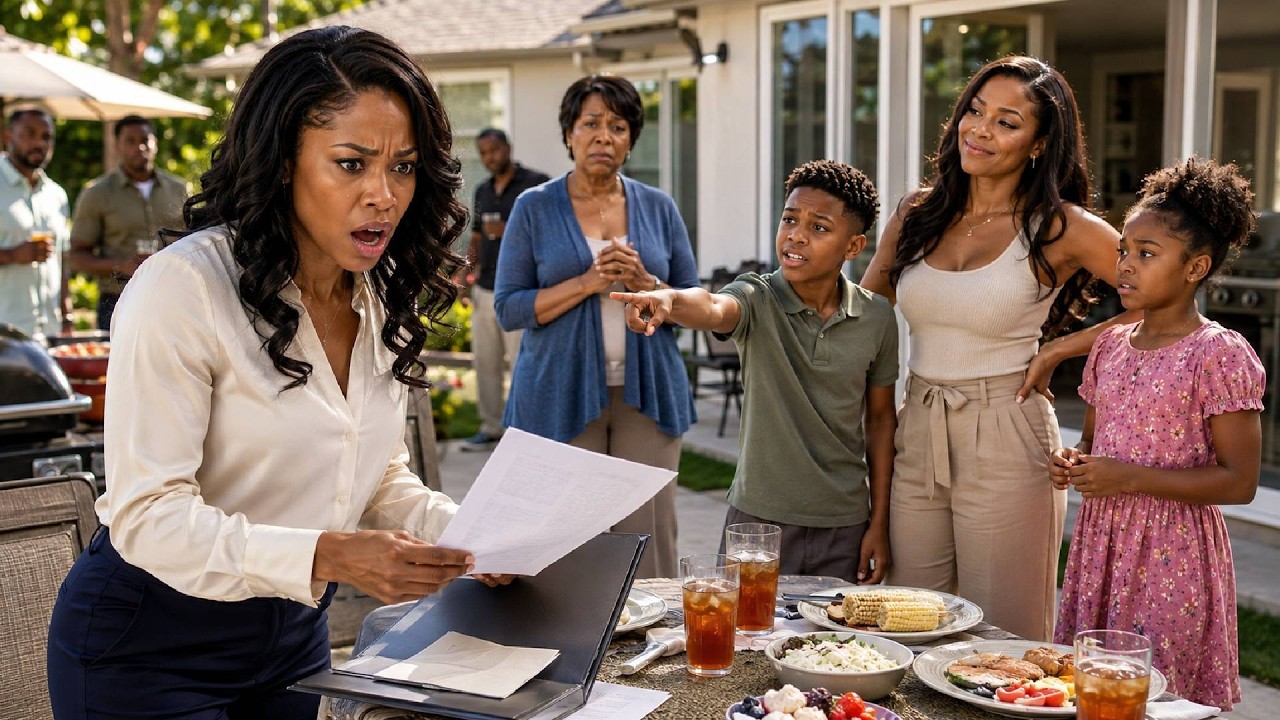
She didn’t even look embarrassed. She smiled and said, “Jean, don’t make this awkward. The kids have always known they’ll inherit this place someday. ”
Every conversation around the backyard stopped.
My eyes drifted to the open property folder on the patio table, where a document I had never seen before was tucked between my mortgage papers. In that moment, I realized this wasn’t an innocent misunderstanding. Someone had been planning my future without me. Saturday’s barbecue had ended almost an hour earlier, but my backyard still looked as if the conversation had been frozen in place.
Paper plates sat on the patio table beside half-empty glasses of iced tea. Someone had forgotten a serving spoon in the potato salad. The property folder was exactly where I’d left it after everyone hurried to pretend nothing uncomfortable had happened. Nothing uncomfortable.
That seemed to be my family’s favorite way of describing moments that quietly rearranged reality. I picked up the folder again. The unfamiliar document was tucked neatly between a copy of my homeowner’s insurance declaration and last year’s property tax statement. It wasn’t notarized.
It wasn’t signed. It was a printout from a real estate website. Across the top, someone had typed in bold letters: “Future Family Home Plan. ” Below it was a rough list.
Primary residence: Jean Hoffman. Future occupants: Ethan Carter, Ava Carter. Long-term plan: remain in the family. No author.
No date. No signature. Just enough to make me wonder whether someone had been rehearsing a story until everyone believed it. I slipped the page into a separate envelope before calling my best friend, Mia Reynolds.
She had been my closest friend since graduate school. While I spent my days designing homes, she had become a real estate attorney. She wasn’t dramatic, which was exactly why I trusted her. She answered on the second ring.
“You don’t usually call on Saturday nights. ”
“I need you to tell me if I’m overreacting. ”
“That sentence almost always means you’re not. ”
I laughed, but only because my body didn’t know what else to do.
I told her everything. My nephew’s comment, Monica’s response, everyone else’s silence, the strange document. Mia didn’t interrupt. When I finished, she asked quietly, “How confident was Monica?
”
“What do you mean? ”
“Did she sound like she was joking, hoping, or certain? ”
I thought about the expression on my sister’s face. There hadn’t been hesitation.
There hadn’t been embarrassment. She had looked at me as if I were the one forgetting an agreement. “Certain,” I finally answered. There was a pause.
“I don’t like that. ”
Neither did I. After we hung up, I couldn’t stop replaying conversations from the past year. At the time, each one had seemed harmless.
Together, they started fitting together like pieces of a picture I hadn’t wanted to see. About eight months earlier, Monica had brought Ethan and Ava over while I was finishing drawings for a client. The kids ran through the house laughing as children should. Monica stopped in my upstairs guest room.
“This would make such a cute bedroom for Ethan. ”
I smiled. “It’s a guest room for now. ”
I remembered thinking the comment was odd.
Then she laughed and changed the subject. Another afternoon, she wandered through my kitchen while I prepared lunch. “You really don’t need four bedrooms. ”
“I like having space.
”
“You could practically raise a family in this house. ”
“I suppose. ”
She shrugged. “Well, somebody probably will.
”
At the time, I’d assumed she meant me. Now, I wasn’t so sure. There were other moments. Every birthday, every holiday, every family dinner seemed different when viewed through this new lens.
Monica often referred to my home as “the family house. ” Not “your house. ” Never “Jean’s house. ” Always “the family house.
”
I had corrected her once. She smiled. “I’m speaking emotionally. ”
I let it go.
Apparently, she hadn’t. Monday morning, I arrived at my architecture firm early. Owning my own company had taken twelve exhausting years. Long nights, weekend site visits, projects that nearly failed before becoming the work clients later admired.
No one had handed me this house. No inheritance, no lucky investment. Every payment had come from drawings, contracts, deadlines, and years of saying yes to work when everyone else was taking vacations. Looking around my office usually filled me with pride.
That morning, it filled me with protectiveness. During lunch, I searched my email. I wasn’t looking for anything specific, just patterns. One message caught my attention.
It had been sent eleven months earlier from Monica Carter. Subject: “Blueprint Question. ” “Hey Jean, the kids are doing a school project about houses. Can you send me the floor plan?
They think your layout is really interesting. Love you. ”
I remembered forwarding a simplified floor plan. Nothing detailed, nothing confidential, just enough to satisfy curious children.
At least that’s what I had believed. An hour later, I found another email. This one came from my mother. Denise Hoffman rarely wrote emails longer than three sentences.
This one said: “I’m glad everything stays in the family eventually. That’s what matters most. ”
I had replied with a heart emoji because I assumed she meant memories. Now, I wasn’t sure what she’d actually meant.
That evening, I met Mia at a small coffee shop downtown. She spread copies of the emails across the table. “I don’t think these prove anyone tried to steal your house,” she said carefully. “I know.
But they do show something else. ”
“What? ”
“A shared assumption. ”
She tapped Monica’s email, then your mother’s.
Then the strange document. “People usually don’t become this comfortable overnight. They repeat an idea until it feels true. ”
I stared out the cafe window.
Cars rolled through the intersection. People hurried home after work. Normal lives. Normal boundaries.
Things that suddenly felt fragile. “I keep asking myself why nobody corrected the kids. ”
Mia answered immediately. “Because somebody had already corrected them in the opposite direction.
”
The words settled heavily between us. She took another sip of coffee, then leaned forward. “Jean, I need to ask you something. ” Her expression had shifted.
This wasn’t casual curiosity anymore. “Has anyone in your family ever had access to your electronic signature, your document portal, or permission to sign something on your behalf? ”
I frowned. “No.
” Then I stopped speaking. A memory surfaced so suddenly it made my stomach tighten. About six months earlier, Monica had called while I was supervising a construction site. She said a delivery company needed confirmation for a furniture order she’d placed.
She couldn’t access the verification link. She’d laughed and said, “Can I just use your e-signature account? It’ll take two minutes. ”
I’d been wearing a hard hat, answering contractors, reviewing structural drawings.
Distracted. Rushed. Trusting. I remembered giving her temporary access.
At the time, it had seemed like helping my sister. Now, sitting across from Mia, I couldn’t remember whether I had changed the password afterward. I slowly looked up. “I think I may have forgotten to revoke her access.
”
Mia didn’t say another word. She simply reached for her notebook and wrote down the date. The moment I got home, I logged into every account connected to my house. Mortgage portal, property tax records, homeowners insurance, county property records, cloud storage, my digital signature account.
Nothing looked unusual at first glance. The deed was still in my name. There were no liens, no transfers, no suspicious loans. For a few minutes, I almost laughed at myself.
Maybe this really had been nothing more than Monica’s imagination getting carried away. Then I opened the activity log for my document account. There were seventeen downloads over the previous eight months. I frowned.
I hadn’t downloaded those files. One by one, I read the names: property survey, warranty deed, insurance declaration, mortgage payoff estimate, floor plan revision, emergency contact form. None of those documents needed to be accessed that often. Certainly not by me.
I exported the activity history before touching anything else. Mia had one rule whenever she dealt with potential legal issues: collect first, react later. So I collected screenshots, download history, login records, backup copies. Only after everything was saved in two different places did I change my passwords.
Every single one. New passwords, new recovery email, multi-factor authentication, security keys. By midnight, every account connected to my home required my phone and my fingerprint. For the first time since the barbecue, I slept for almost six hours.
The next morning, my phone rang while I was driving to a client meeting. Monica. I let it ring twice before answering. “Morning.
”
Her voice sounded unusually cheerful. “Hey, just wondering if you’re home. I was thinking about bringing the kids over after school. ”
“I have meetings all day.
”
“Oh. ” She hesitated. “What time will you be back? ”
“I’m not sure.
”
“I only ask because Ethan left his basketball in your garage. ”
I glanced toward the passenger seat. The basketball she’d mentioned had been sitting in my mudroom for nearly three weeks. She knew that.
“I’ll leave it on the porch sometime this week. ”
Silence. Then she laughed. “You’ve gotten awfully formal.
”
“I’ve gotten busy. ”
“I hope you’re not still upset about Saturday. ”
“I’m thinking. ”
“Thinking about what?
”
“About why everyone seems so comfortable discussing my house as if I weren’t standing there. ”
Her tone softened. “Jean, you’re taking that way too seriously. ”
“Am I?
”
“They’re kids. They repeated something they believed. They misunderstood. ”
“They pointed at you.
”
She didn’t answer immediately. Finally, she sighed. “I don’t want this becoming family drama. ”
Neither did I.
But avoiding drama and ignoring reality weren’t the same thing. “We’ll talk later,” I said. She ended the call without saying goodbye. That afternoon, Mia called.
“I found something. ”
My heartbeat quickened. “What? ”
“I checked something most homeowners never think about.
”
“What is it? ”
“Property information requests. ”
I parked outside my office before answering. “Explain.
”
“In our county, certain public records can be requested online. Most are harmless. Appraisers do it. Contractors do it.
Buyers sometimes do it. ”
“So? ”
“There have been multiple requests tied to your address. ”
“That’s legal.
”
“Yes. But here’s what’s interesting. ” She paused. “Most people request one or two documents.
”
“How many were requested for mine? ”
“Nine. ”
I frowned. “Nine.
”
“Spread over several months. ”
“Can you tell who made them? ”
“Not directly. But they were all made within hours of someone logging into your personal document account.
”
The coincidence felt too precise. “So whoever downloaded my private copies also requested public records. ”
“That’s what it looks like. ”
I rubbed my forehead.
“This still doesn’t prove intent. ”
“No. It proves interest. ”
That evening, I stopped by my parents’ house.
I hadn’t planned to ask questions. I simply wanted to observe. My father, Richard Hoffman, was trimming bushes in the front yard. He smiled.
“Jean. ”
“Hey, Dad. ”
We talked about ordinary things. The weather.
His vegetable garden. A neighbor’s new puppy. Then my mother, Denise Hoffman, came outside carrying iced tea. She hugged me warmly.
“You look tired. ”
“Busy week. ”
She nodded sympathetically. Then, without thinking, she asked, “Did Monica ever get those papers she needed?
”
I looked directly at her. “What papers? ”
She froze for half a second. “Oh, I don’t remember.
You just asked. I probably meant school papers for Ethan. ” She smiled too quickly. “Yes.
”
The conversation drifted elsewhere, but my stomach stayed tight. People accidentally reveal what they’re expecting. They don’t accidentally invent specific paperwork. On my way home, I called Mia.
“I think my mom knows something. ”
“What happened? ”
I told her. She listened carefully.
“Interesting. ”
“You think so? ”
“I think she expected Monica to have documents. ”
“What kind of documents?
”
“That’s exactly the question. ”
The next morning, I received an automated security notification. “New login attempt blocked. Location unavailable.
Device unrecognized. Time: 2:40 a. m. ”
My account had rejected the login because I’d changed the password.
I immediately exported the notification. Then another email arrived. This one contained technical information I’d never noticed before: IP address, device fingerprint, browser version, timestamp. I forwarded everything to Mia.
Ten minutes later, she called. “Jean, you already looked it up. ”
“I did. ”
“And the IP isn’t public.
”
“What does that mean? ”
“It belongs to a residential internet provider. ”
“So? ”
“So I can tell you the general service area.
”
I waited. “It’s on the west side of Charlotte. ”
I slowly sat down. “My parents live on the west side.
”
“I know. ”
“So does Monica. ”
“I know. ”
Neither of us spoke.
The neighborhood covered several square miles, hundreds of homes, thousands of residents. The information wasn’t enough to accuse anyone, but it was enough to erase the comfort I’d been clinging to. Mia finally broke the silence. “Don’t confront anyone.
”
“I’m trying not to. ”
“Because if someone really believes they’re entitled to your house, they’ll make mistakes. ”
“What kind of mistakes? ”
“The kind that happen when people think they’re already winning.
”
I ended the call and stared across my living room. Sunlight poured through the windows I’d spent years saving for. Every room reflected choices I’d made myself. Every wall represented overtime.
Every payment represented sacrifice. For the first time since buying the house, I locked the file cabinet in my home office before going upstairs. As I turned off the lights, my phone vibrated again. A new email from an address I didn’t recognize.
Subject: “Question about the home transfer timeline. ”
I had never seen the sender’s name before. The email sat unopened for almost a minute. I wasn’t afraid of what it said.
I was afraid it would confirm that this had gone far beyond a few careless assumptions. I clicked. The sender introduced herself as Melissa Grant, a local elementary school teacher. She apologized for contacting me unexpectedly.
Then I reached the sentence that made my chest tighten. “I hope you don’t mind me reaching out. Monica mentioned several months ago that your home would eventually become her children’s, and I recently recommended a neighborhood program to Ethan based on that. After Saturday, I realized I may have misunderstood something.
”
I read it again. Not because I hadn’t understood it, but because I couldn’t believe how far the story had traveled. Melissa wasn’t family. She wasn’t even a close friend of Monica’s.
She was simply someone who had believed what she’d been told. I thanked her for reaching out and asked one careful question: “When Monica talked about the house, did she say I had promised it to the children? ”
A few minutes later, she replied. “She said it had always been your plan because you didn’t want children of your own.
She said everyone in the family knew. ”
I closed my laptop. Not because I was angry, but because I needed a minute to absorb the fact that my future had apparently been written by someone else. That evening, I searched through old family group messages.
There were years of birthday wishes, holiday photos, recipes, and reminders about Thanksgiving dinners. Nothing unusual. Then I searched one phrase: “house. ”
Dozens of conversations appeared.
Most had nothing to do with me. One did. Almost eighteen months earlier: “Denise Hoffman: Jean finally found her forever home. ” “Monica Carter: Perfect.
It’ll stay in the family for generations. ” Several relatives reacted with heart emojis. Someone joked that Ethan and Ava would never have to worry about buying a house. At the time, I’d replied with a laughing emoji because I thought everyone was teasing.
Looking back, something else caught my attention. My mother had answered Monica: “That’s always been the hope. ”
Not a joke. Not a correction.
An endorsement. I called my cousin Lauren. If there was one person in our family who never picked sides, it was Lauren. She answered while walking her dog.
“Everything okay? ”
“I need to ask you something strange. ”
“Go ahead. ”
“Have you ever heard anyone say my house would belong to Monica’s kids someday?
”
She didn’t answer immediately. That silence told me more than words could. “You’ve heard it. ”
“I thought everyone had.
”
“What exactly did you hear? ”
Lauren sighed. “Honestly, I thought you and Monica had some private understanding. ”
“We don’t.
”
“I never asked because it wasn’t my business. ”
“Who told you? ”
She hesitated again. “I don’t want to create problems.
”
“The problems already exist. ”
“It was your mom. ”
My grip tightened around the phone. “My mom?
”
“She mentioned it during Aunt Carol’s retirement party last year. ”
“What did she say? ”
Lauren thought for a moment. “Something like, Jean has done well for herself and she’s making sure the next generation is taken care of.
”
“I never said that. ”
“I know that now. ” Lauren sounded genuinely upset. “I feel terrible.
”
“You didn’t do anything wrong. ”
“I should have asked you. ”
“No. The people who started the story should have stopped telling it.
”
After we hung up, I opened my notebook. Until now, I’d been collecting documents. Now, I started building a timeline. Eighteen months ago, my mother publicly suggested the house would stay in the family.
Months later, Monica referred to it as the family house. Then came the blueprint request. Then the repeated document downloads. Then the comments in front of the children.
This hadn’t developed naturally. It had grown one conversation at a time, like a rumor intentionally watered until it looked like truth. The following Sunday, my parents invited everyone over for dinner. Normally, I would have declined.
Instead, I went. I wasn’t ready to confront anyone. I wanted to observe. Dinner felt almost painfully ordinary.
My father grilled steaks. My mother insisted everyone take leftovers home. The children laughed in the backyard. If someone had walked in halfway through the evening, they would have thought we were an ordinary family.
Then Ethan asked an innocent question. “Aunt Jean, when you retire, are you going to move into a condo? ”
Every adult at the table looked at him. Monica smiled.
“I told you not to ask that. ”
“But Mom—”
“It’s okay. ” I interrupted gently. I turned toward Ethan.
“Why do you ask? ”
He shrugged. “So we’ll have enough room. ”
The room became impossibly quiet.
I smiled at him, because none of this was his fault. “What made you think you’d be living in my house? ”
He looked confused. “You and Grandma talked about it.
”
I slowly turned toward my mother. Denise’s face lost its color. She reached for her glass of water. “I don’t remember saying that.
”
Ethan frowned. “Yes, you did. ” Children rarely realize how precise their memories can be. “You said Aunt Jean wouldn’t need such a big house forever.
”
No one spoke. Even Monica looked uncomfortable for the first time. Richard cleared his throat. “Ethan—”
But the boy kept talking.
“You said family shares. ”
He wasn’t accusing anyone. He was repeating what trusted adults had taught him. I looked at my mother.
“I need to ask you something. ”
She avoided my eyes. “Not tonight. ”
“I think tonight is exactly the right time.
”
Monica finally stepped in. “Jean, you’re interrogating everyone over something a child said. ”
“No. ” I kept my voice calm.
“I’m trying to understand why multiple people believe I’ve already made decisions about property I still own. ”
“It’s just an idea. ”
“It stopped being just an idea when children started treating it like a promise. ”
No one argued with that, because they couldn’t.
After dinner ended, my mother followed me to the driveway. The porch light cast long shadows across the concrete. She folded her arms tightly. “I wish you’d let this go.
”
“I wish someone had asked me before making plans for my life. ”
“I never meant any harm. ”
“I believe you. ”
She looked relieved for half a second.
Then I continued. “But harm and intention aren’t always the same thing. ”
She looked away. “I was only trying to help your sister.
”
“By promising her something that wasn’t yours to promise? ”
Her eyes filled with tears. “I thought eventually you’d understand. ”
“I understand more than you think.
”
She swallowed hard. Then, almost in a whisper, she said something I’d been waiting to hear. “Monica didn’t start this. ”
I felt every muscle in my body tense.
“If she didn’t—”
My mother closed her eyes. “Then maybe it’s finally time I told you who did. ”
She didn’t speak right away. She stood in my driveway with her hands wrapped around her elbows, staring at the flower bed I’d planted the first spring after moving in.
I had spent that weekend digging holes for hydrangeas because I wanted something beautiful to greet me every time I came home from work. Funny how homes hold memories you don’t realize are important until someone tries to rewrite them. Finally, she looked at me. “It wasn’t Monica who started talking about the house,” she said quietly.
“It was me. ”
I had prepared myself for a lot of answers. That wasn’t one of them. “You?
”
She nodded. “I never told anyone you’d already promised the house. But I did say I thought it made sense. ”
I waited.
Not because I wanted to make her uncomfortable, but because I’d learned over the past week that silence often revealed more than arguments ever could. She took a slow breath. “When your grandmother was alive, she always said families should keep important things together. ”
“My house isn’t Grandma’s.
”
“I know. ”
“I bought it. ”
“I know. ”
“So why were you telling people it would stay in the family?
”
She pressed her lips together before answering. “Because I thought that’s what would eventually happen. ”
“You didn’t think. You told people.
Those are different things. ”
“A dangerous difference. ”
She lowered her eyes. “Maybe I did.
”
The next afternoon, I met my father for lunch. Richard Hoffman had never been the emotional one. He solved problems by fixing fences, replacing light fixtures, or changing the oil in someone’s car. Feelings made him uncomfortable.
Facts didn’t. I figured facts were my best chance. We sat in a small diner he’d been visiting for years. After our food arrived, I placed a folder beside my plate.
Inside were copies of the emails, the family group messages, Melissa Grant’s email, the activity logs. He flipped through them slowly. By the time he reached the last page, he sighed. “I didn’t know it had gotten this far.
”
“You knew there was something. ”
“I knew your mother worried about Monica. ”
“Worried enough to give away my future? ”
He rubbed his forehead.
“It wasn’t supposed to become that. ”
“What was it supposed to become? ”
He hesitated. “A conversation.
”
I almost laughed. “A conversation that somehow reached neighbors, teachers, cousins, and two children before it reached me. ”
He had no answer. Instead, he admitted something I hadn’t expected.
“Your mother has been afraid for years. ”
“Of what? ”
“That Monica will never recover financially. ”
I leaned back.
My sister had always struggled with money. Not because she was lazy. She worked hard. She had been an elementary school administrative assistant for over a decade.
But she and her husband had made one expensive decision after another. A larger SUV than they could comfortably afford. Private travel sports for Ethan. Multiple credit cards.
A kitchen renovation financed with a home equity loan. Every time they caught up, another emergency seemed to appear. Meanwhile, my life looked stable. I owned a successful architecture firm.
My mortgage was manageable. I had retirement savings, no children, no consumer debt. To my parents, stability had quietly transformed into obligation. Dad looked at me carefully.
“They never wanted to take anything from you. ”
I met his eyes. “Intentions don’t change outcomes. ”
He nodded.
“I know. ”
That evening, Mia came over with takeout. She spread my timeline across the dining room table. “So,” she said, “what did your parents admit?
”
I filled her in. She listened without interrupting. When I finished, she reached for a yellow highlighter. “Look at the pattern.
” She underlined several dates. “First, your mother starts talking. ” She highlighted another line. “Then Monica repeats it.
” Another. “Then extended family accepts it. ” Another. “Then the children are taught it’s true.
”
I looked at the page. “I never realized beliefs can be inherited. ”
“They can. ” She tapped the table.
“Especially when nobody challenges them. ”
Two days later, my phone rang while I was reviewing blueprints with a client. Unknown number. I answered after the meeting ended.
“Is this Jean Hoffman? ”
“Yes. ”
“This is Daniel Brooks from Brookstone Realty. ”
“I think you may have the wrong number.
”
“I hope so. ” His voice sounded cautious. “I’ve been contacted twice regarding your property. ”
My heart skipped.
“What kind of contact? ”
“General questions. ”
“From whom? ”
“I’m not comfortable sharing client information.
”
“I understand. But I can tell you I haven’t listed my house. ”
“I know. ” There was a pause.
“That’s actually why I’m calling. ”
I stopped walking. “The person who contacted us spoke as though a transfer within the family was expected. ”
I closed my eyes.
“What exactly did they ask? ”
“They wanted to know what the estimated resale value might be after title changed ownership. ”
“When? ”
“The first inquiry was about five months ago.
And the second, last week. ”
Last week. The same week as the barbecue. The same week after Monica confidently announced the house would someday belong to her children.
Daniel continued. “I became uncomfortable because they weren’t asking about current ownership. They were asking about future ownership. ”
“Exactly.
”
“Did they identify themselves? ”
“No. But they said everyone involved already understood the arrangement. ”
Arrangement.
I thanked him for calling. Then I sat inside my car for nearly ten minutes without starting the engine. Someone had progressed beyond family conversations. Someone had begun speaking to professionals.
That evening, I called Mia. She listened carefully. “That’s significant. ”
“I thought so too.
”
“It shows expectation. Not legal intent. ”
“No, but expectation often explains behavior. ”
I stared through my windshield.
“I keep asking myself the same question. What made everyone so certain I’d never object? ”
Mia didn’t answer immediately. Instead, she asked a different question.
“Jean, how often have you said yes to your family? ”
I thought about birthdays I’d hosted, loans I’d quietly repaid, repairs I’d paid for without mentioning, college expenses I’d covered for my younger cousins, airport pickups, holiday dinners, emergency babysitting, medical bills. The list kept growing. “I’ve helped a lot.
”
“Yes. ” She spoke gently. “They didn’t wake up one morning believing they were entitled. They learned that saying yes was your default answer.
”
That hurt because it sounded true. Not completely true, but true enough. The following Friday, another piece of the puzzle appeared. I checked my mailbox after work.
Mixed in with utility bills was an oversized envelope from my bank. I hadn’t requested anything. Inside was a routine annual review of my mortgage account. Everything looked normal, until a sticky note slipped onto the kitchen counter.
It wasn’t from the bank. Someone had attached it before the envelope was sealed. Three handwritten words: “Don’t refinance yet. ”
No signature.
No explanation. Just those words. I knew one thing immediately. The bank hadn’t written that note.
Which meant someone had handled my mortgage paperwork before it ever reached me. I picked up my phone and called Mia. “I think we have something much bigger than family gossip. ”
I drove straight to the bank the next morning with the envelope sitting on the passenger seat beside me.
I hadn’t touched the sticky note again. Mia had one rule that was becoming almost a mantra: handle evidence as little as possible. The branch manager, Sandra Collins, welcomed me into a private office after I explained why I was there. “I know this may sound unusual,” I said, placing the envelope on her desk, “but this note wasn’t written by me, and it certainly wasn’t included by the bank.
”
She adjusted her glasses before examining the envelope. “The annual mortgage review is generated automatically,” she explained. “No employee would attach a handwritten note. ”
“That’s what I thought.
”
She turned the envelope over several times, then she frowned. “This wasn’t sealed by us. ”
“What do you mean? ”
She pointed to the flap.
“Our envelopes are machine sealed. This one has been opened and resealed. ”
I stared at it. “You can tell very easily.
” She slid another mortgage envelope from a drawer. The difference was obvious. The original seal ran in one smooth line. Mine had been peeled open and pressed back together.
Someone had opened my mail. Someone had read it. Someone had inserted that note. Sandra looked at me carefully.
“Has anyone else had access to your mailbox? ”
“No. ”
“Do you share a mailbox? ”
“No.
”
“Has anyone ever collected your mail for you? ”
I answered without thinking. “My mother. ”
The words came out before I had time to stop them.
For years, whenever I traveled to inspect construction projects or attend architecture conferences, my parents collected my mail. They had a spare mailbox key. Not because I worried about theft, but because I trusted them. I left the bank and sat in my car.
I didn’t call my mother. I didn’t call Monica. I called Mia. Twenty minutes later, we were sitting in her office.
She carefully photographed the envelope and sticky note before placing them into a clear evidence sleeve. “I still don’t think this proves criminal intent,” she said. “I know. But it absolutely proves your mail was opened.
”
She leaned back. “The question is why. ”
I stared at the handwritten note. “Don’t refinance yet.
”
It wasn’t threatening. It almost sounded helpful. Helpful to whom? Certainly not me.
I had never mentioned refinancing. Not to my family. Not to anyone. Mia tapped the note.
“Think about what refinancing does. It changes the loan. It can also affect equity planning, estate planning, and future borrowing. ”
I frowned.
“So someone wanted me to leave everything exactly as it was. ”
“So they expected your current ownership structure to continue long enough for something. ”
Neither of us finished the sentence. That afternoon, I visited my parents without warning.
Dad wasn’t home. Mom answered the door wearing gardening gloves. “Jean, you should have called. ”
“I was nearby.
”
She smiled. “Come in. ”
Everything looked ordinary. Fresh coffee, family photos, a puzzle spread across the dining room table.
Normal. Almost painfully normal. Then I noticed something hanging beside the key rack. A small brass key.
It looked familiar. Too familiar. Mom noticed me looking. “Oh.
” She took it off the hook. “That’s your spare mailbox key. ”
I blinked. “My what?
”
“You told us years ago to keep it. ”
“I never asked for it back because I never thought about it. ”
She laughed nervously. “I suppose we forgot too.
”
I held out my hand. “Can I have it? ”
She hesitated. Only for a second, but I noticed.
Then she placed it in my palm. “There. ”
I slipped it into my pocket. “Have either you or Dad picked up my mail recently?
”
“No. Not even once. ” She answered too quickly. I changed the subject.
There was no point arguing without proof. On my way out, I passed the family room. Ethan and Ava were sitting on the floor playing a board game. Ethan looked up.
“Hi, Aunt Jean. ”
“Hi. ”
He smiled. “Mom says we’re going to paint our rooms one day.
”
I forced myself to smile back. “What rooms? ”
“The ones upstairs. ”
Before I could answer, Monica walked into the room carrying lemonade.
She looked from Ethan to me. Then she laughed. “He’s talking about a video game. ”
Ethan frowned.
“No, I’m—”
“Sweetie. ” Monica interrupted gently. “Go help your sister. ”
The children left.
Neither of us spoke for several seconds. Finally, I looked at Monica. “You really need to stop. ”
Her smile faded.
“Stop what? ”
“Building a future that isn’t yours. ”
“I haven’t done anything. ”
“You’ve done enough that your children believe they already live here.
”
“They’re children. They’re repeating adults. ”
She crossed her arms. “You know what your problem is?
”
“I’m listening. ”
“You always assume the worst. ”
I almost answered. Instead, I simply walked out.
Arguing with someone invested in a story rarely changes the ending. Evidence does. That evening, Mia called. “I’ve been thinking.
”
“Dangerous. ”
She laughed. “Very. ” Then her voice became serious.
“I don’t think the house itself is the whole goal anymore. ”
“What do you mean? ”
“I think your family believes your entire estate will eventually flow to Monica’s children. ”
I sat upright.
“My estate? ”
“House, retirement, investments, business assets. ”
I hadn’t considered that the house was simply the most visible piece. If someone had convinced themselves that I would never marry or have children, then perhaps they’d quietly built an entire future around inheriting everything.
The realization left me colder than anything we’d uncovered so far. The next morning, I scheduled appointments with my estate planning attorney, my financial adviser, and my CPA. Not because anyone had a legal claim. They didn’t.
But because assumptions have a way of growing when nobody clearly defines reality. By noon, every beneficiary designation connected to my accounts had been reviewed. Emergency contacts were updated. Digital access permissions were revoked.
My mailbox lock was scheduled for replacement. And my attorney began drafting a revocable living trust that reflected my wishes and only my wishes. Late that afternoon, as I returned from the hardware store with a new mailbox lock, my phone buzzed. It was a text from an unfamiliar number.
There was no greeting, no signature, only one sentence: “You should have talked to your family before changing everything. ”
I read it three times. No one outside a very small circle knew I had spent the day updating my legal documents. Somehow, someone already did.
I didn’t reply to the text. I took a screenshot, forwarded it to Mia, and deleted nothing. Three minutes later, she called. “Unknown number?
”
“Yes. ”
“Any idea who it belongs to? ”
“Not yet. ”
“What exactly changed today besides your estate documents?
”
I thought through my entire day. My mailbox lock. My passwords. My trust.
My beneficiary designations. “And who knew all of that? ” I paused. “You, me, my estate attorney, my financial adviser, my CPA.
” I paused again. “And my parents knew I took back the mailbox key. ”
Mia was quiet. “Jean, I think it’s time.
”
“Time for what? ”
“To stop wondering who’s leaking information and find out. ”
“I don’t want to accuse the wrong person. ”
“You won’t.
” She sounded almost confident. “We’re going to let the truth identify itself. ”
Two days later, we met in Mia’s office. She drew three circles on a legal pad.
“Mom, Dad, Monica. We’re going to give each of them different information. ”
I smiled faintly. “A loyalty test.
”
“A truth test. ”
She wrote three separate notes. The first was simple. To my mother, I would mention that I was considering renting out the house for a year while taking on a large commercial project in another state.
To my father, I would casually say I was thinking about selling the house to a young couple from my church. To Monica, I would tell her I was meeting with an architect about adding a detached guest cottage to the property. Only one story would reach the rest of the family. And whichever story spread would identify the source.
“I hate that we’re doing this. ”
“I know. But you’re not creating dishonesty. We’re measuring it.
”
The opportunities came naturally. That Friday, I stopped by my parents’ house to drop off tomatoes from my garden. Dad was in the garage. I handed him the basket.
“I’ve been thinking about the house. ”
He nodded. “I might sell it. ”
His eyebrows lifted.
“Oh? ”
“A young couple from church is looking for their first home. ”
He smiled. “They’d be lucky.
”
“I haven’t decided. ”
“Take your time. ”
That was all. Nothing dramatic.
No emotional speeches. Just one sentence planted carefully. The next afternoon, I helped my mother organize old photo albums. While we worked, I mentioned something different.
“My company may send me to Seattle for almost a year. ”
She looked surprised. “Really? ”
“I’m considering renting the house while I’m gone.
”
She stopped turning pages. “Renting it? ”
“It seems practical. ”
She didn’t answer for several seconds.
Then she forced a smile. “I suppose that makes sense. ”
But her expression never relaxed. On Sunday afternoon, Monica called.
After a few minutes of ordinary conversation, I mentioned the third story. “I’m thinking about adding a guest cottage behind the house. ”
“For what? ”
“Maybe future guests.
Or office space. ”
She laughed. “That’s a waste. ”
“I don’t think so.
”
“You already have plenty of room. ”
“I like options. ”
She changed the subject almost immediately. Exactly as Mia predicted.
People trying to hide information rarely ask many follow-up questions. Then we waited. Monday passed quietly. Tuesday was normal.
Wednesday afternoon, my cousin Lauren called. Her voice sounded hesitant. “I don’t know if I should be asking this. ”
“Asking what?
”
“Are you really selling your house? ”
I sat down. “No. ”
“Oh.
” She exhaled. “I thought it sounded strange. ”
“Who told you? ”
She answered without hesitation.
“Your dad. ”
Interesting. Very interesting. “He said you’d been talking to a couple from church.
”
“I see. ”
After we hung up, I wrote one word beside Dad’s name: “Confirmed. ”
An hour later, Aunt Carol texted me. “Seattle sounds exciting.
”
I stared at the screen. Another note. “Mom confirmed. ”
Two stories.
Two different leaks. Neither one surprised me. But neither explained the anonymous text. That still left Monica.
Friday morning, Mia called. “You need to sit down. I’m driving. Pull over.
”
Something in her voice made me do exactly that. “What happened? ”
“I just received a call from someone I know at the county planning office. ”
My stomach tightened.
“A woman called asking general questions about adding a guest house to your property. ”
I closed my eyes. “When? ”
“Yesterday.
”
“Did she identify herself? ”
“No. But she specifically mentioned your address. ”
I already knew.
Even before Mia said it. Only Monica had heard that story. No one else. The silence between us lasted several seconds.
Finally, Mia spoke. “Now we know. ”
I nodded even though she couldn’t see me. “My father repeated the sale story.
Your mother repeated the rental story. And Monica acted on the guest house story. ”
“Exactly. ”
“None of them kept my confidence.
Not one. ”
That evening, I sat alone on my back patio, the same patio where this entire nightmare had begun. The sun was setting behind the maple trees. For the first time in weeks, I wasn’t confused.
I wasn’t guessing. I wasn’t trying to connect invisible dots. I had proof. Not proof that anyone had committed fraud.
Not proof that anyone had legal rights to my home. But proof that every private conversation I’d trusted my family with had become public property. The betrayal wasn’t one dramatic event. It was hundreds of small choices repeated over months, maybe years.
My phone vibrated. It was Mia. “I’ve been thinking about the next step. ”
“So have I.
”
“You could confront them. ”
“I could. ”
“But if you do, they’ll deny everything. ”
“I know.
”
She paused. “I think it’s time to put every document you’ve collected on the table. All of them. Every email, every timeline, every login, every text, every witness.
”
I looked through the windows of the house I had worked so hard to build. Then I answered quietly. “Invite everyone. ”
“For what?
”
“For one final family dinner. ”
I sent the invitation on Tuesday morning. No dramatic wording, no hint that anything was wrong, just a simple group message: “Dinner at my house this Saturday at 6. I’d like everyone to come.
We haven’t all been together in a while. ”
Within an hour, everyone had replied. My parents said yes. Monica said she would bring Ethan and Ava.
Even my cousin Lauren planned to stop by for dessert. Looking at the responses, I realized something. They all thought they were walking into an ordinary family dinner. Only Mia and I knew it would be something else entirely.
Saturday arrived with unusually clear skies. I spent the morning cooking because routine helped calm my nerves. Roasted chicken, garlic mashed potatoes, green beans, fresh bread. The menu wasn’t important.
Normality was. I didn’t want anyone walking through my front door feeling ambushed. Everything about the evening would begin as it always had. The evidence, not my emotions, would change the atmosphere.
At 5:30, Mia arrived carrying a small leather portfolio. “You sure about this? ” she asked. “No.
” She smiled. “Good. People who are too sure usually stop listening. ”
She placed the portfolio inside my home office.
“We only use these if we need them. ”
“I understand. ”
“No speeches. No accusations.
Just questions. ”
I nodded. That had become our strategy weeks earlier. Questions invited explanations.
Evidence exposed contradictions. By 6:15, everyone had arrived. The children ran to the backyard. Dad complimented the smell of dinner.
Mom offered to help set the table. Monica walked through my kitchen as comfortably as if she lived there. Normally, I wouldn’t have noticed. This time, I did.
She opened cabinets without asking. She knew where the serving bowls were. She reached for placemats she had never bought. Small habits.
Small assumptions. When everyone sat down, conversations stayed pleasantly ordinary. Lauren talked about her new job. Dad complained about the rising cost of groceries.
The children argued over dessert before they’d even finished dinner. For nearly forty-five minutes, I said nothing about the house. Then Ethan smiled at me. “Aunt Jean, your garden looks even better now.
”
“Thank you. ”
“Mom said maybe next spring we’ll plant tomatoes here. ”
Monica’s fork stopped halfway to her mouth. She knew.
She knew exactly where this conversation was heading. I smiled gently at Ethan. “That’s thoughtful. ” Then I looked around the table.
“I actually wanted to talk to everyone about something tonight. ”
The room became quiet. I stood, walked into my office, and returned with one thin folder. Not the thick binder Mia had prepared.
Just one folder. I laid it on the table. “I’ve spent the last few weeks trying to understand something. ”
No one interrupted.
“I wanted to know why so many people believe decisions had already been made about my home. ”
Mom lowered her eyes. Dad folded his hands. Monica leaned back in her chair.
“I’d like to ask a few questions. ” I turned to Monica first. “When Ethan said this house would belong to him someday, where do you think he learned that? ”
She shrugged.
“Kids imagine things. ”
“Ethan told me you said it. ”
“He misunderstood. ”
I opened the folder and removed a printed email.
“This is from Melissa Grant. ” I slid it across the table. Monica glanced at it but didn’t pick it up. “She wrote that you told her I’d already decided my home would eventually belong to your children.
”
Monica’s expression tightened. “I don’t remember saying that. ”
Melissa’s email wasn’t proof of ownership. It was proof of a story.
A story Monica had repeated often enough that people outside our family believed it. I turned toward my mother. “Mom. ”
She looked exhausted.
“Did you ever tell relatives my house would stay in the family? ”
She hesitated. Then she nodded. “Yes.
”
Monica’s head snapped toward her. “Mom—”
Denise raised one hand. “No. ” She looked at me instead.
“I did. ”
The room stayed silent. “I thought I was helping. ”
“You never asked me.
”
“I know. ”
“I never gave you permission to speak for me. ”
“I know. ” Her voice cracked.
“I know. ”
Dad finally spoke. “Jean, none of us meant to hurt you. ”
I looked at him calmly.
“I believe that. ” Everyone seemed surprised by my answer. “I don’t think anyone here woke up wanting to take my house. ”
Relief briefly crossed Monica’s face.
Then I continued. “But intention isn’t the same thing as entitlement. ”
I reached into the folder again. This time I removed three sheets of paper.
“They’re all different. ” I handed one to Dad, one to Mom, one to Monica. “You probably recognize these conversations. ”
Each page contained a summary of the information I had privately shared with them.
Nothing more. Dad frowned first. “The young couple from church. ”
Mom whispered.
“The Seattle project. ”
Monica stared at hers. “The guest cottage. ”
Lauren looked confused.
“What are those? ”
I answered. “Three conversations. ” I let the silence stretch.
“Three private conversations. ” Then I looked at each of them. “I told each of you something different. ”
No one moved.
“I wanted to know whether I could trust my own family. ”
Dad’s shoulders dropped. Monica slowly put her paper on the table. Mom closed her eyes.
Lauren looked from one person to another. “What are you saying? ”
“I’m saying every single private conversation became public. ” I turned toward Dad.
“You told relatives I was selling the house. ”
He looked ashamed. “I mentioned it. ”
“You repeated something I asked you to keep between us.
”
He nodded. “I did. ”
I looked at Mom. “You told Aunt Carol I was moving to Seattle.
”
Tears filled her eyes. “I shouldn’t have. ”
Finally, I faced Monica. “You contacted the county planning office about adding a guest house.
”
She looked genuinely startled. “How did you—” Then she stopped speaking. She had answered without realizing it. Mia quietly stepped forward for the first time that evening.
She hadn’t spoken all night. Now she placed one final document on the table. A timeline. Dates, emails, public records requests, login attempts, the anonymous text.
Nothing exaggerated. Nothing speculative. Only facts. Monica stared at the pages for several long seconds.
Then she slowly looked up at me. “I honestly thought eventually you’d want the kids to have everything. ”
I shook my head. “You didn’t think.
You assumed. ”
“No. ” She whispered. “I was told.
”
Every eye in the room turned toward my parents. Dad looked devastated. Mom quietly covered her face. For the first time since this began, no one argued.
No one blamed. No one tried to change the subject. Because the evidence had done what anger never could. It had forced everyone to see the same truth.
I folded my hands on the table. “I’ve made one final decision. ” Every person in the room looked at me. “I’d like all of you to hear it before anyone speaks.
”
No one spoke. The only sounds in the room were the quiet hum of the refrigerator and the laughter of Ava drifting in from the backyard, where she was still chasing fireflies, completely unaware that the adults inside were confronting years of assumptions. I looked around the table. My father hadn’t lifted his eyes from the timeline Mia had placed in front of him.
My mother was twisting a napkin between her fingers until it almost tore. Monica sat perfectly still, her confident expression gone for the first time since this all began. I took a slow breath. “I’ve already completed my estate planning.
”
Monica’s eyes widened. “So that’s it? That’s what you’ve already decided? ”
“Yes.
”
She leaned forward. “You changed everything without even talking to us. ”
I couldn’t help noticing the irony. “I did exactly what none of you did.
” The room fell silent again. “I made decisions about my own property. ” I paused. “No one had an answer for that.
I didn’t make decisions about yours. ”
Dad finally cleared his throat. “Jean, can we at least understand why? ”
I met his eyes.
“You deserve an explanation. ” I wasn’t saying that because they were entitled to one. I was saying it because I wanted this conversation to end without anyone claiming they had been shut out. “I spent weeks asking myself whether I was imagining things.
” I looked at Monica. “I hoped you had simply misspoken. ” Then at my mother. “I hoped people had misunderstood you.
” Then at my father. “I hoped everyone had filled in the blanks on their own. ” I shook my head. “But every answer led to another piece of evidence.
”
I pointed to the timeline. “No one tried to steal my house. ”
They all looked relieved. “But something else happened.
” I paused. “You slowly erased my right to make my own decisions. ”
No one interrupted. “When children are told something often enough, they believe it.
When relatives hear the same story from multiple people, they stop questioning it. When assumptions go unchallenged for years, they begin to feel like promises. ”
I looked at Monica. “Your children didn’t disappoint me tonight.
”
She frowned. “They trusted the adults in their lives. They repeated what they were taught. My disappointment is with us.
”
Monica stared at the table for a long time. When she finally spoke, her voice sounded smaller than I’d ever heard it. “I never thought of it that way. ”
“I know.
”
“I really believed—” She stopped. “What? ”
“That because you never wanted children—”
“I never said that. ”
“I know.
You assumed it because I wasn’t married. ”
She slowly nodded. “I guess I did. ”
“And because I had more than you.
”
Another nod. “I suppose. ”
“Neither of those things gave anyone permission to plan my future. ”
She covered her face with both hands.
“I can see that now. ”
Then something happened that surprised all of us. Ethan walked into the dining room carrying two empty lemonade glasses. He looked around at the quiet adults.
“Did I interrupt? ”
“No,” I said softly. He walked toward the sink, then he hesitated. “Aunt Jean?
”
“Yes? ”
“I need to tell you something. ”
Monica looked up immediately. “Ethan—”
“It’s okay, Mom.
” He turned back to me. “I shouldn’t have said the house was ours. ”
“You didn’t do anything wrong. ”
“I did.
” His voice cracked slightly. “I made you sad. ”
I stood and walked over to him. “No.
” I knelt so we were at eye level. “You repeated something people you trusted told you. ”
He looked down. “I still should have asked.
”
I smiled. “That’s actually a very grown-up lesson. ”
He nodded slowly. “Can I ask now?
”
“You can ask me anything. ”
He hesitated. “Will this always be your house? ”
I answered honestly.
“As long as I want it to be. ”
He thought about that for a moment. Then he smiled. “That makes sense.
”
It was such a simple sentence, yet it carried more wisdom than weeks of conversations between adults. After the children went back outside, Monica quietly wiped her eyes. “I owe them an apology. ”
“Yes.
”
“I made them believe something that wasn’t true. ”
“Yes. ”
“I wanted them to feel secure. ”
“I understand.
”
“But security built on someone else’s choices doesn’t last. ”
She nodded. “I know. I’ll tell them.
”
“I hope you do. ”
Over the following weeks, I made changes that weren’t emotional. They were practical. My parents returned every spare key they still had.
The garage keypad code was changed. Only Mia remained listed as my emergency property contact. Family visits became invitations instead of assumptions. No one stopped by unannounced.
No one borrowed keys. No one referred to my home as “the family house. ” It became Jean’s house. A small change in language.
A massive change in respect. About six weeks later, Monica called. “Would you have dinner with me? Just us?
”
“Yes. ”
We met at a quiet Italian restaurant halfway between our neighborhoods. There were no lawyers, no evidence folders, no accusations. Just two sisters.
“I’ve started meeting with a financial counselor,” she said. I smiled. “That’s good. ”
“I sold the SUV.
”
I nodded. “We couldn’t afford it. ” She looked embarrassed. “I guess I spent years believing someone would eventually rescue us.
”
“You don’t need rescuing. ”
“I needed responsibility. ” She laughed softly through her tears. “I wish I’d figured that out sooner.
”
“So do I. ”
Then she reached across the table. “I’m sorry, Jean. ”
This time, it wasn’t followed by an explanation, or an excuse, or a reminder about the children.
Just an apology. For the first time, I believed it. Three months after our family dinner, I received a handwritten card in the mail. It wasn’t from Monica.
It was from Ethan. Inside, in careful handwriting, he had written: “Thank you for telling me the truth kindly. Mom says grown-ups can be wrong too. I still like coming to your house because you’re my aunt, not because of your house.
”
I read those words twice before putting the card in my desk drawer. Not because it erased what had happened, but because it reminded me what honesty could repair. Then later that evening, another envelope arrived. The return address belonged to my mother.
I recognized her handwriting immediately. Unlike the birthday cards and holiday notes she’d sent for years, this envelope felt unusually heavy. When I opened it, I found a four-page handwritten letter. The first sentence stopped me before I reached the second.
“I’ve spent weeks trying to understand the difference between loving one daughter and expecting too much from the other. ”
I made myself a cup of tea before opening my mother’s letter again. The first time I had read it, I was too surprised to absorb much beyond the opening sentence. The second time, I slowed down.
Every page was written in her careful cursive, the same handwriting that had filled birthday cards, permission slips, and lunchbox notes when I was growing up. There were no dramatic declarations, no attempts to justify what had happened, no requests for immediate forgiveness. Instead, she described something I had never fully considered. “When you were young,” she wrote, “you were always the child who figured things out.
If your bicycle chain came off, you fixed it. If you forgot your homework, you accepted the consequence instead of asking someone to rescue you. I became so used to believing you would always be okay that I slowly stopped asking whether something was fair. ”
I sat quietly for a long time.
That sentence didn’t excuse anything, but it explained more than months of arguments ever had. She continued. “I wasn’t choosing Monica because I loved her more. I was choosing the child I thought needed more help.
Somewhere along the way, I convinced myself that your strength meant you needed less protection. Looking back, I see how deeply unfair that was. ”
My eyes lingered on those words. Strength had become the reason people expected sacrifice.
Competence had become permission to ask for more. Success had become something that belonged to everyone except the person who earned it. That wasn’t love. It was imbalance.
Near the end of the letter, my mother wrote something else. “I understand if you never trust me with your keys again. I understand if you never ask me to collect your mail. I understand if there are parts of your life that I no longer have access to.
I hope one day we can rebuild a relationship. I no longer expect to rebuild the same level of access. ”
That distinction mattered. She wasn’t asking for things to return to the way they had been.
She was acknowledging that trust, once broken, doesn’t automatically return simply because someone apologizes. A week later, I invited my parents to meet me at a botanical garden. Not my house. Not theirs.
A neutral place. Somewhere peaceful. We spent the first half hour talking about flowers, grandchildren, and the weather. No one mentioned the letter.
Finally, my mother stopped walking. “I wasn’t sure you’d come. ”
“I almost didn’t. ”
“I would have understood.
”
“I know. ”
She looked at me with tears in her eyes. “I don’t expect you to forget. ”
“I won’t.
”
“I don’t expect everything to go back. ”
“It won’t. ”
She nodded. “I just wanted you to know that I finally understand the difference between helping one child and taking from another.
”
I believed she meant it. Not because of the letter, not because she cried, but because she wasn’t asking me to make her feel better. She was accepting the consequences of her own choices. Dad spoke next.
“I should have said something much sooner. ”
“You should have. ”
“I kept telling myself it wasn’t my place. ”
I smiled sadly.
“It was exactly your place. ”
He nodded. “I know that now. ”
Monica and I rebuilt our relationship much more slowly.
There were no dramatic reconciliations, no promises that we’d suddenly become inseparable. Instead, we started with small things. Coffee once a month. Birthday dinners.
Meeting at parks so the kids could play. She never asked for a key to my house again. She never referred to it as anything except Jean’s home. And whenever Ethan or Ava visited, they knocked on the front door, even though I had told them they didn’t have to.
One afternoon, I asked Ethan why. He shrugged. “My mom says respecting someone’s house starts before you walk inside. ”
I smiled.
“She’s right. ”
It was a small lesson, but it told me she really had changed. Several months later, my estate planning attorney called to let me know that everything was finalized. My revocable living trust.
My healthcare directives. My financial powers of attorney. Every document reflected my own wishes. No assumptions.
No expectations. No unwritten family agreements. Only decisions I had made for myself. When I placed the signed binder in my office safe, I felt something I hadn’t experienced since this all began.
Not victory. Peace. Because the goal had never been to punish my family. The goal had been to make sure my life belonged to me again.
Sometimes people ask whether I forgave them. The answer is yes. But forgiveness didn’t look the way many people imagine. Forgiveness wasn’t pretending nothing happened.
It wasn’t handing back spare keys. It wasn’t removing the boundaries that had finally made me feel safe. Forgiveness meant I stopped carrying anger everywhere I went. Boundaries meant I stopped giving other people control over decisions that were never theirs to make.
Those two things can exist together. In fact, for me, they had to. Today, when my family visits, they come because they’re invited. Not because they assume.
Not because they expect. And certainly not because they believe my home belongs to anyone but me. Ironically, once those expectations disappeared, our conversations became easier, lighter, more honest. Because no one was quietly negotiating my future behind my back anymore.
The house never changed. The people inside it did. And that made all the difference.