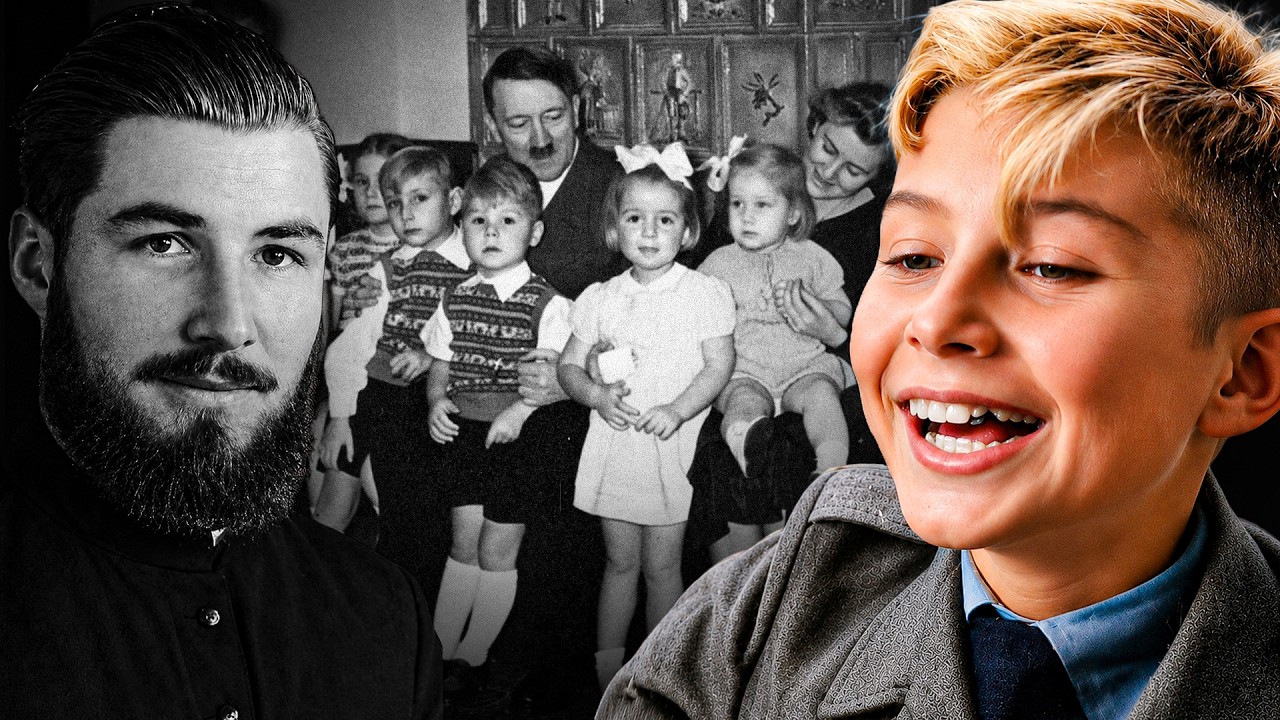
The Tragic Fate of Martin Bormann’s Wife and Children After World War II
The baby at the baptismal font had been given a name that was supposed to guarantee his place inside the most powerful circle in Germany.
Adolf Martin Bormann.
And standing behind the child as his godfather was Adolf Hitler.
Within fifteen years, Hitler would be dead, the Third Reich would be rubble, the boy’s father would be wanted as one of the most important Nazi criminals in Europe, and the family that had once lived behind guarded gates in Hitler’s mountain kingdom would be scattered under false names.
But the strangest part came later.
The boy whom his family nicknamed “Krönzi” — from Kronprinz, “Crown Prince” — would eventually kneel before a Catholic bishop and be ordained a priest.
Then he would disappear into the Congo as a missionary.
Then he would leave the priesthood and marry a former nun.
Then, decades after the war, science would finally settle the mystery of what happened to his fugitive father.
And just when Martin Bormann Jr. seemed to have spent a lifetime constructing a story about conscience, reconciliation and escaping the shadow of his name, another accusation emerged from his own past.
It was the kind of family history in which every apparent ending opened another door.
And it began in a place designed to feel untouchable.
High above Berchtesgaden in southern Germany, the Obersalzberg was not simply a beautiful Alpine retreat. During the Nazi era it became a sealed world of privilege and power surrounding Hitler’s Berghof.
Senior Nazi officials had homes there. SS guards controlled access. Political decisions that affected millions of lives were made only a short distance from gardens where the children of the regime’s elite played.
Martin and Gerda Bormann raised their family inside this extraordinary bubble. The Obersalzberg historical documentation describes the children of men such as Bormann and Albert Speer growing up in immediate proximity to the Nazi leadership, regularly entering the private orbit around Hitler’s residence. (Dokumentation Obersalzberg)
To a small boy, however, none of that necessarily looked sinister.
It looked like home.
His father, Martin Bormann Sr., was becoming one of the most powerful men in Hitler’s system. He eventually headed the Nazi Party Chancellery and became Hitler’s secretary, controlling access, paperwork and enormous portions of the machinery surrounding the dictator. The U.S. Holocaust Memorial Museum notes Bormann’s involvement in policies including forced labor and the persecution and deportation of Jews. (Bách Khoa Toàn Thư Holocaust)
His son knew another version of him.
A father who occasionally came home.
A powerful man whom everybody obeyed.
A man close enough to Hitler that Hitler himself became the boy’s godfather.
The nickname “Krönzi” was almost too perfect.
Crown Prince.
At Christmas in 1939, according to Martin Jr.’s later recollections, Hitler gave his godson toy soldiers and a model anti-aircraft gun. The next year, at ten, Martin entered the Nazi Party’s elite school at Feldafing near Lake Starnberg. There, political indoctrination was not an extracurricular activity. It was part of the world in which the children were formed. (Spectator Archive)
There was another irony that would matter much later.
Christianity had little place in the ideological education his father wanted for him.
Martin Jr. later recalled that his father instructed his educators to make him a proper National Socialist. At his elite school, religion was replaced by an ideological curriculum, alongside demanding physical training and political instruction. (Tag des Herrn)
The son did not rebel.
Not then.
He believed.
That is essential to understanding what happened next.
When the Nazi system collapsed, Martin Bormann Jr. was not a secret dissident waiting to be liberated. He was fifteen years old and emotionally invested in the world that was disappearing around him.
In the spring of 1945, boys his age were being drawn into the Reich’s final desperate defensive efforts. Martin later remembered digging trenches and receiving instruction connected with anti-tank weapons before his school disintegrated as Germany collapsed. (Tag des Herrn)
Then came the message that Hitler was dead.
Years later, Martin remembered it as something close to the end of the world.
For the adults around him, it was not merely the death of a political leader. Their careers, identities, beliefs and futures had been constructed around the Führer.
For Martin, it was worse in one particular way.
His father was in Berlin.
And no one could tell him whether Martin Bormann Sr. was alive.
The boy who had grown up inside one of the most protected environments in Germany was suddenly on his own.
Meanwhile, hundreds of kilometers away, Gerda Bormann was facing a catastrophe of her own.
She should not be remembered merely as an innocent wife swept unwillingly into her husband’s politics. Historical records portray Gerda as a committed National Socialist in her own right. She came from a deeply Nazi family, embraced the ideology, and even discussed radical ideas about restructuring marriage and reproduction according to racial concepts. (LEO-BW)
But ideology did not protect her when the regime collapsed.
On April 25, 1945, Allied aircraft struck the Obersalzberg. The Bormann family residence and Hitler’s Berghof were destroyed in the bombing, while Gerda and the children survived inside the extensive shelter system.
The following day, she fled south with the children.
The family that had lived inside guarded Nazi privilege now traveled toward South Tyrol under another identity.
The reversal was almost grotesque.
Months earlier, the surname Bormann had opened doors.
Now it could bring interrogation, arrest or worse.
Shortly after reaching northern Italy, Gerda developed severe abdominal bleeding.
Doctors treated her first in Bolzano and later in Merano. She eventually revealed who she was. Historical research preserved by the Baden-Württemberg state biography portal says she had abdominal cancer; British occupation authorities did not permit the planned transfer to Munich for an operation. The same source states that her death on March 23, 1946, resulted not directly from the cancer but from mercury poisoning associated with her treatment. (LEO-BW)
She was thirty-six.
Her husband had disappeared.
Her political world was gone.
Her children were about to lose the final center holding their family together.
And her eldest son was not at her bedside.
He did not even know she was dead.
While Gerda was deteriorating, Martin had been wandering through the Salzburg region under a false identity.
He called himself Martin Bergmann.
For a teenager who had grown up with guards, servants, elite schooling and one of the most notorious surnames in Europe, survival now depended on convincing ordinary people that he was nobody.
Eventually a mountain farmer took him in.
That household changed him in a way armies and tribunals could not.
Martin later said the farmer’s Christian life made an impression on him. There was no grand debate, no dramatic ideological showdown.
Instead, the boy who had been taught to see National Socialism as the center of existence encountered another moral structure through daily life.
Work.
Meals.
Prayer.
Ordinary kindness.
And newspapers.
The newspapers were dangerous.
Every article about the liberation of concentration camps threatened to tear apart everything he had been taught.
Martin read accounts of Nazi crimes while hiding his identity from the people around him. According to an account of his later public testimony, he followed reports about the Nuremberg proceedings privately because his emotional reaction might expose who he really was. (Tag des Herrn)
Imagine the psychological collision.
For most readers, “Martin Bormann” was the name of a missing Nazi leader.
For the fifteen-year-old holding the newspaper, it meant Father.
The documents appearing at Nuremberg told a story radically different from the domestic memories of the man he had known.
The International Military Tribunal ultimately found Martin Bormann Sr. guilty of war crimes and crimes against humanity and sentenced him to death by hanging in absentia. The tribunal did not know with certainty that he was already dead. (Bảo Tàng Nuremberg)
Martin Jr. was therefore trapped inside an extraordinary uncertainty.
Perhaps his father had died in Berlin.
Perhaps he had escaped.
Perhaps he could appear again one day.
For years, no one could prove which was true.
Then came another newspaper story.
His mother was dead.
Martin later said that he learned the news only after reading it in the press.
There was no final conversation.
No bedside farewell.
No family gathering.
One moment he was hiding as “Martin Bergmann.”
The next, he understood that he was essentially an orphan carrying one of postwar Europe’s most infamous names.
His younger brothers and sisters were also facing a future no one in their family could have imagined.
Martin and Gerda Bormann had ten children, although one twin daughter had died shortly after birth. Their youngest son, Volker, also died in 1946. After Gerda’s death, a Catholic priest, Theodor Schmitz, whom she had designated as guardian, helped arrange foster placements for the surviving children. Most eventually entered the Catholic faith. (Wikipedia)
Think about that reversal.
These were children whose names themselves reflected the Nazi hierarchy.
One son had been named after Hitler.
Another had originally carried Rudolf Hess’s name.
Another had been named after Heinrich Himmler.
Now the regime was gone, the godfathers had fallen, their father was condemned at Nuremberg, and the Bormann children were being placed with ordinary families.
The “Crown Prince” no longer had a kingdom.
And then he made a choice his father would almost certainly never have imagined.
Martin Bormann Jr. became a Catholic.
On May 4, 1947, after receiving instruction at Maria Kirchental, he was baptized. He later described his encounter with Christianity as providing a new spiritual home during a period when everything he had previously believed had collapsed. (PRO | Das christliche Medienmagazin)
But even baptism could not erase his name.
Eventually his identity was discovered.
The fugitive teenager was taken into custody and interrogated.
The frightening irony was unmistakable: authorities searching for information about Martin Bormann had found Martin Bormann.
Just not the one they wanted.
The father was still missing.
The son was eventually released.
And instead of running from the Church after the interrogation, he went deeper into it.
He completed his education.
Studied theology.
Joined the Missionaries of the Sacred Heart.
And on July 26, 1958, Adolf Hitler’s godson was ordained a Roman Catholic priest.
There are historical transformations that sound invented because reality has arranged the symbolism too perfectly.
This was one of them.
The child specifically raised to become a loyal National Socialist now stood at an altar.
The boy whose education had been designed to keep Christianity at a distance wore clerical vestments.
The “Crown Prince” had become Father Martin.
But he was not finished running from the shadow.
In 1961 he went to the Congo as a missionary, entering a country experiencing the violent upheaval that followed independence.
Perhaps distance mattered.
Germany was full of reminders.
In Africa, “Bormann” did not necessarily enter every room before he did.
Yet history followed him there too.
The Congo was descending into crisis, rebellions and competing armed movements. By 1964, the Simba rebellion made missionary work extraordinarily dangerous. Contemporary and later accounts record that Bormann and other missionaries became caught in the violence; he eventually returned to Europe and later went back to the Congo for another period. (ResearchGate)
The symmetry was disturbing.
His childhood had been protected by armed men serving a dictatorship.
His adulthood as a missionary placed him among people endangered by armed revolution.
And still, his father remained a ghost.
Back in Germany, rumors about Martin Bormann Sr. had become almost a postwar industry.
He had escaped to Argentina.
He had reached South America with Nazi treasure.
He was living under another name.
He was being protected.
He had survived.
Books, newspaper investigations and alleged sightings kept the mystery alive for decades.
For the son, those stories were not simply historical speculation.
They meant that any unexpected knock could theoretically be his father.
Imagine converting to the religion your father despised while wondering whether he might still be alive somewhere to discover what you had done.
Martin himself later acknowledged the emotional contradiction he never entirely solved.
He condemned his father’s actions.
But he could not pretend that the condemned Nazi leader had ceased to be his father.
In interviews he would make an uncomfortable distinction: the private father in his childhood memories and the political official documented by history could occupy the same human being.
That position did not absolve Martin Bormann Sr.
Martin Jr. publicly accepted his father’s culpability.
But he also refused to perform the easier psychological trick of claiming he had never loved him.
“I love him as my father,” he told The Spectator decades later, while making clear that he could not acquit him of the guilt accumulated through his political life. (Spectator Archive)
Then, after years as a priest, came another reversal.
In 1969 Martin suffered a serious accident.
During his recovery he was cared for by a nun named Cordula.
The Catholic priest and the nun eventually made a decision that must have stunned people who knew them.
Both left religious life.
They married in 1971.
They had no children.
Father Martin became Martin Bormann again.
The former “Crown Prince” of Hitler’s mountain circle, then missionary priest, now built a quieter existence as a teacher of religion, philosophy and theology. He retired in 1992. (Wikipedia)
Yet retirement did not mean silence.
As he grew older, Martin increasingly spoke publicly about National Socialism.
He went into schools.
He spoke with younger Germans and Austrians.
He became involved in dialogue projects bringing descendants of Nazi perpetrators into conversation with descendants and survivors of Nazi persecution.
He traveled to Israel.
The surname that had once represented access to Hitler’s inner circle became the very reason audiences came to listen.
That was perhaps the deepest irony in the entire Bormann family story.
His father had helped operate a system based on obedience and exclusion.
The son spent years warning people about what such systems could produce.
WDR later described him as one of the earlier descendants of high-ranking Nazi perpetrators to speak openly about his family inheritance and his father’s responsibility. (WDR)
But one question never disappeared.
What had actually happened to Martin Bormann Sr.?
Then Berlin produced an answer.
In December 1972, construction work near Lehrter station uncovered human remains. Forensic examination, particularly dental evidence, strongly indicated that one skeleton was Martin Bormann.
The decades of South American sightings suddenly looked very different.
West German authorities declared him dead.
But conspiracy theories survived.
They always had one argument left:
Where was absolute proof?
That proof arrived through a technology that the Third Reich could never have imagined.
DNA.
German forensic scientists compared mitochondrial DNA recovered from the remains with DNA from a living maternal relative of Martin Bormann.
The sequences matched.
The scientific study later published in the International Journal of Legal Medicine concluded that the genetic findings supported the identification of the skeleton as Bormann’s. (PubMed)
The father who had haunted newspapers for more than half a century had apparently never reached Argentina.
He had never built a secret life in South America.
He had not been waiting somewhere to return.
Evidence indicated that Martin Bormann Sr. had died during the collapse of Berlin in May 1945.
The son had spent most of his life being followed by the ghost of a man who had likely been dead since he was fifteen.
And here the popular retelling of the story often introduces one final cinematic image:
Martin Bormann Jr., the converted son, personally scattering his father’s ashes after DNA finally confirmed the body.
It is powerful.
It is also not what the strongest contemporary reporting says happened.
After the identification was settled, German authorities had Bormann’s remains cremated. In August 1999, officials secretly scattered the ashes over the Baltic Sea specifically to prevent any burial place from becoming a neo-Nazi shrine.
The Guardian reported that no grieving relatives were present at the ceremony. (The Guardian)
That detail arguably makes the ending even colder.
Martin Bormann Sr., once a man who controlled access to Hitler, received no monumental grave.
No family tomb.
No final place for followers to gather.
Only ashes over grey water.
The state wanted the physical story to end there.
For Martin Jr., however, there was no way to scatter a surname into the Baltic.
He kept speaking.
When students asked about his father, he did not describe inherited guilt as something a child could simply repay.
A son could not serve a sentence for his father.
Nor could he pretend the relationship had never existed.
At a public appearance reported in 2003, he reduced his predicament to a devastating idea: a person cannot simply run away from his parents, and never entirely becomes free of them. (Tag des Herrn)
By then his life almost seemed to have acquired a coherent shape.
Born into fanaticism.
Destroyed by defeat.
Converted by kindness.
Priest.
Missionary.
Teacher.
Public witness.
A man attempting to transform an inherited name from a symbol of power into a warning about power.
If the story had ended there, it would have been easy to package it as redemption.
History refused to give him such a simple ending.
In late 2010 and 2011, an allegation surfaced concerning Bormann’s own years as a Catholic priest and educator.
A former pupil said Bormann had sexually abused him when he was a twelve-year-old student decades earlier.
Other former pupils also described physical violence.
By then Bormann was elderly and reportedly suffering from dementia. Accounts of his response differ: some contemporary reporting said he did not remember the accuser, while WDR later characterized the allegation as denied and never conclusively resolved. No criminal trial produced a legal judgment against him. (Upi)
The religious order rejected the sexual-abuse allegation.
But the independent Austrian Klasnic Commission reached a different assessment.
In 2012, the commission accepted the former pupil’s account sufficiently to award him a five-figure compensation payment and funded therapy through the Catholic Church. ORF reported both the commission’s decision and the religious order’s continuing rejection of the allegation. Such compensation was not a criminal conviction or a court determination of Bormann’s guilt, an important distinction when describing the case. (salzburg.ORF.at)
And suddenly the entire architecture of Martin Bormann Jr.’s public life became more complicated.
The son of a perpetrator had spent decades asking how the next generation should confront hidden crimes.
Now an accusation pointed toward his own past.
The man who had spoken about silence was surrounded by a case that emerged after decades of silence.
The teacher who had warned young people about moral responsibility was now the subject of allegations concerning a child once placed under adult authority.
There was no satisfying courtroom ending.
No dramatic verdict.
No single document that resolved every question.
Martin’s dementia meant the accusation emerged when his ability to engage with it was severely limited.
That is where the story becomes uncomfortable in a way that viral tales about “redemption” often avoid.
Human lives rarely obey the clean categories we try to impose on them.
A victim in one chapter can hold power in another.
A child is not responsible for his father’s crimes.
Conversion does not automatically erase everything a person may later do.
Public remorse for one history cannot prove innocence concerning another.
Nor does an allegation become a criminal conviction simply because it fits an emotionally powerful narrative.
Martin Bormann Jr. died on March 11, 2013, at the age of eighty-two. (WDR)
By then almost everything that had defined his childhood had vanished.
Hitler’s Reich had lasted twelve years.
Martin lived nearly seven decades after its destruction.
The mountain world of armed guards and powerful visitors was gone.
His mother Gerda had died at thirty-six in Merano, still carrying significant elements of the ideology in which she had lived.
His brothers and sisters had been dispersed into foster families after the war.
His father had died anonymously amid Berlin’s ruins, been condemned at Nuremberg without anyone knowing he was already dead, lain underground for decades, been unearthed by construction workers, identified first through forensic evidence and finally through DNA, then cremated and scattered at sea so there could be no shrine. (LEO-BW)
And the child Hitler had once accepted as a godson ended up spending much of his adult life inside a church his upbringing had taught him to reject.
There may be no better symbol of the Bormann family’s collapse than the transformation of that one child.
In the beginning, his identity seemed predetermined.
His father was Martin Bormann.
His godfather was Adolf Hitler.
His school was designed to train the Nazi elite.
His home stood inside the Führer’s protected mountain world.
His nickname was Crown Prince.
Every institution surrounding the boy appeared to tell him exactly who he would become.
Then all of those institutions collapsed almost at once.
At fifteen he had to discover something people born into ordinary families rarely have to confront:
What happens when the adults who taught you the meaning of good and evil are themselves exposed as participants in something monstrous?
Martin tried to answer that question through religion.
Then through missionary work.
Then through teaching.
Then through public dialogue.
Then through confronting his father’s documented responsibility.
Whether that amounted to redemption is not something history can issue as a certificate.
Especially after the allegations that darkened his final years.
But his life demonstrates something more unsettling.
Children inherit names, stories, loyalties and silences long before they are old enough to choose any of them.
What they do not inherit automatically is innocence forever, guilt forever, or redemption forever.
Those things belong to individual actions.
Martin Bormann Jr. could not undo his father’s crimes.
He could not resurrect his mother.
He could not rebuild the family scattered after 1945.
He could not erase the name on his birth certificate.
And the terrible allegations concerning his own conduct could not be resolved simply by pointing to the good he later tried to accomplish.
That may be why his story is more haunting than a straightforward tale of a Nazi son who became a priest.
It contains no clean transformation from darkness into light.
Instead, it contains a child raised beside Hitler, a mother dying before her children could reunite around her, siblings distributed among strangers, a condemned father who was already a corpse while the world hunted him, a son hiding under another name, a conversion, an ordination, a war in Africa, a marriage that ended his priestly life, decades of public reckoning, a skeleton beneath Berlin, DNA from the dead—and finally accusations that prevented the son’s biography from closing with the redemption he had spent a lifetime seeking.
The Nazis had called him Krönzi, the Crown Prince.
In the end, there was no crown.
There was no dynasty.
There was not even a grave for his father.
There was only a name, a shattered family, and a question that survived all of them:
When history hands a child a terrible inheritance, the past may explain where his story begins—but only his own choices can determine what the world remembers when it ends.

