Ancient Bog Mummies Discovered in Florida — What Science Really Says About the DNA Mystery
The Truth Behind Wetland Preservation, Ancient Remains, and Genetic Surprises
Across social media, dramatic claims about “ancient bog mummies” found in Florida have recently circulated, suggesting that unusual DNA results point to unknown civilizations or unexplained human origins.
These claims often include phrases like “scientists are disturbed” or “DNA doesn’t match known populations,” creating the impression of a hidden mystery that challenges established history.
But what does real science actually say about bog-preserved human remains in Florida and similar environments?
The truth is both fascinating—and far more grounded in archaeology, anthropology, and genetics than viral narratives suggest.
To understand it properly, we need to look at three key areas:
- What bog preservation actually is
- What has really been found in Florida wetlands
- How ancient DNA is interpreted (and misinterpreted)
1. What Are Bog Bodies? Nature’s Unusual Preservation System
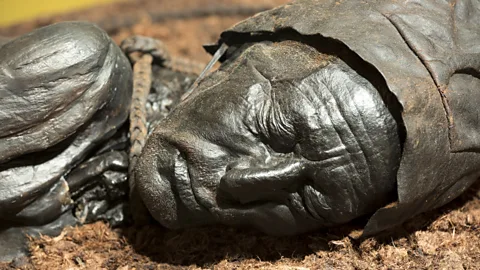
Bog bodies are human remains preserved in wetlands such as swamps, peat bogs, and waterlogged environments.
These environments are rare but powerful natural preservation systems because they contain:
- Low oxygen levels (which slow decay)
- High acidity (which preserves soft tissue)
- Cold, stable conditions in some regions
- Antibacterial natural compounds in peat
Together, these factors can preserve:
- Skin
- Hair
- Internal organs
- Clothing
- Even facial features in rare cases
Most famously, bog bodies have been discovered in Northern Europe, particularly in:
- Denmark
- Ireland
- Germany
- The Netherlands
Some of these remains are thousands of years old, dating back to the Iron Age.
However, Florida is not typically known for classic “peat bog mummies” in the European sense. Instead, it has wetland and aquatic preservation sites, including rivers, sinkholes, and swamp environments.
2. Florida’s Wetlands and Ancient Human Remains
Florida has a long archaeological history due to its unique geography.
Unlike dry desert regions or cold Arctic environments, Florida’s preservation conditions are inconsistent—but in certain wetland contexts, organic material can survive longer than expected.
Archaeologists have discovered:
- Human skeletal remains in submerged sinkholes
- Burials in coastal and riverine environments
- Ancient settlement sites near wetlands
- Artifacts preserved in anaerobic (oxygen-poor) mud layers
However, it is important to clarify:
There is no confirmed discovery of “unknown mummy populations” in Florida wetlands that contradict known Native American ancestry.
What has been studied extensively are remains from Indigenous cultures such as:
- The Calusa
- The Apalachee
- The Timucua
- Early Mississippian-related groups
These cultures inhabited Florida for thousands of years before European contact.
Their genetic and archaeological record is well-documented through:
- Burial sites
- Ceramic analysis
- Settlement patterns
- Stable isotope studies
- Ancient DNA sampling (in limited cases)
3. Where the “DNA Mystery” Claims Come From
The viral narrative often claims that DNA from certain remains “does not match known Native American lineages.”
To understand why this claim appears online, we need to explain how ancient DNA works.
Ancient DNA (aDNA) is:
- Highly fragmented
- Often contaminated
- Difficult to extract in humid climates
- Sensitive to modern interference
Florida’s warm, wet environment is actually one of the worst conditions for DNA preservation. Unlike Arctic permafrost or dry caves, DNA degrades quickly in humid soils.
This means:
Step 1: DNA is partial
Only small fragments survive.
Step 2: DNA is compared statistically
Researchers compare fragments to reference populations.
Step 3: Results are probabilistic, not absolute
Matches are expressed in likelihoods, not exact identity.
So when people say:
“DNA doesn’t match known populations”
It often actually means:
- The sample is incomplete
- The statistical confidence is low
- There is no perfect reference match available
- The degradation level is high
This is very different from “unknown civilization discovered.”
4. Why Ancient DNA Can Look “Strange” in Analysis

There are several scientifically known reasons why ancient DNA results may appear unusual:
1. Genetic Diversity in Ancient Populations
Ancient populations were not genetically uniform. Early Native American groups were diverse, with multiple migration waves into the Americas.
Modern reference databases represent only a subset of that diversity.
2. Population Mixing Over Time
Human populations have always migrated, mixed, and shifted genetically over thousands of years.
This means:
- Ancient DNA may not perfectly match modern descendants
- Regional variation can be significant
3. Degraded or Partial Samples
In humid environments like Florida:
- DNA breaks into tiny fragments
- Some markers disappear entirely
- Contamination risk increases
This can produce “uncertain” results.
4. Limited Reference Databases
Genetic science relies on comparison samples. If an ancient population is not well-represented in modern datasets, results may appear ambiguous.
5. What Science Actually Says About Florida’s Ancient Populations
Archaeology and genetics consistently support a well-established understanding:
- Humans have lived in Florida for at least 12,000–14,000 years
- Populations migrated into North America via multiple routes
- Indigenous groups in Florida are part of broader Native American ancestry networks
There is no credible scientific evidence for:
- Unknown human species in Florida wetlands
- “Lost civilizations” unrelated to known Indigenous groups
- Genetic populations outside established human migration history
Instead, what researchers find is complexity within known human history—not contradictions of it.
6. Why “Lost Civilization” Theories Spread Online
The idea of mysterious ancient civilizations is extremely popular in digital media.
There are several reasons for this:
Emotional Appeal
Mystery-driven narratives are more engaging than scientific explanations.
Misinterpretation of Scientific Language
Terms like:
- “unexpected result”
- “uncertain match”
- “limited data”
can be misread as something extraordinary or alarming.
Algorithm Amplification
Platforms tend to promote:
- shocking headlines
- unresolved mysteries
- fear-based curiosity
Lack of Context
Scientific papers are often complex and easily misunderstood when simplified into short posts.
7. The Reality of Archaeological Discovery
Real archaeological discoveries rarely look like dramatic revelations.
Instead, they involve:
- Careful excavation
- Slow interpretation
- Peer-reviewed validation
- Multiple independent confirmations
When truly unknown populations or major discoveries occur, they undergo:
- Multi-year verification
- International review
- Genetic replication studies
Extraordinary claims require extraordinary evidence.
So far, Florida wetland discoveries remain consistent with:
Known Indigenous populations and established migration history.
8. What Would “Unknown DNA” Actually Mean in Science?
If a truly unmatched genetic profile were ever found, scientists would not immediately conclude “unknown civilization.”
Instead, they would consider:
- contamination
- sequencing errors
- missing reference data
- previously unclassified variation within known populations
Only after exhaustive testing would more radical hypotheses be considered.
Even then, it would not imply non-human or unknown civilization origins.
9. Why Florida’s Environment Makes This Research Difficult
Florida’s climate creates major challenges for archaeologists:
- High humidity accelerates decomposition
- Acidic soils break down organic material
- Flooding disturbs burial layers
- Microbial activity destroys DNA quickly
Because of this:
- Human remains are often incomplete
- DNA preservation is rare
- Interpretation requires caution
This is why many Florida archaeological findings rely more on:
- bone structure
- artifact context
- settlement patterns
than genetic data alone.
10. The Importance of Responsible Science Communication
One of the biggest challenges today is how scientific findings are shared online.
When complex research is simplified into headlines, important context is often lost.
For example:
Scientific wording like:
- “inconclusive genetic match”
Can become online claims like:
- “DNA does not match any known humans”
These are not the same.
Responsible interpretation requires understanding:
- uncertainty is normal in science
- incomplete data does not equal mystery civilization
- research evolves over time
Conclusion: Mystery or Misinterpretation?
The idea of “ancient Florida bog mummies hiding a DNA secret” makes for a compelling story—but current scientific understanding does not support claims of unknown civilizations or unexplained human origins.
What it does show is something equally important:
- Human history in the Americas is complex
- DNA preservation in wet environments is difficult
- Scientific results must be carefully interpreted
- Viral narratives often exaggerate uncertainty
Rather than revealing hidden civilizations, these discoveries highlight the ongoing work of archaeology and genetics to piece together humanity’s real—and already fascinating—past.
In the end, the “mystery” is not about unknown beings or lost worlds.
It is about how fragile evidence becomes, how science interprets uncertainty, and how easily modern storytelling can transform complexity into speculation.
And that is often more revealing about us today than about the ancient past itself.