In the 15th century B.C., amid a period of great uncertainty for Egypt, Thutmose III stood at the threshold of greatness. A newly crowned pharaoh following the death of Queen Hatshepsut, Thutmose faced the crucial challenge of consolidating power over both Egypt and its extensive territories in the Levant. The threat came not only from local rebellions but from a coalition of rival forces aiming to challenge Egypt’s authority in the region.
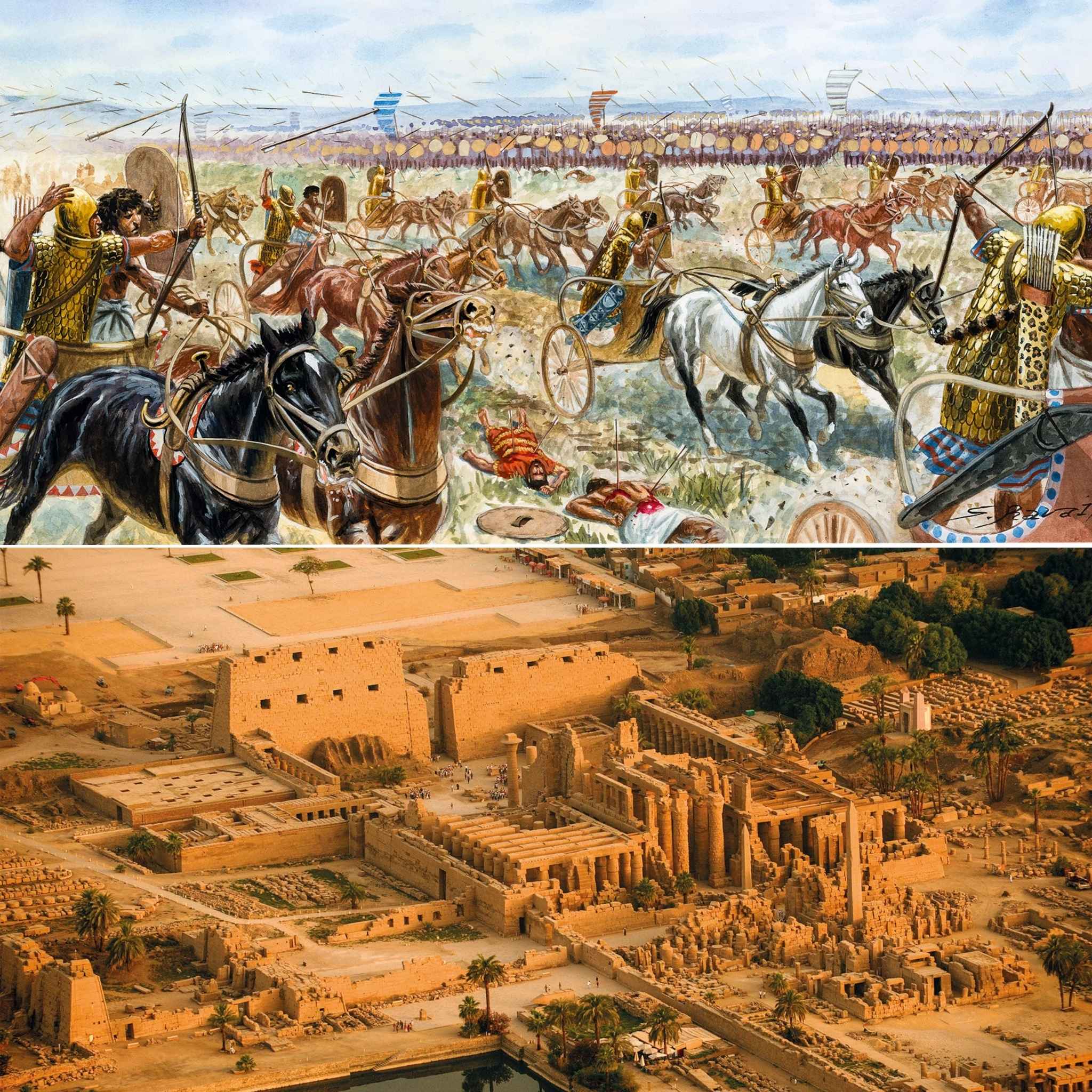
The pivotal moment came when Thutmose was thrust into his first military campaign, which would ultimately determine whether Egypt could assert its dominance. The Battle of Megiddo, fought in the Levant—modern-day Israel—became a defining moment in Egypt’s history. Thutmose’s decisive victory at Megiddo would establish Egypt as a regional superpower, its influence stretching over vast territories, and cement his place as one of the most powerful and skilled pharaohs to have ever ruled. (BBC History)
🏺 The Death of Queen Hatshepsut and Thutmose’s Ascension
The death of Queen Hatshepsut, one of Egypt’s most notable female pharaohs, left a power vacuum in Egypt’s political structure. After a reign lasting 22 years, Hatshepsut disappeared from history, and Thutmose III, her stepson, assumed the throne alone. While his early reign was marked by diplomatic tensions, it wasn’t until he confronted the Canaanite city-states that Thutmose truly stepped into his role as pharaoh. (The Metropolitan Museum of Art)
At this time, a coalition of Canaanite city-states, including the influential rulers of Kadesh, rose up against Thutmose’s rule. Supported by the powerful Mitanni Empire, these rebellious forces sought to assert control over the Levant, an area of vital importance for Egypt’s trade routes and military presence.
🚶 The Journey to Megiddo: A Desperate Move
In what would be his first military campaign, Thutmose III led an Egyptian army to confront the coalition forces in the city of Megiddo, a strategically significant city located in what is today northern Israel. The city controlled vital trade routes, including one linking Egypt with Mesopotamia and another heading north towards Kadesh. Whoever controlled Megiddo controlled the entire region.
Thutmose gathered his army and began the journey from Tjaru, a border fortress in the eastern delta of Egypt, toward the city of Megiddo. While the exact size of the Egyptian forces remains unknown, historians believe Thutmose mobilized thousands of soldiers, likely marching through the Way of Horus, a route used by pharaohs to move troops into Asia.
⚔️ The Aruna Pass: A Dangerous Gamble
As the Egyptian forces advanced, Thutmose III faced a critical decision: which route to take to reach Megiddo? His generals advised against taking the Aruna pass, a narrow, perilous route that could leave his army vulnerable to an ambush. The pass was narrow, with steep walls on both sides, and an enemy army could easily trap them.
But Thutmose, confident in his resolve and determined to defy the expectations of his enemies, chose the Aruna pass as his route. He swore an oath to Amun-Re, the sun god, and vowed to lead his men through the treacherous path himself. His generals reluctantly followed his decision.
The Aruna pass was only about 8 miles long, but at its narrowest point, it was just 30 feet wide, offering little room for maneuver. The enemy, expecting Thutmose to avoid such a risk, had stationed their troops on the other routes, leaving the pass virtually unguarded.
As Thutmose and his forces marched through the pass, they emerged on the other side, surprising the enemy camp with their sudden appearance. The Egyptian army had successfully bypassed the enemy’s defense, leading to confusion and panic among the Canaanite forces. (Smithsonian)
🌅 The Battle and the Egyptian Advance
The following morning, Thutmose III deployed his forces in a crescent formation to advance on the enemy camp. The Egyptian army was divided into three large wings: one to the north, one to the south, and Thutmose himself commanding the center. The formation allowed the Egyptians to overwhelm the enemy forces, striking from multiple angles.
Thutmose’s army pushed forward, overwhelming the Canaanite defenders with speed and precision. The Canaanite leaders, seeing their army falter, fled toward Megiddo’s fortified walls. While the Egyptians looted the Canaanite camp, many of the fleeing leaders were hoisted up into the city by ropes thrown over the walls.
🏰 Siege of Megiddo: Seven Months of Struggle

Despite the successful ambush and retreat of the Canaanite forces, Megiddo’s fortifications presented a significant challenge. The Egyptians were unable to capture the city immediately, leading Thutmose to lay siege to the city. Over the next seven months, the Egyptian forces surrounded Megiddo, cutting off all routes of escape for the defenders.
The siege ultimately succeeded when the city surrendered. The ruler of Megiddo and other leaders of the coalition were captured, though the Prince of Kadesh managed to escape. The victory gave Thutmose III control over the Levant, solidifying Egypt’s dominance in the region. (PBS)
🎖️ The Booty and Consequences of Victory
The victory at Megiddo was not just a military triumph but also a symbolic and material one. According to Egyptian records, the army took 2,041 horses, 924 chariots (including gold‑carved chariots from the rulers of Kadesh and Megiddo), and a significant amount of weaponry, including 502 composite bows from Mesopotamia.
Thutmose’s victory at Megiddo marked the beginning of a new era of Egyptian power. The battle would be remembered as a turning point in Egypt’s history, elevating Thutmose III to the status of a legendary ruler. His triumph in Megiddo opened the door for Egypt to assert its dominance over much of the Levant and Nubia. (The New York Times)
🏛️ Thutmose III: A Pharaoh of Legends

In the aftermath of the Battle of Megiddo, Thutmose III embarked on further campaigns in the Levant and Nubia, expanding Egypt’s influence far beyond its borders. By the 33rd year of his reign, he had defeated the Mitanni Empire in the north, bringing Egypt’s dominance to its zenith.
Thutmose III’s military success would be commemorated by the creation of victory steles placed in far‑flung regions like Nubia and Syrian territories, where he described his triumphs over both northern and southern enemies. His reign was characterized not only by military victories but also by his contributions to Egypt’s art and architecture. (The British Museum)
🌍 Legacy of Thutmose III: The Birth of a Superpower
The consequences of the Battle of Megiddo were far‑reaching, as it consolidated Egypt’s military, political, and economic influence in the region. Thutmose III’s leadership transformed Egypt into a regional superpower, capable of controlling both the Levant and Nubia. The victory was symbolic of Egypt’s enduring might and the rise of Thutmose III as one of the most powerful pharaohs in history.
In the centuries that followed, the Battle of Megiddo would be remembered as one of the greatest military victories in Egyptian history, and Thutmose III’s reign would serve as the standard for future generations of rulers.
The young pharaoh’s daring military strategies and courage in battle turned Egypt into the dominant power in the ancient world — and his legacy would inspire future generations to seek control over the lands of the Levant, Mesopotamia, and Nubia.
📜 Conclusion
The triumph of Thutmose III at Megiddo was not just a single battle — it was a monumental turning point in the history of ancient Egypt. With one bold decision to march through the Aruna pass, Thutmose proved himself as a leader capable of outsmarting his enemies and solidified Egypt’s status as a superpower of the ancient world.
This battle, and the subsequent victory, would shape not only Thutmose III’s reign but also the future of Egypt for centuries to come.