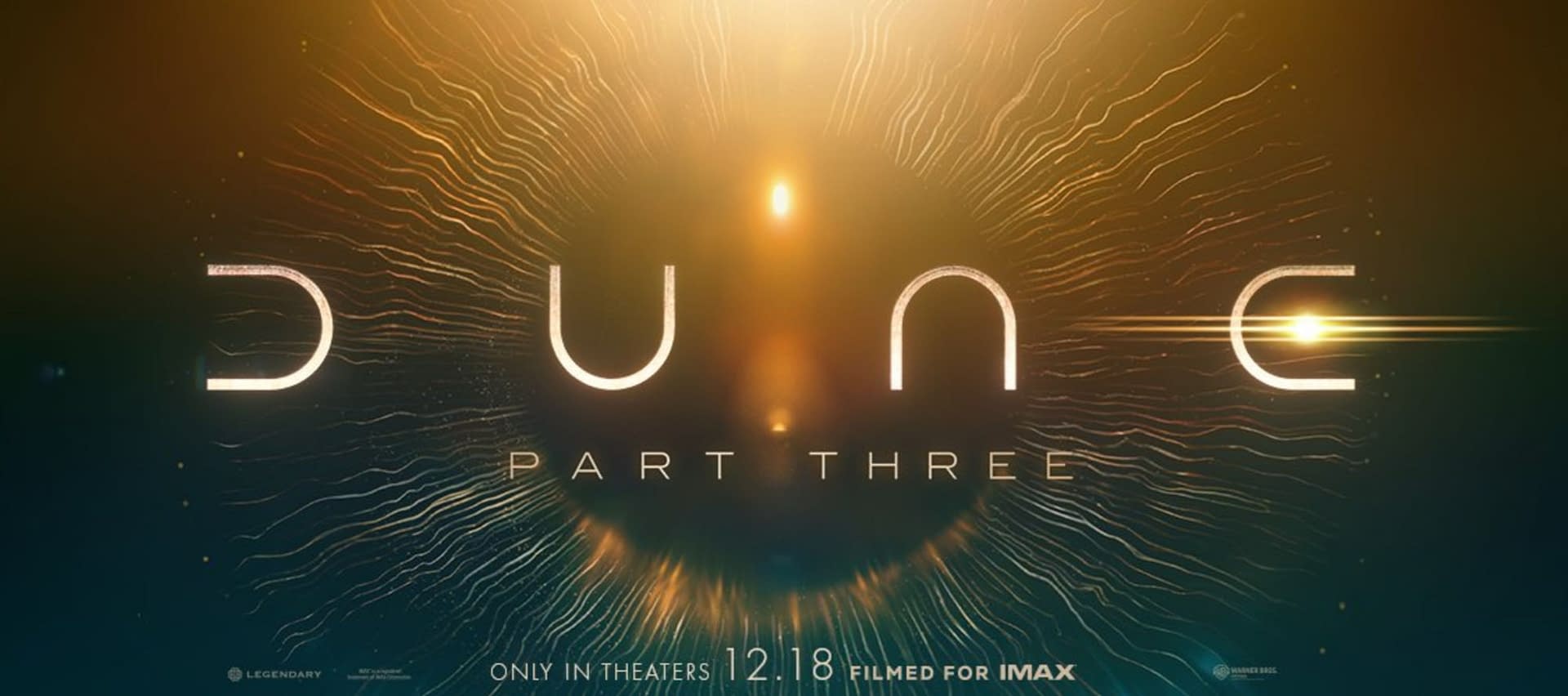
DUNE: PART THREE — THE WAR FOR THE FUTURE OF ARRakis
The sands of Arrakis are calling once again.
After the massive success of Dune and Dune: Part Two, Denis Villeneuve’s epic sci-fi saga is expected to continue with Dune: Part Three, the next monumental chapter in the story of Paul Atreides, the Fremen, and the battle for control of the most valuable substance in the universe — spice.
What began as the journey of a young noble heir has evolved into something far more dangerous. Paul Atreides is no longer simply the displaced son of House Atreides. He has become a myth, a prophet, a conqueror, and perhaps the most feared man in the galaxy.
But with absolute power comes devastating consequences.
Dune: Part Three is expected to adapt major elements from Frank Herbert’s Dune Messiah, bringing audiences into a darker and more psychologically intense phase of the story. The film promises political warfare, betrayal, religious fanaticism, and emotional tragedy on a scale unlike anything seen in the previous chapters.
The rise of Paul Atreides changed the universe.
Now the universe must deal with what he has become.
PAUL ATREIDES RULES THE GALAXY — BUT AT WHAT COST?
By the end of Dune: Part Two, Paul seized control of Arrakis and defeated House Harkonnen, fulfilling the prophecy embraced by the Fremen people. What once seemed impossible became reality: Paul Atreides ascended as Emperor.
But victory was only the beginning.
Dune: Part Three reportedly explores the horrifying aftermath of Paul’s rise to power. Across the galaxy, fanatical followers wage holy war in his name, spreading destruction and death on countless worlds. Entire civilizations are falling beneath the banner of Muad’Dib.
And Paul can see it happening.
One of the most compelling aspects of the next film is expected to be Paul’s terrifying awareness of the future. Thanks to his growing prescient abilities, he sees countless possible outcomes unfolding simultaneously — and nearly all of them lead toward unimaginable suffering.
The tragedy is that even with near-godlike power, Paul may no longer be able to stop what he started.
TIMOTHÉE CHALAMET’S DARKEST PERFORMANCE YET
Timothée Chalamet’s portrayal of Paul Atreides has been central to the success of the modern Dune films, but Part Three could deliver his most emotionally devastating performance yet.
This version of Paul is no longer the uncertain young heir from the beginning of the saga. He is now a ruler burdened by prophecy, worshipped by billions yet isolated by his immense power.
The film reportedly focuses heavily on Paul’s psychological deterioration as he struggles with:
- Guilt over the holy war
- Fear of becoming a tyrant
- The pressure of leadership
- His visions of catastrophic futures
- The loss of his humanity
Paul’s transformation from hero into a deeply conflicted messianic figure may become one of the defining emotional arcs of the trilogy.
Unlike traditional science-fiction protagonists, Paul is not simply trying to save the universe.
He’s trying to survive becoming its destroyer.
CHANI’S ROLE CHANGES EVERYTHING
Zendaya’s Chani is expected to play a far more central role in Dune: Part Three.
At the end of Part Two, Chani walked away from Paul after realizing the growing danger of his rise to power. While Paul embraced prophecy and political domination, Chani saw the cost of what he was becoming.
That emotional divide is likely to become one of the most important aspects of the next film.
Chani represents humanity, emotion, and resistance against blind fanaticism. She is one of the few people willing to challenge Paul directly rather than worship him.
Their relationship reportedly becomes increasingly tragic as political pressure, religious extremism, and Paul’s growing isolation threaten to destroy the love they once shared.
And in the brutal world of Dune, love is rarely allowed to survive power.
THE GALAXY TURNS AGAINST PAUL
Although Paul now sits on the throne, many powerful factions secretly fear him.
The Bene Gesserit remain deeply suspicious of Paul’s abilities and his growing control over the universe. The Spacing Guild fears the disruption of spice production and the future Paul sees. Political enemies across the galaxy begin plotting rebellion.
Dune: Part Three transforms from a survival story into a tense political thriller filled with conspiracies, assassinations, and hidden agendas.
Paul’s enemies understand something terrifying:
As long as Paul Atreides lives, nobody else can control the future.
That makes him the most dangerous man alive.
THE RETURN OF FLORENCE PUGH’S PRINCESS IRULAN
Florence Pugh’s Princess Irulan is expected to have a much larger role moving forward.
After becoming politically tied to Paul through marriage, Irulan finds herself trapped between duty, ambition, and emotional conflict. She lives inside Paul’s empire while secretly navigating dangerous political tensions beneath the surface.
Irulan is intelligent, calculating, and deeply aware that Paul’s rule may eventually consume everything around him.
Her role reportedly becomes increasingly complex as alliances shift and palace conspiracies intensify.
Rather than simply serving as a political figure, Irulan may emerge as one of the story’s most unpredictable players.
ARRakis HAS CHANGED FOREVER
The world of Arrakis itself continues evolving in dramatic ways.
One of the most fascinating elements of Dune: Part Three is the transformation of the desert planet. The Fremen dream of reshaping Arrakis into a greener world is slowly becoming reality — but that change may come with dangerous consequences.
Arrakis is more than just a planet.
It is the foundation of the entire galactic economy because of spice.
Any major environmental shift threatens the balance of civilization itself.
This creates an intense conflict between:
- Progress and preservation
- Power and survival
- Ecology and empire
Villeneuve’s films have consistently treated Arrakis as a living, breathing character, and Part Three is expected to deepen that connection even further.
VISUALS THAT PUSH SCIENCE FICTION FORWARD
If the first two films redefined cinematic science fiction visually, Dune: Part Three may push the genre even further.
Denis Villeneuve is expected to expand the universe beyond Arrakis, exploring more of the Imperium’s massive political and cultural landscape. Audiences could see:
- New planets
- Massive imperial cities
- Expanding religious armies
- Interstellar warfare
- Strange futuristic technologies
- More terrifying sandworm sequences
The visual scale of the trilogy has always emphasized realism, atmosphere, and overwhelming grandeur instead of traditional blockbuster excess.
Every frame feels ancient, sacred, and monumental.
That cinematic identity will likely continue in Part Three, making it one of the most visually ambitious science-fiction films ever created.
A STORY ABOUT POWER — NOT HEROISM

One reason Dune stands apart from other major franchises is its refusal to present simple heroes and villains.
Paul Atreides is not a traditional savior.
He is a warning.
Frank Herbert originally wrote Dune as a critique of charismatic leaders and blind religious devotion. Dune: Part Three is expected to fully embrace those darker themes.
The film reportedly explores:
- The corruption of power
- Religious extremism
- Manipulation through prophecy
- The burden of leadership
- The danger of hero worship
This makes Dune feel far more mature and psychologically layered than most modern blockbuster franchises.
The audience is forced to question whether Paul is truly saving humanity — or leading it toward destruction.
THE POSSIBLE END OF PAUL ATREIDES’ STORY
Although details remain secret, many fans believe Dune: Part Three could serve as the emotional conclusion of Paul Atreides’ journey.
And if Villeneuve follows the darker direction of Dune Messiah, audiences should prepare for a heartbreaking story filled with devastating consequences.
Paul’s greatest battle may not be against an enemy army or political rival.
It may be against destiny itself.
The closer Paul moves toward ultimate control, the more trapped he becomes by the future he can already see.
That tragic paradox is what gives Dune its emotional power.
CONCLUSION: THE PROPHECY BECOMES A NIGHTMARE
Dune: Part Three promises to be more than just another sci-fi sequel.
It is shaping up to become an epic tragedy about power, destiny, love, and the terrifying cost of becoming a legend.
The sands of Arrakis created a messiah.
Now the universe must survive him.
With breathtaking visuals, complex political storytelling, emotionally devastating performances, and some of the darkest themes ever explored in a major blockbuster franchise, Dune: Part Three could become the defining science-fiction event of the decade.
Because in the world of Dune, the most dangerous thing in existence is not a weapon, an empire, or even a sandworm.
It is a man who can see the future.