In the arid desert along Peru’s northern coast lies one of the most remarkable archaeological discoveries of the 21st century. El Castillo de Huarmey, or the Castle of Huarmey, revealed a secret that had been hidden for centuries: a mausoleum containing the remains of 58 elite women of the Wari culture, a pre-Inca civilization that shaped much of Andean society. The story of this discovery not only illuminates the sophistication of the Wari but also challenges long-standing assumptions about gender, power, and ritual in ancient Peru.
A Forgotten Fortress
El Castillo de Huarmey sits in the Ancash region, nearly 550 miles north of the Wari capital in the Ayacucho Valley. Founded by the Wari people, this capital was the heart of a culture that spread its influence across the Andes long before the rise of the Inca. Though not widely known today, the Wari are increasingly recognized as architects of one of the earliest Andean empires. Their cities were intricately planned, with monumental architecture and a complex social hierarchy.
The site of Huarmey had been glimpsed by early researchers but remained largely forgotten. In 1919, Julio C. Tello, widely regarded as the father of Peruvian archaeology, visited the area but was forced to leave due to an outbreak of bubonic plague. Over the decades, El Castillo de Huarmey attracted the attention of looters, known locally as huaqueros. Their illicit digs, coupled with a devastating earthquake in the 1970s, disturbed the site and exposed artifacts, leaving only fragments for researchers to study. By the early 2000s, much of the area was littered with debris, both natural and human-made.
Yet hope remained. In 2010, two determined archaeologists, Miłosz Giersz from Poland and Roberto Pimentel Nita from Peru, began systematic excavations at Huarmey. Their goal was audacious: to find intact remains amid centuries of disruption. As they cleared the rubble, what emerged was beyond all expectation—a massive mausoleum built into the bedrock of a hill, a hidden underground chamber, and an extraordinary glimpse into Wari life and death.
Discovering the Mausoleum
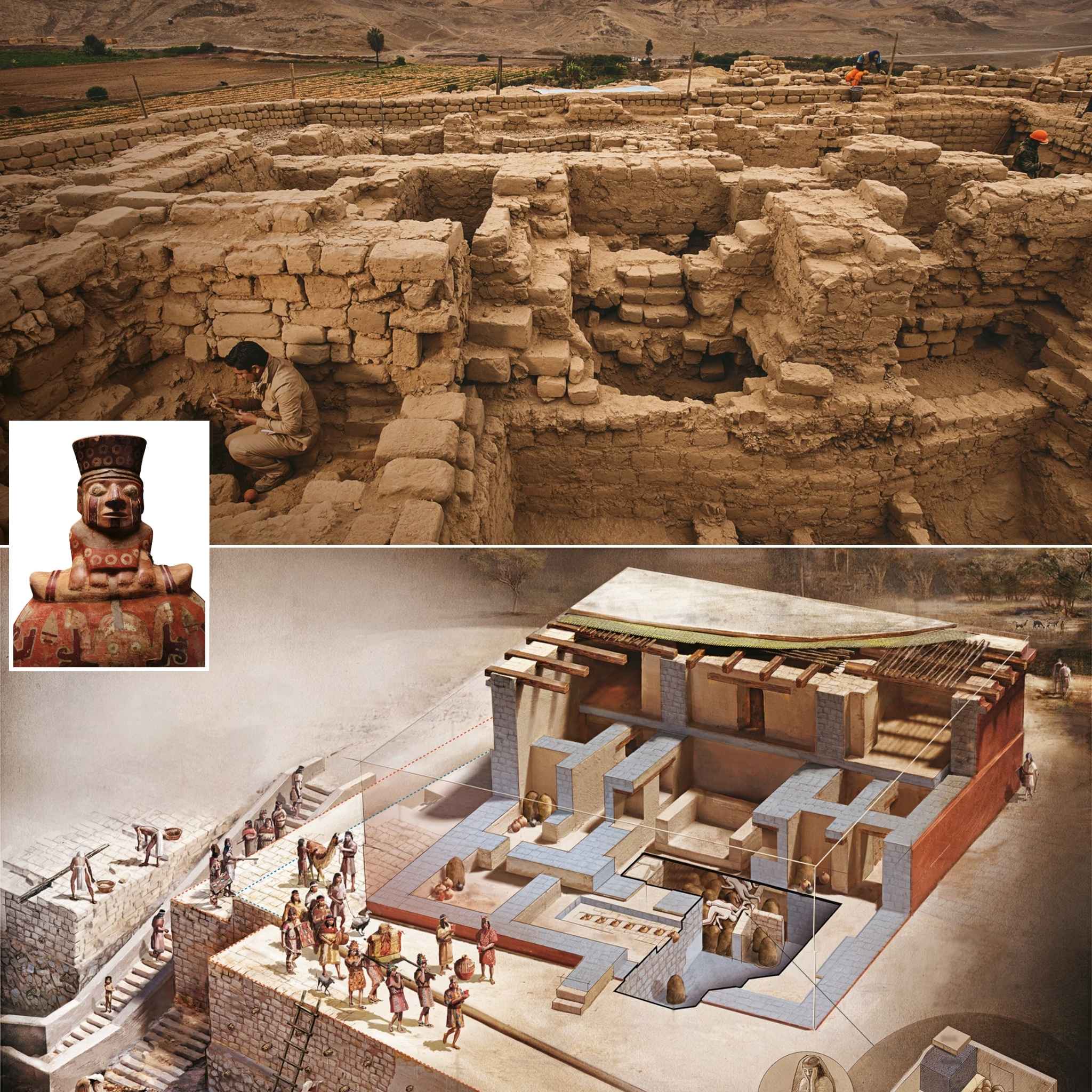
The mausoleum at Huarmey is an architectural marvel. Though only the lower sections of its walls survived, archaeologists could discern its original layout: a labyrinthine complex with more than 20 chambers. The building featured a red-painted facade and was carefully aligned with the hill’s natural contours, reflecting the Wari’s advanced knowledge of construction and landscape. Central to the mausoleum was a throne room—a ceremonial space dominated by a bench resembling a throne, likely used for rituals honoring the dead.
Below this ceremonial chamber lay a hidden treasure: the first intact collective burial of Wari elite ever discovered. In a subterranean room, the team found 58 women, each carefully wrapped in funeral bundles. Their preservation was extraordinary, thanks to the dry desert conditions. The women had been buried in a seated position, encased in green and white textiles and bound with thick mesh. It was a sight that reshaped archaeologists’ understanding of Wari funerary practices.
The mausoleum at El Castillo de Huarmey, with its intricate underground chambers and ceremonial throne room.
Among the women, one stood out immediately: the so-called “Huarmey Queen.” Around 60 years old at the time of her death, she was buried with objects signaling her high status, including gold ear flares—a symbol traditionally associated with male leaders in Andean society. Her presence suggested that elite Wari women held significant political and ceremonial power, challenging the male-centric narratives long assumed about pre-Inca leadership.
A Treasure Trove of Artifacts
The excavation revealed more than 1,300 artifacts, ranging from ceremonial vessels and jewelry to weapons and weaving implements. Many were made from rare and valuable materials: obsidian, turquoise, red spondylus shells imported from Ecuador, and metals of remarkable quality. The Huarmey Queen’s weaving tools, crafted from gold, indicate not only her wealth but also the cultural importance of textile production among the Wari elite. Weaving was a powerful symbol of status, ritual knowledge, and lineage in Andean society, and the presence of gold tools suggests that high-ranking women could wield influence comparable to that of male leaders.
Gold ear flare with winged motifs, one of the many symbols of elite status found in the tomb of the Huarmey Queen.
The burial itself provides evidence of complex ritual practices. The chamber had not been sealed immediately; insects, fly pupae, and even snakes had entered the space, suggesting that burials occurred over time. When the chamber was finally closed, it was filled with earth, stones, and mud. In this final act, six adolescent girls were sacrificed and left as offerings—a practice seen in other elite Wari burials, perhaps meant to serve or accompany the dead in the afterlife.
Life and Death Among the Wari Elite
Analysis of the remains shows that the women were in good health during their lifetimes, confirming their elite status. The Wari clearly invested significant resources in caring for these individuals and in honoring them after death. This commitment demonstrates the cultural importance of ancestor worship and the intertwining of political and spiritual life.
The mausoleum’s layout reflects a sophisticated understanding of social hierarchy. The central burial chamber, beneath the throne room, was reserved for the most powerful women. Lateral subchambers housed other elite women, perhaps queens or princesses. The throne above the chamber served as a ceremonial space, likely used for rituals that reaffirmed the connection between living rulers and their revered ancestors.
The Wari also incorporated guardians into their mortuary practices. The last burials in the chamber were of a man and woman, who had been sacrificed to watch over the tomb. To prevent them from leaving, their left feet had been amputated—a grim but telling indication of the lengths to which the Wari went to protect their sacred spaces. These “eternal watchers” demonstrate that the mausoleum was both a religious and political statement, linking death, authority, and protection.
Twin ceramic vessels wrapped in cloth, typical of the offerings placed with the Wari elite during burial.
Insights into Wari Society
The discovery at Huarmey has transformed archaeologists’ understanding of the Wari. The scale and sophistication of the mausoleum indicate a centralized state capable of organizing complex construction projects and managing elite burials. Moreover, the role of women in Wari society appears far more prominent than previously recognized. The Huarmey Queen’s burial suggests that women could hold significant political, religious, and economic power—a revelation that challenges the long-held assumption that Andean pre-Inca societies were predominantly patriarchal.
The use of textiles, the importation of exotic materials, and the careful arrangement of ceremonial objects all point to a society that valued artistry, ritual, and hierarchy. The presence of sacrificed individuals and the careful placement of guardians indicate a sophisticated belief system in which the dead were active participants in the social and political order, even after death.
The Human Stories Behind the Burial
While artifacts and architecture tell one story, the human lives behind the tomb provide another. The women of Huarmey were clearly chosen for their status and abilities. Some may have been ritual specialists, leaders, or individuals of familial importance. The adolescent girls who were sacrificed represent the Wari’s belief in the necessity of offerings to secure the spiritual integrity of the elite.
The Huarmey Queen herself provides a compelling glimpse into a woman’s life in the Wari empire. Her age at death, combined with the elaborate grave goods, suggests she played a long-standing and central role in her society. The gold weaving tools and ceremonial objects buried with her indicate that her influence extended beyond politics into religious and cultural spheres.
Preservation Against the Odds
The discovery of the Huarmey mausoleum was made possible not only by the dry coastal climate but also by meticulous archaeological work. Despite centuries of looting and natural disasters, the subterranean chamber remained largely intact. The archaeologists’ careful excavation methods ensured that fragile textiles, organic materials, and skeletal remains were preserved for study.
This preservation allows scientists to reconstruct not only the physical aspects of the Wari elite but also their cultural practices. Radiocarbon dating, analysis of textiles, and examination of burial techniques all contribute to a more nuanced understanding of pre-Inca societies in the Andes.
A Legacy Carved in Stone and Earth
El Castillo de Huarmey offers more than just archaeological insight; it provides a tangible connection to the human experiences of an ancient civilization. The mausoleum stands as a testament to the Wari’s sophistication, their social hierarchy, and their reverence for the dead. It also highlights the central role of women in the political, religious, and cultural life of the Andes long before the rise of the Inca Empire.
The site invites reflection on the ways that power, ritual, and gender intersected in the ancient world. The Huarmey Queen and the 57 other women buried with her were more than ceremonial figures—they were leaders, guardians, and