Archaeologists Uncover Rare Circular Temple in Egypt Linked to Sacred Nile Rituals
A mysterious circular temple buried for more than 2,000 years beneath the sands of northeastern Egypt is giving archaeologists an extraordinary glimpse into how ancient Egyptians may have worshipped water itself.
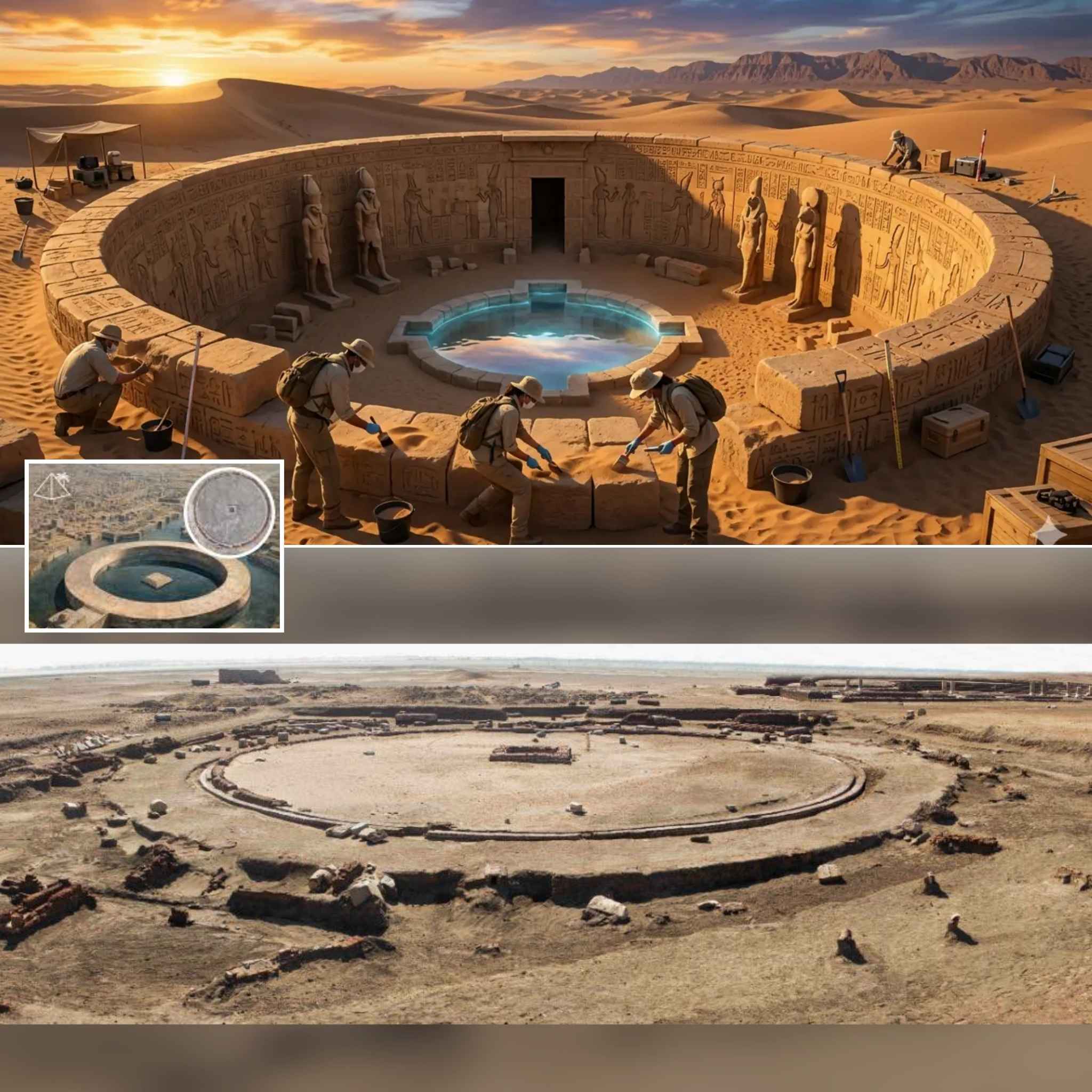
The newly excavated sanctuary, discovered at the ancient city of Pelusium, contains an elaborate network of water channels, reservoirs, and a massive circular basin connected directly to a branch of the Nile River. Researchers now believe the site may have hosted sacred rituals tied to purification, fertility, and the life-giving floods of the Nile.
Even more remarkably, the temple appears to have been dedicated to a little-known local deity named Pelusius — a god associated with mud, silt, and the fertile deposits carried by the river.
The discovery is already being hailed as one of the most unusual religious finds unearthed in Egypt in recent years.
A city guarding the edge of Egypt


The temple was uncovered at Tell el-Farama, the archaeological remains of ancient Pelusium, a major city located on the eastern edge of the Nile Delta in what is now Egypt’s North Sinai governorate.
In antiquity, Pelusium occupied one of the most strategic locations in the ancient world.
Positioned near the mouth of the Nile and close to the border between Egypt and the Near East, the city served as both fortress and gateway. Armies passed through it. Merchants crossed its harbors. Customs officials monitored trade entering Egypt from the eastern Mediterranean.
For centuries, Pelusium functioned as a critical defensive and economic center.
Archaeologists have long known the site contained important temples and administrative buildings. In 2022, excavators uncovered a pink granite temple dedicated to Zeus there, highlighting the city’s multicultural character during the Greek and Roman periods.
But the newly revealed sanctuary to Pelusius may be even more unusual.
The structure that baffled archaeologists
The first hints of the temple emerged in 2019.
At the time, archaeologists exposed only part of a large circular red-brick structure. Based on its shape, researchers initially believed they had discovered a senate house or civic assembly building.
That interpretation changed dramatically once excavations expanded.
As workers carefully removed layers of debris and sand, they revealed the full scale of the complex — and realized it was not political architecture at all.
At the center stood a giant circular basin roughly 115 feet (35 meters) across.
In the middle of the basin sat a square pedestal, likely once supporting a colossal statue of Pelusius himself.
Surrounding the structure was an intricate hydraulic system unlike anything researchers expected to find.
A temple built around water


The sanctuary appears to have been designed entirely around the movement and symbolism of water.
Archaeologists uncovered channels, reservoirs, and water-control systems connected directly to a branch of the Nile River. Inside the basin itself, researchers found preserved Nile silt and traces of standing water.
Those discoveries strongly suggest the structure was intentionally flooded during ceremonies.
The temple’s design may have symbolized the Nile’s annual inundation — the event that made Egyptian civilization possible.
Each year, floodwaters carried nutrient-rich mud across farmland, renewing the soil and sustaining agriculture. Without the Nile floods, ancient Egypt could not have survived.
That connection may explain the nature of the deity worshipped there.
The name Pelusius is believed to derive from an ancient Greek word connected to mud or silt, directly linking the god to the fertile sediments of the Nile.
Researchers now suspect the sanctuary hosted sacred water rituals celebrating renewal, fertility, and divine protection.
A rare circular temple in Egypt
Circular religious structures are extremely uncommon in ancient Egyptian architecture.
Most Egyptian temples followed rigid rectangular layouts aligned with cosmic or solar principles. Monumental gateways, courtyards, and straight ceremonial axes dominated traditional temple design.
That makes the Pelusius sanctuary particularly remarkable.
Its circular form, combined with Greek and Roman architectural influences, reflects the increasingly cosmopolitan nature of Egypt after the conquest of Alexander the Great in 332 B.C.
By the second century B.C., Egypt had become a crossroads of cultures where Egyptian, Greek, and later Roman traditions merged.
The Pelusius temple appears to embody that fusion.
Built during a changing world
Researchers believe the sanctuary was first constructed during the second century B.C., when Egypt was ruled by the Greek-speaking Ptolemaic dynasty.
The temple remained in use for centuries — potentially until the sixth century A.D. during the Byzantine era.
That means generations of Egyptians, Greeks, and Romans may all have worshipped at the same sacred site.


This long lifespan reflects the remarkable religious adaptability of ancient Egypt.
Even after foreign conquests, local gods often survived by blending with Greek and Roman religious traditions. Temples evolved architecturally while preserving older spiritual meanings tied to the Nile and the land.
The sanctuary of Pelusius may represent exactly that kind of hybrid religious world.
Why the discovery matters
Archaeologists say the temple is important not only because of its unusual design, but because it reveals how significant Pelusium once was.
Today the site lies in relative obscurity compared to famous locations like Giza Pyramid Complex or Luxor Temple.
But in antiquity, Pelusium stood at the edge of empires.
Its ports connected Egypt to Mediterranean trade routes. Its military fortifications guarded the eastern frontier. And its temples reflected a society increasingly shaped by cultural exchange.
The newly discovered sanctuary suggests religion there was equally dynamic.
The blending of Egyptian, Greek, and Roman architectural elements demonstrates how interconnected the ancient Mediterranean world had become.
Sacred water and the power of the Nile
For ancient Egyptians, water was never merely practical.
The Nile was viewed as a divine force — a source of life, order, and rebirth. Religious rituals frequently centered on purification, flooding cycles, and sacred water symbolism.
Priests performed ceremonies using water from the Nile. Temple lakes symbolized the primordial waters from which creation emerged. Gods connected to fertility and renewal often had close ties to rivers and inundation.
The Pelusius sanctuary appears to take that symbolism to an entirely different level.
Rather than simply including water features, the entire temple seems to have been engineered around controlled interaction with the Nile itself.
If researchers are correct, worshippers may have watched floodwaters enter the circular basin during rituals reenacting cosmic renewal and divine creation.
The mysteries still buried beneath the sand
Despite the major discovery, many questions remain unanswered.
Archaeologists still do not fully understand:
- How rituals were conducted inside the sanctuary
- Whether priests intentionally flooded the basin during ceremonies
- What the colossal statue of Pelusius looked like
- Why the temple adopted such an unusual circular design
- And how local Egyptian beliefs merged with Greek and Roman traditions there
Excavations at Tell el-Farama are continuing, and researchers believe more structures may still lie hidden beneath the surrounding sands.
Given the city’s importance and long history, Pelusium may hold many more surprises waiting to emerge from the desert.
For now, the circular temple stands as a reminder that ancient Egypt was not frozen in time.
It was a civilization constantly evolving — absorbing outside influences while preserving deep spiritual connections to the Nile that sustained it for thousands of years.