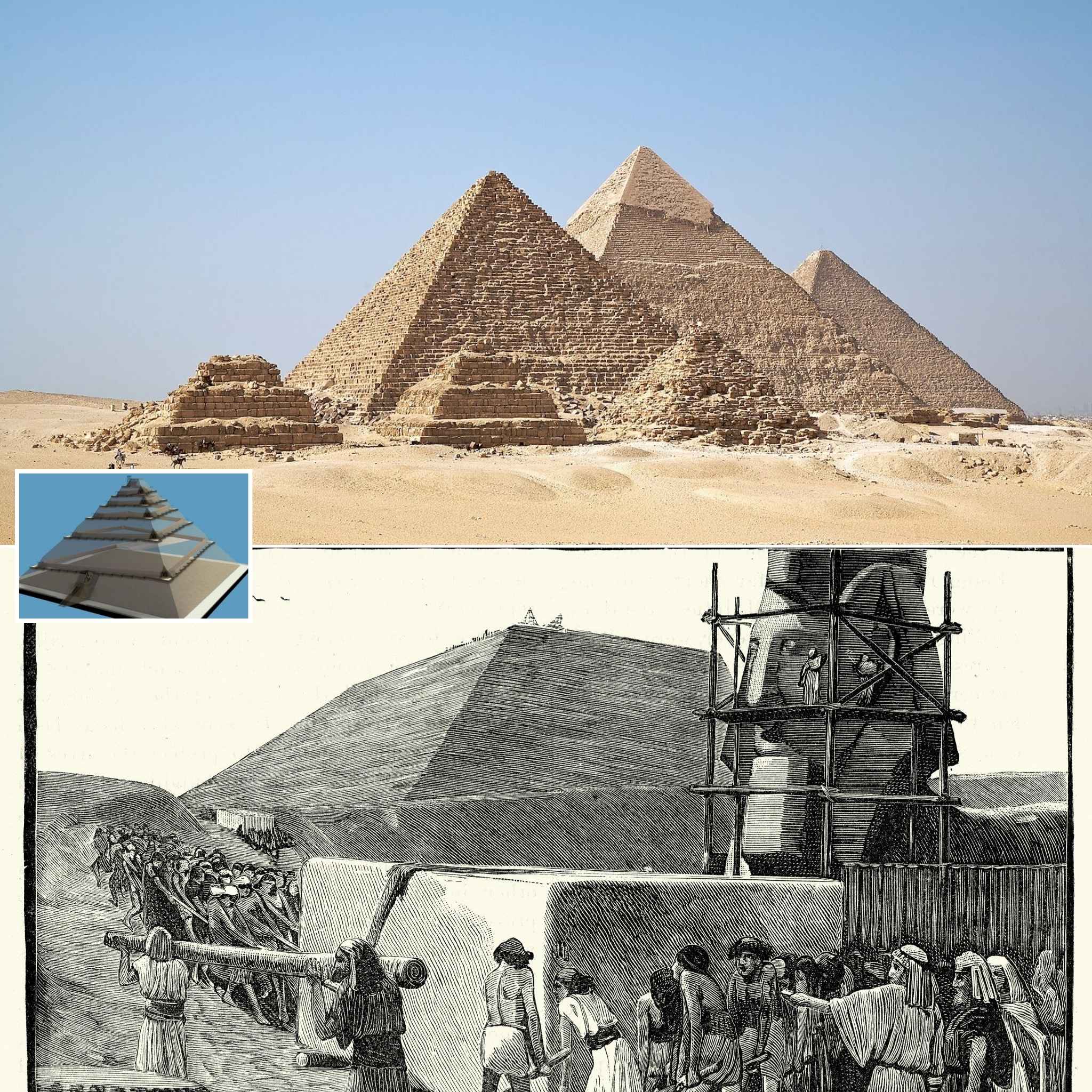
For more than four millennia, the Great Pyramid of Giza has towered over the Egyptian desert as one of humanity’s most astonishing architectural achievements. Built during the reign of Pharaoh Khufu roughly 4,600 years ago, the massive structure has endured wars, storms, erosion, looting, and the relentless passage of time.
But perhaps even more remarkable is this:
The pyramid has also survived powerful earthquakes that would have severely damaged or destroyed many modern structures.
Now, new scientific research is revealing why the ancient monument has remained standing for so long. According to researchers studying vibrations inside the pyramid, the Great Pyramid possesses extraordinary natural resistance to seismic activity — thanks largely to the sophisticated engineering knowledge of the ancient Egyptians.
The findings suggest the builders of the pyramid may have unintentionally — or perhaps intentionally — developed architectural features capable of absorbing and reducing earthquake vibrations thousands of years before modern seismic engineering existed.
A Monument That Refused to Fall
The Great Pyramid, also known as the Pyramid of Khufu, originally stood about 481 feet (146.6 meters) tall when it was completed during Egypt’s Old Kingdom period between 2649 and 2150 B.C.
Today, after thousands of years of erosion and the loss of outer casing stones, the structure still rises roughly 448 feet (136.5 meters) above the Giza Plateau.
That means the pyramid has lost only about 33 feet (10 meters) of height over nearly five millennia — an astonishing level of preservation for a monument built long before steel reinforcement, modern concrete, or computer modeling.
Its endurance becomes even more impressive considering the earthquakes it has survived.
Historical records and geological evidence show that Egypt has experienced numerous significant earthquakes throughout history. Among them was a powerful magnitude 6.8 earthquake that struck near Fayum south of Cairo in 1847, as well as a magnitude 5.9 quake in 1992 that caused some of the uppermost stones of the pyramid to collapse.
Yet despite these events, the core structure of the Great Pyramid remained intact.
That mystery has fascinated engineers and archaeologists for decades.
How could a 4,600-year-old stone structure survive seismic activity so effectively?
Now researchers believe they finally have part of the answer.


Scientists Measured Vibrations Inside the Pyramid
The new research was led by Asem Salama, a geoscientist at the National Research Institute of Astronomy and Geophysics in Cairo.
To investigate the pyramid’s structural behavior, Salama and his team placed highly sensitive vibration sensors at 37 locations inside and around the monument. Measurements were taken during periods when tourists were absent to minimize outside disturbances.
The researchers carefully recorded ambient vibrations naturally occurring within the structure and the surrounding ground.
What they discovered surprised them.
Throughout most of the pyramid, vibration frequencies remained remarkably consistent — ranging between approximately 2.0 and 2.6 hertz.
f \approx 2.0\text{–}2.6\ \mathrm{Hz}
The surrounding ground, however, vibrated at a much lower frequency of roughly 0.6 hertz.
f_{ground} \approx 0.6\ \mathrm{Hz}
That difference turned out to be critically important.
Why Frequency Matters During Earthquakes
During an earthquake, seismic waves travel through the ground carrying energy into buildings and structures above.
When a structure vibrates at a frequency similar to the ground beneath it, dangerous resonance can occur. Resonance amplifies movement dramatically, increasing the likelihood of collapse.
Modern engineers carefully design skyscrapers, bridges, and stadiums to avoid these resonance effects.
The Great Pyramid, however, appears to naturally avoid them.
Because the pyramid vibrates at frequencies significantly different from the surrounding ground, seismic energy does not transfer as efficiently into the structure during earthquakes.
In simple terms, the pyramid behaves almost like it is partially isolated from the ground’s motion.
That separation likely helps reduce destructive stress throughout the monument during seismic events.
Researchers believe this may be one of the key reasons the pyramid has remained stable for thousands of years.
Ancient Egyptians May Have Discovered Natural Seismic Engineering
The findings are especially remarkable because the pyramid builders had no modern scientific understanding of wave mechanics, resonance, or earthquake engineering.
Yet through centuries of experimentation and refinement, ancient Egyptian architects appear to have developed construction techniques that accidentally — or deliberately — produced extraordinary structural resilience.
Salama described the discovery as evidence of the “extraordinary practical engineering knowledge” possessed by ancient Egyptian builders.
Rather than relying on mathematical simulations or advanced instruments, the architects likely improved their methods gradually through observation, experience, and trial-and-error over generations.
The Great Pyramid may represent the peak of that accumulated knowledge.
The Pressure-Relieving Chambers Play a Crucial Role
One of the most fascinating discoveries from the study involves a series of hidden chambers located above the King’s Chamber deep inside the pyramid.
These rooms, known as pressure-relieving chambers, were originally believed to serve a simple purpose: reducing the immense weight pressing down on the burial chamber of Pharaoh Khufu.
But the new research suggests they may also function as vibration dampeners.
The chambers interrupt the normal upward flow of seismic energy through the structure.
Typically, vibrations become stronger toward the tops of tall buildings during earthquakes — similar to how skyscrapers sway during seismic events.
The pyramid follows that same general pattern, but researchers found something unusual.
At approximately 200 feet (61 meters) above ground level, where the relieving chambers are located, the vibration pattern changes significantly.
The chambers appear to absorb or disrupt some of the seismic energy before it can travel toward the uppermost sections of the pyramid.
That effect may help protect the structure’s apex from excessive movement and structural stress.


Massive Weight Also Helps Stabilize the Pyramid
Another major factor behind the pyramid’s durability is simply its enormous mass.
The Great Pyramid contains an estimated 2.3 million stone blocks, many weighing several tons each. Its immense weight creates tremendous stability and lowers the structure’s center of gravity.
Unlike tall, narrow buildings that are vulnerable to swaying, the pyramid’s broad base distributes forces evenly across the ground.
The geometry itself is naturally stable.
Its symmetrical four-sided design allows seismic forces to spread throughout the structure rather than concentrating in weak points.
Researchers also noted the importance of the limestone plateau beneath the pyramid. The monument sits atop a strong, stable geological foundation that further reduces vulnerability to ground movement.
Together, these factors create a structure uniquely capable of surviving earthquakes over extremely long periods.
The Pyramid Was Not Built in a Single Leap
The new findings also reinforce an important point about ancient Egyptian engineering:
The Great Pyramid did not emerge suddenly from nowhere.
Earlier pyramids reveal numerous signs of experimentation and evolving architectural techniques.
Some early pyramids suffered partial collapses or structural instability due to steep slopes, weak foundations, or internal design flaws.
Over time, Egyptian architects refined their methods.
They adjusted pyramid angles, modified chamber layouts, improved weight distribution systems, and learned how different materials behaved under stress.
The Great Pyramid may therefore represent the culmination of generations of engineering innovation.
“Earlier pyramids show evidence of experimentation and structural evolution,” Salama explained, including modifications in geometry and internal architecture.
The builders were learning continuously — much like modern engineers today.
A New Tool for Preserving Ancient Monuments
Beyond solving historical mysteries, the research may also help protect the Great Pyramid and other ancient monuments in the future.
By understanding how vibrations move through the structure, conservation experts can better identify hidden weaknesses, stress points, or areas vulnerable to long-term deterioration.
The vibration mapping technology used in the study allows scientists to study the pyramid without damaging it — an essential consideration for one of the world’s most important cultural heritage sites.
Salama emphasized that such noninvasive techniques could improve long-term preservation strategies while fully respecting the monument’s integrity.
Researchers hope to apply similar methods to other Egyptian pyramids and archaeological structures in the future.
Each Pyramid May Behave Differently
Although the Great Pyramid appears exceptionally resilient, researchers caution that not all pyramids necessarily respond to earthquakes in the same way.
Egyptian pyramid construction evolved over centuries, meaning each structure possesses unique architectural features.
Differences in slope angles, chamber arrangements, materials, and foundations could significantly affect how vibrations move through individual monuments.
Some earlier pyramids, for example, suffered cracking or partial structural failures due to less refined engineering techniques.
Future studies may reveal why certain pyramids endured better than others.
A Monument That Continues to Surprise Scientists
Even after thousands of years of study, the Great Pyramid continues to reveal new secrets.
The monument has already astonished generations of researchers with its precision, alignment, scale, and complexity. Now scientists are discovering that its resilience to earthquakes may be yet another example of the extraordinary sophistication achieved by ancient Egyptian engineers.
What makes the discovery especially compelling is that the builders likely developed these techniques without formal scientific theory.
They accomplished it through observation, craftsmanship, experimentation, and accumulated practical knowledge passed down across generations.
In many ways, the pyramid functions like a giant stone machine carefully optimized for stability.
And it has worked remarkably well.


Humanity’s Most Durable Engineering Achievement?
Modern skyscrapers are often designed to last a century or two.
The Great Pyramid has already survived nearly fifty centuries.
It has endured earthquakes, sandstorms, erosion, political collapse, invasions, and environmental change while remaining one of the most recognizable structures on Earth.
The new research suggests its survival is not simply luck.
Instead, it may reflect one of the greatest engineering achievements in human history — an achievement created long before modern science fully understood the principles involved.
For all the technological advances of the modern world, the Great Pyramid still stands as a reminder that ancient civilizations possessed extraordinary practical knowledge capable of producing structures of astonishing durability.
And after 4,600 years, the monument continues to teach scientists new lessons about architecture, engineering, and human ingenuity.