How a Single Battle—and One Young Pharaoh—Turned Egypt Into a Superpower
In the mid-15th century B.C., the ancient Near East stood on the edge of upheaval. Across the Levant, powerful city-states watched Egypt closely, waiting for signs of weakness after the disappearance of one of the most extraordinary rulers in Egyptian history: Queen Hatshepsut.
For more than two decades, Hatshepsut had ruled Egypt with confidence and political skill. Her reign brought prosperity, monumental construction projects, and stability to the Nile Valley. Yet after her death, uncertainty spread rapidly beyond Egypt’s borders. The empire’s northern territories—stretching through Canaan and Syria—began to stir with rebellion.
At the center of the coming crisis stood a young ruler who had not yet proven himself alone: Thutmose III.
What followed would become one of the most decisive campaigns in ancient military history. The Battle of Megiddo did more than crush a rebellion. It transformed Egypt into an international superpower, established Thutmose III as one of history’s greatest military commanders, and reshaped the political landscape of the ancient Near East for generations.
Egypt Faces Rebellion
When Hatshepsut vanished from the political stage, Egyptian authority in the Levant immediately came under threat. A coalition of Canaanite rulers—supported by the kingdom of Kadesh and the rising Mitanni Empire—began organizing resistance against Egyptian control.
The rebel coalition centered itself in the fortified city of Megiddo, strategically positioned in what is now northern Israel. Megiddo overlooked key trade routes linking Egypt with Syria and Mesopotamia. Whoever controlled the city controlled commerce, military movement, and political influence throughout the region.
For the young Thutmose III, this was a defining moment. If he failed to crush the uprising, Egypt’s empire in Asia could collapse almost immediately.
Ancient Egyptian records preserved at the Temple of Amun-Re in Karnak describe the campaign in dramatic detail. Though clearly propagandistic, the inscriptions are considered by many historians to be among the earliest reliable military accounts in recorded history.


March to War
Thutmose gathered his army near the eastern frontier fortress of Tjaru in the Nile Delta before beginning the long march northward along the coastal military highway known as the Way of Horus.
The journey itself demonstrated remarkable discipline and organization. Egyptian troops covered roughly 125 miles in ten days before reaching Gaza. From there, they advanced toward the settlement of Yehem, only about 25 miles from Megiddo.
At Yehem, the pharaoh and his generals faced a critical decision.
Three routes led toward the rebel city:
- A northern road through Zefti
- A southern approach near Taanach
- A narrow central route through the Aruna pass
The safer northern and southern roads were expected routes. The Aruna pass, however, was extremely dangerous. In places, the pathway narrowed to only about 30 feet wide, hemmed in by steep cliffs that could allow enemy troops to ambush the Egyptians from above.
Thutmose’s commanders strongly opposed taking the central route. According to the Karnak inscriptions, they warned:
“Let our victorious lord march by whichever road he wishes, but do not make us go on this dangerous path.”
But Thutmose understood something crucial: unpredictability could become a weapon.
The young pharaoh swore an oath before the god Amun-Re that he would take the Aruna route personally. Even more dramatically, he insisted on leading the march himself.
It was a staggering gamble.
Had the enemy positioned soldiers above the cliffs, the Egyptian army could have been annihilated before even reaching Megiddo.
But the coalition commanders made the same assumption as Thutmose’s generals—that no sane ruler would risk such exposure.
The pass was left undefended.
The Surprise at Megiddo
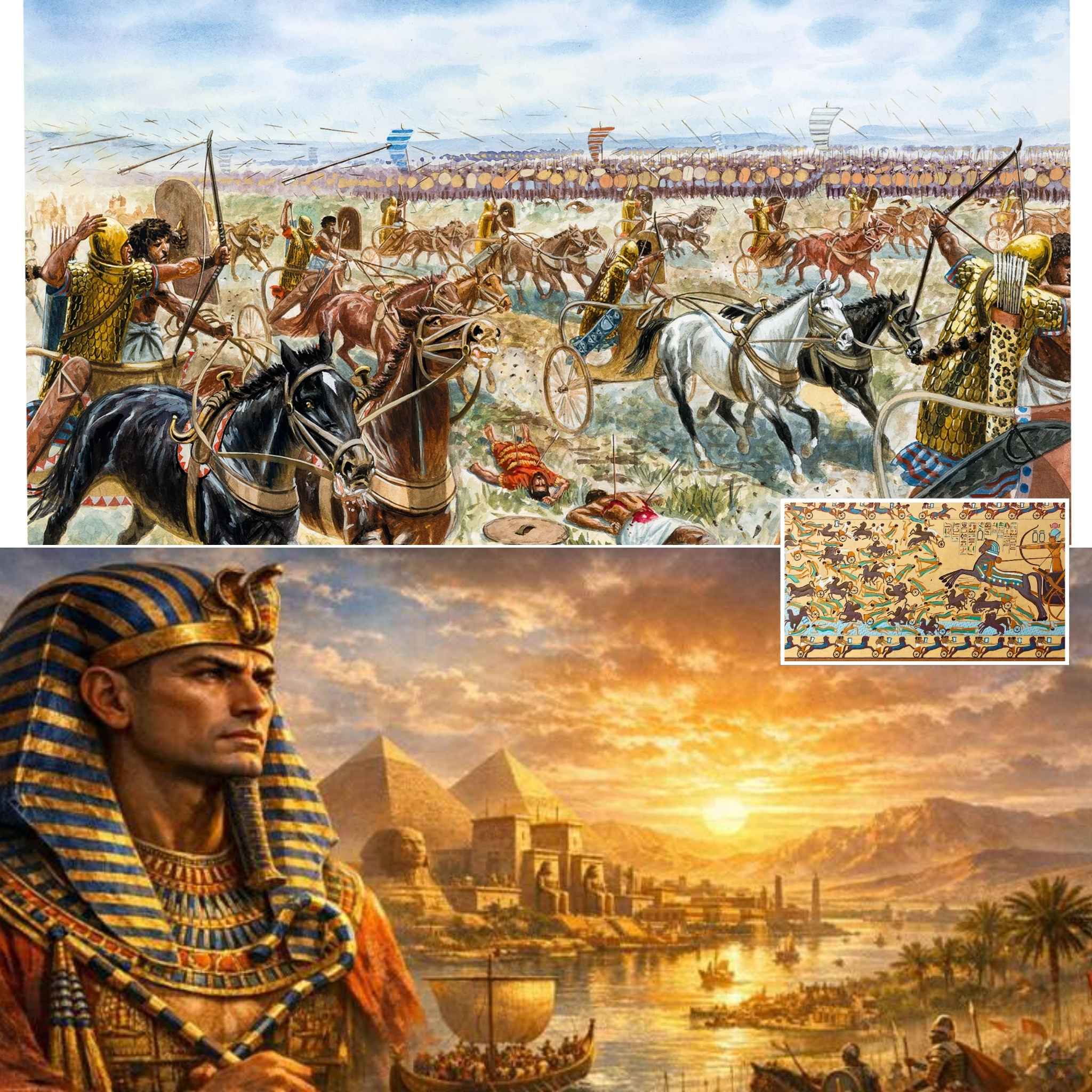
The Egyptian army crossed the Aruna pass in a single day and emerged unexpectedly into the Qina Valley near Megiddo.
The rebels were stunned.
Instead of meeting the Egyptians on the safer approaches, they suddenly found Thutmose’s forces directly in front of them.
At dawn the following day, the Egyptian army deployed into three divisions arranged in a crescent formation. Thutmose commanded the center personally, while the wings stretched north and south to outflank the enemy encampment.
The Karnak Annals describe the moment vividly:
“His Majesty was in their center, Amun protecting him in the fray.”
The attack shattered the coalition almost immediately.
Panic spread through the rebel camp. Soldiers fled toward the fortified walls of Megiddo while Egyptian troops stormed through their abandoned tents and chariots.
But then came a costly mistake.
Instead of immediately pursuing the fleeing enemy into the city, many Egyptian soldiers stopped to plunder the abandoned camp. Precious goods, horses, weapons, and golden chariots proved irresistible.
That pause allowed many rebel leaders to escape inside Megiddo’s walls.
Ancient Egyptian scribes later criticized the troops openly for this error, claiming the city might have fallen immediately had the soldiers maintained discipline.
Still, the Egyptians had won a decisive battlefield victory.


Seven Months of Siege
Megiddo itself remained unconquered.
The city’s defenders sealed the gates, trapping themselves inside while Egyptian forces surrounded them. According to Egyptian accounts, some fleeing commanders had to be pulled over the walls using ropes tied to their clothing because the gates had already been shut.
Unable to storm the fortress directly, Thutmose ordered a full siege.
Egyptian soldiers built fortifications using timber cut from nearby forests, effectively imprisoning the city. The pharaoh understood Megiddo’s enormous strategic value and reportedly declared:
“The capture of Megiddo is the capture of a thousand cities.”
For seven months the siege continued.
Eventually starvation, exhaustion, and hopelessness forced the city to surrender.
The ruler of Megiddo was captured. The leader of the coalition—the prince of Kadesh—managed to escape, but the rebellion itself had collapsed.
Thutmose III had passed his first great test.
The Spoils of Empire
The victory at Megiddo produced immense wealth.
Egyptian records list staggering quantities of captured goods:
- 924 chariots
- More than 2,000 horses
- Hundreds of suits of armor
- 502 composite bows
- Large herds of livestock
- Massive stores of grain and supplies
Many of the captured weapons represented advanced military technology imported from Mesopotamia and Syria. Composite bows, in particular, were highly prized because of their power and range.
The victory also delivered something even more important than treasure: prestige.
News of Thutmose’s triumph spread rapidly across the Near East. Foreign rulers began sending diplomats and lavish gifts to Thebes, hoping to maintain favorable relations with the newly dominant Egyptian king.
Egypt was no longer merely defending its borders.
It was becoming an empire.
Thutmose III Builds a Superpower
The Battle of Megiddo marked only the beginning of Thutmose III’s military career.
Over the following decades, he launched at least 16 additional campaigns into Syria and Mesopotamia. Egyptian armies captured strategic ports, secured trade routes, subdued rebellious city-states, and eventually crossed the Euphrates River to challenge the Mitanni Empire directly.
The campaigns transformed Egypt into the dominant military and economic power of the eastern Mediterranean.
Under Thutmose III:
- Egyptian influence stretched deeper into Asia than ever before
- Trade networks expanded dramatically
- Tribute from conquered territories enriched Egypt
- Foreign princes were educated in Egyptian courts
- Monumental building projects flourished across the Nile Valley
Many historians therefore describe Thutmose III as the “Napoleon of ancient Egypt,” though in reality Napoleon came more than 3,000 years later.
The Egyptian empire created under Thutmose would shape the political balance of the ancient Near East for generations.
The Mythmaking of Victory
The triumph at Megiddo also entered Egyptian cultural memory as legend.
One of Thutmose’s generals, Djehuty, later became the hero of an Egyptian tale known as The Taking of Joppa. In the story, Egyptian soldiers hide themselves inside baskets to infiltrate an enemy city—a plot device strikingly similar to the Trojan Horse centuries later in Greek mythology.
The parallels suggest Egyptian military storytelling may have influenced later Mediterranean legends.
Meanwhile, at Karnak, Thutmose filled temple walls with scenes of his victories. Reliefs showed the pharaoh towering above kneeling enemies, crushing them beneath his mace while the gods blessed his campaigns.
These images were not just historical records.
They were propaganda designed to present Thutmose as a divinely chosen conqueror.


One of History’s First Documented Battles
Modern historians continue to study the Battle of Megiddo because of the extraordinary level of detail preserved in Egyptian records.
Unlike many ancient conflicts that survive only through fragmented legends, Megiddo offers insight into:
- Military logistics
- Battlefield tactics
- Political strategy
- Siege warfare
- Propaganda and royal ideology
The campaign demonstrates that Egyptian armies were highly organized, strategically flexible, and capable of sustained operations far from home territory.
It also reveals the personality of Thutmose III himself.
The decision to march through the Aruna pass was bold, risky, and psychologically brilliant. By doing what his enemies considered impossible, the young pharaoh seized the initiative before the battle even began.
That single decision changed history.
Legacy of Megiddo
The victory at Megiddo transformed Egypt from a powerful kingdom into a true imperial state.
The campaign secured control over the Levant, expanded Egyptian trade, increased wealth flowing into the Nile Valley, and projected Egyptian influence deep into western Asia.
It also launched the career of one of antiquity’s most successful military leaders.
Even centuries later, Egyptian rulers looked back on Thutmose III as the model warrior king. His victories became symbols of divine favor, national strength, and imperial destiny.
Today, the ancient city of Megiddo remains one of the most important archaeological sites in the Near East. Layers of civilizations buried beneath the hill testify to its strategic significance across thousands of years.
But among all its wars and rulers, none left a greater mark than the campaign of a young pharaoh who dared to lead his army through a narrow mountain pass—and in doing so changed the balance of power in the ancient world forever.