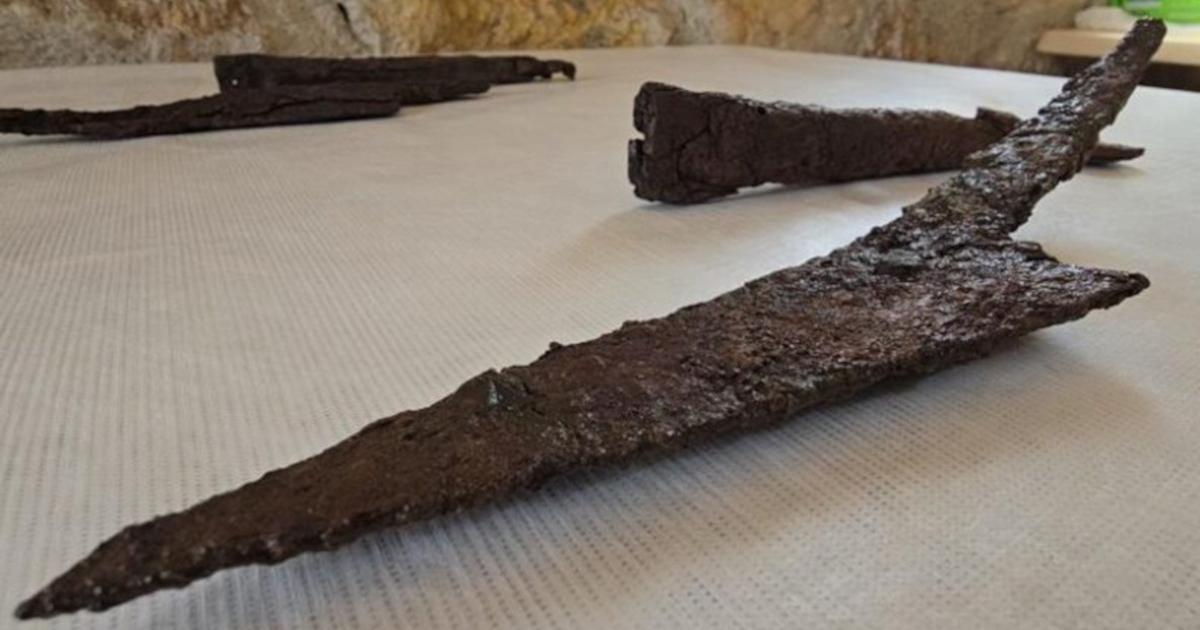
 Archaeologists working in northern Turkey have uncovered a rare 1,500-year-old knife set that is offering an extraordinary look into everyday life during the Late Roman and Early Byzantine periods.
The discovery was made in the ancient city of Hadrianopolis, a historic settlement often called the “Zeugma of the Black Sea” because of its remarkable mosaics and archaeological richness.
Researchers say the newly uncovered artifacts provide powerful evidence that livestock farming played a major role in the region’s economy more than a millennium ago.
A Rare Discovery Hidden Beneath an Ancient Settlement
The knife set was discovered during excavation work inside the Hammam Building Complex, an area believed to have served as a long-term settlement zone through several historical periods.
The excavation is being led by Ersin Çelikbaş from Karabük University.
According to archaeologists, the artifacts were uncovered in what appears to have once been the kitchen section of the complex.
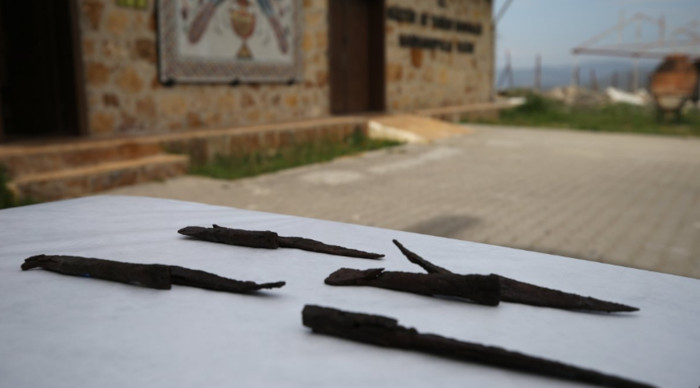 The find includes four iron knives of different sizes along with a traditional sharpening stone known locally as a “kösüre taşı.”
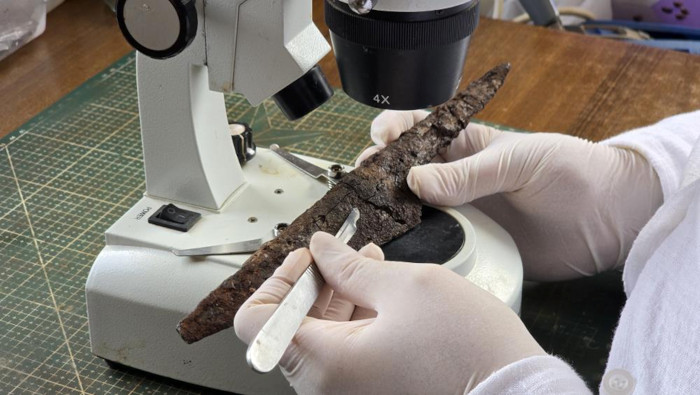
Although the knives were badly damaged when first discovered, researchers carefully restored them in the laboratory.
“When the knives were first uncovered, they were in nearly 250 fragments,” Professor Çelikbaş explained. “After detailed restoration work, we were able to reconstruct them into their original forms.”
Evidence of Ancient Livestock Farming
Experts believe the location and condition of the artifacts strongly suggest they were regularly used by families involved in animal husbandry.
The knives appear to have been practical tools connected to food preparation and livestock processing, reinforcing earlier archaeological evidence that the region supported intensive farming activities during the 5th and 6th centuries AD.
Researchers say the discovery helps confirm that communities living in Hadrianopolis relied heavily on raising animals as part of daily economic life.
The finding also offers a rare snapshot of ordinary people rather than elite rulers or military leaders, helping historians better understand how local families lived and worked during the Early Byzantine era.
 A Tradition That Survived for Centuries
One of the most intriguing discoveries was the sharpening stone found beside the knives.
The same type of stone was famously used in the region centuries later during the Ottoman period, suggesting that local sharpening techniques and agricultural traditions may have survived across generations for more than a thousand years.
This continuity highlights how certain practical customs remained deeply rooted in Anatolian communities despite major political and cultural changes over time.
Hadrianopolis Continues to Reveal Its Secrets
Often described as one of Turkey’s most important archaeological sites, Hadrianopolis has produced numerous discoveries in recent years, including mosaics, churches, baths, and residential structures from the Roman and Byzantine worlds.
Archaeologists say the latest discovery adds another important layer to the city’s history by revealing the practical realities of everyday survival, food preparation, and rural life in ancient Anatolia.
As restoration and excavation work continues, researchers believe Hadrianopolis may still hold many more clues about how ordinary communities lived nearly 1,500 years ago.