For much of modern history, the idea of the “family” has been tightly bound to biology: parents, children, and lineage traced through bloodlines. Blended families, adoption, fostering, and long-term social parenting have often been framed as relatively recent social developments tied to urbanization and modern legal systems.

But a groundbreaking wave of ancient DNA research is now forcing archaeologists to rethink that assumption entirely. A large-scale genetic study of Neolithic burial sites in Central Europe suggests that what we would today call “patchwork families” were not only common, but may have been a foundational feature of early farming societies more than 5,000 years ago.
Instead of neatly structured biological households, these prehistoric communities appear to have organized life—and death—around flexible social bonds, where kinship was defined as much by shared experience and community identity as by genetics.
A Revolution Hidden Inside Stone Tombs
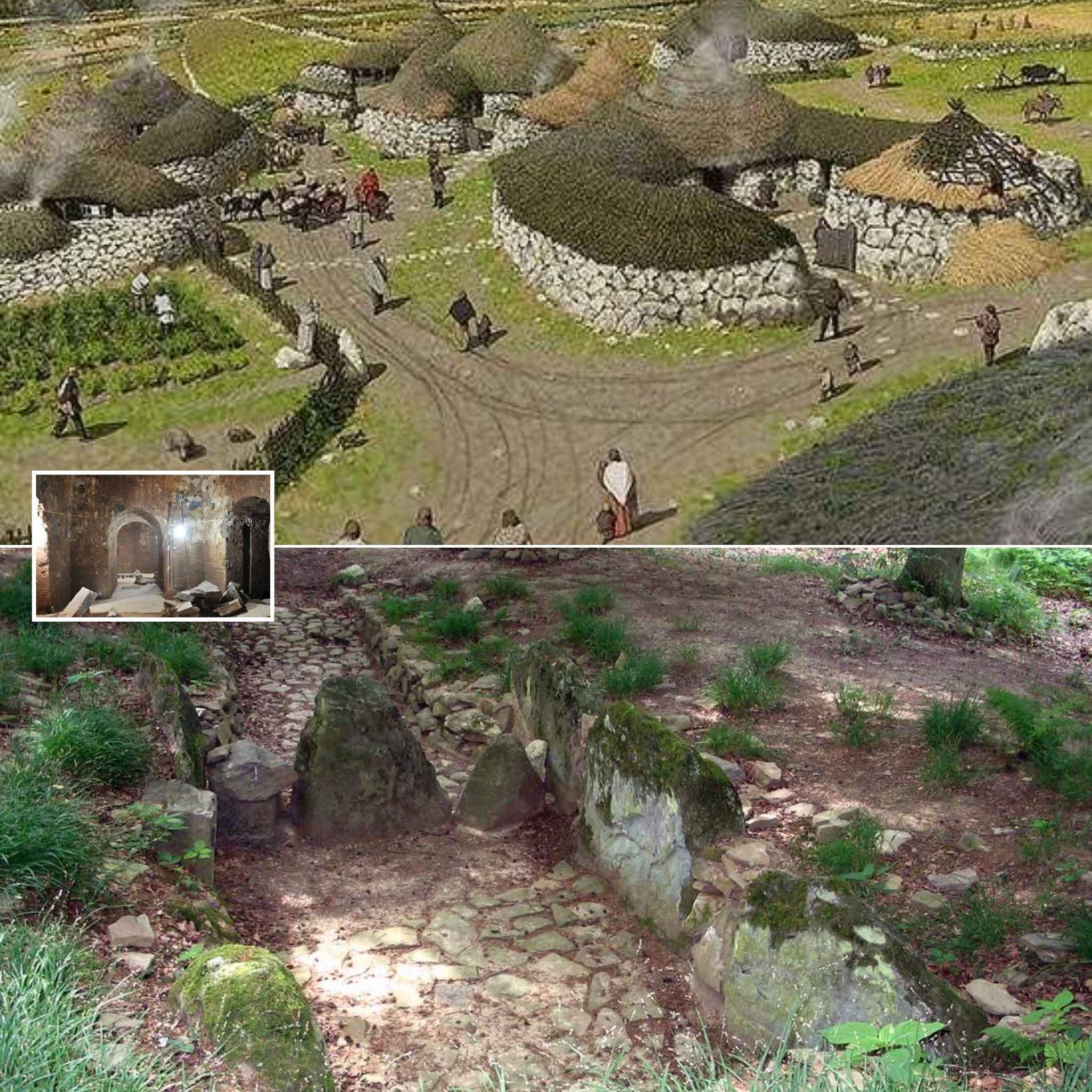
The turning point for this discovery comes from a major international research project analyzing ancient genomes from megalithic burial complexes associated with the Wartberg culture in what is now Germany. Published in Science, the study examined DNA from 203 individuals buried across six Neolithic sites spanning Lower Saxony, Hesse, and North Rhine-Westphalia.
These communities lived during the late Neolithic period, when Europe was undergoing profound transformation: farming was well established, settlements were expanding, and monumental architecture—especially megalithic stone tombs—was reshaping how people understood death, ancestry, and belonging.
What the genetic data revealed, however, was not a rigid system of inherited elite family tombs or strictly biological dynasties. Instead, it showed something far more complex and surprisingly modern in its social flexibility.
Many individuals buried together were not closely related at all.
That single finding has reshaped how archaeologists interpret Neolithic society.
Rethinking Kinship in Early Farming Communities
At first glance, megalithic tombs across Europe appear to reflect collective burial practices: groups of people laid to rest together inside shared stone chambers. For decades, archaeologists assumed that these groups represented extended biological families or lineage-based clans.
But ancient DNA has changed that narrative.
In the Wartberg sites, researchers found that many individuals buried side by side had no detectable close genetic relationship. Instead of strict family plots, the tombs appear to represent socially constructed communities—groups bound by residence, cooperation, and shared identity rather than blood alone.
This suggests that prehistoric farming villages may have been far more socially dynamic than previously believed.
People joined communities through movement, marriage, adoption-like practices, or long-term social integration. The dead were then buried according to those social bonds, not strictly biological descent.
In effect, Neolithic burial practices were recording a social world that modern assumptions had largely missed.
Long-Distance Mobility and Hidden Networks
One of the most striking findings came from evidence of long-distance kinship connections stretching across hundreds of kilometers.
In one case, researchers identified a biological father buried in one tomb and his son buried approximately 250 kilometers away in another megalithic site. This confirmed that individuals were not only mobile within regions—they were part of interlinked networks spanning vast distances across Neolithic Central Europe.
Such mobility is particularly surprising given the technological limitations of the time. This was a world before domesticated horses were widely used for transport in the region, meaning that movement over such distances required sustained effort, planning, and social motivation.
It suggests that Neolithic Europe was not a patchwork of isolated villages, but rather a deeply interconnected landscape of human movement, exchange, and alliance-building.


Women on the Move: A Different Pattern of Society
Another key insight from the genetic data involves gendered mobility.
The study suggests that women and girls were particularly likely to move between communities during their lifetimes. Rather than remaining within a single natal group, many appear to have relocated to new settlements, forming new social bonds and integrating into different burial communities.
This pattern challenges older assumptions that prehistoric societies were rigidly patrilocal (where women always remain in their birth community).
Instead, the evidence points to a flexible social system where movement was common and socially accepted—possibly linked to marriage exchange systems, alliance formation, or broader economic cooperation between groups.
In this sense, Neolithic Europe may have functioned less like isolated villages and more like a networked social ecosystem.
Megaliths as Social Spaces, Not Just Tombs
Megalithic burial chambers—large stone structures built to house the dead—have long fascinated archaeologists. Traditionally interpreted as ancestral monuments for powerful families, they are now increasingly understood as communal spaces that reflected broader social realities.
In the Wartberg culture, these tombs appear to have functioned as shared resting places for socially defined groups, not exclusively biological ones.
This interpretation is supported by the absence of clear dynastic clustering. Unlike later elite tomb systems in ancient civilizations such as Egypt or Mesopotamia, there is little evidence that burial placement in these European tombs was determined by hereditary hierarchy.
Instead, the arrangement of the dead seems to reflect inclusion within a social group at the time of death—who belonged, rather than who was born into the right family.
This has profound implications for how we understand the emergence of inequality, hierarchy, and political organization in prehistoric Europe.
A Patchwork of Families, Not a Single Lineage
One of the most important conclusions of the study is that Neolithic communities in Central Europe often resembled what modern sociology would call “blended” or “patchwork” families.
Within a single burial chamber, researchers identified:
- Individuals with no close genetic relationship
- Children buried alongside non-biological adults
- Complex kinship networks spanning multiple tombs
- Evidence of repeated integration of outsiders into local communities
This suggests that family structures were fluid and adaptive.
Rather than relying exclusively on biological descent, these societies appear to have defined kinship through:
- Shared residence
- Social obligation
- Long-term caregiving relationships
- Inter-community alliances
In other words, “family” was something actively constructed rather than simply inherited.
Inside the DNA: Reconstructing 5,000-Year-Old Lives
The study relied on advances in ancient DNA sequencing, allowing researchers to reconstruct genetic relationships from highly degraded skeletal remains.
By comparing genomes across burial sites, scientists were able to identify patterns of relatedness—or lack thereof—between individuals.
One of the most surprising outcomes was how often individuals buried together were not genetically related in any close sense. This was not an occasional anomaly but a repeated pattern across multiple sites.
At the same time, genetic links between distant tombs revealed that biological families were often distributed across multiple communities.
Together, these findings paint a picture of a society where biological and social structures were deliberately decoupled.
The Archaeological Context: Life in the Wartberg Culture
The Wartberg culture flourished during the late Neolithic period in Central Europe. These communities were part of a broader transformation in human history: the shift from mobile hunter-gatherer groups to settled agricultural societies.
They built monumental stone tombs, practiced mixed farming, and maintained regional networks of exchange.
Yet despite these developments, they did not appear to develop rigid hereditary elite systems—at least not in the way seen in later ancient civilizations.
Instead, their social organization seems to have been remarkably flexible.
This flexibility may have been essential for survival. Farming communities depended on cooperation: shared labor, collective storage, and coordinated resource management. Flexible family structures may have helped integrate newcomers, strengthen alliances, and stabilize small but growing populations.


Cultural Exchange Without Mass Migration
Another major finding from the study challenges the idea that cultural change in prehistoric Europe always required large-scale population movement.
By comparing genetic data from Wartberg sites with other megalithic cultures across Europe, researchers found that similar burial traditions did not always correspond to shared ancestry.
This suggests that ideas—such as monument building, burial customs, and ritual practices—were transmitted culturally rather than genetically.
In other words, people adopted practices from neighboring groups without necessarily intermarrying or migrating in large numbers.
This highlights a key feature of Neolithic Europe: it was not only genetically diverse, but culturally interconnected.
Rethinking Inequality in Prehistoric Societies
Perhaps one of the most important implications of this research is what it reveals about social hierarchy.
Many models of human civilization assume that as societies grow more complex, inequality increases. Elites emerge, wealth concentrates, and social stratification becomes more rigid.
But the Wartberg evidence complicates this assumption.
While inequality certainly existed in some Neolithic societies, these Central European communities appear to have maintained relatively fluid social boundaries within burial contexts. There is little sign that biological lineage alone determined status or burial rights.
Instead, social inclusion appears to have been more important than inherited rank.
This does not mean these societies were “equal” in a modern sense. But it does suggest that inequality was not the inevitable outcome of early social complexity.
A Different Model of the Past—and the Present
Taken together, the genetic evidence from Neolithic Central Europe paints a picture of prehistoric life that is far more dynamic than earlier models suggested.
These were not simple farming villages organized around rigid family trees. They were mobile, interconnected communities where people moved frequently, formed new bonds, and integrated outsiders into shared social systems.
Family, in this context, was not a fixed biological structure—it was a living social agreement.
And in many ways, this makes Neolithic societies feel unexpectedly modern.
They challenge the idea that “traditional” family structures have always been static or biologically defined. Instead, they reveal that flexibility, adaptation, and social bonding beyond bloodlines have deep roots in human history.
What Comes Next for Ancient DNA Research?
As genetic techniques continue to improve, archaeologists expect even more detailed reconstructions of prehistoric social life.
Future research may help answer questions such as:
- How were children integrated into non-biological households?
- What roles did adoption or fostering-like systems play?
- How were alliances formed between distant communities?
- Did social structure change during times of climate stress or migration?
Each new dataset adds another layer to the emerging picture of Neolithic Europe—not as a static prelude to civilization, but as a complex social world in its own right.
Conclusion: The Family Was Never Just One Thing
The discovery of “patchwork families” in Neolithic Europe forces a reevaluation of one of the most fundamental assumptions about human society: that family equals biology.
Five thousand years ago, people were already building communities that transcended genetic ties. They cared for children who were not their own, buried their dead according to social belonging rather than ancestry, and maintained networks that stretched across vast distances.
In doing so, they created a social world that was flexible, interconnected, and surprisingly modern in its structure.
The DNA from ancient bones is not just revealing who these people were—it is revealing how deeply human the need for belonging has always been.