THE SKY ENGINEERS: A SCI-FI REIMAGINING OF THE WRIGHT BROTHERS AND THE FIRST FLIGHT PROTOCOL
In the final years of the 19th century, the Earth was still learning the shape of its own sky.
It did not yet understand that air could be negotiated with—only that it resisted everything. Every attempt to rise into it had ended in bruised bodies, shattered wood, and the quiet embarrassment of gravity reaffirming its ancient authority.
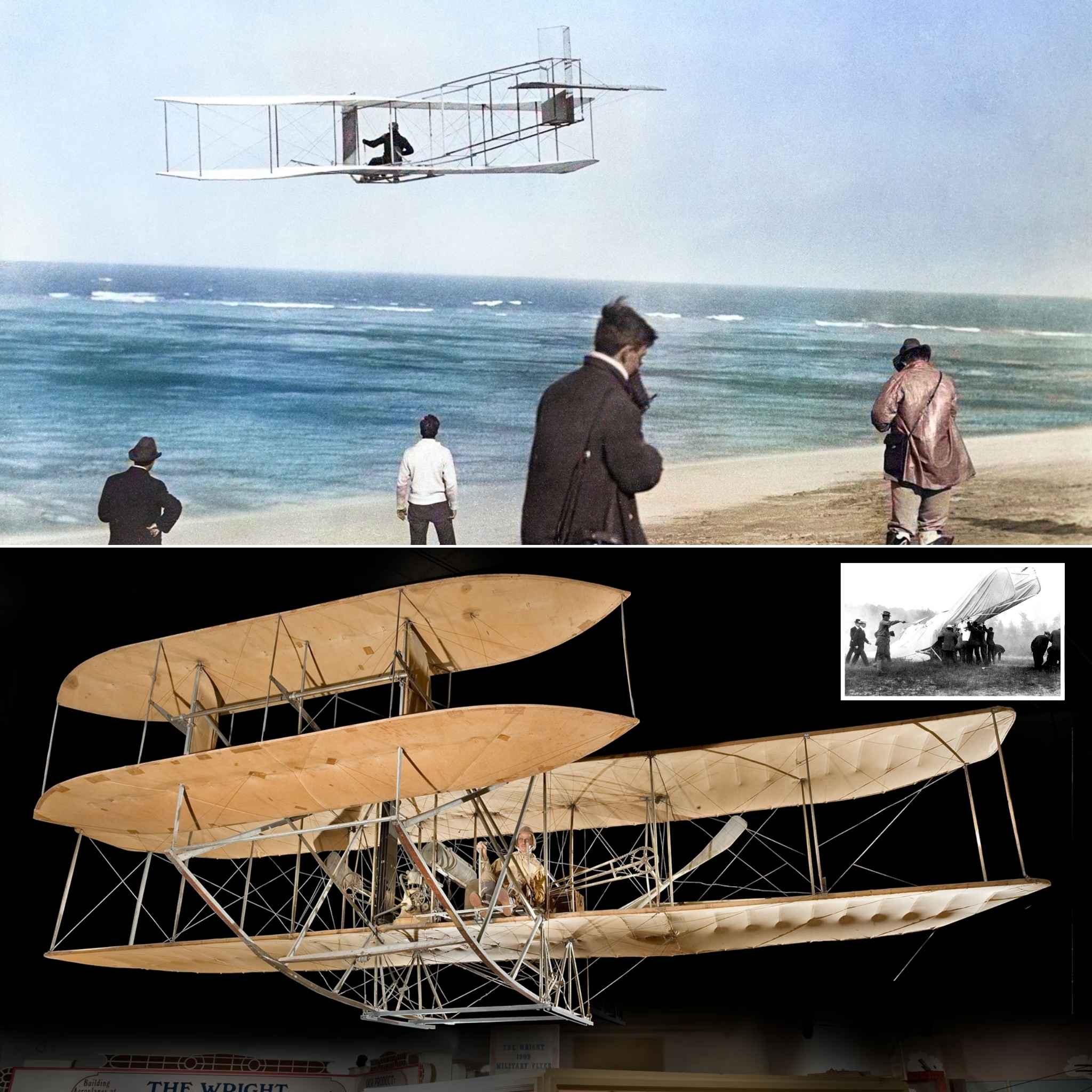
But in Dayton, Ohio, two brothers were about to treat the atmosphere not as a barrier… but as a system that could be decoded.
Wilbur and Orville Wright were not dreamers in the traditional sense.
They were engineers who had not yet been told that the sky was impossible.
I. THE DUNES WHERE GRAVITY LEAKED
Kitty Hawk, North Carolina, was not chosen for beauty.
It was chosen because reality behaved strangely there.
The wind came in from the Atlantic like an unsolved equation—steady, abrasive, almost intelligent. Sand dunes shifted daily, erasing footprints as if refusing memory itself.
To the Wright brothers, this was not wilderness.
It was a laboratory.


In this unstable landscape, the brothers tested machines that looked less like inventions and more like compromises between biology and mechanics.
Their gliders did not simply fly.
They argued with the air.
Wilbur lay prone in the frame, adjusting his body as if he were tuning a musical instrument that only wind could hear. Orville stood nearby, reading the sky the way others read weather reports—except to him, pressure was language.
They discovered something no institution had yet formalized:
The sky was not empty.
It was structured.
And structure could be mapped.
II. THE WIND TUNNEL AND THE BIRTH OF CONTROL THEORY
Back in Dayton, the brothers stopped trying to fly.
They began trying to understand lift as a controllable force.
Inside a bicycle shop that smelled of oil, wood dust, and stubbornness, they built a device that would quietly alter human history: a wind tunnel.
It was not impressive to look at. A wooden box. A fan. Instruments salvaged from bicycles and machining tools.
But inside it, air became measurable.


They tested wing shapes the way other men tested faith.
Flat wings failed.
Curved wings responded.
And in that curve, they found something like permission.
Otto Lilienthal’s death years earlier had been treated as tragedy. To the Wright brothers, it was corrupted data—an incomplete system that needed correction.
Wilbur began to see flight not as defiance of gravity, but as continuous negotiation with it.
Orville, more tactile, began building machines that could survive that negotiation.
Together, they built a doctrine:
- Lift could be calculated
- Control mattered more than power
- Stability was not natural—it was engineered
This was not aviation.
It was early aerospace cognition.
III. THE MACHINE THAT LEARNED THE AIR
By 1903, the brothers had created something that frightened them more than it excited them.
The Wright Flyer was not simply a vehicle.
It behaved like a system that responded to its operator with delayed understanding.
Wood, fabric, chain, engine—assembled into a fragile geometry that seemed to hesitate before obeying commands.
When they brought it back to Kitty Hawk, the air felt different.
Not calmer.
More aware.
On December 17, 1903, the machine lifted for twelve seconds.
Twelve seconds in which humanity briefly stopped being bound to the surface of the Earth.


The first flight was not celebrated.
It was recorded.
Then questioned.
Then dismissed.
Then, slowly, it became undeniable.
Because the machine kept working.
And machines that keep working eventually rewrite belief.
IV. THE SILENCE BETWEEN INVENTIONS
After 1903, the Wright brothers did something unexpected.
They stopped flying publicly.
Not because they had failed.
Because they had succeeded too early.
They understood a dangerous truth:
If others saw the system too soon, they would replicate it without understanding it.
And replication without comprehension leads to collapse.
So they refined in silence.
At Huffman Prairie—an Ohio pasture where cows grazed unaware of their role in technological history—the brothers began teaching their machines to do something new:
Stay airborne while obeying human intention.
Circles.
Turns.
Controlled descent.
Recovery.
This was no longer flight.
This was aerial navigation.
And it required a new kind of pilot.
Someone who could think in three dimensions while suspended inside instability.
V. THE SKY BECOMES A MARKETPLACE
By 1908, the sky was no longer empty.
It was contested.
France, Germany, Britain—all were building their own interpretations of flight. Some believed engines were the key. Others believed spectacle was enough.
But the Wright machine was different.
It did not merely rise.
It obeyed.
That difference made it dangerous.


When Orville demonstrated the aircraft at Fort Myer, observers did not feel awe first.
They felt uncertainty.
Because the machine’s precision suggested something unsettling:
Flight was no longer experimental.
It was becoming industrial.
And anything industrial can scale.
VI. THE FIRST PASSENGER PROTOCOL
Then came Wilbur’s demonstration in France.
Le Mans.
A racetrack converted into a temporary runway for humanity’s most fragile machine.
Crowds gathered expecting failure.
They received control.
Wilbur’s aircraft moved like a thought being tested in real time.
Turns were not dramatic.
They were precise.
Aviation was no longer spectacle.
It was execution.
When Wilbur lifted into a figure-eight pattern, something shifted in human psychology.
The sky stopped being symbolic.
It became operational space.
VII. THE FRACTURE EVENT
Not all systems survive contact with reality unchanged.
At Fort Myer, the Wright machine encountered instability.
A propeller failure. A sudden imbalance. A loss of control.
The aircraft descended too fast.
It struck the ground.
Lieutenant Thomas Selfridge became the first human casualty of powered flight.
The system had proved itself.
And then it had proven its cost.


Afterward, Orville lay injured for weeks.
But the machine was not abandoned.
Because it was no longer just a machine.
It was infrastructure in its earliest, most violent form.
VIII. THE SKY ENGINEERS’ FINAL MODEL
By 1909, the system stabilized.
The Wright aircraft evolved into something the military could integrate.
It was no longer experimental.
It was functional.
It carried passengers. Observers. Officers.
It met speed thresholds. Endurance thresholds. Reliability thresholds.
In other words:
It became a technology the world could trust.
And once trust enters a system, scaling becomes inevitable.
IX. THE FIRST ARMY AIRFRAME
When the U.S. Army accepted the Wright machine as Signal Corps No. 1, something unprecedented occurred:
A government formally adopted the sky as operational territory.
This was not invention anymore.
It was annexation.
A new domain had been claimed—not land, not sea, but atmosphere itself.
And the Wright brothers, once bicycle mechanics, had become the architects of that domain.
X. WHAT THE SKY REMEMBERED
Modern historians often describe the Wright brothers as inventors of the airplane.
But that framing is incomplete.
They were not inventors of flight.
They were the first engineers to treat the atmosphere as a system that could be modeled, corrected, and stabilized.
Flight existed before them—in birds, in myth, in failed machines.
What they introduced was control architecture.
A feedback loop between human intention and aerodynamic response.
A contract with instability.
And once that contract was signed, humanity could no longer remain grounded in the same way.
XI. EPILOGUE: THE SKY DOES NOT FORGET
The Wright Flyer now rests in a museum.
Its wood has aged. Its fabric has stiffened. Its chains no longer move.
But the principle it represents is still active.
Every aircraft that follows is part of the same protocol:
Lift. Balance. Control. Repeat.
The sky, once an unreachable abstraction, is now a regulated environment filled with machines that inherit the logic of two brothers who refused to accept impossibility.
And if you listen closely—inside the hum of modern aviation—you can still hear the earliest version of their experiment:
A bicycle shop.
A wind tunnel.
A dune field where gravity briefly hesitated.
And two men who decided that the sky was not the end of Earth…
…but the beginning of its second system.