Tudor Heart: The Golden Necklace That Preserved the Lost Love Story of Henry VIII and Katherine of Aragon
For nearly five centuries, it lay hidden beneath mud and stagnant water, untouched by the storms of history that erased kingdoms, shattered marriages, and transformed England forever.
Then, one ordinary day in central England, a metal detector emitted a sharp signal beside the remains of a dried pond. What emerged from the earth was not simply a piece of jewelry. It was a glittering relic from one of the most dramatic royal romances in European history: a magnificent Tudor-era gold necklace celebrating the union of King Henry VIII and Katherine of Aragon.
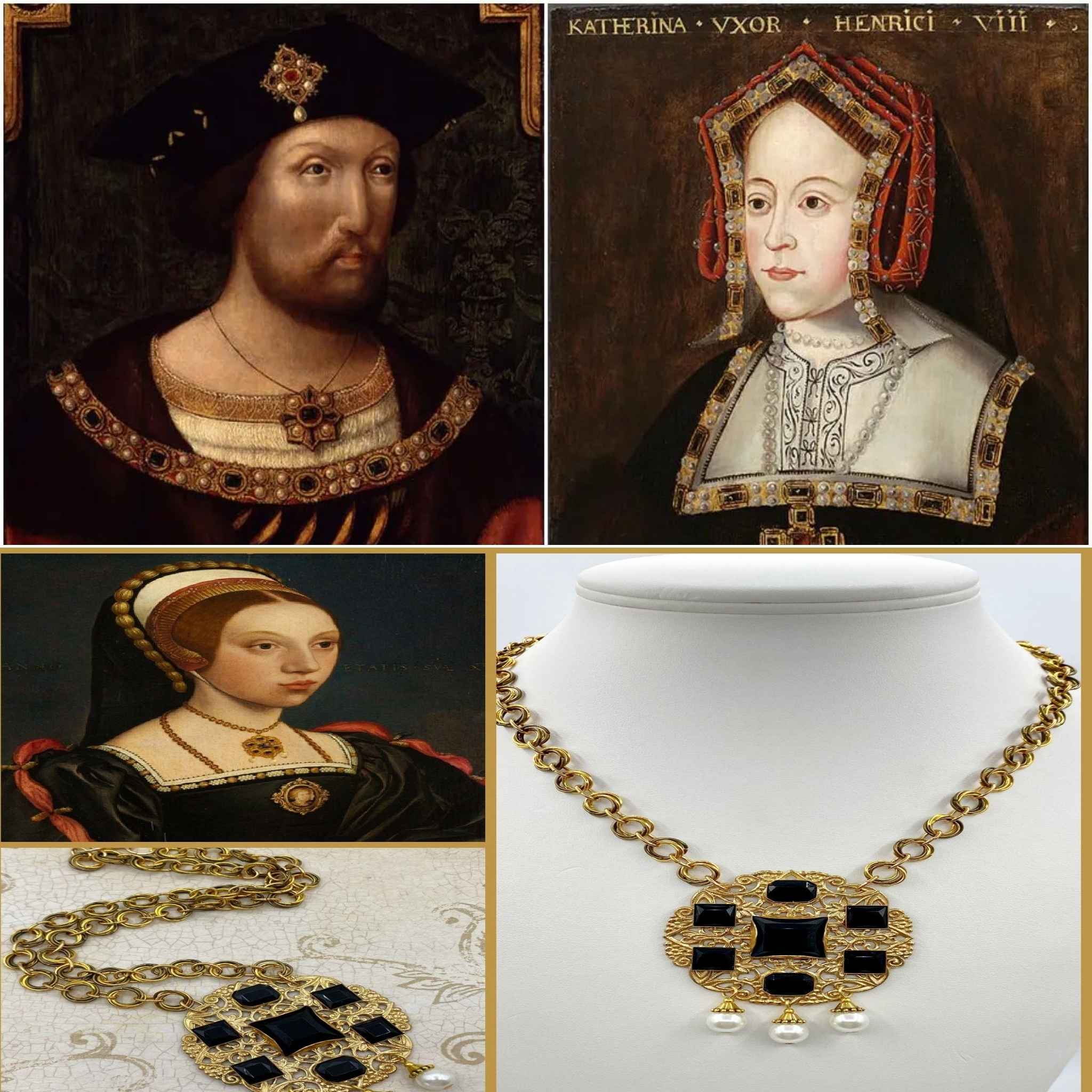
The object, now known as the Tudor Heart, is among the rarest survivals from the early Tudor court. Crafted from nearly pure gold and decorated with symbols of dynastic unity, love, and political ambition, the necklace appears to preserve a moment before Henry VIII’s marriage collapsed into scandal, religious revolution, and national upheaval.
Its heart-shaped pendant carries intertwined initials, royal emblems, and a cryptic French-English pun that may once have proclaimed eternal devotion between England’s king and queen.
Today, historians view the discovery as one of the most important Tudor jewelry finds in modern British archaeology.
A Treasure in the Mud
The Tudor Heart was discovered unexpectedly in a dried-up pond in Warwickshire, England, by a metal detectorist surveying farmland. Buried for centuries beneath layers of sediment, the necklace survived in astonishing condition.
Experts later confirmed that the jewel dated to the early 16th century, placing it firmly within the reign of Henry VIII and during his marriage to Katherine of Aragon.
The necklace immediately stunned researchers.
Very little jewelry from the Tudor royal court survives today. Goldsmiths frequently melted older treasures down to create newer pieces as fashions changed or political fortunes shifted. During Henry VIII’s reign especially, objects associated with disgraced figures could be deliberately destroyed.
Katherine of Aragon herself fell from favor after Henry sought to annul their marriage in the 1530s. Many royal possessions linked to her disappeared in the political and religious chaos that followed.
That makes the Tudor Heart extraordinarily rare.
It preserves not only Tudor craftsmanship, but also a vanished emotional and political world — the era before England broke from the Catholic Church and before Henry VIII became infamous for his six marriages.
The Necklace Itself


The Tudor Heart consists of three major components: a heavy gold chain, a decorative clasp, and a remarkable heart-shaped pendant.
The chain itself is made from 75 intricately linked pieces of 24-karat gold. Measuring approximately 17.1 inches (43.4 centimeters) long and weighing around 9.4 ounces (267 grams), it reflects immense wealth and elite status.
The clasp is equally symbolic.
Fashioned in the shape of a hand emerging from a cloud, it appears to represent divine blessing or heavenly union — imagery common in Renaissance art and royal symbolism.
Suspended beneath it hangs the pendant that gives the object its name.
The heart-shaped ornament measures roughly 2.3 inches (5.9 centimeters) tall and weighs 1.8 ounces (50 grams). Both sides are richly decorated with enamel and engraved symbolism.
One side features a white-and-red Tudor rose intertwined with a pomegranate branch.
These were not random floral motifs.
The Tudor rose represented the ruling English dynasty established after the Wars of the Roses, while the pomegranate symbolized Katherine of Aragon and her Spanish heritage. The fruit had become closely associated with Katherine after her arrival in England.
Together, the two symbols form a visual declaration of dynastic unity — England and Spain joined through marriage.
The reverse side is even more personal.
It bears the initials “H” and “K” joined together by a tasseled cord, representing Henry and Katherine bound in union.
Around the pendant appears the word toujours — French for “always.”
Yet historians believe the inscription may contain a clever bilingual pun. Spoken aloud, the spacing of the word can sound like “tous yours,” blending French and English into the phrase “all yours.”
The necklace may therefore have carried a double meaning:
“Always.”
And also:
“All yours.”
The Golden Couple
To understand the emotional power of the Tudor Heart, one must understand the extraordinary political importance of Henry VIII and Katherine of Aragon’s marriage.
When Katherine first arrived in England in 1501, she was intended not for Henry, but for his older brother, Prince Arthur. Their marriage was designed to cement an alliance between England and Spain, two emerging European powers.
But tragedy struck quickly.
Arthur died only months after the wedding, leaving Katherine widowed in a foreign land.
For years, diplomatic uncertainty surrounded her future. Eventually, Henry VII arranged for Katherine to marry his second son instead.
When Henry VIII became king in 1509, he married Katherine almost immediately.
At first, the union appeared remarkably successful.
Henry was young, charismatic, athletic, and admired across Europe. Katherine was intelligent, politically experienced, deeply religious, and highly respected. Together they represented one of Europe’s most powerful royal partnerships.
The early Tudor court celebrated them as the ideal Renaissance monarchs.
The Tudor Heart likely emerged during this optimistic period — a time when Henry and Katherine were still viewed as inseparable symbols of dynastic stability and divine favor.
Jewelry as Political Propaganda


In the Tudor era, jewelry was never merely decorative.
Royal accessories communicated political messages, dynastic loyalties, religious beliefs, and social status. Goldsmiths functioned almost like propagandists, embedding meaning into every gemstone, symbol, and inscription.
The Tudor Heart appears designed to broadcast allegiance to Henry VIII and Katherine.
But intriguingly, historians do not believe the king or queen actually owned it.
The necklace does not appear in surviving royal inventories, despite detailed records of Tudor treasures. This absence suggests the object may instead have belonged to a noble supporter or courtier.
One theory proposes that the necklace was commissioned to celebrate the 1518 betrothal of Princess Mary — the only surviving child of Henry and Katherine — to the French Dauphin, Francis III.
Although the engagement eventually collapsed, the proposed alliance represented a major diplomatic achievement at the time.
Another theory suggests the necklace may have been awarded during a royal tournament or jousting event.
Its design seems intended for visibility from a distance, and some scholars note that while the gold quality is exceptional, the craftsmanship itself is slightly less refined than the finest royal jewels.
That could indicate the object was ceremonial rather than intimate — a public statement of loyalty and prestige.
Katherine’s Pomegranate
One of the most fascinating details of the necklace is its repeated use of the pomegranate.
The fruit had deep significance for Katherine of Aragon.
In Spain, the pomegranate symbolized Granada, the last Muslim kingdom conquered during the Reconquista. It therefore represented both Spanish unity and Christian triumph.
Katherine adopted the fruit as her personal emblem after arriving in England.
The symbolism worked beautifully in Tudor imagery. The many seeds inside the fruit suggested fertility, prosperity, and dynastic abundance — crucial themes for a queen expected to produce heirs.
But history turned cruelly ironic.
Although Katherine became pregnant multiple times, most of her children died young. Only Princess Mary survived infancy.
Henry VIII grew increasingly desperate for a male heir.
Eventually, his obsession with securing succession led him to seek an annulment from Katherine — a request the Pope refused to grant.
The result would change Europe forever.
The Divorce That Shattered England
By the late 1520s, Henry VIII had fallen in love with Anne Boleyn and become convinced that his marriage to Katherine was cursed.
He argued that marrying his brother’s widow violated biblical law.
Katherine fiercely rejected the claim.
For years, Europe watched as Henry attempted to persuade the papacy to annul the marriage. But Katherine’s nephew happened to be the powerful Holy Roman Emperor Charles V, making the issue politically explosive.
When the Pope resisted, Henry took a radical step.
He broke England away from the authority of Rome and established the king as supreme head of the English Church.
The English Reformation had begun.
Katherine was stripped of her royal title and isolated from court. Princess Mary was declared illegitimate.
The once-celebrated union symbolized by the Tudor Heart collapsed into bitterness and national transformation.
That history gives the necklace an almost haunting quality.
What once proclaimed eternal devotion became a relic of a marriage destroyed by ambition, politics, and obsession.
Survival Through Centuries


The survival of the Tudor Heart is remarkable in itself.
Most Renaissance jewelry vanished long ago. Gold objects were routinely melted, recycled, or refashioned as political regimes changed and fashions evolved.
Objects associated with Katherine of Aragon became especially vulnerable after her downfall.
The necklace somehow escaped destruction.
Perhaps it was lost accidentally during travel or ceremonial activity. Perhaps it was hidden intentionally during political unrest. Or perhaps it slipped unnoticed into muddy water centuries ago and remained untouched ever since.
Its burial may have saved it.
The oxygen-poor environment of the pond helped preserve the gold and enamel while shielding the necklace from looters and later recycling.
Today, the object offers historians a direct connection to the emotional world of the Tudor court.
Unlike official portraits or political records, jewelry often reveals deeply personal messages. The intertwined initials, the romantic motto, the symbolic flowers — all suggest intimacy and hope rather than royal propaganda alone.
A Window Into Tudor Identity
The Tudor Heart also reveals how interconnected Renaissance Europe had become.
The necklace combines English heraldry, Spanish symbolism, French language, Christian imagery, and Renaissance craftsmanship into a single object.
It reflects a cosmopolitan royal court where diplomacy, fashion, and politics crossed borders constantly.
Henry VIII’s England was not yet the isolated Protestant power it would later become.
Instead, it remained deeply tied to continental Europe through dynastic marriage and shared aristocratic culture.
The necklace embodies that lost world.
Its French pun, Spanish pomegranate, and English rose together tell a story not only of love, but of international alliance and political ambition.
The Human Story Behind the Gold
Perhaps the greatest power of the Tudor Heart lies in its humanity.
History often remembers Henry VIII as a tyrant obsessed with wives and succession. Katherine of Aragon is frequently remembered mainly as the discarded queen.
But the necklace reminds us there was once genuine affection between them.
For more than two decades, Henry and Katherine appeared devoted partners. Contemporary observers often praised their closeness. Katherine even ruled as regent while Henry campaigned in France.
The Tudor Heart likely dates from that earlier chapter — before betrayal, annulment, and religious revolution consumed their marriage.
The inscription “always” now feels painfully ironic.
Yet that irony makes the artifact even more compelling.
It preserves a frozen moment before history unraveled.
A Jewel That Outlived a Kingdom’s Illusions
Today, the Tudor Heart stands as far more than a beautiful Renaissance ornament.
It is a surviving witness to one of the most consequential royal relationships in European history — a marriage that transformed England politically, religiously, and culturally.
The necklace captures the optimism of the early Tudor age: the belief that dynastic unions could secure peace, prosperity, and permanence.
But it also reminds us how fragile those dreams can be.
Empires rise and fall. Marriages collapse. Religions divide nations. Yet somehow, beneath centuries of mud and silence, a small golden heart endured.
And in its intertwined symbols, it still whispers the promise once believed eternal:
Always.