Brazil Lost 80 Percent of Its National Museum Collection in One Night. Now It’s Fighting to Rebuild a Civilization’s Memory
On the night of September 2, 2018, flames consumed one of the greatest cultural institutions in the Americas.
As fire spread through the grand halls of Rio de Janeiro’s National Museum, windows exploded outward into the darkness. Ancient artifacts collapsed into ash. Fossils cracked beneath impossible heat. Entire languages, preserved only in fragile audio archives, disappeared forever.
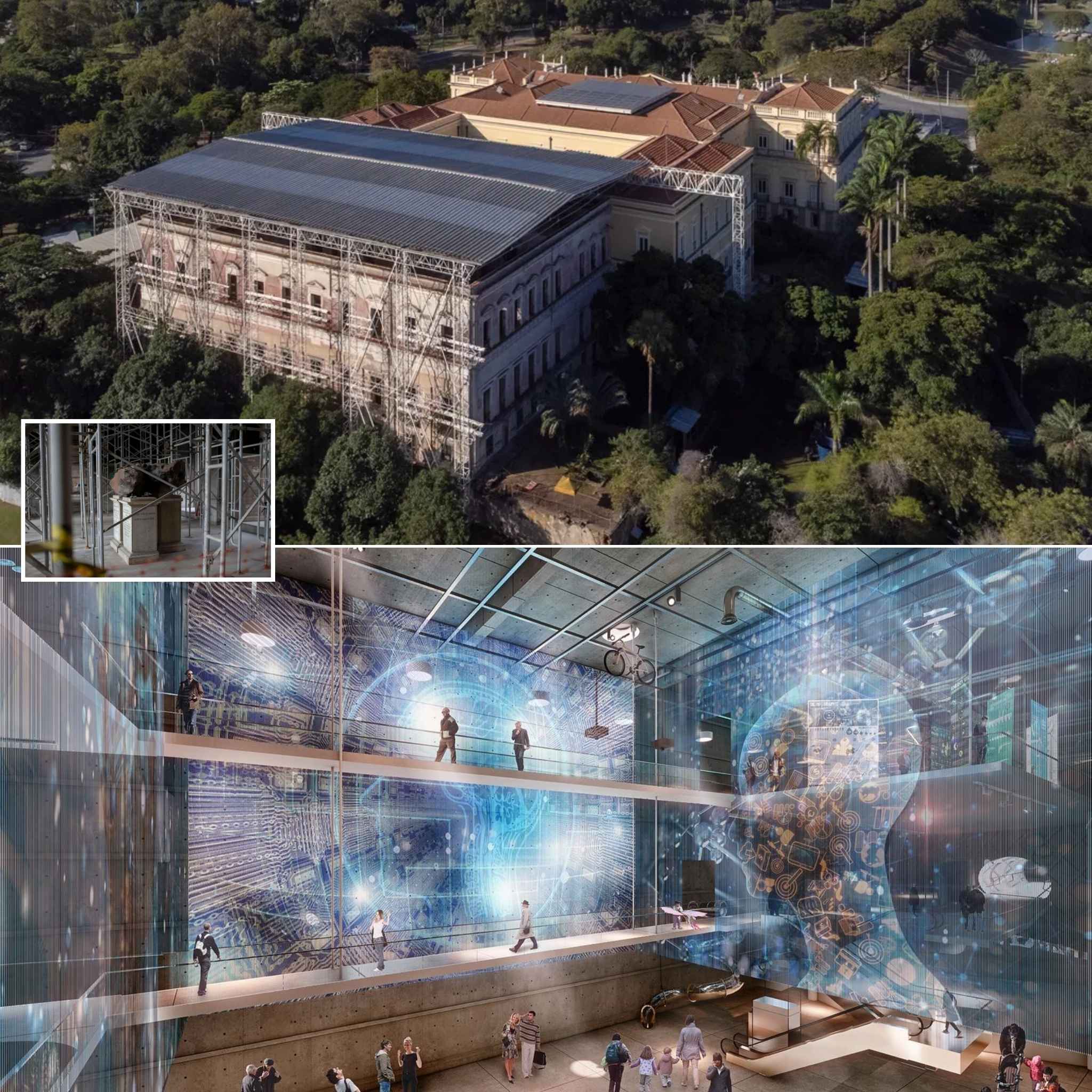
By dawn, Brazil had lost nearly 80 percent of the National Museum’s collection — more than 16 million objects accumulated over two centuries.
For many Brazilians, it felt like watching memory itself burn.
The National Museum was not merely a building filled with artifacts. It was a repository of human history, scientific discovery, and national identity. Founded in 1818 by King João VI of Portugal, it was the oldest scientific institution in Brazil and the oldest national history museum in the Americas.
Generations of schoolchildren walked its corridors. Researchers devoted their lives to its collections. Scholars traveled from across the world to study specimens housed nowhere else on Earth.
Then, in a matter of hours, centuries vanished.
Yet seven years later, amid blackened walls and exposed steel beams, the museum is slowly rising again.
Its rebirth has become one of the most ambitious cultural restoration efforts in Latin America — and one of the most emotional.
The Palace That Held a Nation’s Memory


Long before it became a museum, the building itself already carried extraordinary history.
Known as the Paço de São Cristóvão, the palace once served as the residence of Portuguese royalty after the royal court fled Napoleon’s invasion of Europe in the early 19th century. Later, it became home to Brazil’s imperial family, including Emperor Dom Pedro II.
The palace stood within Quinta da Boa Vista, a vast public park in Rio de Janeiro.
Its yellow-and-white facade became one of the most recognizable historic landmarks in Brazil. Massive halls, ornate staircases, and royal chambers eventually transformed into galleries housing treasures from around the world.
Inside were Egyptian mummies, Indigenous artifacts, dinosaur fossils, meteorites, rare manuscripts, taxidermy collections, and millions of biological specimens.
Among its most famous treasures was Luzia, the oldest human remains ever discovered in the Americas. Estimated to be over 11,000 years old, Luzia’s skull reshaped debates about the peopling of the New World.
The museum also preserved priceless recordings of Indigenous languages, some no longer spoken anywhere on Earth.
It was impossible to replace what the museum contained.
The Night of the Fire
The blaze began in the evening hours of September 2, 2018.
At first, witnesses saw smoke emerging from upper floors. Then flames erupted through windows, illuminating the palace against the night sky.
Firefighters arrived quickly, but disaster escalated almost immediately.
Hydrants near the building were dry.
Crews were forced to pump water from a nearby lake while flames spread unchecked through the aging structure. Decades of underfunding had left the museum dangerously vulnerable.
According to later investigations, electrical problems likely triggered the fire. But experts warned that the tragedy had been building for years.
Whistleblowers had reportedly raised concerns about fire risks as early as 2004.
Museum director at the time, paleontologist Alexander Kellner, later described years of chronic financial neglect.
Ironically, new funding for maintenance and restoration had finally arrived shortly before the fire, tied to the museum’s 200th anniversary celebrations.
The repairs simply came too late.
Watching History Burn
As flames consumed the palace, museum staff gathered helplessly outside.
Some researchers rushed inside during the early stages of the disaster, risking their lives to rescue scientifically irreplaceable specimens. Others stood frozen in horror.
Historian Regina Dantas later described entering her office after the fire and finding complete devastation.
“I cried profusely,” she recalled. “I lost everything — I didn’t have a pen.”
The destruction extended far beyond physical objects.
Researchers lost decades of notes, unpublished work, archives, and scientific records. Entire collections built over generations disappeared overnight.
The museum’s insect collection — one of the largest in Latin America — was destroyed.
Ancient Egyptian mummies vanished.
A royal Hawaiian feather cloak gifted to Brazil’s imperial family was lost forever.
Recordings of extinct Indigenous languages disappeared into smoke.
For many scientists, it felt like the destruction of an irreplaceable library of human civilization.
The Survivors


Yet amid the devastation, a few miracles emerged.
One of the most famous survivors was the Bendegó meteorite, an enormous 11,820-pound iron meteorite discovered in Brazil in 1784.
The meteorite had already survived floods, transport disasters, and centuries of history. During the fire, it endured temperatures that destroyed nearly everything around it.
After the flames died down, the giant space rock remained standing almost untouched among the ruins.
Then came another astonishing discovery.
As crews sifted carefully through debris, they located fragments of Luzia’s skull.
Though damaged, substantial portions survived.
The recovery became a powerful symbol of resilience — proof that even after catastrophic destruction, fragments of history could still endure.
Workers also recovered thousands of smaller objects buried beneath collapsed rubble.
The rebuilding effort treated the palace almost like an archaeological excavation site. Teams moved layer by layer through ash, melted glass, and fallen stone searching for survivable artifacts.
Among the finds were fragments of imperial ceramics, charred manuscripts, and damaged archaeological pieces now undergoing painstaking restoration.
Around 5,000 recovered artifacts are currently being conserved.
Experts estimate the process could take decades.
A Museum Reborn
In September 2025, for the first time since the fire, portions of the National Museum reopened to the public.
The response was overwhelming.
Tickets sold out within hours.
For many Brazilians, the reopening represented far more than access to exhibitions. It symbolized national recovery after trauma.
Visitors entering the palace encountered a strange mixture of restoration and ruin.
The restored yellow facade gleamed once more beneath Rio’s sunlight. Thirty rooftop statues of Greek gods had returned after careful conservation.
Yet inside, scars remained visible.
Some walls still bore black burn marks from the inferno. Twisted steel support beams remained exposed in places as reconstruction continued around them.
The museum intentionally preserved parts of the damage as testimony to what had happened.
New exhibits also revealed how the institution was evolving.
One dramatic addition was a massive 51.5-foot-long sperm whale skeleton suspended beneath a newly installed glass skylight made from 138 panels.
The museum was not simply recreating the past.
It was rebuilding itself for the future.
The Financial Challenge


Reconstruction, however, remains enormously expensive.
The nonprofit initiative Projeto Museu Nacional Vive (“The National Museum Is Alive”) was created to coordinate fundraising and restoration efforts alongside UNESCO, the Federal University of Rio de Janeiro, and the Vale Cultural Institute.
Despite major support, funding gaps remain severe.
Museum officials estimate the project still lacks approximately $29 million needed for full restoration.
Comparisons with the rebuilding of Notre-Dame Cathedral are unavoidable.
After Notre-Dame’s 2019 fire, nearly $1 billion in donations poured in within days from wealthy patrons and corporations.
Brazil’s National Museum never received that scale of international financial response.
Part of the difference reflects broader cultural and economic realities.
“In France, the culture of donating money for reconstruction and historical heritage is much different from here,” explained Larissa Graça, a technical manager involved in fundraising efforts.
Still, the Brazilian government contributed emergency funding immediately after the disaster, allowing reconstruction to begin without delay.
Rebuilding Collections From Nothing
The challenge facing the museum goes beyond architecture.
How do you rebuild collections accumulated over 200 years?
The answer involves donations, international partnerships, scientific collaboration, and new acquisitions.
Institutions worldwide have stepped forward to help replace destroyed specimens and artifacts where possible. Scientists have donated duplicate research materials. Museums have offered collaborative exhibits and loans.
Yet some losses remain impossible to repair.
Extinct-language recordings cannot be recreated.
Unique fossils and archaeological artifacts vanished forever.
Entire scientific reference collections essential for taxonomy disappeared permanently.
The fire forced museum staff to confront painful questions about what cultural heritage means in the modern world.
Can memory survive when its physical evidence is destroyed?
The Human Cost
Behind every lost artifact stood human lives devoted to preserving it.
Researchers spent decades building collections now reduced to ash.
Curators lost archives representing entire careers.
Students lost access to irreplaceable scientific resources.
The emotional toll continues years later.
Some museum employees describe the institution almost as a living being — wounded but surviving.
Director Ronaldo Fernandes, who served as assistant director during the fire, now leads the reconstruction effort.
His task extends beyond rebuilding walls.
He is helping reconstruct trust, identity, and hope.
A Symbol Larger Than Brazil
The National Museum fire became a global warning about the fragility of cultural heritage.
Around the world, aging museums struggle with inadequate maintenance, limited funding, and growing climate risks.
The tragedy highlighted how quickly humanity’s accumulated knowledge can disappear.
At the same time, the rebuilding effort has become a powerful example of resilience.
The museum’s reopening plans for 2029 represent more than institutional recovery. They symbolize a determination to protect memory itself against neglect, disaster, and time.
The Long Future of Restoration
Even when the museum fully reopens, reconstruction will continue for generations.
Conservation experts warn that many damaged artifacts require painstaking treatment lasting decades.
Some objects recovered from the rubble remain too fragile to display.
Others must be digitally reconstructed using surviving records and photographs.
Future technologies may even help restore currently unreadable materials.
In that sense, the National Museum exists today in multiple forms at once:
As a ruin.
As a construction site.
As a scientific institution.
And as a promise.
Memory Against Oblivion
The fire at Brazil’s National Museum was one of the worst cultural disasters of the 21st century.
Yet perhaps the most remarkable aspect of the story is not the destruction itself, but the refusal to surrender afterward.
Workers continue sorting debris.
Scientists continue rebuilding collections.
Architects continue restoring halls once thought lost forever.
Schoolchildren are returning.
And within the partially reopened palace, visitors now walk through rooms where blackened walls stand beside new exhibitions — visible reminders of both catastrophe and survival.
The National Museum burned in one terrible night.
But its story did not end there.
Against ash, ruin, and loss, Brazil chose to rebuild not only a museum, but a piece of civilization’s collective memory itself.