A Hoard of Gold Treasures Reveals the True Power of a Mysterious Bronze Age Civilization
For centuries, Cyprus occupied a strategic position at the crossroads of the ancient Mediterranean. Situated between Egypt, Anatolia, the Levant, and the Aegean world, the island witnessed the rise and fall of some of history’s greatest civilizations. Yet despite its crucial location and immense wealth, Bronze Age Cyprus has often remained overshadowed by its more famous neighbors.
Now, a spectacular discovery from the ancient port city of Hala Sultan Tekke is forcing historians to rethink the island’s place in the ancient world.
Archaeologists have uncovered an extraordinary collection of gold jewelry, precious stones, imported luxury goods, and elite burial treasures dating back more than 3,000 years. Among the finds are elaborate gold diadems resembling royal crowns, intricate rings and pendants, and even gold mouthpieces that evoke comparisons to modern celebrity dental jewelry.
Far from representing a remote trading outpost, these remarkable discoveries suggest that Cyprus was one of the Mediterranean’s most influential economic powers during the Late Bronze Age—a civilization whose merchants commanded vast international networks stretching from Egypt to India and from Anatolia to the Baltic Sea.
The Forgotten Superpower of the Bronze Age
The Late Bronze Age, roughly spanning the 17th to 12th centuries BC, was one of the most interconnected periods in ancient history.
Powerful kingdoms dominated the region. To the south, Egypt flourished under rulers such as Akhenaten, Tutankhamun, and Ramesses II. To the north, the Mycenaean Greeks controlled much of mainland Greece. The mighty Hittite Empire ruled large portions of Anatolia and the Near East.
Amid these competing powers stood Cyprus.
Unlike its neighbors, Cyprus did not build colossal pyramids or leave behind vast libraries of written records. Yet it possessed something every major kingdom desperately needed: copper.
Copper was the essential ingredient in bronze production, and bronze was the technological foundation of the era. Weapons, tools, armor, agricultural implements, and luxury goods all depended on it.
According to archaeologist Peter Fischer of the University of Gothenburg, Cyprus possessed copper resources on a scale unmatched anywhere else in Europe.
“The Cypriots were sitting on a mountain of copper,” Fischer explains.
This resource transformed the island into one of the most valuable economic centers in the ancient Mediterranean.
Without Cyprus, the Bronze Age economy as historians know it could scarcely have functioned.
A Port City Filled with Secrets
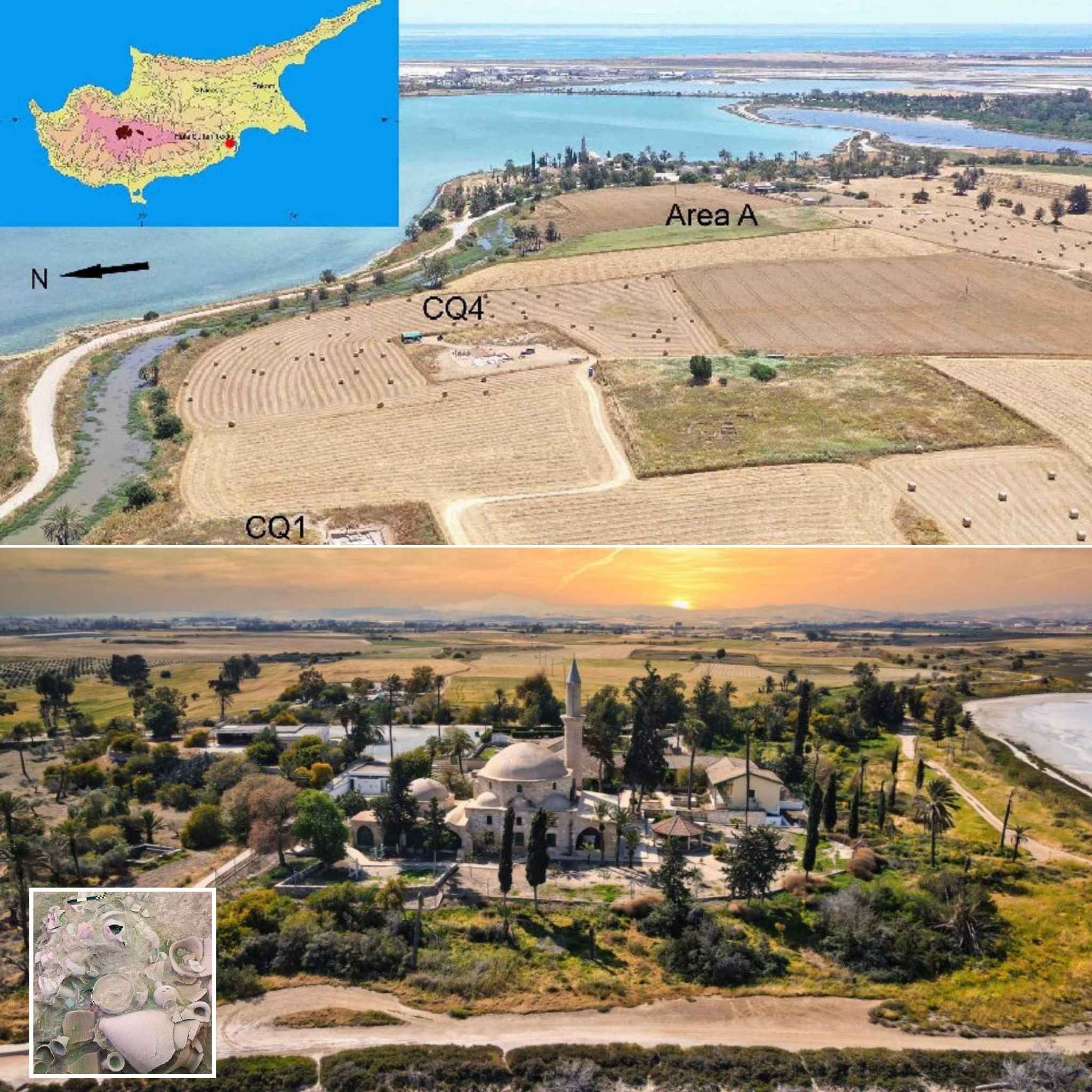
The discoveries come from Hala Sultan Tekke, located near modern-day Larnaca on Cyprus’s southern coast.
Today the site appears relatively quiet, but more than three millennia ago it was among the most important commercial hubs in the Mediterranean world.
Its sheltered harbor connected traders to shipping routes stretching across thousands of miles of sea.
Archaeologists have investigated the site intermittently since the nineteenth century. British excavators first explored the area in the 1800s, removing numerous artifacts that eventually found their way into museum collections abroad.
Serious archaeological work resumed during the twentieth century, but many of the site’s secrets remained hidden underground.
Everything changed in 2014.
That year, Fischer and his team discovered a vast cemetery associated with the ancient port city. Over the next decade and a half, archaeologists returned annually to excavate its remarkable tombs.
What they found exceeded even their most ambitious expectations.
Caption: Gold diadems, jewelry, and ceremonial ornaments discovered in elite Bronze Age tombs reveal the extraordinary wealth of Cyprus’s merchant aristocracy.
Family Tombs of the Bronze Age Elite
The tombs themselves are unusual.
Many are shaped roughly like the number eight, consisting of two connected circular burial chambers carved into the earth.
Some chambers contain the remains of dozens of individuals.
One tomb alone held more than sixty people.
Initially, archaeologists wondered whether these were communal graves or burial spaces used by unrelated members of society. Genetic analysis has since revealed a different story.
The individuals buried together were members of extended families.
Parents, children, siblings, grandparents, and multiple generations rested within the same chambers.
These discoveries provide an intimate glimpse into elite family life on Bronze Age Cyprus.
Rather than isolated burials of kings or warriors, these tombs served as dynastic resting places for powerful merchant families who dominated trade networks throughout the eastern Mediterranean.
Their wealth is reflected in the extraordinary treasures buried alongside them.
Gold Crowns for the Living and the Dead
Among the most striking discoveries are nine gold diadems.
These elegant headpieces were crafted from thin sheets of gold and decorated with intricate motifs.
Spirals, flowers, bulls, ibexes, wild cats, and geometric patterns cover their surfaces.
Some of the designs clearly reflect artistic influences from neighboring civilizations.
Others appear uniquely Cypriot.
The craftsmanship is exceptional.
Importantly, many of the diadems show signs of wear.
This suggests they were not manufactured solely for burial.
Instead, they were likely worn during life as visible symbols of status and authority before being placed in family tombs after death.
These were not merely ornaments.
They were declarations of power.
The individuals who wore them likely occupied the highest levels of Cypriot society.
Bronze Age “Grillz”
Perhaps the most surprising discoveries are two gold mouthpieces recovered from the tombs.
At first glance, they resemble modern dental jewelry popularized by musicians and celebrities.
These thin sheets of gold were placed over the mouths of deceased individuals.
Unlike the diadems, the mouthpieces show little evidence of use during life.
Researchers believe they were created specifically for funerary rituals.
Such objects are known from several ancient cultures and may have symbolized the transition from life to death.
According to art historian Marian Feldman of Johns Hopkins University, these mouth coverings reflect a surprisingly widespread human concern.
“It almost feels like a quasi-universal need to show the deceased is no longer breathing and no longer speaking and no longer eating,” she notes.
The discovery highlights how Bronze Age elites used precious metals not only to display wealth but also to express beliefs about death and the afterlife.
A Mediterranean Marketplace in a Tomb
While many artifacts were likely produced locally, others arrived from astonishingly distant regions.
The tombs contained evidence of trade relationships extending across thousands of miles.
Researchers recovered:
- Egyptian-inspired jewelry and motifs
- Anatolian silver figurines
- Mycenaean pottery
- Greek drinking vessels
- Luxury ceramics
- Baltic amber
- Lapis lazuli from Afghanistan
- Carnelian gemstones from India
The range of imported materials is extraordinary.
Few sites from the Bronze Age demonstrate such extensive commercial connections.
Each family tomb appears to emphasize different regions of the Mediterranean.
One burial chamber, for example, contains a remarkable concentration of Egyptian goods.
Others feature artifacts associated primarily with Anatolia or the Aegean world.
This pattern has led Fischer to propose an intriguing theory.
Merchant Dynasties of the Ancient World
Rather than representing political rulers, the occupants of these tombs may have been elite merchant families.
Each family could have specialized in trade with a particular foreign region.
Some may have focused on Egypt.
Others maintained relationships with Anatolia, Greece, or the Levant.
Their wealth derived from controlling the movement of copper and luxury goods through Mediterranean trade routes.
If correct, this interpretation transforms our understanding of Bronze Age Cyprus.
The island was not merely a supplier of raw materials.
It was a sophisticated commercial power run by merchant aristocracies whose influence extended across continents.

Caption: The ancient harbor city of Hala Sultan Tekke served as one of the Mediterranean’s most important commercial centers during the Late Bronze Age.
The Mystery of Cyprus
Despite its importance, much about Bronze Age Cyprus remains unknown.
One major challenge is language.
The writing system used by Late Bronze Age Cypriots remains undeciphered.
Like the famous Linear A script of Minoan Crete, the Cypriot script has resisted decades of scholarly efforts.
Without written records, archaeologists must reconstruct Cypriot society using material evidence alone.
This makes discoveries like those at Hala Sultan Tekke especially valuable.
Every artifact becomes a clue.
Every imported object reveals another connection.
Every burial adds another piece to a puzzle that has remained incomplete for more than three thousand years.
A Culture of Its Own
One of the most fascinating aspects of the finds is that they are not simple copies of foreign styles.
Cypriot artisans borrowed ideas from neighboring civilizations but transformed them into something distinct.
Egyptian symbols appear alongside local artistic traditions.
Anatolian influences merge with indigenous motifs.
Greek-inspired objects coexist with uniquely Cypriot forms.
Rather than losing its identity through trade, Cyprus used international connections to create a vibrant hybrid culture.
“The Cypriots amalgamated various cultures’ designs,” Fischer explains.
“By this amalgamation, they created something of their own.”
This blending of influences reflects the island’s role as a cultural crossroads where ideas traveled as freely as goods.
Beyond the Role of Middleman
For many years, historians tended to view Cyprus as a convenient intermediary between larger powers.
The new discoveries challenge that assumption.
Cyprus was not merely facilitating exchanges between civilizations.
It was actively shaping them.
Its merchants controlled vital resources.
Its craftsmen produced luxury goods.
Its ports linked distant regions into a single economic system.
According to Bernard Knapp, one of the most respected scholars of Cypriot archaeology, evidence increasingly suggests that Cyprus was a major player in its own right.
“The more we know about Cyprus,” Knapp says, “the clearer it becomes that it wasn’t just a go-between.”
The Legacy of a Lost World
The Late Bronze Age eventually came to a dramatic end.
Around 1200 BC, many of the great civilizations of the eastern Mediterranean collapsed during a period of widespread upheaval.
Trade networks fractured.
Cities were abandoned.
Empires disappeared.
Cyprus also experienced profound disruptions.
Yet the treasures buried at Hala Sultan Tekke survived.
Hidden beneath the earth for over three millennia, they now offer a remarkable window into a lost world of merchants, sailors, craftsmen, and aristocratic families whose wealth rivaled that of kings.
The gold diadems, mouthpieces, imported gemstones, and luxury goods tell a story that historians are only beginning to understand.
They reveal a civilization that stood at the center of ancient globalization.
A civilization enriched by copper, connected by trade, and powerful enough to shape the course of Mediterranean history.
Far from being a forgotten island on the edge of great empires, Bronze Age Cyprus was one of the engines that helped drive the ancient world.
Caption: Imported treasures from Egypt, Anatolia, Greece, Afghanistan, India, and the Baltic region demonstrate the enormous reach of Cypriot trade networks more than 3,000 years ago.