What Happened to the ‘Vanished’ Colonists of Roanoke? The 400-Year-Old Mystery That Still Haunts American History
For more than four centuries, the disappearance of the Roanoke colonists has remained one of the most enduring mysteries in American history. Entire generations of historians, archaeologists, explorers, and amateur investigators have attempted to uncover what became of the 115 English settlers who seemingly vanished without a trace from England’s first colony in North America.
The story contains all the elements of a historical thriller: a remote settlement struggling to survive, a desperate voyage across the Atlantic, a years-long delay caused by international war, cryptic messages carved into wood, and an abandoned colony that appeared to have simply disappeared.
Yet despite centuries of investigation, no definitive answer has ever emerged.
Did the colonists die of starvation? Were they massacred by Native American tribes or Spanish soldiers? Did they attempt a dangerous escape by sea? Or did they simply blend into Native American communities and leave behind descendants whose identities have been lost to history?
Today, advances in archaeology, genetics, and historical analysis are bringing researchers closer than ever to solving the mystery. While the truth remains elusive, evidence gathered over the past few decades has begun to reveal what may have happened to the famous “Lost Colony” of Roanoke.
England’s First American Colony
The Roanoke Colony was established during a period when European powers were racing to claim territory in the New World.
England, eager to challenge Spanish dominance in the Americas, sponsored expeditions to North America during the late 16th century. Sir Walter Raleigh received royal permission from Queen Elizabeth I to establish colonies along the Atlantic coast, hoping to secure England’s position in the region.
In 1587, a group of approximately 115 English settlers arrived on Roanoke Island, located in what is now North Carolina. Unlike earlier military expeditions, this settlement included women and children. The colonists intended to build a permanent community and establish a new life in the Americas.
Among them was Governor John White, an artist and explorer who would later become central to the mystery.
Life in the colony was difficult from the beginning. Food supplies were limited, relations with some Native American groups were tense, and the settlers depended heavily on shipments from England for survival.
Recognizing the growing crisis, the colonists convinced White to return to England and obtain supplies and reinforcements.
On August 27, 1587, White departed Roanoke, believing he would return within a matter of months.
He had no idea that he would not see the colony again for nearly three years.
A War Delays Rescue
Soon after White arrived in England, Europe became consumed by one of the greatest military confrontations of the age.
Spain, the dominant global superpower of the time, assembled the massive Spanish Armada with plans to invade England. Faced with the threat of conquest, the English Crown commandeered virtually every available ship for national defense.
White repeatedly attempted to organize a return voyage to Roanoke, but military priorities made it impossible.
Only after England defeated the Armada in 1588 did opportunities slowly emerge for transatlantic travel.
Even then, further delays continued to plague White’s efforts.
Finally, in August 1590, nearly three years after his departure, White returned to Roanoke Island.
What he discovered would become one of history’s greatest mysteries.

The Empty Settlement
When White stepped ashore on August 18, 1590, he expected to find a struggling but surviving colony.
Instead, he found silence.
The settlement had been abandoned.
Homes and fortifications showed signs of being carefully dismantled rather than destroyed. There were no signs of battle, no bodies, and no evidence of a sudden attack.
The colonists seemed to have left intentionally.
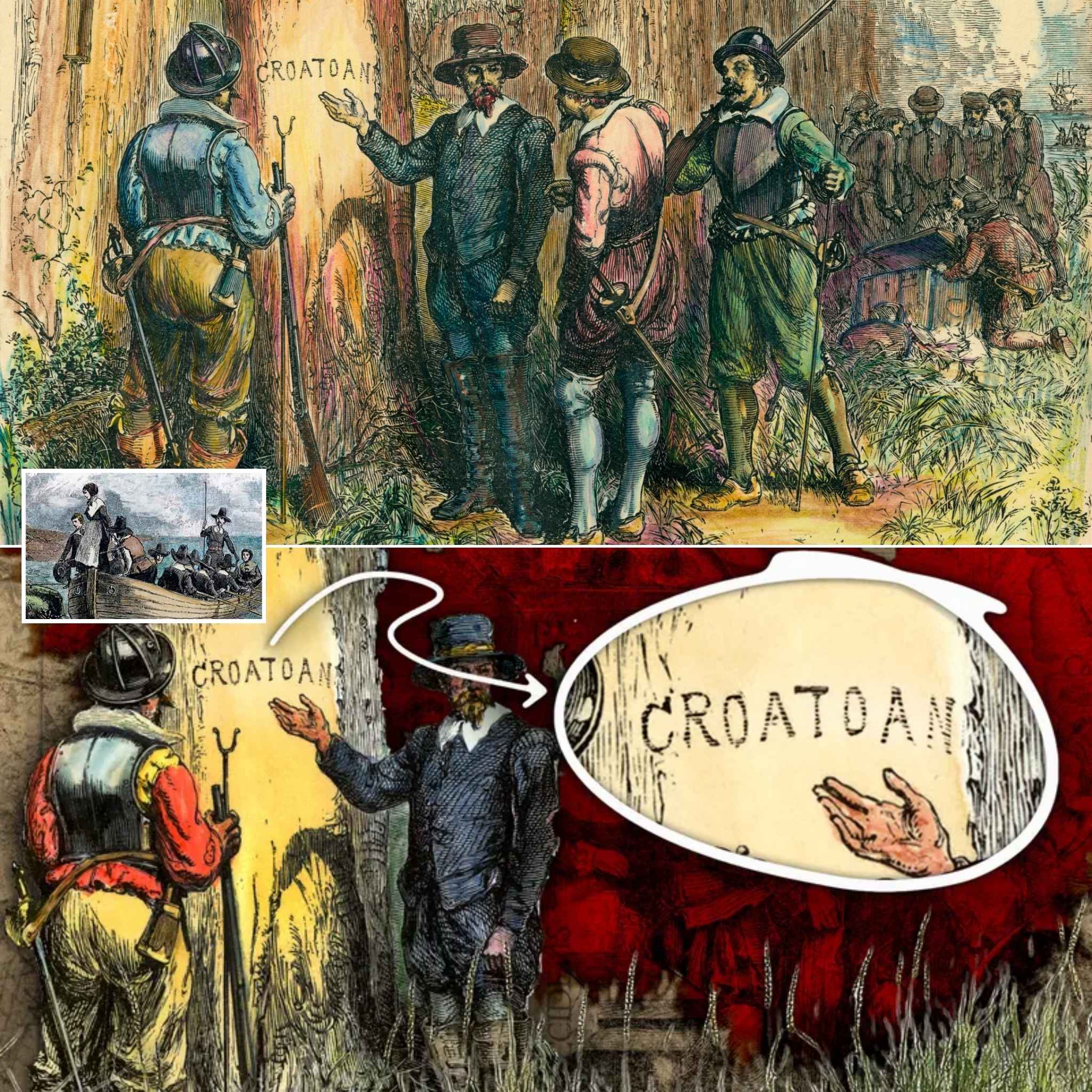
The only clues were two mysterious carvings.
The word “CRO” had been carved into a nearby tree.
More significantly, the word “CROATOAN” had been carved into a wooden palisade post.
At first glance, the message appeared encouraging.
Before leaving for England, White and the settlers had agreed on a system. If they relocated, they would leave a message indicating their destination. If they were forced to leave under duress, they would carve a Maltese cross as a warning.
No cross was present.
This suggested the colonists had moved voluntarily.
White immediately suspected they had relocated to Croatoan Island, known today as Hatteras Island, where friendly Native Americans called the Croatoan people lived.
Unfortunately, nature intervened.
A violent storm prevented White’s crew from sailing to Hatteras Island. The ship was forced to abandon the search and return to England.
White never reached Croatoan.
He never saw his daughter, son-in-law, or granddaughter again.
His granddaughter, Virginia Dare, had been the first English child born in North America.
Their fate would remain unknown.
Early Theories and Rumors
The disappearance quickly generated speculation.
Some English reports claimed that Chief Powhatan, leader of a powerful Native American confederation in what is now Virginia, later admitted that many of the colonists had been killed.
According to these accounts, Powhatan feared the settlers might ally with rival tribes and therefore ordered their destruction.
However, historians remain cautious.
These reports were recorded years after the alleged events and may have been influenced by political motives, misunderstandings, or exaggeration.
Other theories emerged over time.
Some suggested Spanish forces from St. Augustine, Florida, attacked and destroyed the colony. Spain and England were enemies, and Spanish authorities viewed English settlements as threats.
Another possibility was simple starvation.
The colonists may have succumbed to disease, hunger, drought, or harsh environmental conditions.
Yet none of these explanations fully account for the lack of physical evidence.
No mass graves have ever been found.
No clear signs of warfare have emerged.
And no definitive records describe the colony’s end.
This uncertainty has kept the mystery alive for centuries.
The Lost Colony and Jamestown
Interest in Roanoke intensified after the establishment of Jamestown in 1607.
Jamestown became England’s first successful permanent settlement in North America.
Naturally, the new colonists were curious about the fate of their predecessors.
Several searches were conducted in hopes of locating survivors.
None succeeded.
The absence of evidence deepened the mystery.
As decades passed, Roanoke transformed from a colonial tragedy into a historical legend.
Stories circulated about blue-eyed Native Americans, European artifacts found among Indigenous communities, and rumors of surviving descendants.
Most of these accounts lacked verification, but they continued to fuel speculation.
Archaeology Begins to Reveal Clues
For centuries, the mystery remained largely unsolved because there was little physical evidence to examine.
That began to change in the late 20th and early 21st centuries.
Archaeologists started uncovering artifacts that may be connected to the missing colonists.
One of the most significant discoveries occurred on Hatteras Island.
A research team from the University of Bristol, working alongside local archaeologists, recovered several objects dating to the late 1500s.
Among the discoveries were:
- German stoneware pottery
- A rapier sword handle
- A Nuremberg trade token
- European metal artifacts
These objects closely resembled items known to have been used by the Roanoke settlers.
Their presence suggested that at least some colonists may have reached Hatteras Island after leaving Roanoke.
The discoveries supported John White’s original assumption that the settlers had traveled to Croatoan territory.
If true, the implications are enormous.
Rather than disappearing, some colonists may have survived by integrating into Native American society.
Did the Colonists Join Native American Communities?
Many historians now consider assimilation one of the most plausible explanations.
Native American tribes possessed extensive knowledge of local environments, food sources, agriculture, and survival strategies.
For struggling English settlers, joining an established Indigenous community may have represented the best chance of survival.
Historical records indicate that some Native groups maintained relatively friendly relations with the English.
The Croatoan people, in particular, were considered allies.
If the settlers relocated among them, intermarriage could have occurred over subsequent generations.
Some researchers believe descendants of these mixed communities may still exist, although proving such connections remains difficult.
DNA studies have attempted to identify possible genetic links between modern populations and the lost colonists.
Results have been inconclusive so far, but advances in genetic technology continue to offer hope.
Future discoveries may eventually provide answers that archaeology alone cannot.
The Mysterious “Site X” and “Site Y”
Perhaps the most intriguing recent evidence comes from the work of the First Colony Foundation.
Researchers studying a 16th-century map created by John White made a surprising discovery.
Using advanced imaging techniques, they identified hidden symbols beneath patches on the map.
The symbols appeared to represent forts located inland from Roanoke.
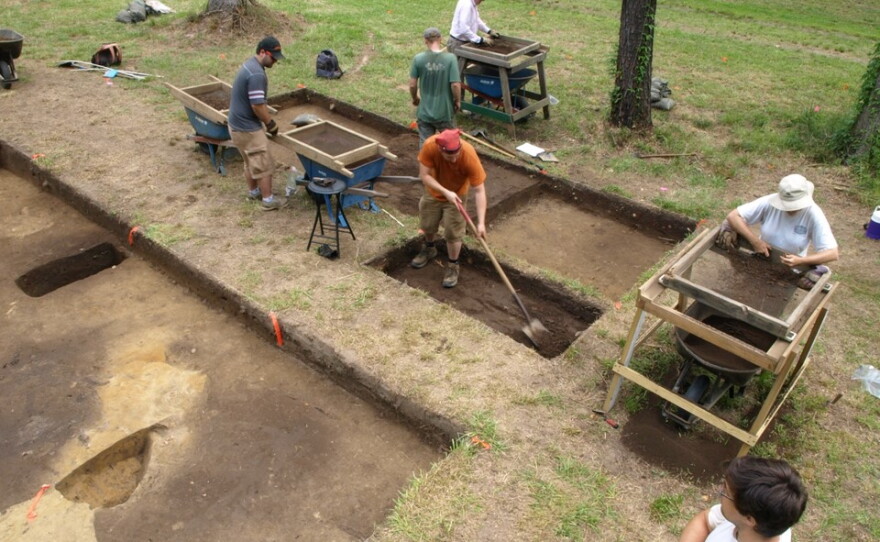
These locations correspond to archaeological sites now known as Site X and Site Y in Bertie County, North Carolina.
Excavations uncovered European ceramics and other artifacts dating to the late 1500s.
The discoveries suggest that some colonists may have moved to the mainland rather than remaining on the coast.
One site lies adjacent to a Native American village, raising fascinating possibilities.
Historian James Horn has argued that survivors may have lived under the protection of the powerful Chowanoac people.
According to this interpretation, Indigenous allies helped shield the settlers during a period of instability and conflict.
If true, Roanoke’s story becomes less a tale of disappearance and more a story of adaptation and survival.
A Colony Divided?
Another compelling theory suggests the colonists did not remain together.
Anthropologist Dennis Blanton has proposed that the settlement may have fragmented into multiple groups.
Historical examples show that struggling colonies often develop internal divisions.
Faced with dwindling supplies and uncertain leadership, different factions may pursue different survival strategies.
Some colonists might have joined Native communities.
Others may have attempted to establish new settlements inland.
A few could have tried to return to England aboard improvised vessels.
This scenario helps explain why evidence appears scattered across multiple locations.
Instead of one dramatic event, the disappearance may have been a gradual process involving several groups following different paths.
Such a conclusion would also explain why no single archaeological site has produced definitive evidence of the colony’s fate.
The Challenge of Finding Roanoke
One of the greatest obstacles facing researchers is surprisingly simple:
Nobody knows exactly where the original settlement stood.
For years, historians assumed it was located at what is now Fort Raleigh National Historic Site.
Recent discoveries have challenged that assumption.
Some artifacts found there date from periods after the colony vanished, suggesting they may not belong to the original settlers.
Meanwhile, centuries of coastal erosion have dramatically altered Roanoke Island.
Large portions of shoreline have disappeared beneath the Atlantic Ocean.
According to the National Park Service, parts of the colony may now be underwater.
If crucial evidence lies offshore, recovering it could prove extremely difficult.
Nevertheless, advances in underwater archaeology may eventually allow researchers to explore submerged areas more thoroughly.
America’s Greatest Unsolved Historical Mystery
William Kelso of the Jamestown Rediscovery Foundation has described Roanoke as “the biggest unsolved mystery in American history.”
More than 400 years later, that assessment remains accurate.
The mystery persists not because there are no theories, but because several theories appear plausible.
The settlers may have integrated with Native Americans.
They may have relocated inland.
Some may have died while others survived.
The truth could involve elements of all these possibilities.
Unlike many historical mysteries, Roanoke does not hinge on a single missing clue. Instead, it represents a complex puzzle scattered across archaeological sites, historical documents, oral traditions, and genetic evidence.
Every new discovery adds another piece.
Yet the complete picture remains frustratingly incomplete.
A Mystery That Refuses to Die
The story of Roanoke continues to fascinate because it touches on universal human questions about survival, identity, and resilience.
What would people do when isolated in a hostile environment thousands of miles from home?
How far would they go to survive?
And what becomes of a community when history loses track of it?
The evidence increasingly suggests that the colonists did not simply vanish into thin air.
Many experts now believe at least some survived by adapting to life among Indigenous peoples, forming new communities, and gradually disappearing from the English historical record.
If that interpretation is correct, the Lost Colony was never truly lost.
Its members may have lived on, married, raised families, and become part of the cultural landscape of North America.
Until definitive evidence emerges, however, Roanoke will remain one of history’s most captivating enigmas—a mystery carved into a wooden post more than four centuries ago with a single word:
CROATOAN.