The Romans and Vikings Left Few Genetic Traces in Britain — But the Anglo-Saxons Changed Everything
New DNA research suggests that some of Britain’s most famous invaders transformed its culture far more than its genes, while others left a lasting biological legacy still visible today.
For centuries, the history of Britain has been told as a succession of invasions.
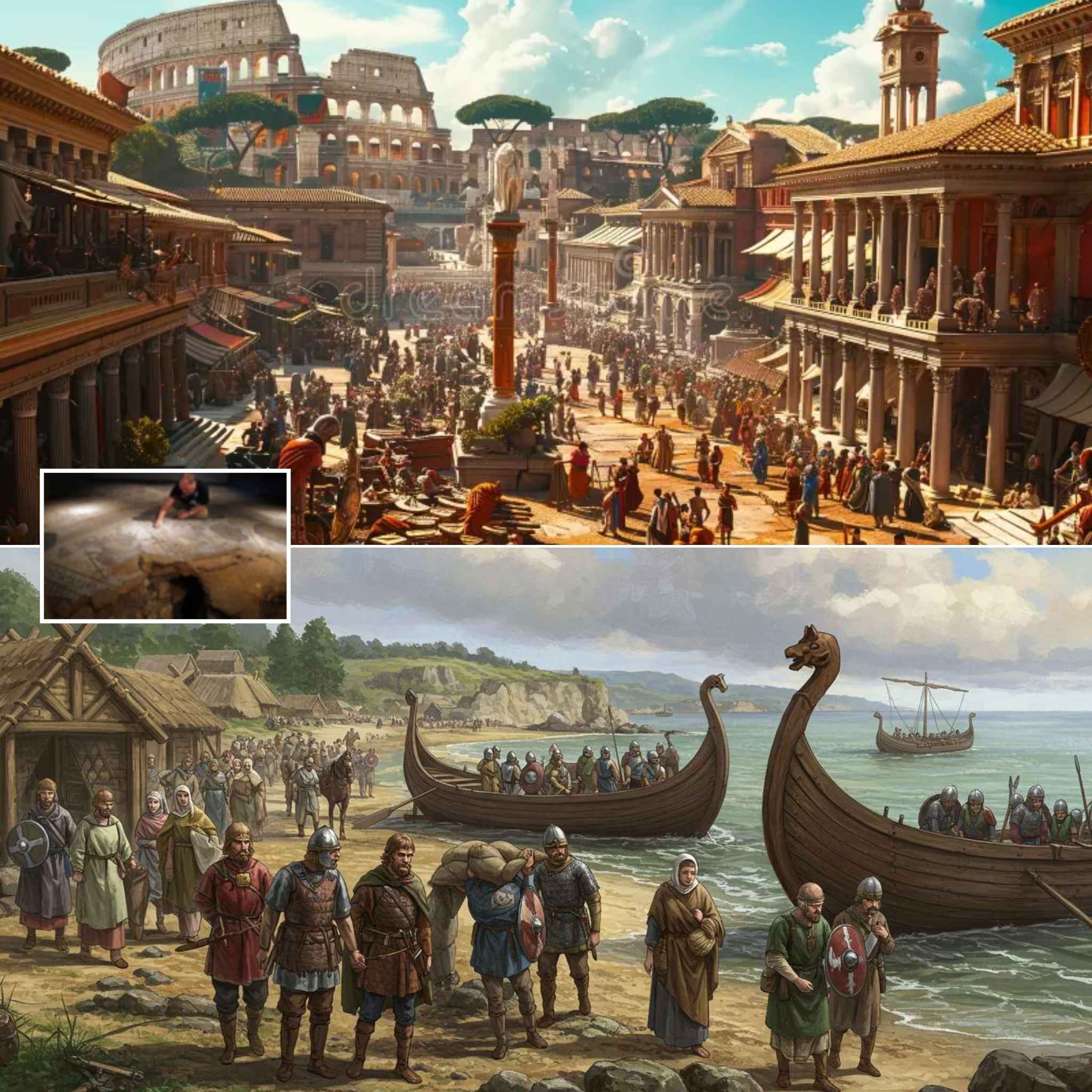
First came the Celts, whose tribes dominated the islands long before written history. Then came the Romans, who conquered much of Britain and ruled it for nearly four centuries. After Rome withdrew, waves of Anglo-Saxon migrants arrived from northern Europe. Centuries later, Viking raiders and settlers swept across large parts of the country, leaving behind stories of conquest, warfare, and cultural transformation.
These invasions profoundly shaped British history.
Roman roads still crisscross the countryside. Anglo-Saxon kingdoms laid the foundations of England. Viking place names remain scattered across northern and eastern Britain.
But a new study suggests that not all invasions leave the same mark.
According to ancient DNA research analyzing more than 1,000 individuals buried in Britain over nearly 4,000 years, the Romans and Vikings appear to have left surprisingly little genetic evidence of their presence. The Anglo-Saxons, however, seem to have transformed Britain’s genetic landscape on a scale far greater than previously understood.
The findings challenge long-held assumptions about migration, conquest, and identity in ancient Britain—and reveal that cultural influence and genetic influence are not always the same thing.
Reconstructing Britain’s Genetic History
The research team examined DNA extracted from the remains of 1,039 individuals buried in Britain between roughly 2550 B.C. and A.D. 1150.
This enormous time span allowed scientists to track population changes across several major historical eras, including:
- The Bronze Age
- The Iron Age
- Roman Britain
- Anglo-Saxon England
- The Viking Age
- The Early Medieval period
By comparing genetic signatures preserved in ancient skeletons, researchers hoped to determine how much different migrations contributed to Britain’s population over time.
The results were surprising.
Despite ruling Britain for nearly 400 years, the Romans left only a modest genetic footprint.
The Anglo-Saxons, by contrast, appear to have dramatically reshaped the population.
And the Vikings, whose reputation as settlers and conquerors remains legendary, contributed far less DNA than many researchers expected.
Rome’s Long Occupation
The Roman Empire invaded Britain in A.D. 43 under Emperor Claudius.
Although Julius Caesar had launched earlier expeditions nearly a century before, it was Claudius who established permanent Roman control.
Over the following centuries, Britain became one of Rome’s most distant provinces.
The Romans built roads, forts, temples, villas, baths, and entire cities.
Places such as Londinium (London), Eboracum (York), and Verulamium became thriving urban centers connected to one of the largest empires in history.
Roman soldiers, merchants, administrators, and craftsmen arrived from across Europe, North Africa, and the Middle East.
Given such extensive occupation, many historians assumed the Roman genetic contribution to Britain would be substantial.
The new research suggests otherwise.
The study found that DNA associated with people whose ancestry originated outside Britain accounted for only about 20% of the genetic profiles of individuals buried during the Roman period.
In other words, most people living in Roman Britain remained largely descended from the native population.
The Romans transformed Britain culturally, politically, and economically—but genetically, their impact appears far more limited.

A Cultural Revolution More Than a Population Replacement
The findings suggest that Romanization occurred primarily through cultural adoption rather than large-scale population replacement.
Native Britons embraced Roman lifestyles, architecture, religion, administration, and trade networks.
They adopted Roman customs.
They used Roman roads.
They participated in Roman markets.
Many likely spoke Latin in official contexts.
Yet they remained, for the most part, descendants of Britain’s earlier inhabitants.
This pattern differs significantly from many historical conquests where incoming populations replaced or absorbed local communities.
Instead, Roman Britain may represent one of history’s clearest examples of cultural transformation occurring without major demographic change.
Archaeologist James Gerrard of Newcastle University noted that people certainly migrated into Roman Britain, but not on the same scale as later Germanic migrations.
The empire influenced how people lived far more than who they were biologically.
The Anglo-Saxon Transformation
If the Roman results were surprising, the Anglo-Saxon findings were even more dramatic.
Following the collapse of Roman authority around A.D. 410, Britain entered a period of political fragmentation.
During the fifth and sixth centuries, groups from what is now Germany, Denmark, and the Netherlands began settling in Britain.
Traditionally known as the Anglo-Saxons, these migrants eventually established kingdoms that dominated much of England.
Historians have long debated the scale of their migration.
Were they a relatively small elite ruling over native Britons?
Or did they arrive in large numbers?
The DNA evidence strongly supports the second scenario.
Researchers found that during the Anglo-Saxon period, approximately 70% of the genetic ancestry of individuals buried in Britain derived from Germanic sources.
This suggests that migration from continental Europe was extensive.
Rather than merely imposing political control, Anglo-Saxon settlers appear to have become the dominant population across large parts of England.
According to archaeologist Duncan Sayer of the University of Lancashire, these findings align closely with earlier genetic studies.
The Anglo-Saxon migration was not simply a cultural event.
It was a demographic transformation.
Why Did Anglo-Saxons Leave a Bigger Genetic Legacy?
One of the central questions raised by the study is why Anglo-Saxons left such a large genetic footprint while Romans did not.
The answer may lie in the nature of settlement itself.
Roman Britain was governed by an imperial administration.
Many Roman officials, soldiers, and merchants eventually returned elsewhere within the empire.
Their presence was often temporary.
Anglo-Saxon migration appears to have been different.
Entire communities—including families—crossed the North Sea and established permanent settlements.
They farmed the land.
They founded villages.
They raised children.
Over generations, their descendants became integrated into local populations.
As a result, their genetic influence accumulated far more extensively.
The distinction highlights an important lesson in history: occupation and migration are not necessarily the same thing.
An empire can rule a territory for centuries without fundamentally replacing its population.
A migration lasting only a few generations can permanently reshape it.

The Viking Surprise
Perhaps the most unexpected finding concerns the Vikings.
Popular imagination often portrays the Viking Age as a period when Scandinavians flooded into Britain.
Beginning in the late eighth century, Viking raiders attacked monasteries, coastal settlements, and trading centers.
Eventually they established permanent settlements and controlled vast regions of northern and eastern England.
The territory known as the Danelaw followed Danish customs, laws, and cultural traditions.
Many scholars assumed this prolonged Scandinavian presence would leave a significant genetic signature.
Yet the study found remarkably little evidence of this.
Only about 4% of the genetic profiles examined from Viking-era England showed Iron Age Scandinavian ancestry.
The result suggests that Viking cultural influence greatly exceeded their demographic impact.
Although Viking traditions spread widely, the number of actual Scandinavian settlers may have been smaller than often assumed.
Alternatively, existing populations may have absorbed newcomers so effectively that their distinct genetic signatures became diluted over time.
Either way, the findings challenge simplistic assumptions about Viking colonization.
The Problem of Sample Size
Not everyone is convinced by the study’s conclusions.
Several experts have urged caution.
James Gerrard points out that only about 200 individuals from the Roman period were included in the dataset.
While significant, this sample remains small compared with the thousands of Roman-era burials studied archaeologically across Britain.
The geographical distribution of the samples may also influence the results.
Many of the remains analyzed came from urban areas.
Rural communities, where most people actually lived, may have experienced different patterns of intermarriage and migration.
Regional differences further complicate the picture.
Roman military activity was concentrated in northern Britain.
Urban development was particularly extensive in eastern England.
Genetic impacts may therefore have varied considerably from place to place.
As Gerrard notes, one of the greatest challenges in ancient DNA research is determining whether sampled individuals truly represent the broader population.
Future studies may refine or modify the conclusions.
Nevertheless, the findings provide valuable insights into Britain’s complex demographic history.
The Hidden Story of Celtic Women
Beyond migration patterns, the research uncovered evidence of changing social structures.
One of the most intriguing discoveries concerns burial practices before and during Roman rule.
Pre-Roman cemeteries often show patterns consistent with matrilineal organization.
In these communities, women appear to have remained within their ancestral territories while men moved into their partners’ communities after marriage.
This arrangement may reflect the prominent social position of women in many Celtic societies.
Classical writers occasionally remarked upon the unusual authority exercised by some Celtic women compared with their counterparts in Mediterranean cultures.
Powerful female leaders such as Boudica demonstrate that women could occupy significant positions within British tribal societies.
DNA evidence suggests these traditions persisted in parts of western Britain even after Roman conquest.
However, the pattern largely disappears in Roman-era cemeteries.
Researchers believe this change may reflect the influence of Roman patriarchal customs, where family identity and inheritance were more strongly associated with male lineage.
The transition provides a fascinating glimpse into how cultural practices changed under imperial rule.
More Than Genetics
Perhaps the most important lesson from the study is that genetics tells only part of the story.
The Romans may have left relatively little DNA, but their influence on Britain was enormous.
They introduced urbanization on an unprecedented scale.
They connected Britain to continental trade networks.
They built infrastructure that shaped settlement patterns for centuries.
Their legal systems, architecture, language, and administrative practices transformed society.
Likewise, the Vikings left a limited genetic footprint yet profoundly influenced culture, language, trade, and politics.
Hundreds of English place names still preserve Norse origins.
Words borrowed from Old Norse remain embedded in modern English.
The impact of a people cannot be measured solely by DNA.
Culture often travels farther than genes.
Rewriting Britain’s Past
The study contributes to a growing revolution in archaeology.
For generations, historians relied primarily on written sources, artifacts, and settlement patterns to reconstruct the past.
Today, ancient DNA provides a new line of evidence.
It allows researchers to track migrations, family relationships, and population changes with unprecedented precision.
Yet genetics rarely provides simple answers.
Instead, it reveals a more complex reality.
Britain was neither isolated nor constantly replaced by newcomers.
Different migrations unfolded in different ways.
Some invaders ruled without dramatically changing the population.
Others arrived in numbers large enough to reshape the genetic landscape itself.
The Romans built an empire in Britain but left relatively little DNA.
The Vikings transformed culture while contributing surprisingly few genes.
The Anglo-Saxons, meanwhile, appear to have changed both.
A New Understanding of Ancient Britain
As further ancient DNA studies emerge, historians will continue refining their understanding of Britain’s past.
The story that is emerging is far richer than traditional narratives of conquest and invasion.
It reveals a land shaped by movement, interaction, adaptation, and cultural exchange.
It shows that political control does not always equal demographic dominance.
And it demonstrates that some of history’s most influential peoples left their greatest marks not in genes, but in ideas, institutions, and culture.
For nearly 400 years, Rome ruled Britain.
For centuries afterward, Viking influence spread across large regions of the island.
Yet according to the latest genetic evidence, neither group altered Britain’s biological heritage as dramatically as the Anglo-Saxons.
The findings serve as a reminder that history is rarely as straightforward as it appears—and that the deepest traces of the past are often hidden not in monuments or written records, but within the DNA of those who lived it.