Can DNA Testing Finally Solve the Mystery of the Fourth Musketeer?
Newly discovered skeletal remains beneath a Dutch church may belong to the real-life d’Artagnan, the legendary soldier who inspired Alexandre Dumas’ immortal hero. But proving it could be one of history’s most difficult forensic challenges.
For nearly two centuries, the name d’Artagnan has been synonymous with adventure.
He is the fearless swordsman who rides into danger without hesitation, the loyal companion who embodies courage and honor, and the unforgettable “fourth musketeer” whose exploits helped make The Three Musketeers one of the most beloved novels ever written.
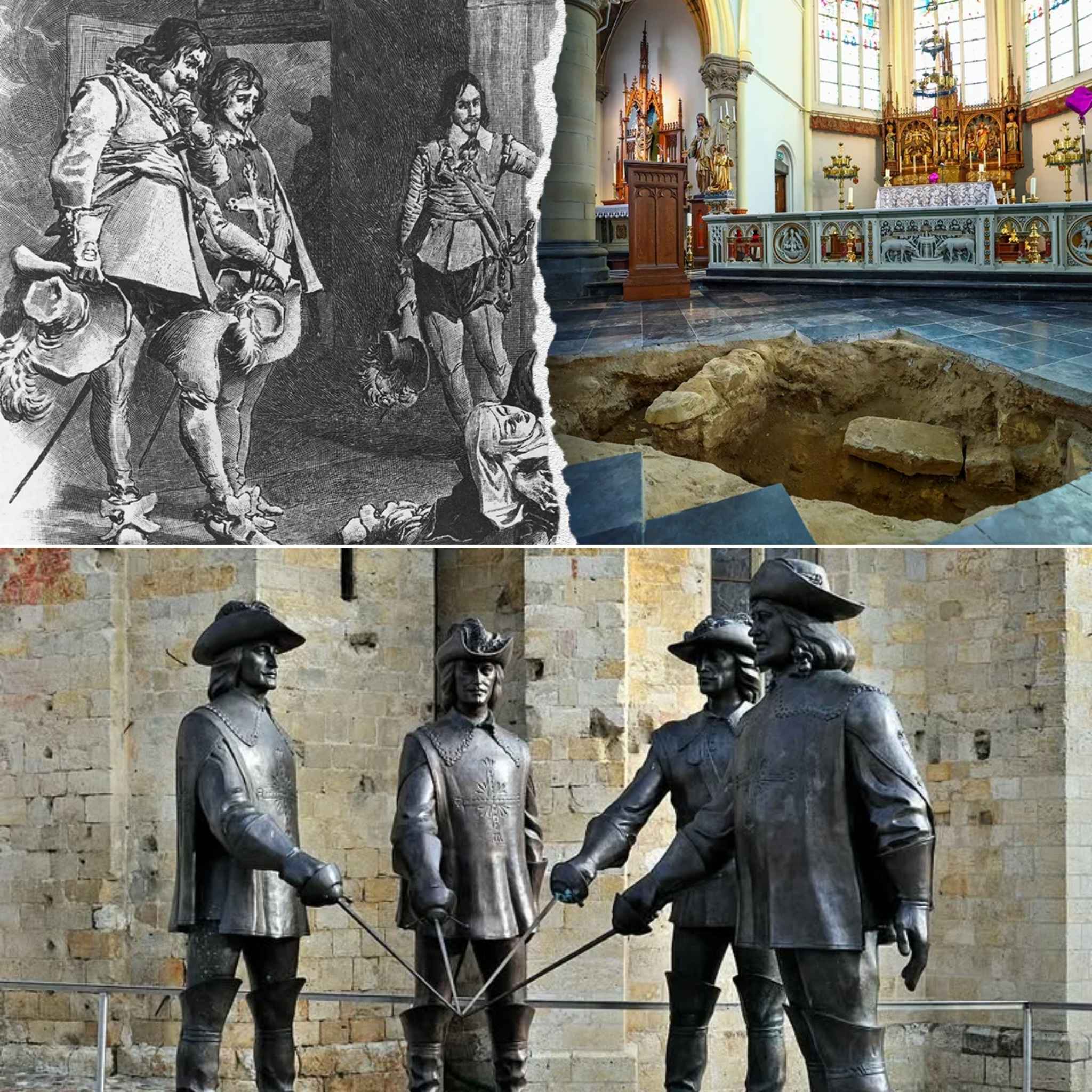
Yet while millions know the fictional d’Artagnan created by Alexandre Dumas, far fewer know the story of the real man behind the legend.
Now, a remarkable discovery beneath a church floor in the Netherlands may bring historians closer than ever to uncovering the truth about the historical d’Artagnan.
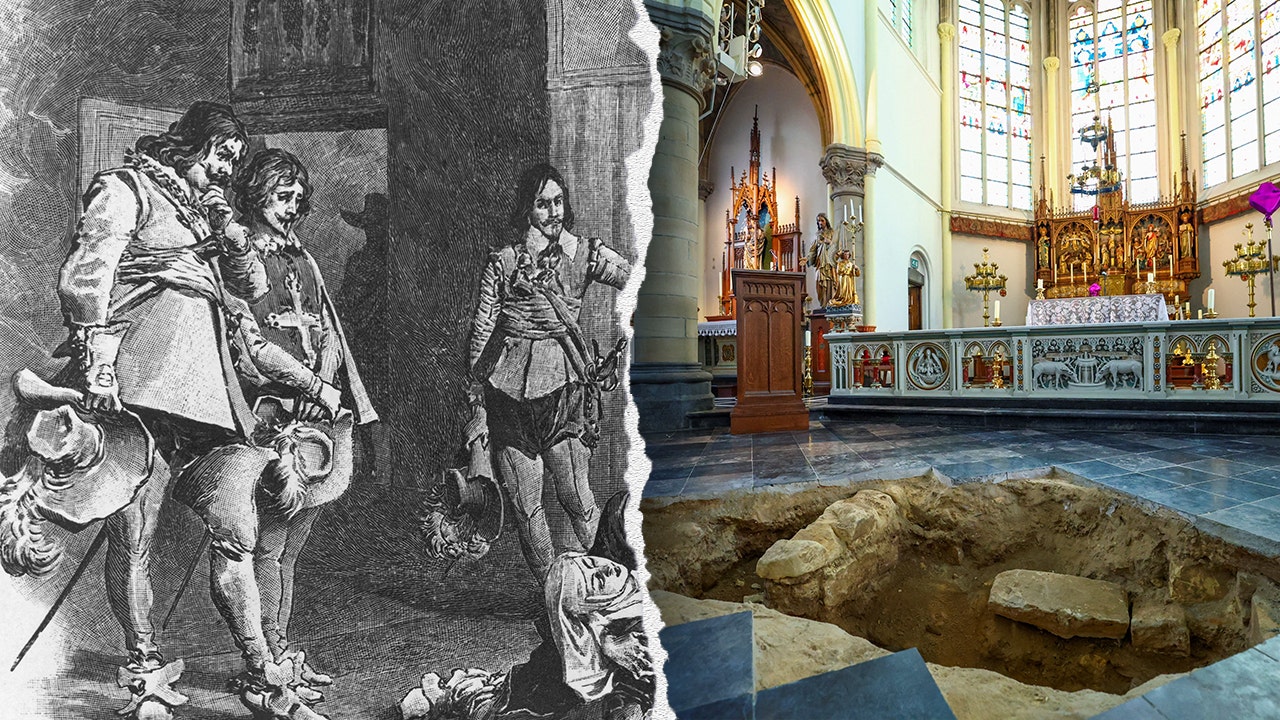
Earlier this year, skeletal remains believed by some researchers to belong to the famed French musketeer were uncovered beneath a church in Maastricht, where the real d’Artagnan died in battle more than 350 years ago.
The discovery has sparked excitement across France and the Netherlands, raising an extraordinary question:
Can modern DNA technology finally reveal whether the bones belong to one of Europe’s most famous historical figures?
The answer could transform our understanding of a man whose real life has long been overshadowed by fiction.
Two D’Artagnans
To understand why the discovery has generated such excitement, it is important to recognize that there are essentially two d’Artagnans.
The first is the fictional hero immortalized by Alexandre Dumas in 1844.
This d’Artagnan is a young Gascon swordsman who travels to Paris and joins the king’s musketeers, embarking on adventures alongside Athos, Porthos, and Aramis.
He is bold, romantic, witty, and fiercely loyal.
Over time, he became one of the most recognizable characters in world literature.
The second d’Artagnan was a real person.
His name was Charles de Batz de Castelmore, a French nobleman and military officer who served under King Louis XIV.
Unlike the literary character, the historical d’Artagnan spent much of his life as a professional soldier, royal bodyguard, and trusted servant of the French crown.
Although Dumas borrowed heavily from historical sources, he altered many aspects of the man’s life for dramatic effect.
As a result, the fictional version eventually eclipsed the real one.
Historian Julien Wilmart describes this phenomenon simply:
“Dumas’s d’Artagnan has almost completely eclipsed the real d’Artagnan.”
The newly discovered skeleton could help reverse that trend.
The Discovery Beneath the Church
The story began in Maastricht, a historic Dutch city near the Belgian border.
Workers carrying out repairs at the Church of St. Peter and Paul in the district of Wolder noticed part of the tiled floor had collapsed.
What appeared at first to be a routine maintenance issue soon became something much more significant.
Human remains were discovered beneath the church.
The find immediately attracted attention because of the church’s historical connection to the French siege of Maastricht in 1673.
That siege is famous because it was the battle in which the real d’Artagnan was killed.
The remains were initially examined by local experts after a church deacon, Jos Valke, alerted retired archaeologist Wim Dijkman.
Dijkman had long believed that d’Artagnan was buried at the site.
When the skeleton was uncovered, he immediately recognized the potential importance of the discovery.
Could the grave finally reveal the final resting place of France’s most famous musketeer?
The Death of a Legend
Charles de Batz de Castelmore was born around 1611 in the Gascon village of Lupiac in southwestern France.
Like many ambitious young nobles of his generation, he sought advancement through military service.
His talent and loyalty eventually earned him a place among the elite Musketeers of the Guard.
Over the years, he became a trusted servant of King Louis XIV and participated in numerous military campaigns.
His career ended dramatically during the Franco-Dutch War.
On June 25, 1673, French forces laid siege to Maastricht.
During the fighting, d’Artagnan was struck in the throat by a musket ball and killed.
His death was widely mourned.
Even centuries later, it remains one of the most famous battlefield deaths in French history.
Because historical records place him at Maastricht when he died, any burial discovered near the battlefield naturally attracts attention.
The newly discovered skeleton contains clues that appear consistent with those records.
Evidence That Supports the Theory
Researchers have identified several intriguing details.
Most notably, fragments of a musket ball were reportedly found near the skeleton.
Historical accounts state that d’Artagnan died after being struck by musket fire.
The location of the burial is also significant.
During the siege, the church was under French control.
Some historians believe it would have been an appropriate location for the burial of a prominent officer.
One theory suggests the French deliberately buried d’Artagnan there so that King Louis XIV, who was overseeing the campaign, could attend funeral ceremonies.
The timing appears plausible.
The injuries appear plausible.
The location appears plausible.
Yet none of these factors alone can prove the identity of the remains.
That is where modern science enters the story.

The Promise of DNA
In recent decades, DNA analysis has revolutionized archaeology.
Researchers have successfully identified the remains of kings, soldiers, nobles, and even victims of historical crimes.
Perhaps the most famous example is England’s King Richard III, whose remains were identified through genetic testing after being discovered beneath a parking lot in Leicester.
Many hope a similar process could confirm whether the Maastricht skeleton belongs to d’Artagnan.
The proposed approach is straightforward in theory.
Scientists would extract DNA from the skeletal remains and compare it with DNA from living descendants of the d’Artagnan family.
Particular attention would likely focus on the Y chromosome.
Because the Y chromosome passes from father to son with relatively little change, it can provide valuable evidence of paternal ancestry.
If living male-line descendants can be identified and matched to the ancient DNA, researchers may be able to establish whether the skeleton belonged to a member of the same family line.
Unfortunately, reality is rarely so simple.
A Race Against Time
The greatest challenge may be the condition of the DNA itself.
Unlike modern forensic investigations, archaeologists often work with remains that have been buried for centuries.
DNA gradually degrades over time.
Moisture, bacteria, temperature changes, and environmental conditions all contribute to its destruction.
Reports indicate that the first DNA samples taken from the skeleton may have been too degraded for analysis.
If true, obtaining a usable genetic profile could prove extremely difficult.
Even when ancient DNA survives, it is often fragmented into tiny pieces.
Scientists must painstakingly reconstruct those fragments before meaningful comparisons can be made.
The older the remains, the harder the process becomes.
At more than 350 years old, the Maastricht skeleton sits near the edge of what is routinely achievable.
Success is possible.
But it is far from guaranteed.
Bureaucratic Complications
Scientific challenges are not the only obstacle.
The project has also become entangled in administrative disputes.
The Municipality of Maastricht has reportedly assumed control over the investigation from the original researchers.
Officials argue that the initial excavation may not have complied with Dutch archaeological regulations.
Because the church is a protected heritage site, strict procedures govern how discoveries must be handled.
Municipal authorities insist that all work now proceed according to established archaeological standards.
As a result, any DNA analysis performed elsewhere may require validation by Dutch laboratories.
These additional requirements could significantly slow the investigation.
While such oversight is designed to protect scientific integrity, it also introduces delays and uncertainty.
For historians eager for answers, patience may be necessary.
The Descendant Problem
Even if scientists recover usable DNA, another problem remains.
How can they be certain the modern descendants are actually related to d’Artagnan?
Family trees stretching back more than three centuries are rarely perfect.
Historical records can contain gaps, errors, or assumptions.
Unexpected breaks in paternal lines may also complicate matters.
A descendant who appears related on paper may not share the same genetic lineage.
Conversely, genuine descendants may be difficult to identify or locate.
These complications do not make genetic testing impossible.
But they do reduce the certainty of any conclusions.
A positive match would be compelling.
A negative result, however, might not necessarily rule out the possibility that the skeleton belongs to d’Artagnan.
Other Scientific Clues
DNA is not the only tool available.
Researchers can employ several additional techniques to investigate the identity of the remains.
One of the most important is radiocarbon dating.
This method measures the decay of radioactive carbon within bones to estimate age.
If the skeleton dates to the late seventeenth century, that would support the d’Artagnan hypothesis.
Scientists can also analyze strontium isotopes preserved within teeth.
These chemical signatures reflect the geology of the region where a person spent childhood.
Because d’Artagnan grew up in Gascony, southern France, his teeth may retain evidence of that environment.
If isotope analysis indicates the individual spent childhood somewhere else, the theory would weaken considerably.
Researchers may also examine:
- Age at death
- Physical injuries
- Diet
- Health conditions
- Military-related skeletal wear
Together, these clues can help build a biological profile of the individual.
While none can identify d’Artagnan alone, collectively they may provide persuasive evidence.
France’s National Hero
The excitement surrounding the discovery reflects more than simple curiosity.
In France, d’Artagnan occupies a unique cultural position.
He is not merely a historical figure.
He is a symbol.
His story represents courage, loyalty, friendship, and service.
The phrase “All for one, one for all” remains instantly recognizable around the world.
Yet many people know only the fictional version.
The real d’Artagnan was a career soldier navigating the complex politics of seventeenth-century France.
He served Cardinal Mazarin.
He protected the king.
He participated in military campaigns across Europe.
Recovering his remains would provide a rare opportunity to reconnect with the historical individual behind the myth.
As Alina Goebel of the d’Artagnan Museum in Lupiac has noted, modern science may finally allow historians to answer questions that have remained unresolved for centuries.
Even basic details, such as his physical appearance, remain uncertain.
When Fiction Overshadows Reality
One of the most fascinating aspects of the story is the relationship between history and literature.
Few historical figures have been transformed so completely by fiction.
Millions recognize d’Artagnan as a literary hero.
Far fewer know Charles de Batz de Castelmore.
If the Maastricht skeleton can be identified, it would represent an unusual reversal.
The fictional character would lead audiences back toward the historical person.
Historian Julien Wilmart describes the possibility as extraordinary.
If confirmed, he argues, it could become the first case in which a fictional hero effectively becomes real again through archaeology.
The Search Continues
For now, the mystery remains unresolved.
The evidence is intriguing but incomplete.
The location fits.
The historical circumstances fit.
The injuries appear consistent.
Yet no definitive proof exists.
DNA analysis may eventually provide answers.
Or it may fail altogether.
Ancient bones do not always surrender their secrets.
Still, the discovery offers a rare opportunity.
Whether the skeleton belongs to d’Artagnan or not, the investigation is already illuminating one of the most famous figures in French history.
And perhaps that is fitting.
After all, the real d’Artagnan spent his life pursuing dangerous missions, surviving impossible odds, and stepping into uncertainty.
More than 350 years after his death, one final adventure may still await him.


