These Exquisite Jade Burial Suits Were Once Thought to Be Legend—Until an Ancient Chinese Tomb Proved They Were Real
Hidden for more than 2,000 years inside a mountain tomb, the spectacular jade burial suits of a Han dynasty prince and princess transformed archaeology’s understanding of ancient China and its beliefs about immortality.
Rising above the plains of Hebei Province, about 120 miles (190 kilometers) southwest of modern Beijing, stands a modest mountain known as Lingshan.
To most visitors, it appears unremarkable.
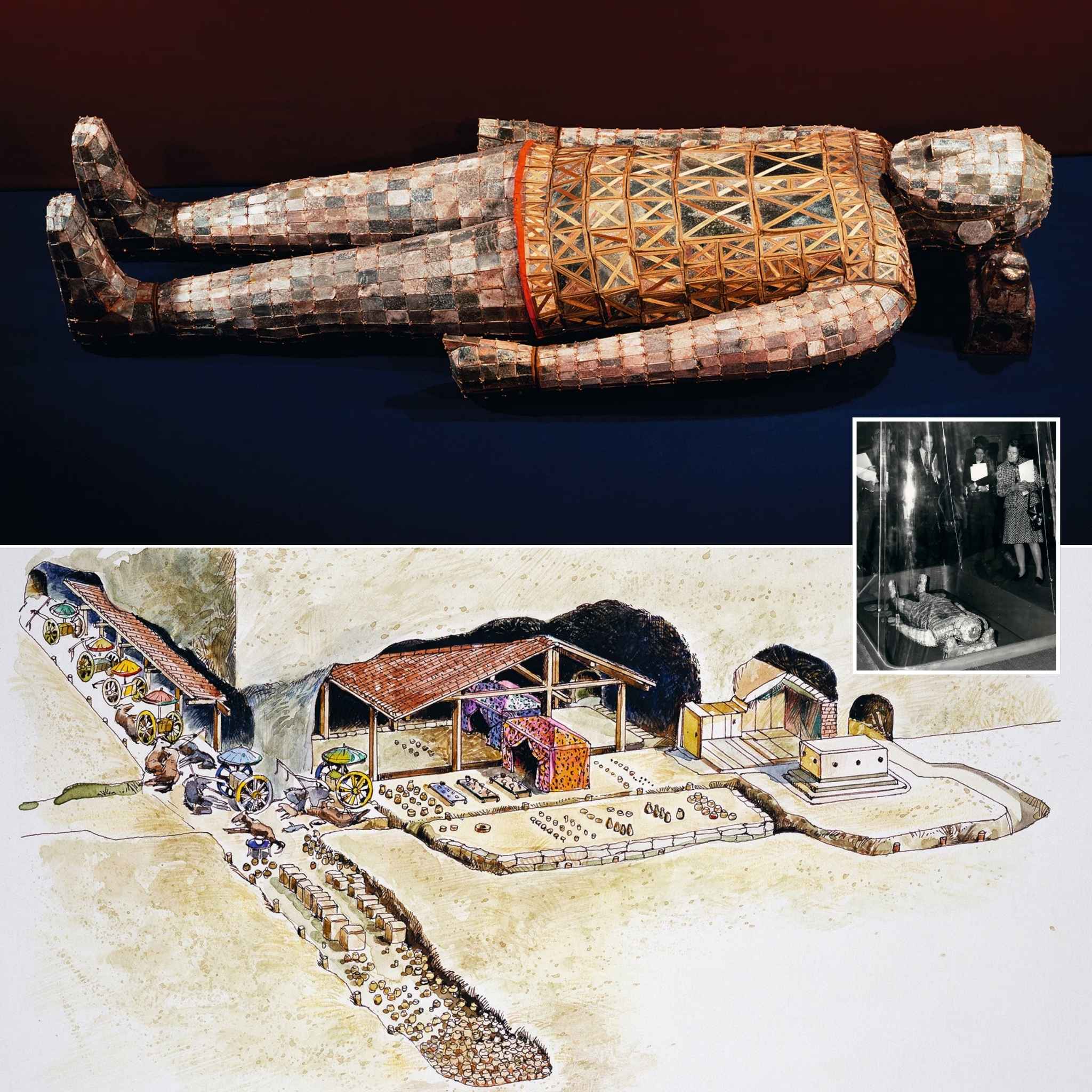
But hidden within its rocky slopes lay one of the greatest archaeological discoveries in Chinese history.
For more than two millennia, two elaborate royal tombs remained sealed inside the mountain, untouched by grave robbers and forgotten by time. Then, in 1968, an accidental discovery by Chinese soldiers revealed an underground world filled with extraordinary treasures.
Among the artifacts were objects many historians had previously known only from ancient texts: magnificent burial suits made entirely of jade.
The discovery stunned archaeologists.
For centuries, descriptions of jade burial suits had survived in historical records, but no intact examples had ever been found. Some scholars questioned whether the accounts were exaggerated or even mythical.
The tombs at Mancheng proved otherwise.
Inside rested the remains of a Han dynasty prince and princess wrapped in thousands of carefully carved jade plaques stitched together with gold wire—a breathtaking testament to ancient Chinese beliefs about death, immortality, and the afterlife.
Today, these jade suits are considered among China’s greatest archaeological treasures and offer a remarkable window into one of the most powerful dynasties in Chinese history.
The Prince Who Ruled the Frontier
The owner of one of the tombs was Liu Sheng, Prince of Zhongshan.
He was no ordinary nobleman.
Liu Sheng was the son of Emperor Jing Di, the sixth ruler of the Han dynasty, one of the most influential imperial dynasties in Chinese history.
The Han ruled China from 206 B.C. to A.D. 220, establishing many political, cultural, and administrative traditions that would shape Chinese civilization for centuries.
In 154 B.C., China faced serious internal unrest.
Regional rebellions threatened imperial authority, particularly in frontier regions.
To strengthen control over the northeastern territories, Emperor Jing Di dispatched his son Liu Sheng to govern Zhongshan, a strategically important kingdom located on the empire’s frontier.
Liu Sheng would rule there for decades.
As his power and wealth grew, preparations began for one of the most ambitious funerary projects of the Han era.
Building a Palace for Eternity
The construction of Liu Sheng’s tomb likely began soon after he arrived in Zhongshan.
The project was immense.
Rather than building a conventional underground burial chamber, workers carved entire tomb complexes directly into the mountainside.
Thousands of tons of rock were removed to create elaborate cave-like structures hidden within Lingshan.
The prince’s tomb was mirrored by a second tomb constructed for his wife, Dou Wan.
Both tombs shared remarkably similar layouts and dimensions.
Creating these underground palaces would have required decades of labor.
Skilled engineers, architects, craftsmen, and laborers worked together to transform the mountain into a royal necropolis.
The undertaking demanded enormous financial resources.
Only members of the imperial family could have commanded such a project.
By the time Liu Sheng died in 113 B.C. and Dou Wan died approximately a decade later, the tombs were fully prepared to receive them.
The chambers were filled with luxury goods, ceremonial objects, and provisions for the afterlife.
Then the entrances were sealed.
Massive brick barriers blocked access.
Cast-iron reinforcements further protected the tombs from intrusion.
The precautions proved extraordinarily effective.
For more than 2,000 years, no one entered again.
The Accidental Discovery
The tombs might have remained hidden forever were it not for a chance event during one of China’s most turbulent periods.
In June 1968, China was in the midst of the Cultural Revolution, a political movement launched by Mao Zedong.
Universities were disrupted.
Scholars were persecuted.
Many forms of academic research were severely restricted.
At the same time, military units across the country were constructing defensive infrastructure amid Cold War tensions.
One army platoon stationed near Lingshan began excavating an air-raid shelter on the mountainside.
As soldiers worked, they broke through a rock wall.
Behind it lay a hidden chamber.
Recognizing the potential significance of the discovery, authorities alerted archaeologists.
A team from the Institute of Archaeology of the Beijing Academy of Sciences was quickly assembled.
What they found exceeded all expectations.
Not only had they uncovered one royal tomb—they discovered two.
And unlike many elite Han burials, neither had been looted.
A Rare Archaeological Miracle
Throughout Chinese history, tomb robbery has been a persistent problem.
Many royal and noble burials were plundered within decades—or even years—of their construction.
Ancient grave robbers targeted precious metals, jewelry, and luxury goods.
As a result, archaeologists often encounter tombs that have been heavily disturbed.
The Mancheng tombs were different.
The elaborate sealing systems worked exactly as intended.
For more than twenty centuries, the chambers remained untouched.
When archaeologists entered, they found a perfectly preserved snapshot of elite Han funerary culture.
Thousands of artifacts remained exactly where they had been placed by mourners over 2,000 years earlier.
The discovery instantly became one of the most important archaeological finds in modern Chinese history.
Inside the Underground Palaces
The tombs were far more elaborate than simple burial chambers.
Each complex functioned as an underground residence designed for eternal life.
Visitors entered through a narrow passageway leading into a large antechamber.
This space was divided into separate functional areas.
One section stored food supplies.
Terracotta containers held provisions intended to sustain the deceased in the afterlife.
Another section served as a stable.
Archaeologists discovered chariots and horse skeletons, reflecting the importance of transportation and status in Han society.
Beyond these areas lay a ceremonial hall.
Supported by wooden structures and covered with tiled roofs, the chamber contained rows of carefully arranged objects.
These included:
- Bronze vessels
- Ritual weapons
- Ceramic servant figurines
- Decorative lamps
- Luxury furnishings
At the rear stood a stone doorway leading to the private funerary chamber.
Here, in the center of the room, rested the sarcophagus.
The design reflects the belief that death represented not an ending but a continuation of life in another realm.
The tomb was essentially a complete household intended to accompany its owner into eternity.
The Discovery That Changed Everything
Among the countless treasures recovered from the tombs, none generated more excitement than the jade burial suits.
Prior to the Mancheng excavation, references to such suits existed mainly in ancient historical texts.
Descriptions suggested that members of the imperial family were sometimes buried inside garments made entirely of jade.
Many scholars considered these accounts difficult to verify.
Then archaeologists opened the tombs.
There, surrounding the bodies of Liu Sheng and Dou Wan, were two nearly complete jade suits.
The legendary garments were real.
And they were even more impressive than anyone had imagined.

Suits Made of Stone
Each burial suit consisted of thousands of individual jade plaques.
Craftsmen carefully carved each piece to fit specific parts of the body.
The plaques were then connected using gold wire.
The result resembled a form of armor.
Every suit was tailored to the deceased.
Rather than being assembled as a single piece, the garments consisted of twelve separate sections designed to follow the body’s natural contours.
The craftsmanship required was extraordinary.
Producing a single suit demanded years of labor by highly skilled artisans.
The jade itself had to be mined, transported, cut, polished, drilled, and assembled.
Only the wealthiest members of society could afford such an object.
The suit belonging to Liu Sheng contains more than 2,400 jade plaques linked by approximately two pounds (over one kilogram) of gold wire.
Its value in the ancient world would have been immense.
Why Jade?
To modern observers, the use of jade in burial garments may seem unusual.
For ancient Chinese society, however, jade possessed profound spiritual significance.
For thousands of years, jade symbolized purity, virtue, immortality, and divine protection.
Unlike many materials, jade does not easily decay.
Its durability made it an ideal symbol of eternal existence.
Han elites believed jade possessed protective properties capable of preserving the body and safeguarding the soul.
As a result, jade objects frequently accompanied the dead into their tombs.
Burial suits represented the ultimate expression of this belief.
By encasing the entire body in jade, mourners hoped to protect the deceased from physical and spiritual decay.
The Han Quest for Immortality
The jade suits reveal much about Han attitudes toward death.
Although ancient Chinese society did not practice mummification in the same manner as ancient Egypt, preserving the dead remained an important concern.
Many Han elites were deeply interested in immortality.
They sought methods to extend life, prevent decay, and achieve transcendence.
Some experimented with alchemical substances.
Others pursued spiritual practices.
Funerary rituals likewise reflected these concerns.
The jade suits served as protective shells designed to assist the deceased’s transition into the afterlife.
Rather than focusing solely on preserving the body, they were intended to preserve essential aspects of the person’s spiritual existence.
The Two Souls of Ancient China
The significance of the jade suits becomes clearer when viewed through traditional Chinese beliefs about the soul.
Many ancient Chinese traditions held that every person possessed two spiritual components.
The first was known as the hun.
The hun represented consciousness, personality, and higher spiritual functions.
After death, it ascended to join the ancestors.
The second was known as the po.
The po remained closely tied to the physical body and earthly existence.
At death, the two souls separated.
Managing this transition became a central concern of funerary practice.
Some traditions viewed the lingering po as potentially dangerous or restless.
The jade burial suits may have functioned as spiritual containers designed to stabilize or restrain this aspect of the deceased.
In this interpretation, the suits protected not only the dead but also the living.
A Treasury of Han Civilization
The tombs yielded far more than jade suits.
Archaeologists uncovered an astonishing variety of artifacts.
Among the most remarkable discoveries were:
- Bronze lamps with smoke-filtering systems
- Water clocks
- Luxury vessels
- Chariots
- Musical instruments
- Ritual objects
- Gold ornaments
- Medical tools
One particularly fascinating find was a collection of golden needles believed to have been used for acupuncture.
These objects provide rare evidence of ancient Chinese medical practices.
Other artifacts demonstrate the technological sophistication of Han society.
The famous bronze lamp discovered in Liu Sheng’s tomb incorporated an internal smoke-removal mechanism that reduced indoor pollution—a remarkably advanced design for its time.
Together, the artifacts reveal a civilization characterized by innovation, wealth, and complex spiritual beliefs.
A Discovery Beyond Archaeology
The significance of the Mancheng tombs extended far beyond scholarship.
The discovery occurred during a politically sensitive period when China sought to highlight the achievements of its ancient civilization.
The artifacts quickly became symbols of national pride.
In 1971, many of the objects were displayed at the Palace Museum inside Beijing’s Forbidden City.
The jade burial suit of Liu Sheng became the centerpiece of the exhibition.
Soon afterward, the suit traveled abroad as part of international exhibitions introducing Chinese archaeology to Western audiences.
For many people outside China, it was the first glimpse of the extraordinary sophistication of Han civilization.
A Window Into the Ancient World
More than half a century after their discovery, the tombs of Liu Sheng and Dou Wan remain among the most important archaeological sites ever excavated in China.
They transformed scholarly understanding of Han burial practices.
They confirmed the existence of legendary jade burial suits.
They revealed astonishing levels of craftsmanship and wealth.
Most importantly, they provided a rare opportunity to examine an elite Han burial exactly as it had been left more than 2,000 years earlier.
Few archaeological discoveries offer such a complete and intimate view of an ancient civilization.
Hidden inside a mountain for centuries, protected by stone, iron, and luck, the tombs preserved a world that might otherwise have been lost forever.
And at the center of that world stood two extraordinary suits of jade—once dismissed as rumor, now recognized as among the greatest treasures of ancient China.


