The shop felt different after everyone left.
Not empty.
Settled.
The folding chairs had been stacked against the wall. The temporary lights had been taken down. A few paper cups sat forgotten near the office door, and the street outside had returned to its usual quiet, the kind that came after people stopped applauding and went home with the story still moving inside them.
Claire sat in the Mustang with both hands on the steering wheel.
For a moment, she did not turn the key.
Dean stood outside the driver’s window, one elbow resting lightly on the roof. He did not rush her. He had waited thirty-seven years for the truth to be heard. Waiting a few more seconds for Claire to find her breath was nothing.
The seat felt lower than she expected. The windshield crack cut a thin line across the glass. The dashboard had small scratches near the gauges. Someone had taped one corner of an old label beneath the ignition, and the edges had browned with age.
Nothing about the car felt polished.
That was why it felt real.
Claire looked at the key in her hand.
It was plain. No branded fob. No ceremony. Just a small metal key worn smooth at the edges by other hands.
Her father’s hands, maybe.
Dean’s.
Maybe Warren’s, once.
Claire swallowed.
“I spent so many years thinking he didn’t care enough to explain,” she said.
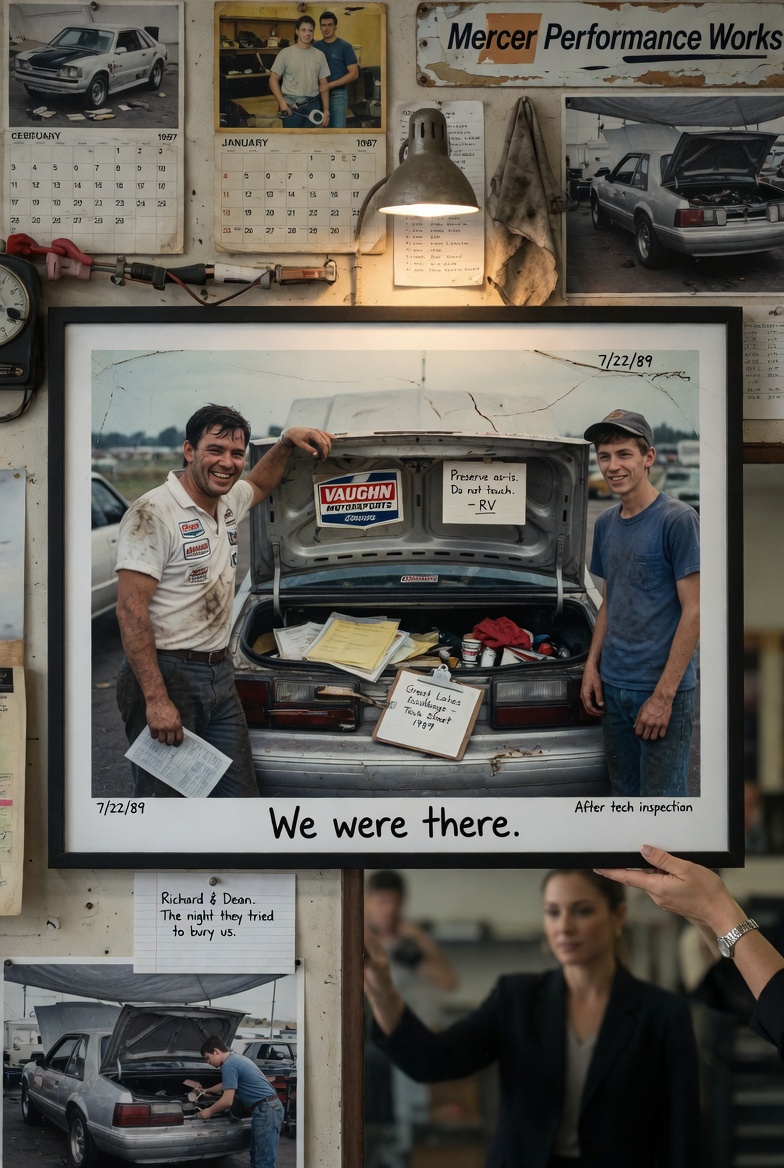
Dean looked through the windshield toward the far wall, where Richard’s photograph now hung above the workbench.
“Maybe he didn’t know how,” he said.
“That doesn’t make it right.”
“No.”
Dean said it without hesitation.
That mattered.
Claire had grown used to people polishing difficult truths until they became easier to display. Dean did not do that. He did not protect Richard by making him smaller or cleaner. He simply left the truth where it was, with all its weight intact.
Claire nodded once, then slid the key into the ignition.
The Mustang resisted at first.
A dry click.
A cough.
Then another.
Dean leaned slightly closer. “Give it a little throttle.”
Claire pressed her foot down, gentle at first, then firmer.
The engine caught.
The V8 roared awake so suddenly that Claire flinched, then laughed despite herself. It was not a neat sound. It was deep, uneven, physical. It moved through the steering wheel, through the floor, through her ribs. The whole car seemed to come alive around her, not like a machine being started, but like an old witness clearing its throat after years of silence.
Dean stepped back.
Across the shop, Luis appeared at the office doorway, still holding a broom. He grinned and said nothing.
Claire kept both hands on the wheel while the engine settled into a rough idle. Her eyes filled again, but this time she did not wipe them away immediately.
For most of her life, her father had been a portrait, a schedule conflict, a signature, a closed door.
Now he was sound.
Not an apology.
Not an excuse.
A sound.
The kind made by steel, fuel, pressure, timing, and a thousand small decisions made correctly by people no one had remembered to thank.
Dean tapped the roof twice.
“She’s warm enough,” he said. “Ease her out.”
Claire looked at him. “You’re letting me drive it?”
He gave her the smallest possible smile.
“Wasn’t kept all these years just to sit under lights.”
The garage door rolled up slowly, rattling in its tracks. Evening air entered the shop, cool and clean. The street beyond was nearly empty, except for Warren Hail standing beside his parked truck with both hands on his cane.
Claire had not seen him arrive.
Warren lifted one hand.
She understood.
Some people did not come to say goodbye. They came to make sure the thing they loved kept moving.
Claire eased the Mustang forward.
The clutch was heavier than anything she was used to. The steering demanded attention. Nothing assisted her. Nothing corrected her. The car required honesty from the person holding it.
At the end of the driveway, she stalled.
The engine died with an embarrassed shudder.
For one second, Claire froze.
Then Dean’s voice came through the open window.
“Start it again.”
She looked at him.
He was not smiling at her failure.
He was trusting her to continue.
So she turned the key.
The engine caught faster this time.
Claire breathed out, shifted carefully, and guided the Mustang into the street. Dean climbed into the passenger seat without comment, closing the door with a heavy metallic click.
They drove slowly at first.
Past the boarded warehouse.
Past the shuttered tool-and-die shop.
Past the faded sign that had watched generations of mechanics grow older beneath it.
The Mustang did not glide. It pushed, pulled, argued, and answered. Claire had to feel it instead of command it. Every vibration told her something. Every corner required listening.
For the first time, she understood what Dean had meant.
Engines remember.
They remember the hands that tuned them, the roads that tested them, the mistakes that nearly broke them, and the people who kept them from being erased.
At a red light, Claire looked over.
Dean was watching the road, but his eyes were somewhere else.
“Did he ever talk about me?” she asked.
Dean did not answer right away.
The light turned green.
Claire eased forward.
“Not often,” Dean said finally. “But when he did, he went quiet afterward.”
Claire held the wheel tighter.
“That sounds like him.”
“No,” Dean said. “That sounded like regret.”
They drove another mile in silence.
The city moved around them: traffic lights, storefronts, bus stops, a man walking a dog, a cyclist cutting across an empty lane. Ordinary life. The kind of life that continues whether history is corrected or not.
And somehow that comforted her.
Because truth did not stop the world.
It gave people a better way to live inside it.
When they returned to the shop, Warren was still there. He stood a little straighter when the Mustang rolled back into the bay. Claire shut off the engine, and the sudden quiet felt almost sacred.
Warren walked to the driver’s side slowly.
For a moment, he only looked at the car.
Then he placed one weathered hand on the fender.
“Well,” he said, his voice rough, “she still knows the way back.”
Claire stepped out.
The three of them stood around the Mustang without arranging themselves for anyone’s camera. There were no reporters now. No board members. No investors. No legal team. Just the people left after the performance of legacy had ended and the responsibility of memory remained.
Naomi’s documentary would come months later.
The archive would grow.
Students would visit Mercer Performance Works and learn that engineering was not only about speed, but also about accountability. Vaughn Motorsports would change, slowly and imperfectly, because companies did not become honest in a single speech. They became honest through repeated choices, especially when no one was applauding.
And Claire would return.
Not every day.
Not as an executive checking on an initiative.
She returned on quiet mornings, sometimes with coffee, sometimes with old questions, sometimes with no reason she could explain. She learned where the photographs were kept. She learned how to read the crew logs. She learned the difference between preservation and nostalgia.
Most importantly, she learned to stop asking the past to become painless before she allowed it to matter.
One afternoon, months after the review decision, Claire found Dean alone in the shop, adjusting the Mustang’s hood latch.
She stood beside him for a while before speaking.
“I used to think legacy meant what people built.”
Dean kept working. “And now?”
Claire looked at the car.
The faded paint.
The cracked windshield.
The corrected record.
The photograph on the wall.
“The truth they’re willing to protect after it costs them something.”
Dean tightened the latch, lowered the hood gently, and nodded once.
Outside, the late sun touched the old Mercer sign, turning the faded letters gold for a few brief minutes. Inside, the Mustang rested under the shop lights, no longer abandoned, no longer hidden, no longer reduced to an asset or a scandal.
It had become what Richard Vaughn had failed to say and what Claire had finally been ready to hear.
A confession.
A witness.
A bridge.
That evening, before locking up, Claire sat in the driver’s seat one more time. Dean stood near the open bay door. Warren’s photograph had been added beside Richard’s on the wall. Naomi had sent the first stills from the documentary. Luis was in the back, labeling parts with the careful seriousness of someone who understood he was not just learning a trade, but inheriting one.
Claire turned the key.
The Mustang came alive.
This time, she did not flinch.
She listened.
And in that sound, she no longer heard only what had been lost. She heard what had survived: a father’s flawed love, a mechanic’s promise, a crew chief’s burden, a journalist’s patience, and a daughter’s courage to stop protecting a lie just because it had been useful.
The engine echoed through the old shop and out into the street.
Not loud enough to change the whole world.
Just loud enough to remind everyone nearby that buried truth does not disappear.
It waits for someone brave enough to start it again.