Part 4: The Shape of Control
Professor Elaine Jenkins arrived at the Blackstone house on a Tuesday morning in a navy coat, sensible shoes, and the expression of a woman who had spent thirty years telling hospital administrators no.
Harper saw her through the front window and felt her stomach drop.
Her nursing advisor did not belong on Briar Hill. She belonged in a cramped office with leaning stacks of student files, a mug that said TRUST ME, I’M A NURSE, and a printer that jammed whenever anyone used legal paper.
Not here.
Not on marble steps between two security men pretending to be landscaping staff.
Harper crossed the foyer just as Mrs. Chen opened the door.
“Professor Jenkins?”
The older woman’s eyes found Harper immediately. Relief appeared first. Then suspicion.
“Harper,” she said. “Are you all right?”
The question landed harder than Harper expected.
For weeks, everyone inside the house had asked whether she was informed, prepared, escorted, cleared, scheduled.
No one had asked whether she was all right.
“I’m fine,” Harper said, because she had learned that answer from Nicholas.
Professor Jenkins did not look convinced.
James Blackstone stepped out of his office before Harper could explain anything. He wore a charcoal suit, no tie, and the kind of calm that made powerful people seem reasonable right before they rearranged your life.
“Professor Jenkins,” he said. “Thank you for coming.”
“I wasn’t aware I had much choice,” she replied.
Harper almost smiled.
James did not. “You always have a choice.”
“Then for clarity, Mr. Blackstone, I chose to come because one of my students has missed two advising appointments, changed housing without proper documentation, and is now apparently employed by a family whose driver refused to let me use my phone inside the gate.”
Mrs. Chen’s eyes lowered.
Harper looked at James.
James looked at no one.
“Your phone will be returned when you leave,” he said.
Professor Jenkins gave a dry laugh. “How generous.”
The meeting took place in the library, not the office. Harper understood why as soon as she sat down. The library felt less like a command center. Softer chairs. Warmer light. A fire burning low behind a brass screen. Still, two guards remained outside the door, and one of the paintings on the wall had a tiny black camera hidden near the frame.
Harper noticed it.
So did Professor Jenkins.
James opened a folder on the table. Harper hated folders now.
“I would like to discuss Miss Reeves’s academic path,” he said.
Professor Jenkins folded her hands. “So would I. Preferably with Miss Reeves.”
“I am sitting right here,” Harper said.
“Yes,” Jenkins replied, looking at her over her glasses. “And I’m waiting for you to remember that.”
The words were not cruel.
That made them worse.
James slid several pages across the table. “Harper’s tuition balance has been resolved. Her lab fees are covered. We are prepared to fund a private clinical tutor, adjust transportation, and secure placement hours at St. Agnes, Westbridge Rehabilitation, and two outpatient clinics under our hospital network.”
Professor Jenkins did not touch the papers.
Harper did.
Her name was printed at the top of every page.
A revised course plan. A projected graduation timeline. Clinical rotations. Exam preparation. Even a recommendation for an accelerated critical care module she had only once mentioned wanting to take.
It was everything she needed.
That was the problem.
James Blackstone had not bought her a gift. He had built her a future and placed it on the table like a contract.
“How did you get access to internal placement openings?” Professor Jenkins asked.
James’s answer was immediate. “St. Agnes is part of a foundation portfolio connected to Blackstone Holdings.”
“That was not my question.”
“No,” James said. “But it is the answer that matters.”
Harper looked at the pages until the words blurred.
A month ago, she had been choosing between a bus pass and groceries. Now someone had arranged the next two years of her life with more efficiency than she had ever been able to afford.
She should have felt rescued.
Instead, she felt redrawn.
“Harper,” Professor Jenkins said, softer now. “Did you ask for this?”
Harper opened her mouth.
No came first.
Then she stopped.
Because the truth was messier than that.
She had not asked for Blackstone to pay her tuition. She had not asked for him to contact her advisor. She had not asked for her schedule, her housing, her clinical hours, and her future salary to be woven into the security structure of a family war.
But she had stayed.
She had signed.
She had taken the room with the heated floors and the emergency medical pouch on the desk. She had watched guards escort an elderly neighbor to safety and had been grateful enough not to ask where.
“I asked to finish school,” Harper said finally.
Professor Jenkins’s face softened with disappointment, not in Harper, but for her.
James leaned back slightly. “Then let us help her do that.”
“That is not help,” Jenkins said. “That is ownership with better stationery.”
The room went quiet.
Harper felt James change beside her. Not anger exactly. Something more controlled. More dangerous because it had been touched in a place he rarely allowed anyone near.
“I do not own people,” he said.
Professor Jenkins held his gaze. “Powerful men rarely call it that.”
For one sharp second, Harper thought of leaving with Jenkins. Walking out past the guards. Taking her old coat from Mrs. Chen. Returning to the laundromat room if the landlord had not rented it already. Going back to Joe’s Diner, overdue notices, cold feet, and a life where danger came from poverty instead of men in tailored suits.
Then her phone vibrated.
Nicholas.
LOW. 63. HISTORY CLASS. DON’T COME IN WEIRD.
Harper was on her feet before she finished reading.
James stood too.
Harper pointed at him. “No.”
His eyes narrowed.
“I’ll handle it,” she said.
Nicholas’s school was twenty minutes away with traffic. They made it in twelve.
Harper entered through a side door with a school nurse who looked terrified of the Blackstone security badge clipped to Elias’s jacket. Harper made him stay in the hallway.
Nicholas sat in the back of a classroom, head bent over a notebook, pretending to write while his face had lost too much color. His classmates were working on a group assignment. No one had noticed yet, which meant there was still time to preserve the one thing he guarded almost as closely as his life.
His dignity.
Harper did not rush.
She walked to the teacher, smiled, and said, “Sorry to interrupt. Nicholas has a family call.”
The teacher blinked. “Right now?”
Harper lowered her voice. “Yes. Right now.”
Something in her tone ended the discussion.
Nicholas looked up as she approached. Embarrassment flashed first, then relief so fast most people would have missed it.
Harper did not.
She placed a folded note on his desk like it was nothing. Inside was glucose gel.
“Hallway,” she murmured.
He stood carefully. Too carefully.
Three students looked up.
One boy smirked. “Blackstone needs permission to leave class now?”
Nicholas’s shoulders tightened.
Harper turned back with a pleasant expression. “He’s taking a call. You’re taking notes. Seems like everyone has a role.”
The room went silent.
Nicholas stared at her in disbelief.
In the hallway, the mask dropped.
He leaned against the lockers and tore open the gel with shaking hands.
“I said don’t come in weird,” he muttered.
“I was incredibly normal.”
“You threatened Tyler with note-taking.”
“Terrifying, I know.”
He swallowed the gel and closed his eyes.
Harper checked the number, then waited. She did not crowd him. She did not touch him. She simply stood beside him while color slowly returned to his face.
After a minute, he said, “You didn’t tell my dad.”
“I texted Elias that you were stable.”
“That’s not the same.”
“No.”
He looked at her, searching for the trick.
There wasn’t one.
Nicholas looked away first. “He thinks if he controls everything, nothing bad can happen.”
“I know.”
“It still happens.”
“I know that too.”
His throat moved.
“My mom used to say he was only scary because he loved people badly.”
Harper looked down the empty hallway. Lockers. Fluorescent lights. A crooked poster about winter formal. Such ordinary things, surrounding a boy whose life had never been allowed to remain ordinary.
“Maybe,” she said, “some people learn protection before they learn tenderness.”
Nicholas gave a humorless little laugh. “That sounds like something from one of your nursing textbooks.”
“My textbooks are mostly pressure ulcers and medication errors.”
“Gross.”
“Very.”
He almost smiled.
When Harper returned to the house that afternoon, Professor Jenkins was gone.
Her phone had been returned. Her opinion had not changed.
A note waited on Harper’s desk, written in Jenkins’s tidy script.
Harper, opportunities that cost too much are still debts. Know the price before you call it luck.
Harper read it three times.
Then she folded it and placed it inside her anatomy book.
That evening, James found her in the east wing sitting room. The room overlooked the garden, where two guards moved along the tree line in the blue dusk.
“Nicholas’s numbers stabilized,” he said.
“Yes.”
“You handled it well.”
She closed her book. “You sent Professor Jenkins away.”
“She had another appointment.”
“Did she leave willingly?”
James looked at her.
Harper waited.
Finally, he said, “Yes. Angry, but willingly.”
That mattered.
Not enough. But it mattered.
“You can’t keep doing this,” Harper said.
“Doing what?”
“Deciding what people need and calling it care.”
His expression hardened. “Care without control is just hope.”
“No,” Harper said. “Care without trust is a cage.”
James turned toward the window.
Outside, one guard paused near the hedges and spoke into his sleeve.
For several seconds, Harper saw only the reflection of James in the glass. Tall. Still. Alone in a house full of people trained to move when he breathed wrong.
“You think I do not know what a cage looks like?” he asked.
“I think you built one so large you stopped noticing the bars.”
That should have made him angry.
Maybe it did.
But when he turned back, anger was not what Harper saw.
She saw exhaustion.
“My wife begged me to take fewer precautions the week she died,” he said quietly. “She said she wanted to feel like a person, not a protected asset. I listened.”
Harper’s breath caught.
James’s face did not change, but his voice lowered until it was almost difficult to hear.
“She took the smaller car. One driver. No follow vehicle. She wanted to stop for coffee after the event because the place reminded her of when we were poor enough to count coins for dinner.”
He looked at the fire.
“I gave her that freedom.”
The room seemed to shrink around them.
“She was dead before midnight.”
Harper had no answer for that.
There are some wounds you cannot argue with because they have built their own logic out of blood.
James looked at her again. “So yes, Miss Reeves. I control doors, cars, phones, schedules, routes, staff, physicians, and enemies. I control what I can because the one night I did not, my son waited at the stairs for a mother who never came home.”
Harper felt the old instinct rise in her.
Comfort him.
Forgive him.
Make the room softer.
But nursing had taught her something else too. Pain explained behavior. It did not excuse harm.
“You didn’t kill her,” Harper said.
His eyes sharpened.
“And Nicholas is not safer because he thinks loving people gets them taken.”
For the first time since she had met him, James Blackstone had no immediate reply.
A knock interrupted them.
Elias opened the door without waiting to be invited. That alone told Harper something was wrong.
“Sir,” he said. “Donovan moved again.”
James’s face closed.
Harper stood.
Elias glanced at her, then back at James.
“Say it,” James ordered.
Elias held out a tablet.
Security footage filled the screen. Grainy, black and white. The hallway of Harper’s old building. Mrs. Patel stepping out with a grocery bag. Two men approaching. One smiling. One watching the stairwell.
Harper’s chest went cold.
“This is from yesterday,” Elias said. “We only recovered it an hour ago. They didn’t take her then. Just spoke to her.”
The footage continued.
Mrs. Patel shook her head, tried to move around them, and one of the men touched her arm.
Harper stepped closer.
In the video, Mrs. Patel looked frightened.
Not confused.
Frightened.
James’s voice was flat. “Where is she now?”
“We moved her to the safe apartment this morning. She’s guarded.”
Harper exhaled shakily.
Then Elias’s jaw tightened.
“What?” Harper asked.
He tapped the screen.
A second video opened.
Mrs. Patel standing outside the safe apartment building.
A delivery man approached with flowers.
Harper’s breath stopped.
The bouquet was white lilies.
The kind placed on graves.
Mrs. Patel did not take them. A guard stepped in. The delivery man dropped the flowers and walked away before security could reach him.
Attached to the bouquet was a card.
Elias zoomed in.
For the girl who keeps saving Blackstones.
Harper read it once.
Then again.
The room became very quiet.
James took the tablet from Elias.
His hand was steady.
Too steady.
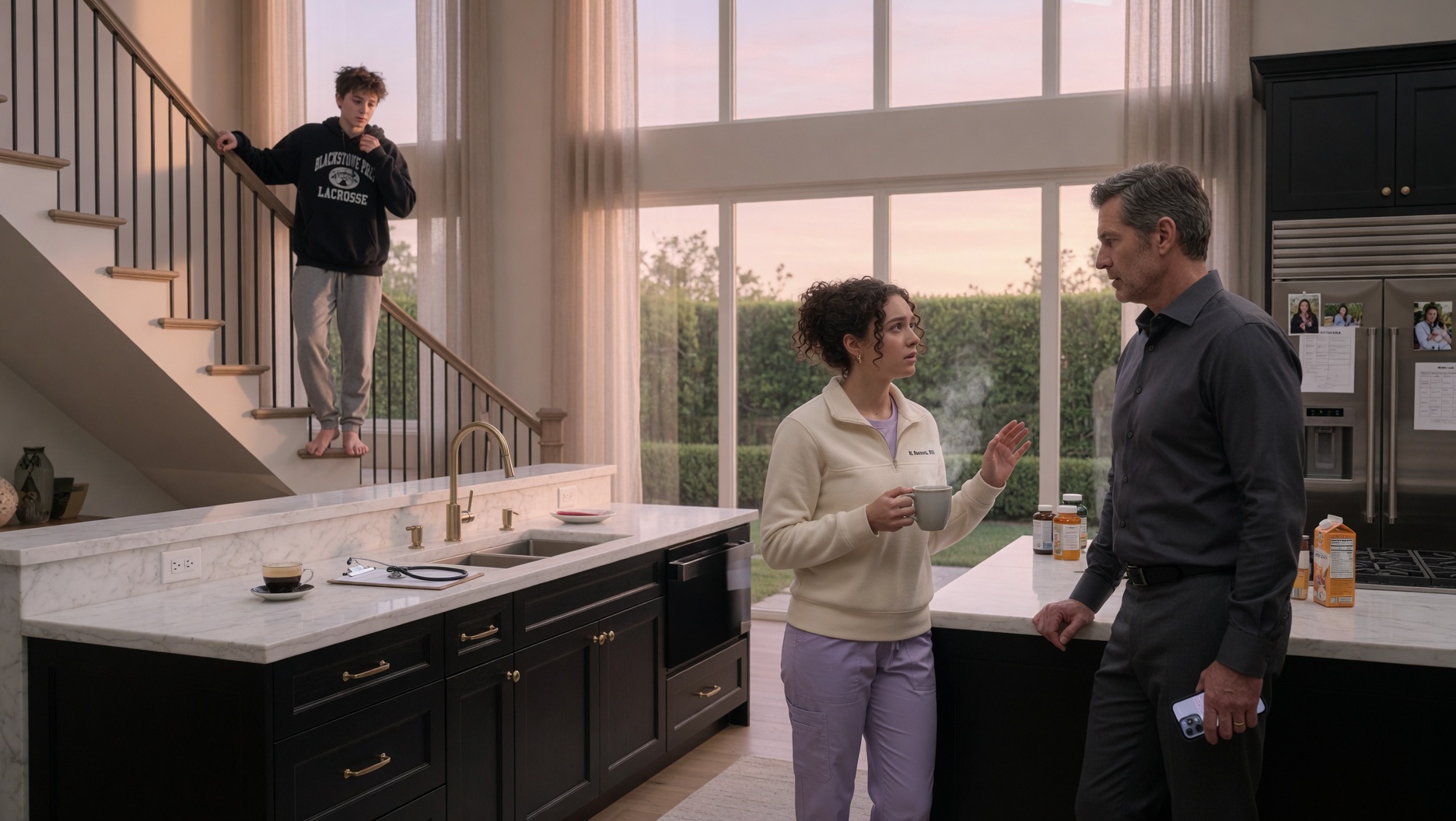
Nicholas appeared in the doorway behind Elias, pale and barefoot, drawn by the kind of silence every child in a dangerous house learns to recognize.
“What happened?” he asked.
No one answered fast enough.
His eyes dropped to the screen.
He saw the card.
He saw Harper’s face.
Something in him collapsed inward.
“This is my fault,” he whispered.
Harper moved toward him immediately. “No.”
“It is.” His voice cracked. “If you hadn’t helped me—”
“If I hadn’t helped you, you might have died in that alley.”
“But now they’re after you.”
“They are after pressure,” Harper said firmly. “That is not the same as being after truth.”
Nicholas stared at her like he wanted to believe it and could not afford to.
James looked at his son, and Harper saw the war inside him. The urge to send Nicholas upstairs. To hide him. To remove every sharp edge of reality from the room.
This time, he did not.
“Donovan wants us reacting emotionally,” James said.
Nicholas swallowed. “Are we?”
“Yes,” Harper said before James could answer.
Both of them looked at her.
She took the tablet from James and placed it face down on the table.
“We are,” she repeated. “Because Mrs. Patel is not a strategy piece. Nicholas is not leverage. I am not bait. And pretending this is just business is how people like Donovan get to keep choosing the rules.”
Elias shifted near the door.
James studied Harper for a long second.
Then he said, “And what do you suggest?”
It was not mockery.
That was what made everyone still.
James Blackstone had asked her.
Not ordered.
Not instructed.
Asked.
Harper looked at Nicholas first. Then at the tablet. Then at the garden beyond the window, where guards watched the dark like it might blink first.
“We stop letting him decide who is weak,” she said.
James’s eyes changed.
Not much.
Enough.
That night, for the first time, Harper was invited below the main floor.
The basement level was not what she expected. No villainous stone corridors. No theatrical darkness. It was clean, bright, and brutally organized. A medical bay. Security monitors. Map walls. Emergency supplies. A communications room where three analysts tracked vehicles across the city.
Harper stood beside Nicholas while Elias explained safe routes, panic signals, and coded alerts. Nicholas listened without jokes. James watched him without interrupting.
Something had shifted.
Not solved.
Not healed.
But shifted.
Harper was no longer being protected from the truth.
She was being armed with it.
Near midnight, after Nicholas went upstairs, Harper remained in the security room with James.
On the largest screen, a city map glowed with blue markers. Blackstone vehicles. Guard posts. Safe apartments. Places Harper had never noticed now appeared connected by invisible threads.
“My life is on that wall,” she said.
James followed her gaze.
“So is mine.”
“And Nicholas’s.”
“Yes.”
She looked at him. “Does it ever feel like living?”
He did not answer quickly.
“No,” he said at last. “But it has felt like keeping him breathing.”
Harper thought of the alley. Her knees in the snow. Nicholas’s pulse under her fingers. James arriving with his emergency kit and his army.
Maybe that was the real shape of the Blackstone world.
Not evil.
Not good.
A fortress built by grief, defended by fear, and mistaken for home.
Then one of the analysts turned sharply from his station.
“Mr. Blackstone.”
James looked up.
The analyst pressed a button, and audio filled the room.
A man’s voice, distorted but clear enough.
“Tell Blackstone the next time we send flowers, we won’t leave them at the door.”
Harper felt Nicholas’s name before anyone said it.
James went still.
The analyst continued, “Call came from a burner routed near Westbridge. Message ended there.”
No one spoke.
Then Harper noticed something on the map.
Westbridge was not near Nicholas’s school.
Not near the house.
Not near Mrs. Patel’s safe apartment.
It was near St. Agnes Hospital.
The hospital where James’s wife had died after the crash.
Harper turned toward him.
James had already seen it.
For one moment, all the power left his face.
Not fear exactly.
Recognition.
Donovan had not just found a pressure point.
He had found the wound underneath it.
And this time, he intended to press until everyone bled.
[Confirm to continue Part 5]
Part 4: The Shape of Control
Professor Elaine Jenkins arrived at the Blackstone house on a Tuesday morning in a navy coat, sensible shoes, and the expression of a woman who had spent thirty years telling hospital administrators no.
Harper saw her through the front window and felt her stomach drop.
Her nursing advisor did not belong on Briar Hill. She belonged in a cramped office with leaning stacks of student files, a mug that said TRUST ME, I’M A NURSE, and a printer that jammed whenever anyone used legal paper.
Not here.
Not on marble steps between two security men pretending to be landscaping staff.
Harper crossed the foyer just as Mrs. Chen opened the door.
“Professor Jenkins?”
The older woman’s eyes found Harper immediately. Relief appeared first. Then suspicion.
“Harper,” she said. “Are you all right?”
The question landed harder than Harper expected.
For weeks, everyone inside the house had asked whether she was informed, prepared, escorted, cleared, scheduled.
No one had asked whether she was all right.
“I’m fine,” Harper said, because she had learned that answer from Nicholas.
Professor Jenkins did not look convinced.
James Blackstone stepped out of his office before Harper could explain anything. He wore a charcoal suit, no tie, and the kind of calm that made powerful people seem reasonable right before they rearranged your life.
“Professor Jenkins,” he said. “Thank you for coming.”
“I wasn’t aware I had much choice,” she replied.
Harper almost smiled.
James did not. “You always have a choice.”
“Then for clarity, Mr. Blackstone, I chose to come because one of my students has missed two advising appointments, changed housing without proper documentation, and is now apparently employed by a family whose driver refused to let me use my phone inside the gate.”
Mrs. Chen’s eyes lowered.
Harper looked at James.
James looked at no one.
“Your phone will be returned when you leave,” he said.
Professor Jenkins gave a dry laugh. “How generous.”
The meeting took place in the library, not the office. Harper understood why as soon as she sat down. The library felt less like a command center. Softer chairs. Warmer light. A fire burning low behind a brass screen. Still, two guards remained outside the door, and one of the paintings on the wall had a tiny black camera hidden near the frame.
Harper noticed it.
So did Professor Jenkins.
James opened a folder on the table. Harper hated folders now.
“I would like to discuss Miss Reeves’s academic path,” he said.
Professor Jenkins folded her hands. “So would I. Preferably with Miss Reeves.”
“I am sitting right here,” Harper said.
“Yes,” Jenkins replied, looking at her over her glasses. “And I’m waiting for you to remember that.”
The words were not cruel.
That made them worse.
James slid several pages across the table. “Harper’s tuition balance has been resolved. Her lab fees are covered. We are prepared to fund a private clinical tutor, adjust transportation, and secure placement hours at St. Agnes, Westbridge Rehabilitation, and two outpatient clinics under our hospital network.”
Professor Jenkins did not touch the papers.
Harper did.
Her name was printed at the top of every page.
A revised course plan. A projected graduation timeline. Clinical rotations. Exam preparation. Even a recommendation for an accelerated critical care module she had only once mentioned wanting to take.
It was everything she needed.
That was the problem.
James Blackstone had not bought her a gift. He had built her a future and placed it on the table like a contract.
“How did you get access to internal placement openings?” Professor Jenkins asked.
James’s answer was immediate. “St. Agnes is part of a foundation portfolio connected to Blackstone Holdings.”
“That was not my question.”
“No,” James said. “But it is the answer that matters.”
Harper looked at the pages until the words blurred.
A month ago, she had been choosing between a bus pass and groceries. Now someone had arranged the next two years of her life with more efficiency than she had ever been able to afford.
She should have felt rescued.
Instead, she felt redrawn.
“Harper,” Professor Jenkins said, softer now. “Did you ask for this?”
Harper opened her mouth.
No came first.
Then she stopped.
Because the truth was messier than that.
She had not asked for Blackstone to pay her tuition. She had not asked for him to contact her advisor. She had not asked for her schedule, her housing, her clinical hours, and her future salary to be woven into the security structure of a family war.
But she had stayed.
She had signed.
She had taken the room with the heated floors and the emergency medical pouch on the desk. She had watched guards escort an elderly neighbor to safety and had been grateful enough not to ask where.
“I asked to finish school,” Harper said finally.
Professor Jenkins’s face softened with disappointment, not in Harper, but for her.
James leaned back slightly. “Then let us help her do that.”
“That is not help,” Jenkins said. “That is ownership with better stationery.”
The room went quiet.
Harper felt James change beside her. Not anger exactly. Something more controlled. More dangerous because it had been touched in a place he rarely allowed anyone near.
“I do not own people,” he said.
Professor Jenkins held his gaze. “Powerful men rarely call it that.”
For one sharp second, Harper thought of leaving with Jenkins. Walking out past the guards. Taking her old coat from Mrs. Chen. Returning to the laundromat room if the landlord had not rented it already. Going back to Joe’s Diner, overdue notices, cold feet, and a life where danger came from poverty instead of men in tailored suits.
Then her phone vibrated.
Nicholas.
LOW. 63. HISTORY CLASS. DON’T COME IN WEIRD.
Harper was on her feet before she finished reading.
James stood too.
Harper pointed at him. “No.”
His eyes narrowed.
“I’ll handle it,” she said.
Nicholas’s school was twenty minutes away with traffic. They made it in twelve.
Harper entered through a side door with a school nurse who looked terrified of the Blackstone security badge clipped to Elias’s jacket. Harper made him stay in the hallway.
Nicholas sat in the back of a classroom, head bent over a notebook, pretending to write while his face had lost too much color. His classmates were working on a group assignment. No one had noticed yet, which meant there was still time to preserve the one thing he guarded almost as closely as his life.
His dignity.
Harper did not rush.
She walked to the teacher, smiled, and said, “Sorry to interrupt. Nicholas has a family call.”
The teacher blinked. “Right now?”
Harper lowered her voice. “Yes. Right now.”
Something in her tone ended the discussion.
Nicholas looked up as she approached. Embarrassment flashed first, then relief so fast most people would have missed it.
Harper did not.
She placed a folded note on his desk like it was nothing. Inside was glucose gel.
“Hallway,” she murmured.
He stood carefully. Too carefully.
Three students looked up.
One boy smirked. “Blackstone needs permission to leave class now?”
Nicholas’s shoulders tightened.
Harper turned back with a pleasant expression. “He’s taking a call. You’re taking notes. Seems like everyone has a role.”
The room went silent.
Nicholas stared at her in disbelief.
In the hallway, the mask dropped.
He leaned against the lockers and tore open the gel with shaking hands.
“I said don’t come in weird,” he muttered.
“I was incredibly normal.”
“You threatened Tyler with note-taking.”
“Terrifying, I know.”
He swallowed the gel and closed his eyes.
Harper checked the number, then waited. She did not crowd him. She did not touch him. She simply stood beside him while color slowly returned to his face.
After a minute, he said, “You didn’t tell my dad.”
“I texted Elias that you were stable.”
“That’s not the same.”
“No.”
He looked at her, searching for the trick.
There wasn’t one.
Nicholas looked away first. “He thinks if he controls everything, nothing bad can happen.”
“I know.”
“It still happens.”
“I know that too.”
His throat moved.
“My mom used to say he was only scary because he loved people badly.”
Harper looked down the empty hallway. Lockers. Fluorescent lights. A crooked poster about winter formal. Such ordinary things, surrounding a boy whose life had never been allowed to remain ordinary.
“Maybe,” she said, “some people learn protection before they learn tenderness.”
Nicholas gave a humorless little laugh. “That sounds like something from one of your nursing textbooks.”
“My textbooks are mostly pressure ulcers and medication errors.”
“Gross.”
“Very.”
He almost smiled.
When Harper returned to the house that afternoon, Professor Jenkins was gone.
Her phone had been returned. Her opinion had not changed.
A note waited on Harper’s desk, written in Jenkins’s tidy script.
Harper, opportunities that cost too much are still debts. Know the price before you call it luck.
Harper read it three times.
Then she folded it and placed it inside her anatomy book.
That evening, James found her in the east wing sitting room. The room overlooked the garden, where two guards moved along the tree line in the blue dusk.
“Nicholas’s numbers stabilized,” he said.
“Yes.”
“You handled it well.”
She closed her book. “You sent Professor Jenkins away.”
“She had another appointment.”
“Did she leave willingly?”
James looked at her.
Harper waited.
Finally, he said, “Yes. Angry, but willingly.”
That mattered.
Not enough. But it mattered.
“You can’t keep doing this,” Harper said.
“Doing what?”
“Deciding what people need and calling it care.”
His expression hardened. “Care without control is just hope.”
“No,” Harper said. “Care without trust is a cage.”
James turned toward the window.
Outside, one guard paused near the hedges and spoke into his sleeve.
For several seconds, Harper saw only the reflection of James in the glass. Tall. Still. Alone in a house full of people trained to move when he breathed wrong.
“You think I do not know what a cage looks like?” he asked.
“I think you built one so large you stopped noticing the bars.”
That should have made him angry.
Maybe it did.
But when he turned back, anger was not what Harper saw.
She saw exhaustion.
“My wife begged me to take fewer precautions the week she died,” he said quietly. “She said she wanted to feel like a person, not a protected asset. I listened.”
Harper’s breath caught.
James’s face did not change, but his voice lowered until it was almost difficult to hear.
“She took the smaller car. One driver. No follow vehicle. She wanted to stop for coffee after the event because the place reminded her of when we were poor enough to count coins for dinner.”
He looked at the fire.
“I gave her that freedom.”
The room seemed to shrink around them.
“She was dead before midnight.”
Harper had no answer for that.
There are some wounds you cannot argue with because they have built their own logic out of blood.
James looked at her again. “So yes, Miss Reeves. I control doors, cars, phones, schedules, routes, staff, physicians, and enemies. I control what I can because the one night I did not, my son waited at the stairs for a mother who never came home.”
Harper felt the old instinct rise in her.
Comfort him.
Forgive him.
Make the room softer.
But nursing had taught her something else too. Pain explained behavior. It did not excuse harm.
“You didn’t kill her,” Harper said.
His eyes sharpened.
“And Nicholas is not safer because he thinks loving people gets them taken.”
For the first time since she had met him, James Blackstone had no immediate reply.
A knock interrupted them.
Elias opened the door without waiting to be invited. That alone told Harper something was wrong.
“Sir,” he said. “Donovan moved again.”
James’s face closed.
Harper stood.
Elias glanced at her, then back at James.
“Say it,” James ordered.
Elias held out a tablet.
Security footage filled the screen. Grainy, black and white. The hallway of Harper’s old building. Mrs. Patel stepping out with a grocery bag. Two men approaching. One smiling. One watching the stairwell.
Harper’s chest went cold.
“This is from yesterday,” Elias said. “We only recovered it an hour ago. They didn’t take her then. Just spoke to her.”
The footage continued.
Mrs. Patel shook her head, tried to move around them, and one of the men touched her arm.
Harper stepped closer.
In the video, Mrs. Patel looked frightened.
Not confused.
Frightened.
James’s voice was flat. “Where is she now?”
“We moved her to the safe apartment this morning. She’s guarded.”
Harper exhaled shakily.
Then Elias’s jaw tightened.
“What?” Harper asked.
He tapped the screen.
A second video opened.
Mrs. Patel standing outside the safe apartment building.
A delivery man approached with flowers.
Harper’s breath stopped.
The bouquet was white lilies.
The kind placed on graves.
Mrs. Patel did not take them. A guard stepped in. The delivery man dropped the flowers and walked away before security could reach him.
Attached to the bouquet was a card.
Elias zoomed in.
For the girl who keeps saving Blackstones.
Harper read it once.
Then again.
The room became very quiet.
James took the tablet from Elias.
His hand was steady.
Too steady.
Nicholas appeared in the doorway behind Elias, pale and barefoot, drawn by the kind of silence every child in a dangerous house learns to recognize.
“What happened?” he asked.
No one answered fast enough.
His eyes dropped to the screen.
He saw the card.
He saw Harper’s face.
Something in him collapsed inward.
“This is my fault,” he whispered.
Harper moved toward him immediately. “No.”
“It is.” His voice cracked. “If you hadn’t helped me—”
“If I hadn’t helped you, you might have died in that alley.”
“But now they’re after you.”
“They are after pressure,” Harper said firmly. “That is not the same as being after truth.”
Nicholas stared at her like he wanted to believe it and could not afford to.
James looked at his son, and Harper saw the war inside him. The urge to send Nicholas upstairs. To hide him. To remove every sharp edge of reality from the room.
This time, he did not.
“Donovan wants us reacting emotionally,” James said.
Nicholas swallowed. “Are we?”
“Yes,” Harper said before James could answer.
Both of them looked at her.
She took the tablet from James and placed it face down on the table.
“We are,” she repeated. “Because Mrs. Patel is not a strategy piece. Nicholas is not leverage. I am not bait. And pretending this is just business is how people like Donovan get to keep choosing the rules.”
Elias shifted near the door.
James studied Harper for a long second.
Then he said, “And what do you suggest?”
It was not mockery.
That was what made everyone still.
James Blackstone had asked her.
Not ordered.
Not instructed.
Asked.
Harper looked at Nicholas first. Then at the tablet. Then at the garden beyond the window, where guards watched the dark like it might blink first.
“We stop letting him decide who is weak,” she said.
James’s eyes changed.
Not much.
Enough.
That night, for the first time, Harper was invited below the main floor.
The basement level was not what she expected. No villainous stone corridors. No theatrical darkness. It was clean, bright, and brutally organized. A medical bay. Security monitors. Map walls. Emergency supplies. A communications room where three analysts tracked vehicles across the city.
Harper stood beside Nicholas while Elias explained safe routes, panic signals, and coded alerts. Nicholas listened without jokes. James watched him without interrupting.
Something had shifted.
Not solved.
Not healed.
But shifted.
Harper was no longer being protected from the truth.
She was being armed with it.
Near midnight, after Nicholas went upstairs, Harper remained in the security room with James.
On the largest screen, a city map glowed with blue markers. Blackstone vehicles. Guard posts. Safe apartments. Places Harper had never noticed now appeared connected by invisible threads.
“My life is on that wall,” she said.
James followed her gaze.
“So is mine.”
“And Nicholas’s.”
“Yes.”
She looked at him. “Does it ever feel like living?”
He did not answer quickly.
“No,” he said at last. “But it has felt like keeping him breathing.”
Harper thought of the alley. Her knees in the snow. Nicholas’s pulse under her fingers. James arriving with his emergency kit and his army.
Maybe that was the real shape of the Blackstone world.
Not evil.
Not good.
A fortress built by grief, defended by fear, and mistaken for home.
Then one of the analysts turned sharply from his station.
“Mr. Blackstone.”
James looked up.
The analyst pressed a button, and audio filled the room.
A man’s voice, distorted but clear enough.
“Tell Blackstone the next time we send flowers, we won’t leave them at the door.”
Harper felt Nicholas’s name before anyone said it.
James went still.
The analyst continued, “Call came from a burner routed near Westbridge. Message ended there.”
No one spoke.
Then Harper noticed something on the map.
Westbridge was not near Nicholas’s school.
Not near the house.
Not near Mrs. Patel’s safe apartment.
It was near St. Agnes Hospital.
The hospital where James’s wife had died after the crash.
Harper turned toward him.
James had already seen it.
For one moment, all the power left his face.
Not fear exactly.
Recognition.
Donovan had not just found a pressure point.
He had found the wound underneath it.
And this time, he intended to press until everyone bled.