The Jiroft Civilization: Iran’s Forgotten Bronze Age Power
Hidden for thousands of years beneath the fertile valleys of southeastern Iran, the Jiroft Civilization is emerging as one of the most intriguing cultures of the ancient world. Monumental architecture, sophisticated craftsmanship, long-distance trade networks, and a possible writing system suggest that this Bronze Age society was far more advanced than scholars once imagined.
For much of modern history, discussions of the world’s earliest civilizations focused on a familiar group of ancient societies.
Mesopotamia, Egypt, the Indus Valley, and later China were traditionally viewed as the primary centers where urban life, writing, monumental architecture, and complex government first emerged.
Yet archaeology has repeatedly demonstrated that the ancient world was more interconnected and diverse than previously believed.
One of the most remarkable examples comes from southeastern Iran, where a series of discoveries over the past two decades has transformed understanding of the Bronze Age Near East.
Known today as the Jiroft Civilization, this ancient culture flourished along the fertile Halil River Valley during the third millennium B.C. Its monumental structures, distinctive artworks, and evidence of literacy have prompted scholars to reconsider long-held assumptions about the origins of civilization.
Although many questions remain unanswered, Jiroft has emerged as one of the most important archaeological discoveries of the twenty-first century.
Discovery Along the Halil River
The story of Jiroft’s rediscovery began unexpectedly.
In 2001, severe floods struck the Halil River Valley in southeastern Iran. The waters eroded ancient burial grounds, exposing artifacts that had remained hidden for more than four thousand years.
Local residents soon began finding elaborately carved stone vessels, ornaments, and other objects emerging from the soil.
The discoveries attracted international attention.
Archaeologists quickly realized that the region contained the remains of a major Bronze Age civilization.
Located south of modern Kerman Province, the Halil River Valley occupies a unique environmental setting.
The river flows through fertile plains bordered by rugged mountains. Seasonal flooding deposits nutrient-rich silt across the landscape, creating ideal conditions for agriculture.
For ancient communities, the valley offered several advantages:
- Reliable water supplies
- Productive farmland
- Access to trade routes
- Natural defensive barriers
These factors helped support the growth of large settlements and a thriving regional culture.
A Civilization Hidden in Plain Sight
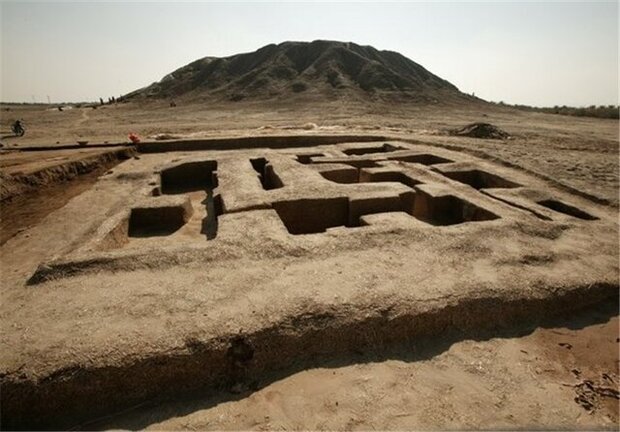
Excavations soon focused on two large archaeological mounds known collectively as Konar Sandal.
The sites revealed evidence of urban planning on a scale previously unknown in the region.
Researchers uncovered:
- Massive mudbrick platforms
- Monumental architecture
- Defensive walls
- Residential districts
- Administrative structures
The discoveries suggested that Jiroft was not merely a local settlement but the center of a sophisticated political and economic system.
Archaeologists found evidence that large portions of the city had been carefully planned and organized.
Such features are typically associated with advanced urban societies.
The scale of construction indicates the existence of centralized authority capable of organizing labor and resources.
The Konar Sandal Complex
Among the most important discoveries were the monumental structures at Konar Sandal North and South.
These sites contain large platforms and architectural remains constructed from mudbrick.
Some researchers have compared them to the ceremonial and administrative complexes found in Mesopotamia.
One structure appears to have functioned as a massive citadel or ceremonial center.
Its elevated position would have made it visible across much of the surrounding valley.
The presence of such architecture suggests a society capable of large-scale engineering and construction projects.
Although erosion and time have damaged many features, the surviving remains indicate that Jiroft possessed an impressive level of architectural sophistication.
The city was clearly more than a collection of villages.
It was a major urban center within the Bronze Age world.
Masterpieces of Stone Carving
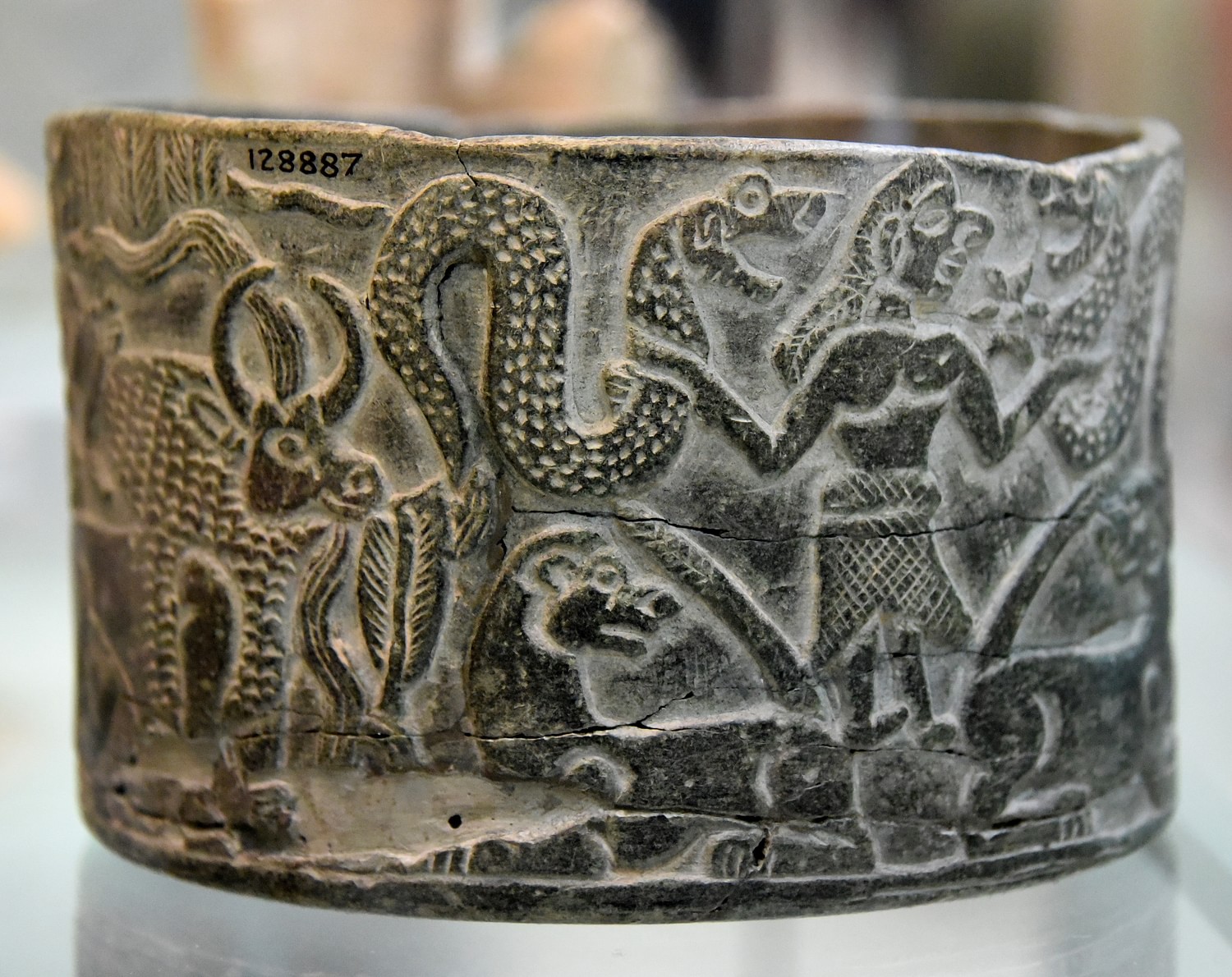
Perhaps the most distinctive artifacts associated with Jiroft are its carved chlorite vessels.
These dark stone objects are decorated with remarkably detailed scenes.
The imagery includes:
- Eagles
- Bulls
- Serpents
- Mythological creatures
- Human figures
- Geometric patterns
The quality of craftsmanship is extraordinary.
Many vessels display intricate relief carvings executed with exceptional precision.
The artistic style differs from neighboring civilizations while also showing evidence of cultural interaction.
These objects have been found not only in Iran but also across a vast region stretching into Mesopotamia and beyond.
Their distribution suggests that Jiroft participated in extensive trade networks connecting multiple Bronze Age societies.
The vessels likely served both practical and ceremonial functions.
Some may have been prestige goods exchanged among elites.
Others may have held religious significance.
Whatever their purpose, they demonstrate the artistic achievements of Jiroft’s craftsmen.
Was Jiroft the Legendary Kingdom of Aratta?
One of the most debated questions surrounding Jiroft concerns its possible identity.
Archaeologist Yusef Majidzadeh proposed that the civilization might be connected to the legendary kingdom of Aratta.
Aratta appears in ancient Sumerian literature as a distant and wealthy land renowned for precious materials and impressive craftsmanship.
According to Sumerian texts, Aratta maintained complex relationships with Mesopotamian cities.
The kingdom’s immense wealth became a recurring theme in ancient stories.
Majidzadeh noted several similarities between descriptions of Aratta and the archaeological evidence from Jiroft.
These included:
- Rich material culture
- Monumental architecture
- Long-distance trade
- Geographic location east of Mesopotamia
However, the theory remains controversial.
Most scholars argue that existing evidence is insufficient to conclusively identify Jiroft as Aratta.
The literary texts are difficult to interpret, and no direct inscription has yet established such a connection.
As a result, the hypothesis remains intriguing but unproven.
Connections to Mesopotamia
Regardless of whether Jiroft was Aratta, evidence demonstrates extensive interaction with Mesopotamian societies.
Many artistic motifs found at Jiroft resemble imagery known from Sumerian and Akkadian traditions.
Researchers have identified scenes featuring creatures and themes associated with Mesopotamian mythology.
Among them are figures that resemble:
- Scorpion-men
- Bull-men
- Heroic warriors
- Mythological animals
Some images recall stories from the Epic of Gilgamesh, one of humanity’s oldest surviving literary works.
For example, several carvings depict hybrid human-animal beings similar to the character Enkidu.
Others feature eagle motifs reminiscent of the legendary king Etana.
These similarities suggest ongoing cultural exchanges between Jiroft and Mesopotamian civilizations.
The relationship was likely complex.
Ideas, goods, technologies, and artistic traditions probably moved in multiple directions across the region.
Rather than viewing Mesopotamia as the sole source of innovation, many researchers now emphasize the interconnected nature of Bronze Age societies.
Challenging Traditional Narratives
For generations, Mesopotamia was widely described as the uncontested “Cradle of Civilization.”
While its importance remains undisputed, discoveries at Jiroft suggest a more nuanced picture.
The evidence indicates that multiple sophisticated societies emerged simultaneously across the ancient Near East.
Jiroft possessed:
- Urban centers
- Monumental architecture
- Specialized crafts
- Trade networks
- Administrative complexity
These characteristics are hallmarks of civilization.
Some scholars argue that Jiroft may have developed independently while maintaining connections with neighboring regions.
If true, it would represent another major center of early urban development alongside Mesopotamia, Egypt, and the Indus Valley.
Evidence of Writing
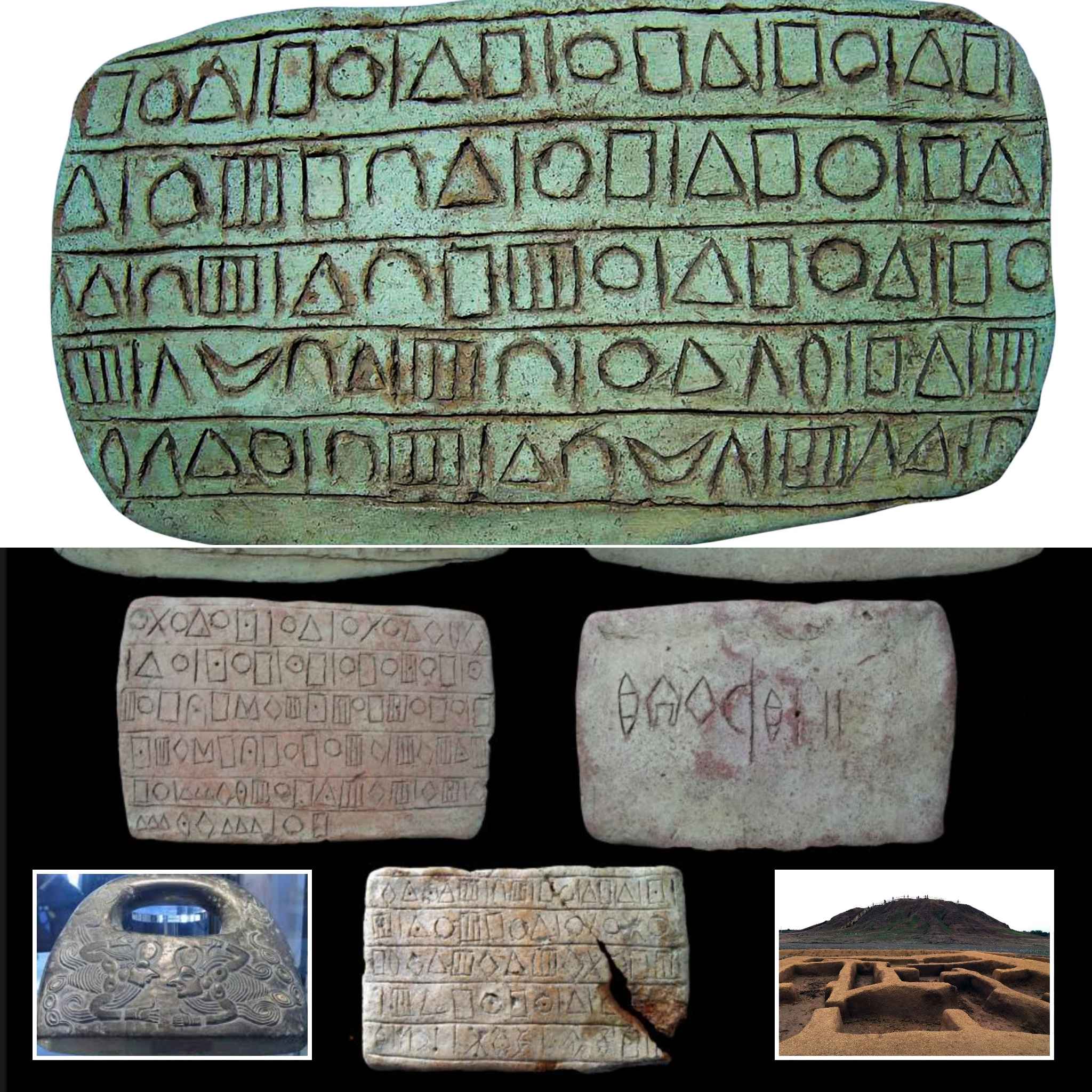
One of the most important discoveries at Konar Sandal involves evidence of literacy.
Archaeologists recovered several clay tablets bearing inscriptions.
These texts appear in two different writing systems.
One resembles Linear Elamite, a script associated with the neighboring civilization of Elam.
The other consists of geometric symbols unlike any previously documented writing system.
Although the inscriptions remain only partially understood, they provide crucial evidence.
Writing is often regarded as one of the defining characteristics of complex societies.
The presence of multiple writing traditions suggests that Jiroft possessed administrative, economic, or religious systems requiring written communication.
Researchers continue to study the inscriptions in hopes of deciphering them more fully.
If successful, these texts could dramatically expand knowledge of the civilization’s language, government, and culture.
Trade Across the Ancient World
Archaeological evidence indicates that Jiroft participated in extensive regional trade networks.
Artifacts from the region have been discovered far beyond southeastern Iran.
Similarly, imported materials found at Jiroft reveal connections with distant cultures.
Trade likely involved:
- Precious stones
- Metal goods
- Luxury vessels
- Agricultural products
- Craft materials
The civilization occupied a strategic position between Mesopotamia, Central Asia, and the Indus Valley.
Its location may have allowed it to function as a major intermediary in long-distance commerce.
Control of trade routes would have generated considerable wealth and contributed to the city’s growth.
Religion and Mythology
Although much remains unknown about Jiroft’s religious beliefs, its artistic imagery provides important clues.
Many artifacts depict supernatural creatures and symbolic scenes.
Researchers believe these images may reflect myths, religious concepts, or cosmological beliefs.
Several recurring motifs include:
- Eagles carrying humans
- Serpents intertwined with trees
- Composite animal beings
- Heroic figures confronting monsters
Such imagery suggests a rich symbolic tradition.
The similarities to Mesopotamian mythology raise questions about cultural exchange, shared beliefs, or parallel development.
At present, however, scholars remain cautious.
Without deciphered texts, interpretations of these images remain tentative.

A Civilization Still Shrouded in Mystery
Despite remarkable progress, many aspects of Jiroft remain uncertain.
Researchers continue investigating fundamental questions:
- What language did its inhabitants speak?
- How was the society governed?
- What caused its decline?
- How extensive was its territory?
- What role did it play in regional politics?
The answers may emerge gradually through future excavations and scientific analysis.
Each new discovery adds another piece to the puzzle.
The challenge lies in reconstructing a civilization that disappeared thousands of years ago while leaving only fragments of its story behind.
Reassessing the Ancient Near East
The significance of Jiroft extends far beyond southeastern Iran.
Its discoveries are encouraging historians and archaeologists to reconsider traditional models of early civilization.
Rather than viewing the ancient world as dominated by a few isolated centers, scholars increasingly recognize a network of interconnected societies exchanging ideas, technologies, and cultural traditions.
Jiroft appears to have been one of those centers.
Its monumental architecture, artistic achievements, and evidence of literacy demonstrate that it was a sophisticated civilization in its own right.
Whether it was the legendary Aratta, the kingdom of Marhashi, or another polity entirely remains uncertain.
What is clear is that Jiroft played a significant role in the Bronze Age world.
An Ancient Civilization Rediscovered
More than four thousand years ago, the people of the Halil River Valley built cities, carved masterpieces from stone, engaged in international trade, and developed systems of communication that reflected a highly organized society.
For centuries, their achievements remained buried beneath the sands of southeastern Iran.
Today, archaeology is bringing their story back to light.
The Jiroft Civilization stands as one of the most fascinating archaeological discoveries of modern times—not because it overturns history, but because it enriches it.
As research continues, this forgotten Bronze Age society promises to reveal even more about the complex and interconnected world that existed long before the rise of classical civilizations.
Far from being a footnote in history, Jiroft may prove to be one of the ancient Near East’s most important lost civilizations.