The Shroud of Turin is a linen cloth preserved in the Cathedral of Saint John the Baptist in Turin, Italy, that bears the faint image of a man with wounds consistent with crucifixion. It has been studied across multiple disciplines — from radiocarbon dating to image analysis and forensic science — yet scholars still do not agree on when or how the image was created, and no definitive explanation has been accepted.

Radiocarbon tests conducted in 1988 dated the shroud cloth to the medieval period (1260–1390 AD), suggesting it was not from the time of Jesus. Although some researchers question the sampling and potential contamination, the mainstream scientific view supports that result.
More recent studies have applied digital imaging, 3D analysis, and pattern recognition techniques, including AI‑assisted methods, to characterize the image’s properties. These analyses confirm that the faint body image encodes three‑dimensional information and has features that are difficult to reproduce with known medieval artistic methods, but do not identify a clear mechanism for the image’s formation.
Some researchers have proposed hypotheses — such as radiation bursts or contact with a modeled surface — but these remain speculative because they have not been corroborated by reproducible laboratory experiments that account for all observed properties of the cloth.
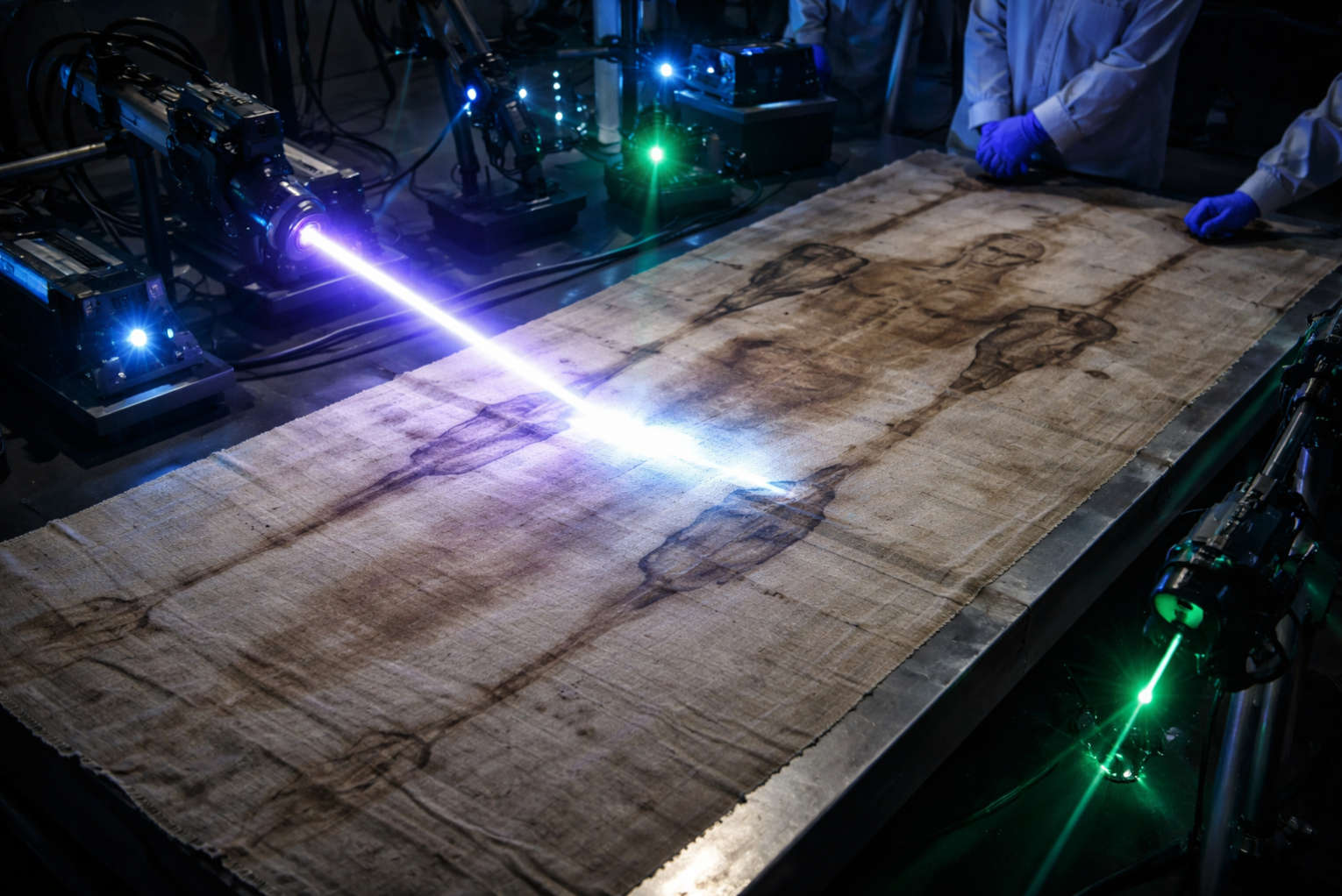
Genetic and environmental analyses of dust, pollen, and DNA traces on the shroud confirm it has interacted with people and places across Europe and the Middle East over many centuries, but they cannot determine the original date or context of creation.
Despite new analytical tools, including digital reconstruction and AI‑based pattern processing, scientists emphasize that no single study has “solved” the mystery of the Shroud’s origin or proven it was used as Jesus’ burial cloth. Instead, the Shroud remains a subject of ongoing scientific investigation and debate, illustrating how interdisciplinary research continues to probe one of history’s most debated artifacts.

