Iron Age Burial in Scotland Reveals Evidence of Unusual Postmortem Ritual Practices
Archaeologists investigating a 2,000-year-old burial cairn in northern Scotland have uncovered compelling evidence of a funerary ritual unlike any previously documented in Iron Age Britain. The remains of a woman buried at Loch Borralie in Sutherland display signs of deliberate postmortem modification, including the apparent removal of brain tissue and the reshaping of several long bones before they were carefully returned to the grave.
The discovery, published in the journal Antiquity, offers rare insight into how some Iron Age communities may have interacted with their dead long after death. Far from representing a simple burial, the evidence suggests a complex sequence of ceremonial actions involving the treatment, transformation, and eventual reburial of human remains.
For archaeologists, the find is significant not only because of the unusual nature of the modifications but also because human remains from Iron Age Britain are relatively scarce. The exceptional preservation conditions of northwestern Scotland have allowed researchers to examine details that would normally be lost to time.
The burial raises important questions about memory, ancestry, identity, and the relationship between the living and the dead in prehistoric Europe.
A Rare Discovery in the Scottish Highlands
The burial site lies near Loch Borralie in Sutherland, close to the rugged northwestern coast of mainland Scotland.
The area is characterized by dramatic landscapes of rocky hills, sea lochs, and windswept coastlines. Today it appears remote, but during the Iron Age it formed part of a network of maritime communities connected by travel along the sea.
The remains were excavated as part of the COMMIOS Project, a research initiative led by scholars from the University of York that seeks to understand mobility, migration, and social interaction in prehistoric Scotland.
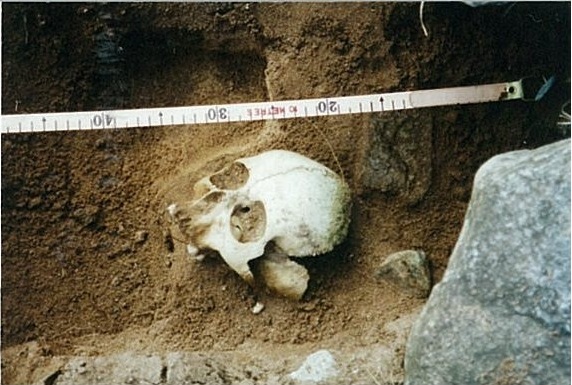
Within a low stone cairn, researchers uncovered the remains of two individuals:
- An adult female, designated Individual 1
- A juvenile male, designated Individual 2
Radiocarbon dating indicated that both individuals lived approximately 2,000 years ago during the late Iron Age.
At first glance, the burial appeared relatively ordinary.
Closer examination revealed a very different story.
Evidence of Deliberate Brain Removal
The most surprising discovery emerged during detailed osteological analysis of the woman’s skull.
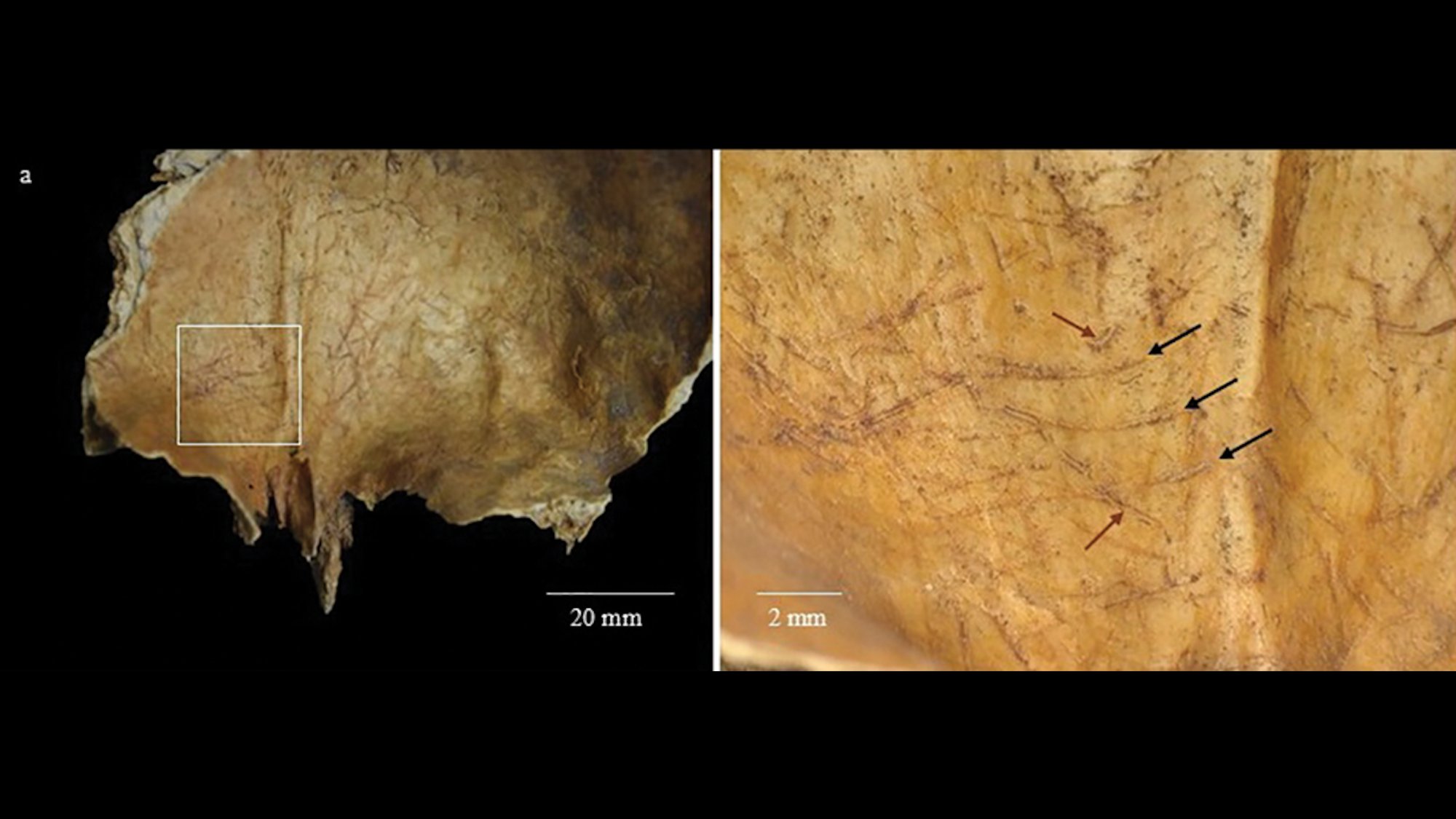
Researchers identified a series of fine cut marks on the internal surface of the cranium. These marks were clearly produced by a sharp implement and could not be explained by natural processes.
The location and pattern of the incisions suggest that someone intentionally accessed the cranial cavity shortly after death.
According to the research team, the most likely explanation is that the woman’s brain was deliberately removed as part of a funerary ritual.
Such practices are known from certain ancient cultures around the world, including some Egyptian mummification traditions and specific prehistoric mortuary customs. However, no comparable example has previously been identified in Iron Age Britain.
The discovery therefore represents a unique addition to the archaeological record.
Researchers emphasize that the procedure appears to have been performed carefully and intentionally rather than as a result of violence or accidental damage.
The act seems to have formed part of a broader sequence of postmortem rituals carried out by members of the community.
Long Bones Carefully Reshaped
The woman’s remains revealed another remarkable feature.
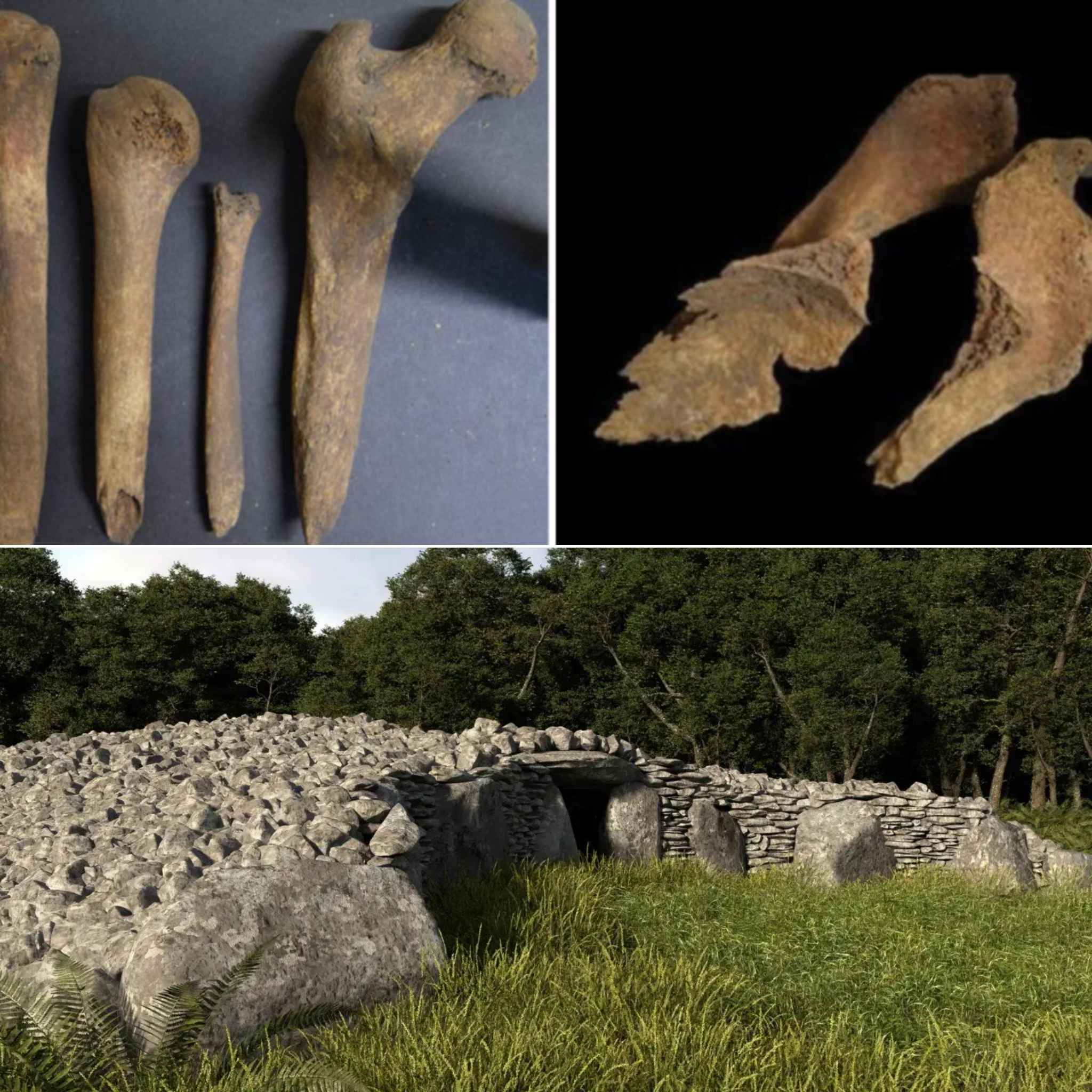
Four of her long bones—the two upper arm bones, one ulna from the forearm, and a femur—had been intentionally modified after death.
The bones had been broken and then carefully shaped into tapered points.
Microscopic analysis revealed smooth surfaces and signs of deliberate workmanship.
The modifications were so precise that researchers believe the bones were fashioned into tools or ritual objects before eventually being placed back into the burial.
This detail is especially important.
Rather than removing the modified bones permanently, members of the community returned them to the grave and arranged them in their proper anatomical positions.
The process suggests a ritual that involved temporary transformation of the deceased before final reburial.
Such treatment demonstrates a level of care and intentionality that goes beyond simple disposal of human remains.
Instead, it reflects an active relationship between the living community and the deceased individual.
Death as a Continuing Process
Modern societies often view burial as the final stage of death.
Many prehistoric cultures appear to have understood death differently.
Across Europe, archaeologists have found evidence that the dead were sometimes revisited, exhumed, rearranged, or incorporated into ongoing rituals.
The Loch Borralie burial fits within this broader pattern.
The careful manipulation of the woman’s remains suggests that death may have been viewed as a gradual transition rather than a single event.
Some researchers propose that dismantling parts of the body could have been associated with releasing the spirit from its earthly form.
Others suggest that bones may have functioned as ancestral relics used during ceremonies before final deposition.
While the precise meaning remains uncertain, the evidence indicates that the deceased continued to play a role in community life long after biological death.
The Young Man Buried Beside Her
The second individual discovered within the cairn was a juvenile male.
Unlike the woman, his remains showed no signs of modification or ritual alteration.
Ancient DNA analysis revealed that the two individuals were related.
Genetic evidence suggests they were most likely maternal second cousins.
This finding demonstrates that family relationships may have influenced burial practices.
However, the contrast between the treatment of the two individuals raises new questions.
Why was the woman subjected to extensive postmortem rituals while the young man was not?
Did she occupy a special social position?
Was her treatment linked to age, status, ancestry, or spiritual beliefs?
At present, archaeologists can only speculate.
The answers may remain lost to history.

A Maritime World Connected by Sea
The burial also reveals important information about Iron Age mobility.
Isotopic analysis of the teeth indicated that neither individual grew up near Loch Borralie.
Instead, both likely spent their childhood approximately 80 kilometers southeast of the burial site.
Ancient DNA further identified genetic links with communities in:
- Orkney to the northeast
- Applecross on Scotland’s western coast
These connections suggest that Iron Age populations regularly moved along coastal routes.
The sea may have functioned as a highway rather than a barrier.
Archaeologists believe communities used skin-covered boats similar to later currachs, allowing travel across considerable distances.
Such mobility would have facilitated not only trade and migration but also the spread of ideas, traditions, and religious practices.
The unusual funerary customs observed at Loch Borralie may therefore have formed part of a broader cultural network extending across northern Scotland.
Shared Ritual Traditions Across Prehistoric Europe
Although the apparent brain removal is unique, the modification of human bones has parallels elsewhere in prehistoric Europe.
Archaeologists have documented examples of human bones being transformed into:
- Pendants
- Amulets
- Ritual objects
- Ceremonial relics
Sites in France, Bulgaria, and other regions have produced evidence of deliberate postmortem manipulation.
These practices demonstrate that human remains often held symbolic value beyond death.
In many societies, ancestors remained active participants in communal identity.
Bones could serve as tangible links between generations, preserving memory and reinforcing social continuity.
The Loch Borralie burial adds an important new example to this growing body of evidence.
Rethinking Iron Age Attitudes Toward Death
For many years, understanding Iron Age funerary practices in Britain has been difficult due to the scarcity of surviving burials.
The Loch Borralie cairn offers an unusually detailed glimpse into a world where death involved far more than interment.
The evidence suggests a prolonged ritual process involving:
- Careful treatment of the body
- Possible removal of soft tissue
- Modification of skeletal elements
- Reassembly of remains
- Final placement within a memorial cairn
Rather than forgetting their dead, these communities maintained ongoing relationships with them.
The deceased remained meaningful members of society whose bodies continued to play roles in ritual and memory.
The discovery challenges simplistic views of prehistoric burial practices and highlights the sophistication of Iron Age belief systems.
As research continues, the people buried at Loch Borralie may help archaeologists better understand how ancient communities navigated one of humanity’s most universal experiences: the transition between life and death.
Far from being silent relics of the past, these carefully treated remains reveal a society deeply engaged with ancestry, remembrance, and the enduring bond between the living and the dead.