Merit’s Wig: The 3,400-Year-Old Egyptian Headpiece Preserved with Ancient Hair Gel
In the dry desert sands of ancient Egypt, time often stands still.
While most organic materials vanish over centuries, Egypt’s unique climate has preserved extraordinary traces of everyday life. Among the most fascinating discoveries is a remarkably well-preserved wig belonging to an elite Egyptian woman named Merit. More than 3,400 years after it was carefully placed inside her tomb, the wig still retained traces of the oils and styling products used by its owner during the height of Egypt’s New Kingdom.
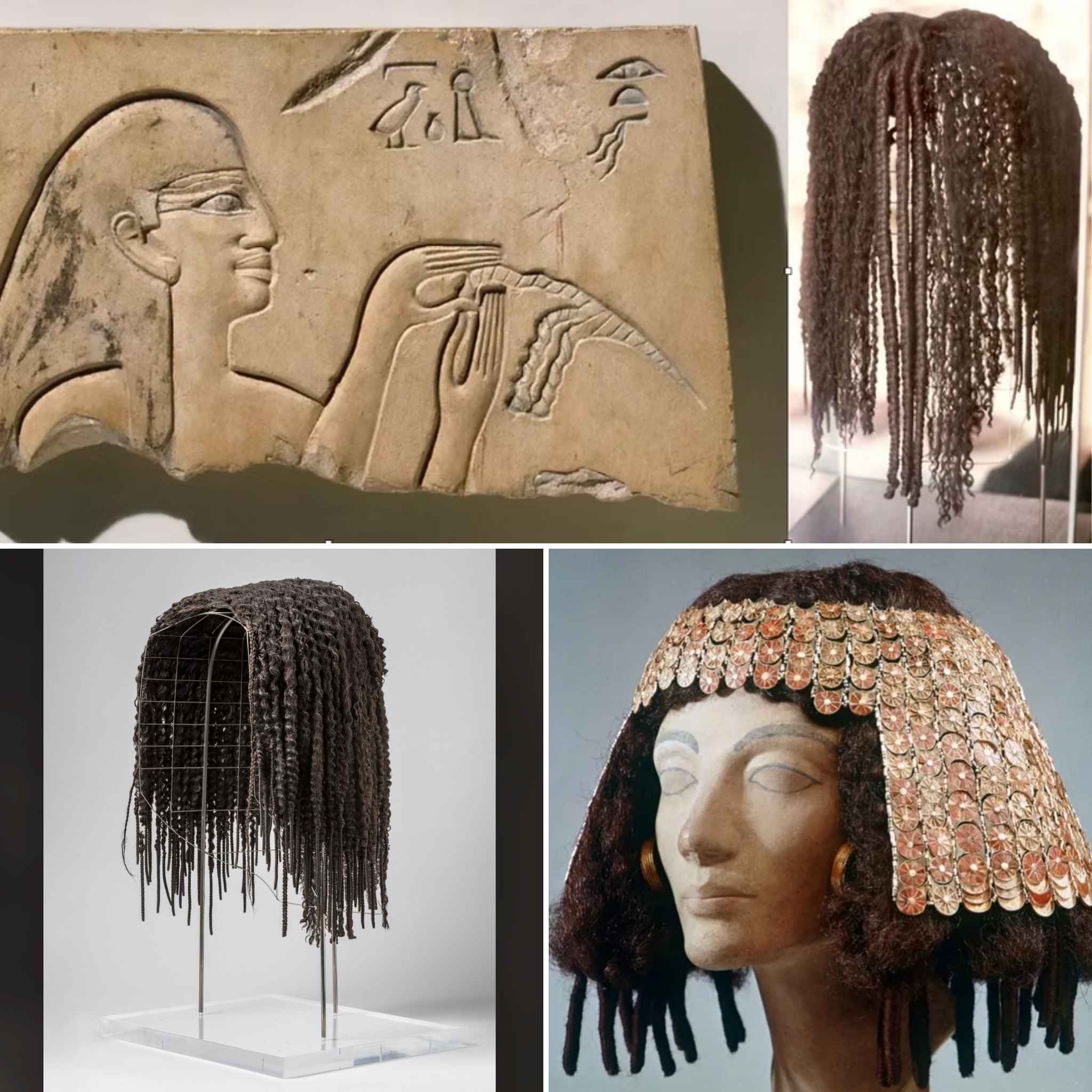
Discovered in 1906 inside one of the most intact non-royal tombs ever excavated in Egypt, Merit’s wig offers an intimate glimpse into beauty standards, personal grooming, social status, and even ancient cosmetic technology. Modern scientific analysis has revealed that ancient Egyptians were using sophisticated hair-care products thousands of years before the invention of modern hair gel.
Far more than a fashion accessory, the wig tells the story of an elite woman who lived during one of the greatest periods in Egyptian history.
The Discovery of the Tomb of Kha and Merit
The story begins in 1906 when Italian archaeologist Ernesto Schiaparelli led excavations in the necropolis of Deir el-Medina near Luxor, ancient Thebes.
Unlike many Egyptian tombs that had been robbed in antiquity, the tomb of Kha and his wife Merit remained remarkably intact.
The discovery stunned archaeologists.
Inside were more than 500 artifacts that had remained untouched for over three millennia.
The tomb belonged to Kha, an accomplished architect and royal official who supervised construction projects during the reign of Pharaoh Amenhotep II and later rulers of Egypt’s 18th Dynasty. Kha occupied an important position within Egyptian society, overseeing work connected to royal monuments and elite building projects.
His wife, Merit, enjoyed a similarly elevated social status.
Their burial chambers contained an astonishing array of possessions:
- Jewelry made from gold and precious stones
- Fine furniture
- Clothing and linens
- Cosmetic equipment
- Personal grooming tools
- Food offerings
- Religious objects
- Luxuriously decorated coffins
Among these treasures was an object that would become one of the most famous examples of ancient Egyptian hairstyling ever discovered.
A carefully preserved wig.
A Wig Preserved Inside Its Own Cabinet
Unlike many burial objects simply placed around the tomb, Merit’s wig received special treatment.
It was stored inside a tall wooden cabinet made from acacia wood.
The box itself bore inscriptions identifying its owner.
Inside, archaeologists found the wig resting on two specially constructed wooden stands covered in linen.
The arrangement suggests that the wig was considered valuable enough to deserve its own storage container and display system.
Even more astonishing was its condition.
When Schiaparelli opened the cabinet, he noted that the dark-brown human hair still possessed a subtle shine.
More than thirty centuries after Merit’s death, traces of the perfumed oils applied during her lifetime remained visible.
The discovery immediately captured scholarly attention.
The wig was not merely an artifact.
It was a direct connection to the appearance and daily habits of a woman who lived during Egypt’s golden age.
What Did Merit Look Like?
Although we can never know exactly how Merit appeared in life, her wig provides important clues.
The hairstyle reflects fashions popular during the mid-18th Dynasty, roughly around 1400 BC.
The wig features:
- A center parting
- Carefully arranged waves
- Crimped strands
- Shoulder-length styling
- Symmetrical construction
Researchers believe the waves were likely produced through braiding.
Hair would have been dampened and braided tightly.
After drying, the braids would be removed, leaving the characteristic crimped texture visible in the wig today.
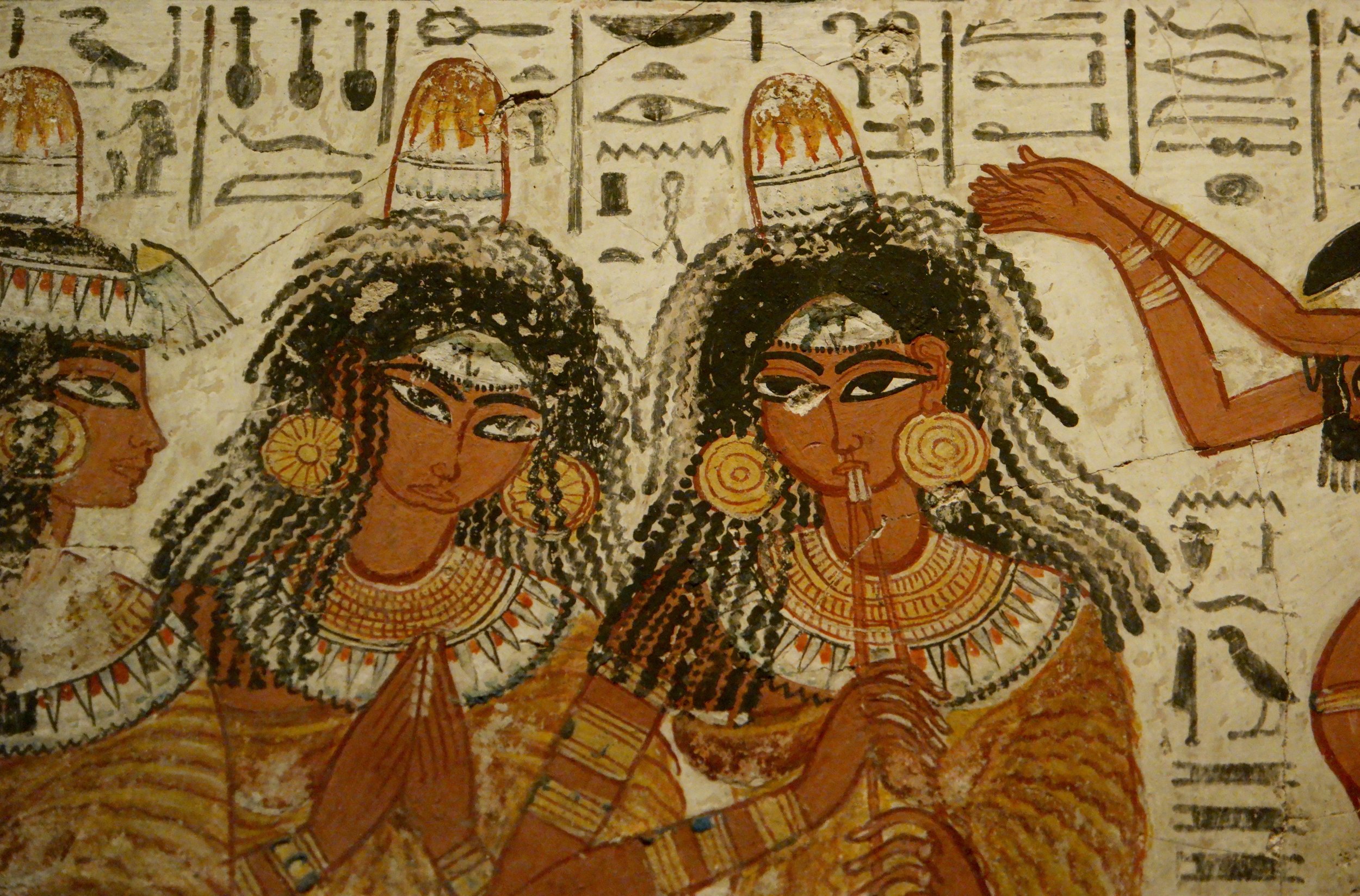
Ancient Egyptian art frequently depicts elite women wearing similar hairstyles.
Paintings and statues from the period show wigs adorned with:
- Fresh flowers
- Perfumed cones
- Decorative diadems
- Gold ornaments
- Precious stones
Such styles were considered fashionable among upper-class women during the reigns of the great New Kingdom pharaohs.
Merit’s wig would have immediately signaled wealth, refinement, and social standing.

Why Did Ancient Egyptians Wear Wigs?
Modern people often assume wigs were primarily cosmetic accessories.
In ancient Egypt, however, wigs served multiple purposes.
The Egyptian climate was harsh.
Temperatures regularly exceeded comfortable limits, and intense sunlight posed health risks.
Shaving the head offered practical advantages.
It reduced overheating and simplified hygiene.
Head lice and other parasites could be controlled more easily.
At the same time, social expectations demanded elegant appearance.
Wigs provided the perfect solution.
Individuals could maintain shaved or closely cropped natural hair while displaying elaborate hairstyles when required.
Elite Egyptians often owned multiple wigs for different occasions.
Some wigs were intended for:
- Daily wear
- Religious ceremonies
- Banquets
- Festivals
- Funerary preparations
Wigs also became important symbols of status.
The more elaborate the wig, the greater the social prestige associated with its owner.
For wealthy individuals like Merit, wigs represented both practicality and luxury.
Human Hair and Master Craftsmanship
One of the most remarkable aspects of Merit’s wig is its construction.
Analysis confirms it was made from real human hair.
Ancient Egyptian wig makers were highly skilled artisans.
Creating a wig required:
- Collecting hair
- Sorting strands by length
- Preparing support structures
- Sewing individual sections together
- Styling and treating the finished piece
The process could take weeks or even months.
Some wigs incorporated hair from multiple donors to achieve desired volume and appearance.
The resulting products often rival modern craftsmanship in complexity.
Merit’s wig demonstrates the exceptional technical knowledge possessed by ancient Egyptian hair specialists.
The even wave patterns and symmetrical styling reveal careful planning and execution.
It was not simply a collection of hair.
It was a masterpiece of personal adornment.
Ancient Hair Gel: The Science Behind Merit’s Hairstyle
For more than a century after the discovery, scholars admired the wig without fully understanding how it had been maintained.
That changed in 2016.
Researchers conducted an extensive scientific examination using gas chromatography-mass spectrometry (GC-MS), an advanced analytical technique capable of identifying tiny chemical residues.
The results were extraordinary.
Scientists discovered traces of several substances applied to the hair.
These included:
- Plant oils
- Plant gums
- Balsams
- Beeswax
Together, these ingredients formed a sophisticated styling product remarkably similar in purpose to modern hair gel.
The mixture would have:
- Smoothed loose strands
- Enhanced shine
- Preserved hairstyle shape
- Reduced tangling
- Protected hair fibers
In effect, Merit was using an ancient cosmetic formula thousands of years before commercial hair products existed.
Researchers concluded that she likely combed her hair flat before applying the mixture to maintain a sleek appearance.
The findings reveal an unexpectedly advanced understanding of hair care among New Kingdom Egyptians.

Clues Hidden in a Comb
The tomb yielded more than just the wig itself.
Archaeologists also recovered an assortment of personal grooming tools.
Among them were:
- Wooden combs
- Hairpins
- Razors
- Cosmetic containers
One particular comb provided an intriguing discovery.
Chemical analysis detected traces of cholesterol between its teeth.
Cholesterol naturally occurs in human skin oils and scalp secretions.
Its presence indicates that the comb had actually been used by Merit during her lifetime.
This seemingly small detail transforms the object from a symbolic burial item into something deeply personal.
The comb had once passed through her hair.
It carried microscopic evidence of daily grooming practices performed more than three millennia ago.
Such discoveries offer rare opportunities to connect directly with individuals from the ancient world.
Beauty and Identity in Ancient Egypt
Appearance played a central role in Egyptian society.
Personal grooming was closely connected to concepts of status, purity, and social identity.
Both men and women devoted considerable attention to:
- Hair care
- Cosmetics
- Perfumes
- Jewelry
- Clothing
Beauty was not viewed as vanity alone.
Maintaining one’s appearance reflected order, discipline, and respectability.
Religious beliefs reinforced these values.
Physical cleanliness was associated with spiritual purity.
Priests often shaved their bodies entirely as part of ritual requirements.
Elite Egyptians adopted many similar grooming practices.
Merit’s carefully maintained wig reflects this broader cultural context.
Her hairstyle was not merely decorative.
It communicated social position, personal identity, and participation in elite cultural norms.
The Long History of Egyptian Wigs
Merit’s wig belongs to a tradition stretching back thousands of years.
According to Egyptologist Joann Fletcher, the earliest known Egyptian wigs date to around 3400 BC.
This means wig usage existed long before the construction of the pyramids.
Over time, styles evolved dramatically.
Different periods favored different shapes and lengths.
Some wigs featured:
- Tight curls
- Long braids
- Layered locks
- Elaborate ornamentation
- Massive ceremonial constructions
The New Kingdom represented one of the most sophisticated periods of wig production.
Advances in craftsmanship allowed increasingly complex designs.
The wigs of this era often appear remarkably modern in their styling and construction.
Merit’s example stands among the finest preserved specimens from this period.
What Merit’s Wig Reveals About Ancient Life
The significance of Merit’s wig extends far beyond fashion history.
It provides evidence for:
- Advanced cosmetic technology
- Specialized craftsmanship
- Elite social customs
- Trade in beauty products
- Personal grooming habits
- Funerary traditions
Most importantly, it humanizes the ancient past.
When people think of ancient Egypt, they often imagine monumental pyramids, powerful pharaohs, and grand temples.
Yet behind these achievements were ordinary human experiences.
People worried about appearance.
They followed fashion trends.
They cared for their hair.
They experimented with beauty products.
Merit’s wig reminds us that despite the immense distance in time, many aspects of human life remain familiar.
A Timeless Connection Across Millennia
More than 3,400 years ago, Merit sat before a mirror.
She likely reached for her comb, smoothed her hair with scented oils, and carefully arranged her fashionable hairstyle.
She could never have imagined that thousands of years later, scientists would analyze microscopic traces of those same cosmetic products.
Nor could she have known that her wig would survive almost perfectly intact inside a wooden cabinet beneath the desert sands.
Today, preserved within the Egyptian Museum in Turin, the wig stands as one of the most intimate artifacts from ancient Egypt.
It is more than a hairstyle frozen in time.
It is a portrait of a woman, her routines, her status, and her world.
Through a few strands of carefully arranged hair, Merit continues to tell her story across thirty-four centuries, revealing that even in the age of pharaohs, people cared deeply about looking their best.

.png)