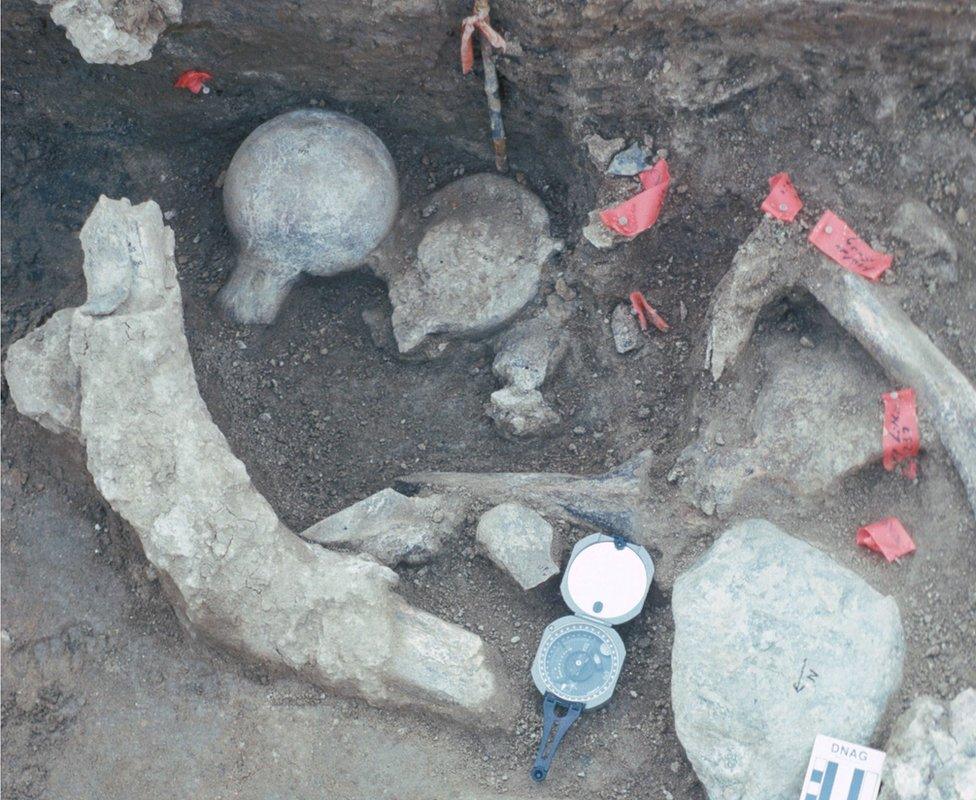
The Cerutti Mastodon site in San Diego County, California, contains deeply buried mastodon bones and large stones that show signs of deliberate breakage and use‑wear consistent with hammerstones and anvils, which researchers interpret as evidence of hominin activity. Radiometric dating of fossilized mastodon bones using uranium‑thorium methods placed the burial age at approximately 130,700 ± 9,400 years ago, a period long before the previously accepted arrival of humans in the Americas around 15,000–20,000 years ago.

Researchers proposed that the spiral fractures and percussion marks on the bones, along with the patterned distribution of stones, indicate that an unidentified species of Homo with the ability to use tools may have processed the mastodon remains for marrow extraction or tool production. Such early dates — if confirmed — would substantially revise the timeline for hominin presence in North America and challenge conventional models of migration into the New World.
However, this interpretation remains highly controversial within the archaeological community. Many scholars question whether the bone breakage and stone positioning definitively reflect human tool use, pointing out that unequivocal stone tools and human skeletal remains have not been found at the site, and that natural processes like trampling or geological forces might also account for the observed patterns.
Because of this debate, most mainstream archaeologists view the Cerutti findings with caution, emphasizing that extraordinary claims about such early human presence require extraordinary evidence that meets strict archaeological criteria. Nonetheless, the site continues to stimulate research and discussion about early human movements and the settlement of the Americas, encouraging new explorations that might uncover additional evidence from the deep past.