A LAVISH ROMAN VILLA OUTSIDE ROME — A LOST WORLD OF IMPERIAL LUXURY BURIED IN THE COUNTRYSIDE
Just a few miles beyond the ancient walls of Rome, in the quiet rural landscape of Castel di Guido, archaeologists have uncovered a discovery that is reshaping our understanding of Roman elite life.
Beneath farmland once known in antiquity as Lorium, a vast and richly decorated villa has emerged from the soil—its mosaics still intact, its frescoed walls still visible, and its architectural grandeur pointing to a world deeply connected to the highest levels of Roman power.
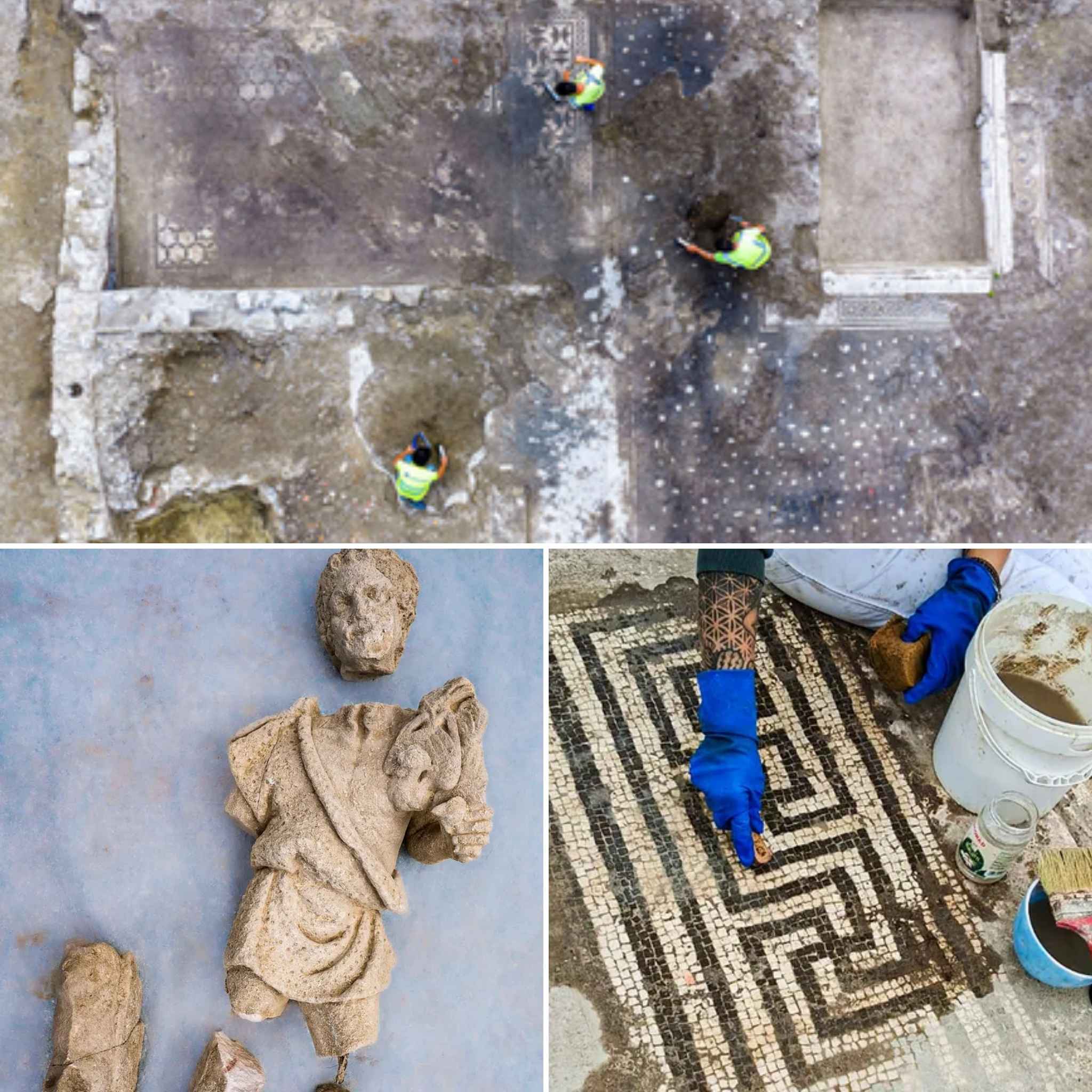
What makes this discovery extraordinary is not only its preservation, but its location.
This was a landscape frequented by emperors.
Hadrian, Antoninus Pius, and Marcus Aurelius all had ties to this region. And now, a previously unknown villa has appeared in the same territory—raising new questions about who lived here, how they lived, and how closely their world may have intersected with imperial Rome itself.
DISCOVERY THROUGH DESTRUCTION: HOW THE VILLA CAME TO LIGHT
Unlike many archaeological breakthroughs that begin with careful excavation, this discovery began with damage.
Authorities were alerted after reports of illegal excavation activity using heavy machinery on government land. Deep cuts made by a backhoe had already disturbed sections of ancient masonry, exposing fragments of walls and mosaics that had remained sealed for nearly two millennia.
Emergency archaeologists from the Special Superintendency of Rome, led by Alessia Contino, were dispatched immediately.
Their mission was urgent: document what remained, stabilize the exposed structures, and prevent further destruction of a site that had been hidden since antiquity.
What they uncovered exceeded expectations.
Beneath the disturbed soil lay a first-century Roman villa of considerable scale and refinement, decorated with intricate mosaics, painted walls, and architectural features associated with elite Roman residences.
A COUNTRY ESTATE BUILT FOR THE ROMAN ELITE
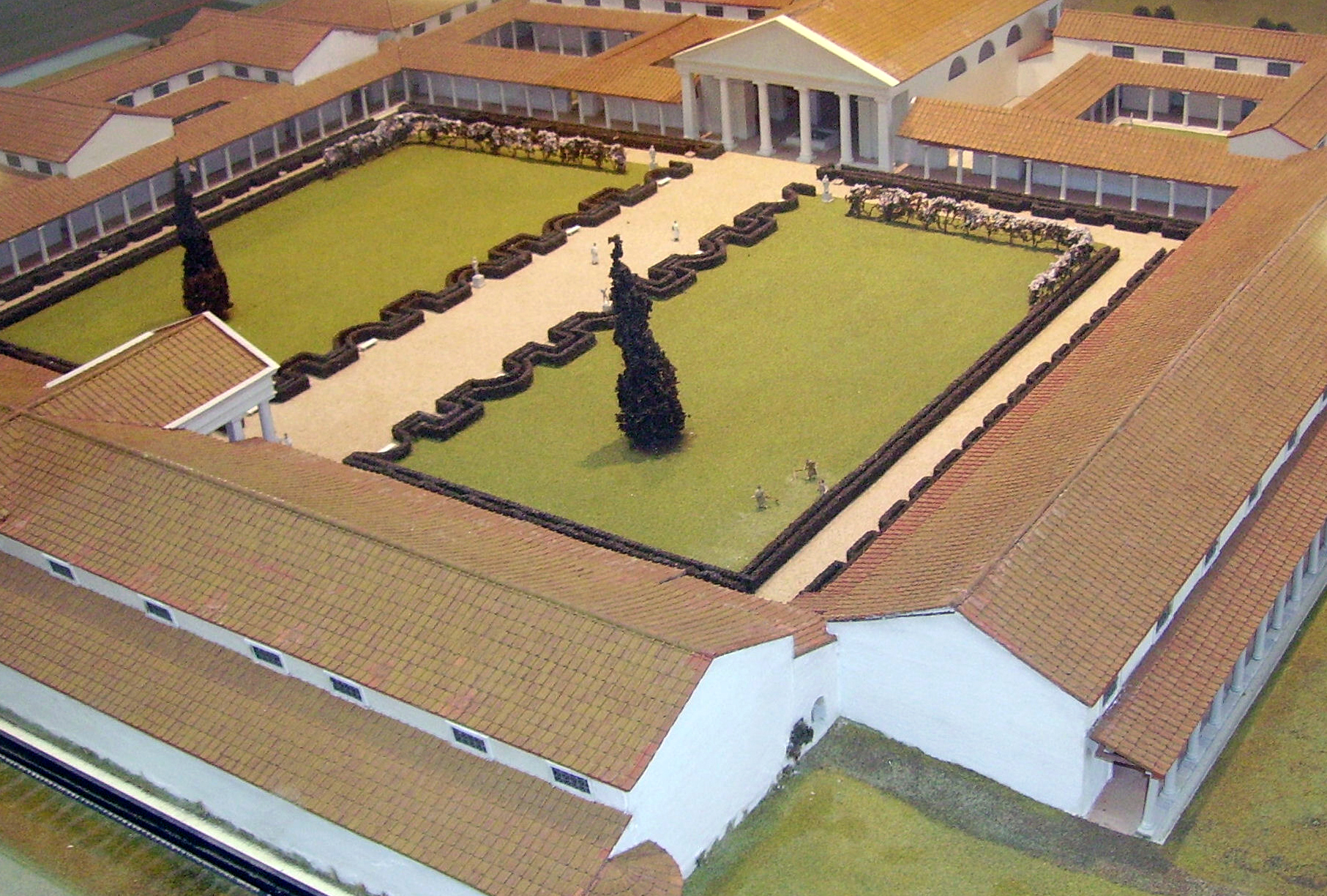
The villa follows the classic layout of high-status Roman rural architecture, designed not only for comfort but also for representation.
At its center lies a grand atrium, the ceremonial heart of the household. In Roman culture, the atrium was more than a room—it was a symbolic space where wealth, authority, and family identity were displayed.
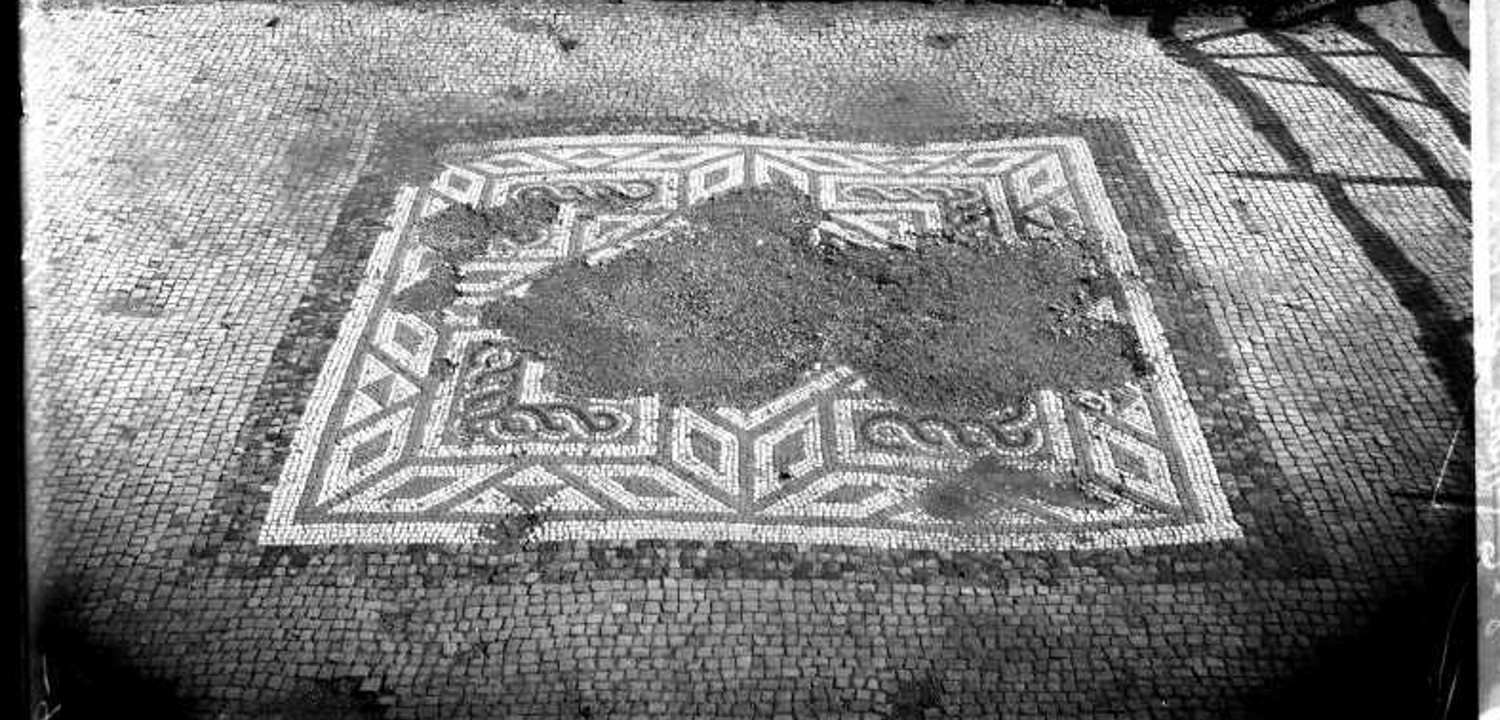
At the center of this atrium is a marble-lined impluvium, a basin designed to collect rainwater through an opening in the roof. Around it stretches a carefully arranged mosaic floor, composed of black-and-white geometric patterns and vegetal motifs.
The craftsmanship is striking.
Even in its fragmented state, the villa’s decoration demonstrates a high level of artistic investment—suggesting ownership by individuals of significant wealth and social standing.
This was not a modest countryside retreat.
It was an estate designed to impress.
Image 1: The Atrium and Impluvium
MOSAICS THAT SPEAK A LANGUAGE OF STATUS AND POWER
Surrounding the atrium are multiple rooms, each with distinct decorative programs that reflect both artistic taste and social identity.
Archaeologists identified several preserved mosaic floors, including:
- A room decorated with nine geometric panels
- Another featuring black octagonal patterns on a white background
- A third filled with bold rectangular motifs arranged in symmetrical sequences
- Decorative borders featuring the famous Greek key (meander) design
In Roman elite culture, mosaics were never simply decoration. They were a form of communication.
Patterns, symmetry, and iconography reflected:
- The wealth of the owner
- Their cultural sophistication
- Their connection to Roman artistic traditions
- Their participation in elite social identity
Walking through such a villa would have been a visual experience of controlled order and luxury—an environment designed to communicate dominance over both nature and society.
A STATUE BURIED IN WATER: THE GOD SILVANUS
Among the most remarkable discoveries inside the villa’s central impluvium was a broken marble statue, approximately 80 centimeters tall.
It depicts a bearded male figure dressed in a short tunic, carrying a basket filled with fruit and birds.
Scholars have identified the figure as likely representing Silvanus, a Roman deity associated with forests, agriculture, livestock, and rural prosperity.
Silvanus was a guardian of the countryside—an appropriate divine presence for a villa embedded in agricultural land.
But its placement is unusual.
The statue was found inside the water basin itself, broken and partially submerged.
This raises several possibilities:
- It may have been discarded during abandonment
- It may represent a ritual deposit
- It may have been damaged during the villa’s final years
Whatever the explanation, the statue adds a deeply human layer to the site—suggesting moments of crisis, transition, or symbolic closure at the end of the villa’s occupation.
Image 2: Roman Mosaic Floor Patterns
LORIUM: A LANDSCAPE OF IMPERIAL CONNECTIONS
The villa’s importance cannot be understood without its geographical context.
The site lies within Lorium, an area known in antiquity as a suburban retreat for Rome’s elite families and imperial households.
Historical records suggest that:
- Emperor Antoninus Pius grew up in Lorium
- He later maintained imperial residences in the area
- He may have died there
- Emperors Hadrian and Marcus Aurelius also had strong associations with nearby estates
Lorium was not a remote countryside.
It was part of the extended political and social ecosystem of imperial Rome—a landscape where power was exercised not only in the city but across carefully managed rural estates.
This makes the discovery particularly significant.
Even if the villa did not belong directly to the imperial family, it existed within their immediate orbit.
A WORKING ESTATE, NOT JUST A LUXURY RETREAT
Although its decoration emphasizes luxury, the villa also shows clear signs of agricultural function.
Around the residential core, archaeologists identified rooms likely used for:
- Storage of grain and agricultural goods
- Processing of crops
- Estate management activities
- Support for rural production systems
This dual structure was typical of Roman elite villas.
Wealth in the Roman world was rarely passive. It was tied directly to land ownership and agricultural output.
Elite villas functioned simultaneously as:
- Private residences
- Economic centers
- Political symbols
This villa reflects all three roles at once.
A FRAGMENTED WORLD INTERRUPTED BY TIME
The villa appears to have been constructed in the early first century AD and abandoned sometime in the third century AD, a period marked by increasing instability across the Roman Empire.
By the time it fell out of use, the empire itself was undergoing profound transformation:
- Political instability
- Economic strain
- Military pressure on multiple frontiers
- Shifting elite power structures
The villa’s abandonment may reflect these broader historical changes, though its exact end remains uncertain.
What is clear is that it was not deliberately preserved.
It was simply left behind.
And over time, it was buried.
Image 3: Aerial View of Roman Villa Excavation
THE QUESTION OF OWNERSHIP
One of the most compelling mysteries surrounding the site is its ownership.
No inscriptions have yet been found identifying the villa’s inhabitants. However, archaeologists believe the scale, craftsmanship, and location strongly suggest ownership by:
- A wealthy senatorial family
- Possibly individuals connected to imperial administration
- Or landowners integrated into elite Roman social networks
Families such as the Aurelii and Arrii, closely linked to Emperor Antoninus Pius, are known to have held property in the Lorium region.
While there is no direct evidence connecting them to this villa, the possibility remains open.
For now, the identity of the owners is one of the site’s most intriguing unanswered questions.
DAMAGE BEFORE DISCOVERY: A SITE UNDER THREAT
One of the most troubling aspects of the excavation is that it was discovered too late.
Illegal excavation using heavy machinery had already caused significant damage:
- Sections of walls were cut through
- Mosaic floors were partially destroyed
- Archaeological layers were disturbed before documentation
This highlights a major issue facing archaeological heritage worldwide: the irreversible loss of context before scientific study can begin.
Once context is destroyed, history becomes fragmented.
And interpretation becomes more uncertain.
A WINDOW INTO ROMAN PRIVATE LIFE
Despite the damage, the villa still offers an extraordinary window into Roman life beyond the city.
Unlike monumental structures such as temples or forums, villas reveal something more intimate:
- How elites lived day to day
- How they displayed wealth in private spaces
- How they combined domestic life with economic production
- How religion and household worship were integrated into architecture
This villa captures all of these elements in a single space.
It is not just a building.
It is a snapshot of Roman identity.
A SITE STILL REVEALING ITS SECRETS
Excavation is ongoing, and archaeologists hope further study will clarify:
- The full layout of the villa complex
- The precise chronology of construction and renovation
- The identity of its owners
- Its relationship to nearby imperial estates
- The reasons for its abandonment
Each new layer of soil removed may reveal further clues about the people who once lived here.
CONCLUSION: A LOST WORLD JUST BENEATH THE SURFACE
The discovery at Castel di Guido is a reminder that much of Rome’s history still lies hidden beneath modern landscapes.
What appears today as quiet farmland was once part of a vibrant network of elite estates—spaces where wealth, politics, religion, and agriculture were deeply intertwined.
Whether or not emperors ever walked through this particular villa, it clearly belonged to the same world they shaped.
A world of marble, mosaics, agricultural estates, and carefully constructed displays of power.
And now, after nearly two thousand years of silence, that world is slowly re-emerging.
One wall at a time.