
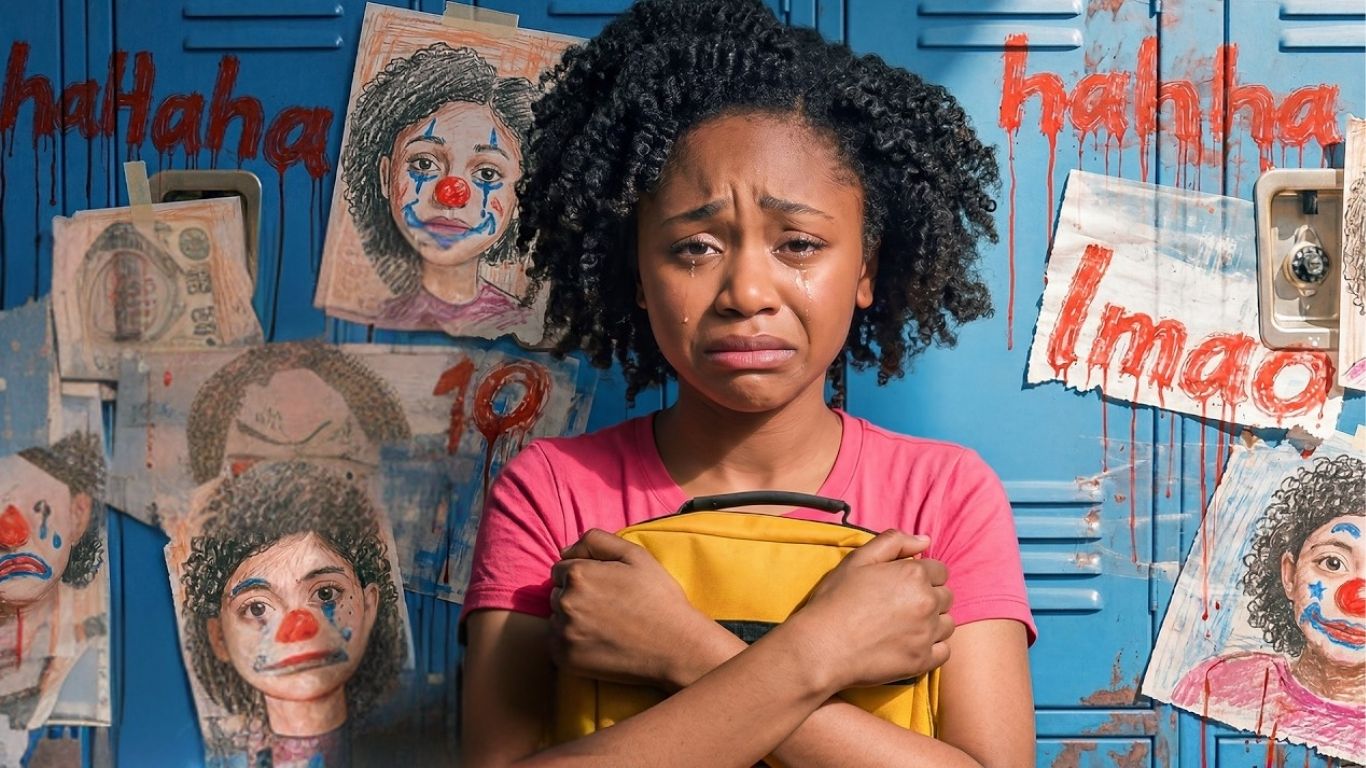
 The first time Ella realized something was wrong, it wasn’t because she saw her own face everywhere.
It was because people stopped looking at her the same way.
By the time she reached her locker that morning, the hallway already felt different. Conversations dipped when she passed. Phones lifted a little too quickly. A few students didn’t even pretend to be subtle anymore.
Then she saw it.
Her face—printed dozens of times—pinned across lockers like a coordinated message. Not a celebration. Not a joke that got out of hand. Something colder.
The photo was private. Cropped too carefully. Taken from a moment she never remembered sharing publicly. She was laughing in it, unaware, relaxed. And that made it worse. It made it feel stolen instead of just exposed.
Underneath every copy was the same handwritten line:
“Valedictorian material?”
Ella stopped walking.
Not because she didn’t understand what it meant—but because she understood it immediately.
Across the hallway, leaning against a row of lockers like she had arrived early just to watch, was Cynthia.
She wasn’t smiling fully. That would have been too obvious. Instead, she had that quiet expression of someone observing a reaction they had already rehearsed in their head.
Ella didn’t say anything. She didn’t give her the satisfaction.
But something shifted right there, in the silence between them.
This wasn’t school drama anymore.
It was positioning.
Ella had always been the quiet kind of top student. Not loud, not performative. The kind of person teachers trusted without needing to constantly prove herself. She stayed late in empty classrooms, rewriting essays until every sentence felt precise enough to defend itself.
Valedictorian wasn’t something she talked about. It was something she was already being shaped into.
Cynthia was the opposite.
Where Ella built consistency, Cynthia built presence. She knew how to enter a room and shift attention without effort. Teachers described her as “confident.” Students described her as “dominant.” The truth sat somewhere colder—Cynthia understood perception like a system you could exploit.
They had never been friends. But they had always been compared.
And Cynthia hated losing comparisons.
By lunchtime, the hallway posters were no longer the main issue.
The video was.
It spread through group chats first, then classroom screens, then whispered conversations that died the moment teachers entered the room. It showed Ella in the library late at night, opening a document, copying text into her assignment.
The implication wasn’t subtle. It didn’t need to be.
Plagiarism.
Ella stared at the video in disbelief the first time she saw it, replaying it twice, then a third time, trying to locate even a fragment of recognition.
The desk looked similar to hers. The lighting was correct. The timing matched her late study sessions.
But the document on screen wasn’t something she had ever seen before.
And the copy-paste action didn’t align with anything she remembered doing.
It felt stitched together. Smooth. Too smooth.
Like something built to survive scrutiny just long enough to do its job.
By the end of the day, she was sitting in an office with the assistant principal, listening to words that were carefully neutral but already final in tone.
“Based on the preliminary review, there are concerns regarding academic integrity.”
“Concerns,” Ella repeated quietly.
“It is standard procedure to temporarily suspend your valedictorian consideration during investigation.”
Temporary.
But nothing about it felt temporary.
Outside that office, Brooklyn stood near the water fountain, staring at the floor like it had answers she didn’t want to hear.
She had seen more than she was supposed to.
Not just the video.
The moments before it.
Because Brooklyn wasn’t just watching this unfold.
She was part of how it was unfolding.
A week earlier, she had received a message.
No name. No direct threat. Just a folder link.
Inside it—her blog.
Not the public one. The real one. The anonymous space she used to write things she couldn’t say out loud. Thoughts she never thought anyone could connect back to her.
Then came the second message.
“We both know what happens if this gets out.”
Cynthia didn’t need to ask for help. She only needed leverage.
And Brooklyn, trapped between fear and exposure, had started following instructions.
Small things at first. File access. Metadata edits. System navigation she didn’t fully understand but didn’t question.
She told herself it was temporary.
Now, watching Ella walk past her like someone moving through a collapsing version of their own life, Brooklyn realized something she hadn’t wanted to admit.
Temporary choices still built permanent outcomes.
The final accusation arrived quietly, like the previous ones.
An automated plagiarism report.
100% match.
Ella’s essay—her strongest submission of the year—had been flagged as fully copied from an older institutional archive.
Except she had never read it.
Let alone submitted it.
The structure mirrored her style too closely to feel random, but the language had a polished artificiality to it that made her stomach tighten.
Not human copying.
Something else.
Something generated.
Something inserted.
That evening, Cynthia finally stopped pretending.
She didn’t hide behind distance anymore. She waited for Ella outside an empty classroom like she had been invited there.
“You always thought working harder meant you were safer,” Cynthia said calmly.
“I didn’t cheat.”
Cynthia tilted her head slightly. “Doesn’t matter what you did. Only what they can prove.”
That sentence hung in the air longer than anything else.
Because Ella realized something in that moment.
This wasn’t about rivalry anymore.
It wasn’t even about grades.
It was about control over the narrative.
And Cynthia had already built the system to decide it.
The announcement came during the school assembly.
Principal Hargrove’s voice carried through the auditorium with the practiced neutrality of institutional language.
“Due to confirmed violations of academic policy, Ella Nguyen’s eligibility for valedictorian has been revoked.”
A pause followed.
Long enough for the message to settle.
Then came scattered applause. Not enthusiastic. Not unified. Just present enough to make it real.
Ella sat still in the front row.
Not broken. Not reacting.
Processing.
Measuring.
Understanding that whatever came next would determine more than her academic standing.
It would determine whether truth mattered at all here.
Then Brooklyn stood up.
The movement was so sudden it almost looked like a mistake.
She didn’t sit back down.
“I did it.”
The room shifted instantly.
Confusion first. Then noise. Then attention locking onto her like a spotlight.
Brooklyn’s hands were shaking, but her voice didn’t disappear.
“I helped alter the files. I helped insert the essay. I helped make it look like she cheated.”
The silence that followed wasn’t empty. It was compressing.
People trying to understand what category of reality this belonged to.
Then she added the part that changed the direction of everything.
“Cynthia told me to do it.”
A wave of movement passed through the room. Heads turning. Phones lifting. Whispers breaking apart into fragmented disbelief.
Cynthia stood halfway up.
“No,” she said immediately. “She’s lying.”
But Brooklyn pulled her phone out.
The screen lit up the auditorium.
Messages. Instructions. Screenshots. Time stamps.
A structured pattern of manipulation laid out in digital form.
And then Brooklyn said the thing she had been avoiding saying for weeks.
“She didn’t just target Ella. She needed all of us controllable.”
The IT coordinator entered at that exact moment.
Holding printed logs.
“I checked the admin override access,” he said carefully. “The essay injection came from a credentialed internal account.”
He looked up.
“It was accessed using Cynthia Park’s login.”
That was when the room changed completely.
Not emotionally.
Structurally.
Because suddenly this wasn’t accusation anymore.
It was verification.
Cynthia didn’t move at first. Not because she didn’t understand, but because she did.
She had been careful.
Too careful in places that mattered.
But systems always left something behind.
Evidence doesn’t need permission to exist.
What followed wasn’t chaos.
It was procedure.
Meetings. Documentation. Screens sliding across tables. Silence replacing argument.
Cynthia didn’t defend herself with emotion. She didn’t plead. She analyzed.
That was what made it worse.
Because it confirmed she understood exactly what she had done.
And what it meant that it was now visible.
Brooklyn stood near the wall, refusing to sit. Not out of defiance, but out of exhaustion. Like sitting would mean accepting she had been standing inside this situation for too long already.
Ella stayed quiet.
Not because she had nothing to say.
But because there was nothing left to argue.
Eventually, the decision was delivered.
Suspension pending investigation.
External review.
System audit.
And then, the correction:
Ella’s academic standing reinstated. Valedictorian restored.
No applause followed.
Just recalibration.
As if the system was correcting a calculation it had briefly gotten wrong.
Cynthia was escorted out without resistance.
But before she left, she turned slightly.
Not to Ella.
Not to Brooklyn.
But to the room itself.
And for the first time, there was something in her expression that wasn’t control.
It was recognition.
That influence only works as long as it remains invisible.
After that, it becomes evidence.
The hallway felt different afterward.
Not because it changed physically, but because people did.
Whispers softened. Conversations recalibrated. Attention became more cautious.
Brooklyn approached Ella days later, not asking for forgiveness, not performing regret.
Just standing there.
“I didn’t know how to stop it,” she said quietly.
Ella looked at her for a long moment.
“You didn’t need to be perfect,” she said. “You just needed to stop agreeing with something you knew was wrong.”
That was all.
No resolution that erased what happened.
No clean closure.
Just the beginning of something slightly more honest than before.
And in the end, what remained wasn’t the sabotage or the accusation or even the exposure.
It was the realization that control built on hidden pressure always collapses the moment someone decides not to carry it anymore.
Because truth doesn’t need to be loud to be dangerous.
It just needs to be said out loud once.
And after that, it doesn’t belong to anyone anymore.


