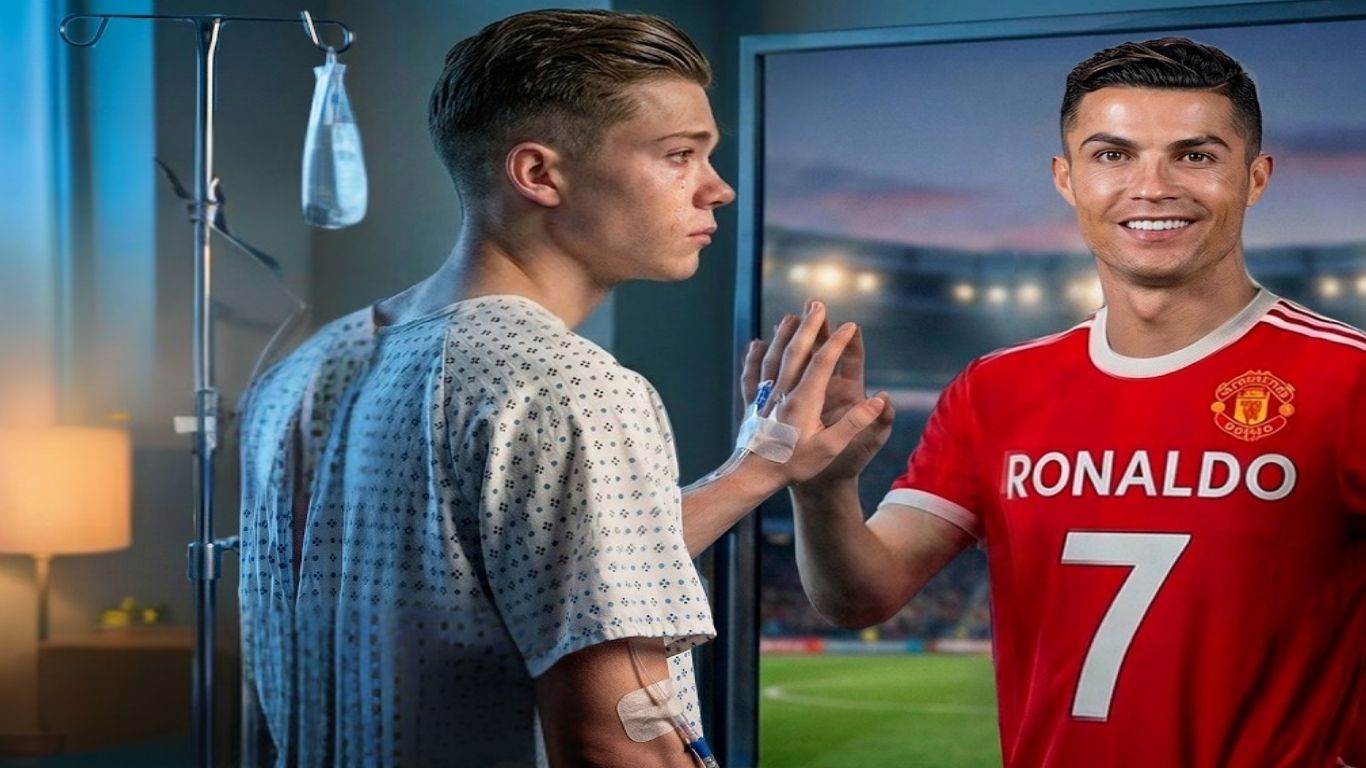
 Jaylen first realized something was wrong with his heart during a sprint drill.
It wasn’t pain at first.
It was a pause.
A strange, sudden hesitation inside his chest like his body had briefly forgotten how to keep rhythm.
He slowed down instinctively, hand pressing against his sternum. Around him, cleats hit the turf in steady rhythm, whistles blew, coaches shouted corrections.
No one noticed him stop except Coach Ramirez.
“You good?” the coach called from across the field.
Jaylen nodded too fast. “Yeah. Just tired.”
But he wasn’t tired.
Not really.
He had been tired before. Tired was familiar. Tired didn’t feel like your heartbeat missing a step it should never miss.
That night, he didn’t tell his mother right away.
Because people like them didn’t run to hospitals for “maybe something.”
People like them waited until “definitely something” forced their hand.
Westbridge Soccer Academy was supposed to be the escape.
A full scholarship. Clean dorms. Real turf. Real scouts watching.
For Jaylen, it wasn’t just a school.
It was oxygen.
Where he came from, soccer wasn’t a pathway. It was a rumor. A distraction. Something you did until life got serious and reminded you it didn’t care about your footwork.
His father made sure of that.
A man who once had talent of his own, or at least that’s what he claimed when sober, which wasn’t often anymore.
“You think kicking a ball is gonna feed you?” his dad would say, leaning too heavily on the doorway. “Dreams don’t pay rent.”
Jaylen learned early not to answer those moments.
Not because he agreed.
But because answering only made things worse.
His mother, Lena, was the only steady thing in the house.
She worked double shifts and still managed to be home early enough to check his schoolwork, tape his ankles before games, and remind him every night of the same sentence like it was a law of physics:
“Obstacles either stop you or make you stronger.”
He used to think it was just comfort talk.
Then life started proving it wasn’t.
The diagnosis came after a collapse during practice.
Not dramatic. Not cinematic.
Just a sudden drop to one knee that didn’t make sense to anyone until he didn’t stand back up quickly enough.
The medical report had words that felt too big for their life.
Cardiac arrhythmia. Structural irregularity. Surgical intervention required.
And then the number.
The cost.
It didn’t feel real at first. It felt like a mistake printed on the wrong file.
But it wasn’t.
It was just math.
Cold, indifferent math deciding whether a dream could continue existing.
Coach Ramirez tried to help. The school tried to fundraise. Even teammates passed around donation links quietly.
But Jaylen could see what everyone was thinking even when they didn’t say it.
Players with heart conditions don’t become professionals.
They become stories about what could have been.
At school, the bullying started almost immediately after rumors spread.
“Glass heart.”
“Scholarship charity case.”
“Westbridge mistake.”
One of the seniors, Beckett, made it personal.
Beckett was everything Jaylen was expected to admire and resent at the same time—privileged, polished, already half-scouted for professional academies.
During training scrimmage one afternoon, Beckett shoulder-checked him just hard enough to send him off balance.
“Careful,” Beckett said with a grin. “Wouldn’t want your heart to quit on the field.”
Laughter followed.
Jaylen didn’t respond.
Not because he was weak.
Because he was calculating.
He was learning something important in those moments.
Anger wasted energy.
Control conserved it.
The surgery came after weeks of silence from home, insurance stress, and his mother working herself into exhaustion without saying it out loud.
Lena sat beside him the night before the operation.
“You scared?” she asked.
Jaylen stared at the ceiling.
“Yes,” he admitted.
She nodded like that was acceptable.
Then she repeated it again, softer.
“Obstacles either stop you or make you stronger.”
He turned his head toward her.
“What if it stops me?”
Lena didn’t hesitate.
“Then we find a way to stand anyway.”
That was the last thing he clearly remembered before anesthesia pulled him under.
Recovery was not a straight line.
It was frustration disguised as progress.
Learning to walk without dizziness.
Learning to breathe without hesitation.
Learning to trust a body that had betrayed its own rhythm.
There were days he stared at the ceiling and wondered if Westbridge had already moved on without him.
Because institutions always move on.
Dreams don’t wait.
But Beckett’s name kept appearing in updates.
Goals scored. Matches won. Scouts attending games.
The world kept turning.
And Jaylen had to decide whether he would turn with it.
Or stay still.
He chose movement.
Slow at first.
Then deliberately.
Then aggressively.
Rehab became training.
Training became obsession.
Every time his chest tightened, he didn’t stop.
He adjusted.
He learned limits not as walls, but as instructions.
The return to Westbridge was quieter than he expected.
No announcement. No ceremony.
Just him walking back onto the field with a medical clearance and a body that no longer felt like the one he left with.
Some players stared.
Some pretended not to.
Beckett looked at him for a long moment before smirking.
“Didn’t think you’d make it back,” he said.
Jaylen nodded once. “Neither did I.”
That honesty shifted something.
Not friendship.
Not yet.
But recognition.
The match that changed everything was a semifinal qualifier.
Westbridge was down by one goal.
Fifteen minutes left.
The coach hesitated before putting Jaylen in.
Not because of skill.
Because of risk.
But desperation makes decisions easier.
When Jaylen stepped onto the field, the air felt different.
Not lighter.
Focused.
He didn’t try to prove anything.
He played simple.
Clean passes. Controlled movement. Smart positioning.
And something unexpected happened.
Beckett started adapting to him instead of against him.
At one point, after a fast exchange that broke through two defenders, Beckett glanced at him mid-run.
“You always play like this?” he shouted.
Jaylen didn’t smile.
“Only when I need to survive.”
That was the moment the system clicked.
They weren’t rivals anymore.
They were complementary pressure points.
Five minutes left.
Beckett drew defenders.
Jaylen slipped through space that didn’t exist a second earlier.
One touch.
Shot.
Goal.
The stadium didn’t explode immediately.
It processed.
Then erupted.
Not because of style.
Because of consequence.
After the final whistle, Jaylen didn’t celebrate loudly.
He stood still first.
Hand on his chest.
Checking.
Not fear.
Habit.
Beckett walked over, breathing hard.
“You’re different,” he said.
Jaylen nodded. “So are you.”
That was as close as they got to friendship in that moment.
But it was enough.
Scouts came after that.
Not because of sentiment.
Because of performance under pressure.
Because of consistency.
Because of adaptation.
Eastbridge FC offered a development contract first.
Then a professional pathway.
Then stability.
But before signing anything, Jaylen went home.
The apartment looked smaller than he remembered.
His father was on the couch, half-aware, half-absent.
Lena was in the kitchen, still working.
Still moving.
Still carrying everything.
Jaylen placed the contract on the table.
“I can change things,” he said.
His father scoffed without looking up. “Soccer?”
Jaylen didn’t argue.
He just said, “It already did.”
The first thing he bought after signing wasn’t a car.
It wasn’t clothes.
It was a house.
Small, but stable.
A place where his mother could sit down without calculating the next shift.
When he showed her the keys, she didn’t speak immediately.
She just looked at him for a long time.
Then said, quietly:
“Obstacles either stop you or make you stronger.”
Jaylen smiled this time.
“I think I understand it now.”
Years later, interviews would try to frame his story as resilience, or talent, or destiny.
But Jaylen never used those words.
Because what he remembered wasn’t inspiration.
It was choice.
Every time he could have stopped.
Every time quitting would have made sense.
Every time fear tried to sound like logic.
He kept moving anyway.
Not because the path was easy.
But because stopping would have meant agreeing with everything that tried to define him before he ever got a chance to define himself.
And that, more than trophies or contracts or headlines, was the only victory that ever mattered.