FIRE BEFORE HUMANS: BONES FROM WONDWERWERK CAVE PUSH HUMAN HISTORY BACK 1.8 MILLION YEARS
Deep inside Wonderwerk Cave in South Africa’s Northern Cape, archaeologists have uncovered some of the most compelling evidence yet that early human ancestors were interacting with fire far earlier than previously believed—possibly as far back as 1.79 million years ago.
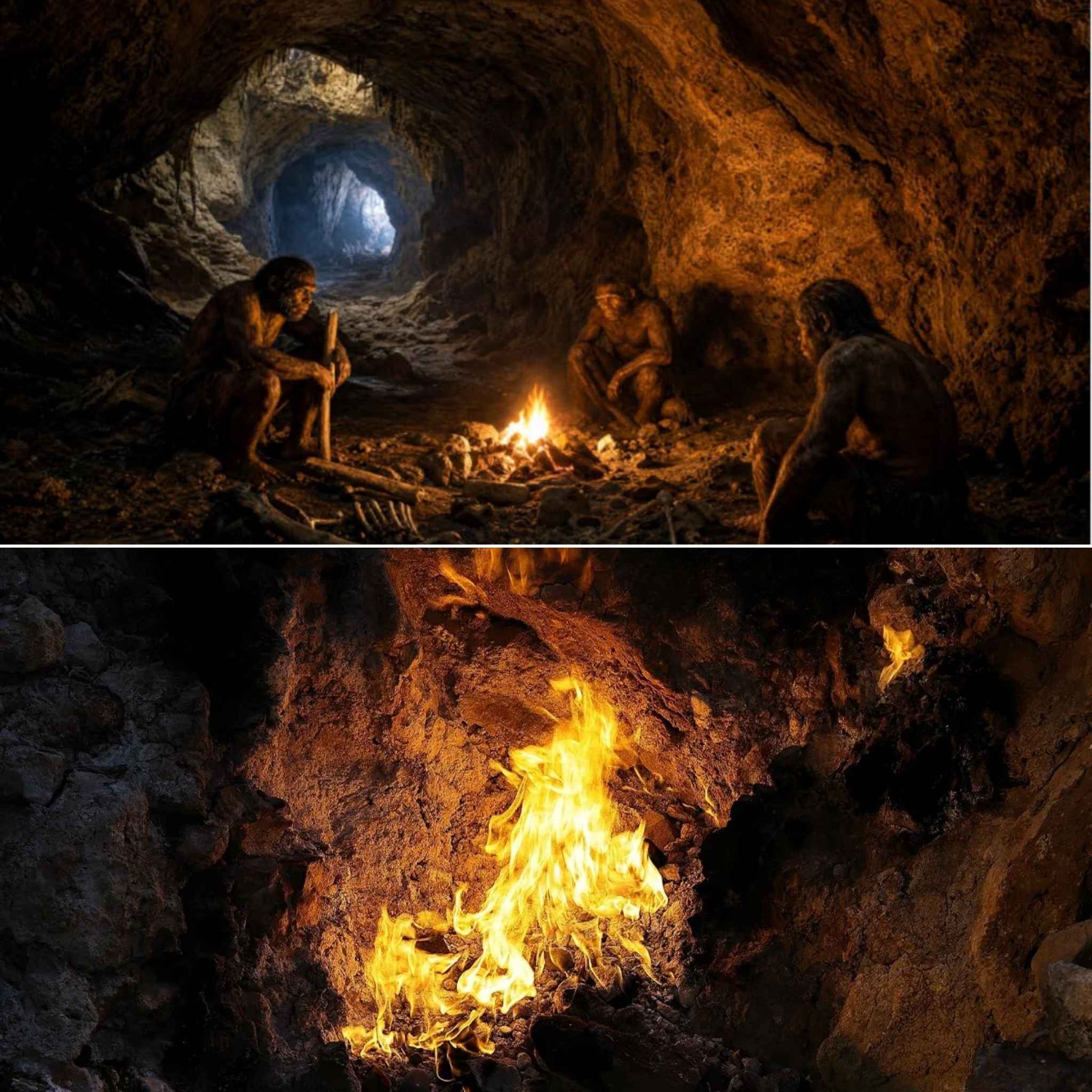
If confirmed, the discovery would significantly rewrite one of the most important chapters in human evolution: when Homo erectus or closely related hominins first gained control over fire.
Published in PLOS One, the study combines cutting-edge analytical techniques with fossil evidence preserved in deep cave sediments, revealing traces of burning on ancient bones that cannot easily be explained by natural wildfires.
What emerges is a picture of early humans not merely surviving in harsh environments—but actively shaping them with fire.
A CAVE THAT PRESERVES DEEP TIME
Wonderwerk Cave has long been recognized as a key archaeological site for understanding early human behavior. Unlike open-air sites, caves can preserve microscopic traces of activity over vast stretches of time.
Inside its layered sediments, researchers have previously identified evidence of fire use dating to around 1 million years ago. But the latest study pushes this timeline back by nearly another million years.
The key evidence comes from deeper sediment layers known as:
- Stratum 10
- Stratum 11
These layers date to between 1.07 and 1.79 million years ago, placing them firmly in the Early Pleistocene—a period associated with early Homo erectus populations in Africa.
BONES THAT GLOW WITH ANCIENT HEAT
At the heart of the discovery are 161 fossilized bones, mostly from small mammals.
These remains were likely accumulated in the cave over time by barn owls, which brought prey remains into the cave as pellets. But something unusual happened afterward.
Some of these bones were exposed to heat intense enough to permanently alter their structure.
To detect this, researchers used two advanced methods:
1. Bone luminescence analysis
When exposed to high-energy blue light, heated bones emit a distinctive reddish glow, while unburned bones remain dark.
2. Fourier Transform Infrared Spectroscopy (FTIR)
This technique identifies microscopic changes in bone minerals caused by heating.
Both methods confirmed the same result:
many bones in the deepest layers had been exposed to significant burning temperatures.
Even more striking, all tested bones from Stratum 11 showed signs consistent with burning.
Image 1: Wonderwerk Cave Interior
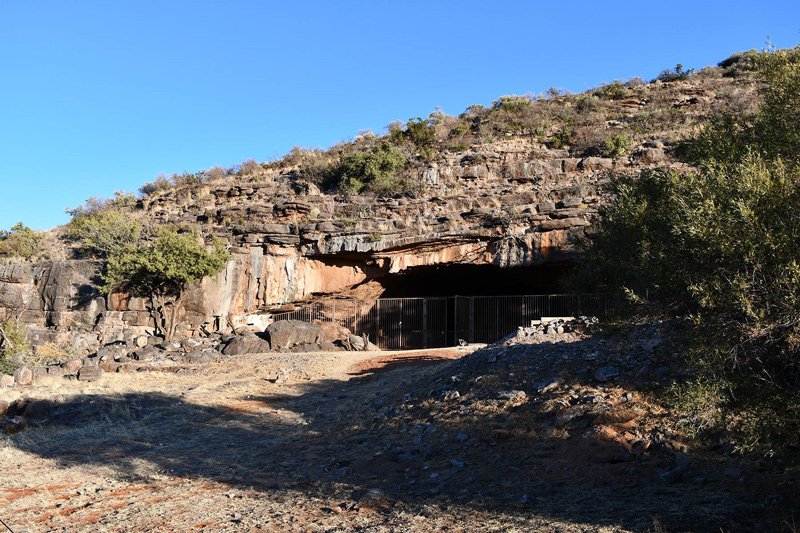
FIRE INSIDE THE EARTH: WHY NATURAL EXPLANATIONS FALL SHORT
One of the strongest arguments for intentional fire use comes from the location of the burnt remains.
The affected bones were found at least:
- 30 meters (nearly 100 feet) inside the cave entrance
At this depth, natural wildfires are extremely unlikely to penetrate. Surface fires simply do not travel that far into enclosed cave systems, especially not with enough intensity to alter bone chemistry.
This spatial separation strongly suggests that fire was brought into the cave intentionally.
Not only that, but the burnt remains were found in distinct clusters, indicating:
- Repeated fire use events
- Concentrated activity zones
- Long-term behavioral patterns
Rather than a single accidental burning event, the evidence points toward ongoing interaction with fire over extended periods.
EARLY HUMANS AND THE CONTROL OF FIRE
The findings are associated with Acheulean stone tools, a technological tradition linked to early Homo erectus populations.
This association matters because it places fire use within a broader pattern of behavioral development, including:
- Improved toolmaking techniques
- Expanded hunting strategies
- Increased cognitive planning
- Social cooperation
Importantly, the study does not claim that early hominins could create fire at will (through friction or sparks). Instead, the evidence supports a more likely scenario:
Fire acquisition strategy:
- Collecting embers from natural wildfires
- Transporting them back to the cave
- Maintaining and managing burning material
- Using fire repeatedly in controlled settings
This alone would represent a major cognitive leap.
Fire management requires:
- Planning ahead
- Understanding cause and effect
- Environmental awareness
- Group coordination
These are hallmarks of increasingly complex early human intelligence.
Image 2: Early Human Fire Scene (Reconstruction)

WHY FIRE CHANGED EVERYTHING
If early hominins were indeed using fire 1.79 million years ago, it reshapes how we understand human evolution.
Fire provides several critical advantages:
1. Protection
Fire deters predators and allows humans to occupy safer environments.
2. Warmth
It enables survival in colder climates and extended nighttime activity.
3. Cooking
Cooked food is easier to digest and provides more energy, potentially influencing brain development.
4. Social structure
Fire encourages group gathering, communication, and shared activity.
5. Environmental expansion
Fire allows humans to adapt to a wider range of habitats.
In short, fire is not just a tool—it is a transformation of human ecology.
A CONTROVERSIAL BUT POWERFUL TIMELINE SHIFT
For decades, scientists believed controlled fire use became widespread much later, perhaps around 400,000–800,000 years ago.
The Wonderwerk Cave findings dramatically extend that timeline backward.
However, researchers remain cautious. The evidence suggests:
- Controlled use or transport of fire is possible
- But continuous fire-making technology is not proven
- The behavior may have been intermittent rather than permanent
Even so, the implications are enormous: early Homo erectus may have been interacting with fire far earlier than previously thought, long before it became a stable part of human life.
THE SCIENCE OF DETECTING DEEP FIRE HISTORY
One of the most important contributions of this study is methodological.
The introduction of bone luminescence analysis gives archaeologists a new way to detect ancient burning without destroying fragile fossils.
This technique could now be applied to:
- Other African cave sites
- Early Homo erectus settlements
- Open-air archaeological sites with poor preservation
- Deep stratified sediment deposits
It opens the door to reevaluating fire use across multiple regions and time periods.
Image 3: Burned Bone Under Microscopy
A SAFE HAVEN FOR EARLY FIRE USE
Wonderwerk Cave’s deep interior environment is crucial to the interpretation.
Unlike open-air sites, caves offer:
- Stable temperatures
- Protection from wind and rain
- Long-term sediment preservation
- Minimal disturbance over millennia
These conditions make it one of the few places on Earth capable of preserving evidence of such ancient fire activity.
The location also strengthens the argument that fire was actively managed inside the cave, not simply introduced by external natural events.
WHAT THIS MEANS FOR HUMAN EVOLUTION
If early Homo erectus was indeed using fire at Wonderwerk Cave nearly 1.8 million years ago, it suggests:
- Cognitive abilities developed earlier than assumed
- Behavioral complexity emerged in African populations sooner
- Fire may have played a central role in early expansion out of Africa
- Human survival strategies were more advanced at an earlier stage
Rather than a sudden technological breakthrough, fire use may have evolved gradually as early humans learned to observe, capture, and maintain natural flames.
This positions fire not as a late invention—but as a long-term companion in human evolution.
CONCLUSION: A SMALL CAVE WITH A MASSIVE IMPACT
The discovery at Wonderwerk Cave does not simply add another data point to human history.
It challenges the timeline itself.
Burned bones buried deep in ancient cave sediments suggest that early humans were engaging with fire far earlier than once believed—possibly in structured, repeated ways that required planning and control.
Whether through opportunistic use of natural flames or more sustained fire management, one thing is clear:
fire was already part of the human story nearly 1.8 million years ago.
And in the dark interior of a South African cave, that story has left behind its first surviving traces.