THE OLDEST CHRISTIAN ART IN SYRIA: WHAT EARLY WALL PAINTINGS REALLY TELL US ABOUT JESUS
Deep in the harsh landscapes of eastern Syria, near the ruins of the ancient frontier city of Dura-Europos, archaeologists uncovered one of the most important early Christian spaces ever found.
Inside a modest building converted into a house church around the mid-3rd century AD, faded wall paintings preserve some of the earliest surviving visual depictions of Jesus Christ. These images—showing healing miracles, protective scenes, and shepherd symbolism—have become central to one of the most debated questions in early Christian history:
What did the earliest Christians actually believe about Jesus?
While some modern interpretations claim that Jesus’ divinity developed later, the evidence from early Christian art and texts paints a more complex picture—one rooted in diversity, rapid theological development, and competing interpretations within the first centuries of Christianity.
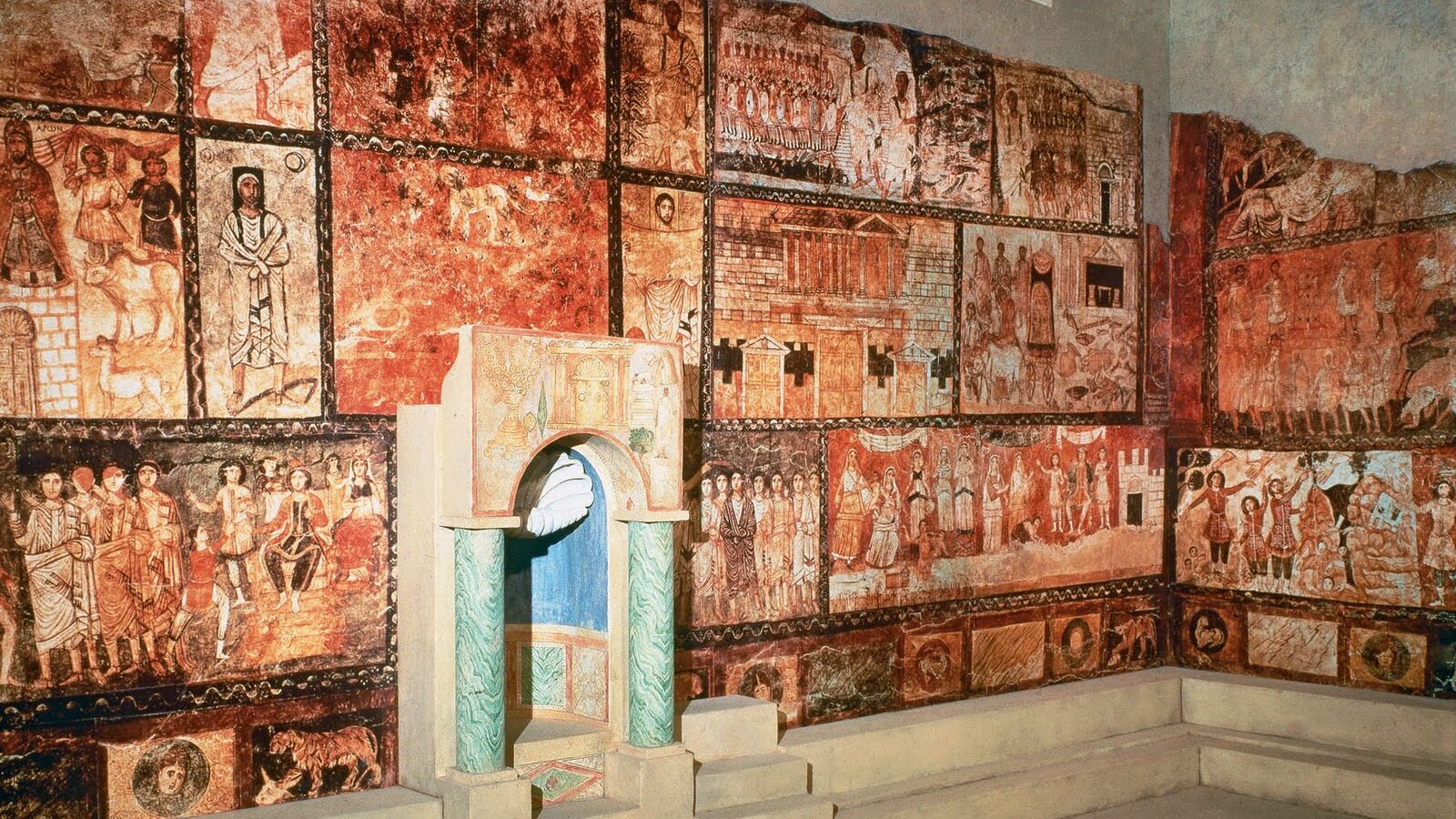
IMAGE 1: THE DURU-EUROPOS HOUSE CHURCH
A DISCOVERY BURIED IN THE DESERT FRONTIER
The site of Dura-Europos was a multicultural city on the edge of the Roman Empire, situated along the Euphrates River. It was a place where Roman soldiers, Greek settlers, Jewish communities, and early Christians lived side by side.
When archaeologists excavated the site in the 1920s and 1930s, they uncovered something remarkable: a private home that had been converted into a Christian worship space before the city was abandoned in the 250s AD.
Inside this structure were:
- A baptistery (one of the earliest known Christian baptism rooms)
- Painted wall frescoes
- Symbolic religious imagery
- Biblical narrative scenes
This makes the Dura-Europos church one of the oldest securely dated Christian worship spaces in the world.
But its importance goes beyond architecture. The walls preserve a visual theology of early Christianity—one that predates the formal doctrinal definitions established centuries later.
THE WALL PAINTINGS: EARLY CHRISTIAN VISUAL LANGUAGE
The most famous discoveries from the site are the wall frescoes in the baptistery room.
These paintings include scenes such as:
- Christ healing the sick
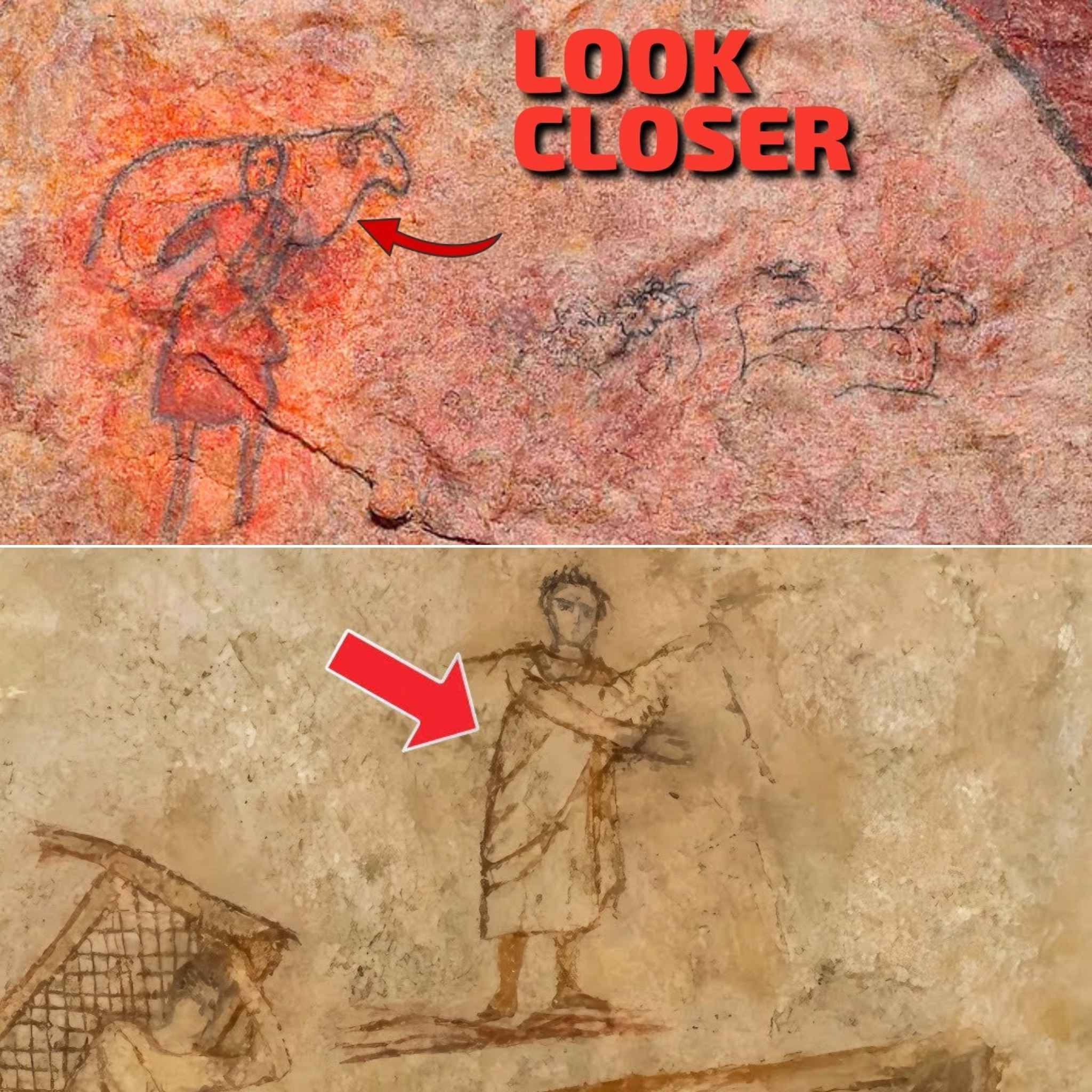
- The “Good Shepherd” carrying a sheep
- Biblical rescue and protection imagery
- Women at the tomb (resurrection symbolism)
One of the most striking images depicts Christ performing healing miracles, reinforcing his role as a divine healer and protector.
Another shows the Good Shepherd, a motif widely used in early Christianity to represent Christ’s care for humanity.
These are not abstract philosophical symbols—they are narrative images meant to communicate religious meaning to worshippers who may have been illiterate or newly converted.
IMAGE 2: THE GOOD SHEPHERD IMAGE (EARLY CHRISTIAN ART)

WHAT DO THESE IMAGES SAY ABOUT EARLY BELIEF?
The key debate surrounding early Christian art is not what is depicted—but what it implies.
Some interpretations emphasize that:
- Jesus is shown performing miracles
- He is associated with divine authority
- He is placed in roles traditionally linked to God’s power (healing, protection, salvation)
From this perspective, the imagery suggests that at least some early Christian communities viewed Jesus as more than a prophet—possibly as a divine or semi-divine figure.
However, historians caution against reading these images as simple doctrinal statements. Early Christianity was not a single unified belief system at this time.
Instead, it was a diverse movement with competing interpretations of Jesus’ identity.
BEFORE NICAEA: A WORLD WITHOUT UNIFORM DOCTRINE
One of the most important historical contexts for interpreting these paintings is the Council of Nicaea (325 AD).
This council—held under Emperor Constantine—was the first major attempt to unify Christian belief across the Roman Empire. It addressed questions such as:
- Was Jesus fully divine?
- Was he equal to God the Father?
- How should the Trinity be understood?
Before this council, Christianity was not standardized. Different communities held different views:
- Some emphasized Jesus’ divinity
- Others emphasized his prophetic or messianic role
- Some blended both ideas in varying degrees
The Dura-Europos paintings, dating to roughly 80 years before Nicaea, belong to this earlier, more fluid period of belief.
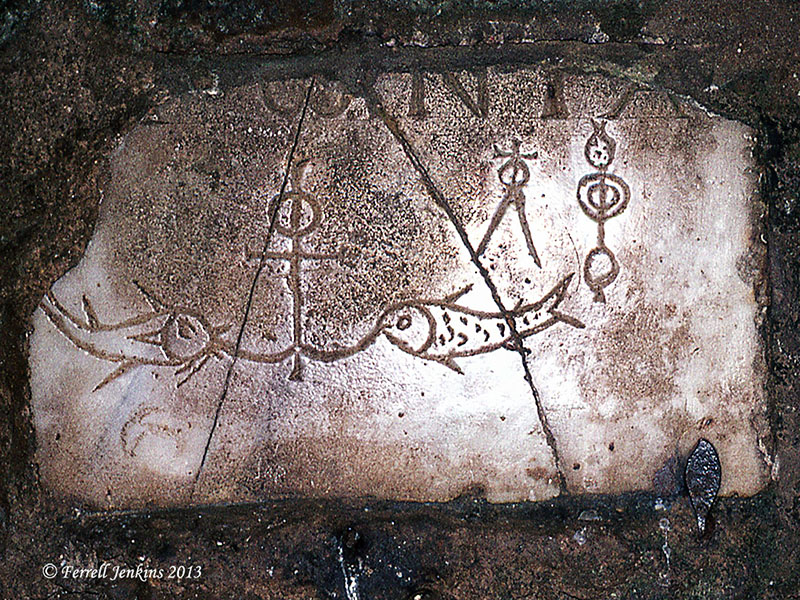
IMAGE 3: EARLY CHRISTIAN CATACOMB ART
ART AS THEOLOGY: WHY SYMBOLS MATTER
In early Christianity, visual art was not decorative—it was theological communication.
Symbols like the Good Shepherd or healing miracles were used to express ideas such as:
- Divine care and salvation
- Jesus as a mediator between God and humanity
- Hope in resurrection and eternal life
- Spiritual protection in a dangerous world
Importantly, these images do not function as formal doctrinal statements. Instead, they reflect belief in action and worship, not written theological definitions.
This is why scholars are careful when interpreting them as evidence of specific later doctrines.
DID EARLY CHRISTIANS SEE JESUS AS GOD?
This question is where interpretation becomes more complex.
Historical evidence from the 1st to 3rd centuries shows that early Christianity included multiple theological positions:
1. High Christology (divine Jesus)
Some early Christians believed Jesus was divine or shared divine status, based on:
- Pauline epistles (earliest Christian writings)
- Johannine traditions (Gospel of John)
- Early hymns and liturgical texts
2. Adoptionist or prophetic views
Other groups viewed Jesus as:
- A chosen human prophet
- A messianic figure elevated after baptism or resurrection
- Distinct from God the Father in essence
3. Gradual standardization
Over time, especially after the 4th century, the doctrine of Jesus’ full divinity became standardized in mainstream Christianity.
WHY THE DURU-EUROPOS DISCOVERY MATTERS
The importance of the Dura-Europos church is not that it “settles” theological debates, but that it provides:
- The earliest physical Christian worship space
- The earliest surviving Christian narrative art in situ
- A snapshot of belief before formal doctrinal definition
It shows that early Christians were already telling stories about Jesus in ways that emphasized:
- Authority
- Miracles
- Protection
- Spiritual power
Whether these depictions reflect full theological divinity or symbolic reverence depends on interpretation—but they clearly show deep reverence and elevated status for Jesus within early worship.
A MULTICULTURAL BORDERLAND FAITH
Another key insight from Dura-Europos is its cultural environment.
This was not a secluded religious center. It was a frontier city where:
- Roman military culture coexisted with Eastern religions
- Jewish synagogues stood near Christian houses
- Greek artistic traditions influenced Christian imagery
This blending of cultures shaped how early Christians expressed their beliefs visually.
The imagery in the church reflects not only theology, but also the artistic language of the Roman East.
THE LIMITS OF WHAT ART CAN PROVE
While the paintings are invaluable, historians emphasize caution:
- Art does not provide explicit doctrinal statements
- Symbolism can carry multiple meanings
- Later interpretations can project ideas backward in time
- Written texts remain essential for theological conclusions
Therefore, the frescoes do not “prove” a single doctrine about Jesus. Instead, they demonstrate that early Christianity already contained strong Christ-centered devotion expressed visually.
CONCLUSION: WHAT THE WALLS ACTUALLY TELL US
The ancient paintings of the Dura-Europos house church do not settle modern theological debates—but they do reveal something equally important:
Early Christians were already building a powerful visual language around Jesus long before Christianity became an officially defined imperial religion.
They depicted him as:
- A healer
- A protector
- A shepherd of souls
- A figure of extraordinary spiritual authority
Whether one interprets this as evidence of fully developed divinity or evolving belief depends on perspective. But the archaeological record is clear on one point:
Jesus was already at the center of Christian worship and imagination centuries before doctrinal standardization.
In the end, these fragile desert paintings do not speak with certainty about modern claims or disputes. Instead, they preserve something more valuable:
A glimpse into the living, developing faith of the earliest Christian communities—still forming, still debating, still shaping the religion that would transform world history.