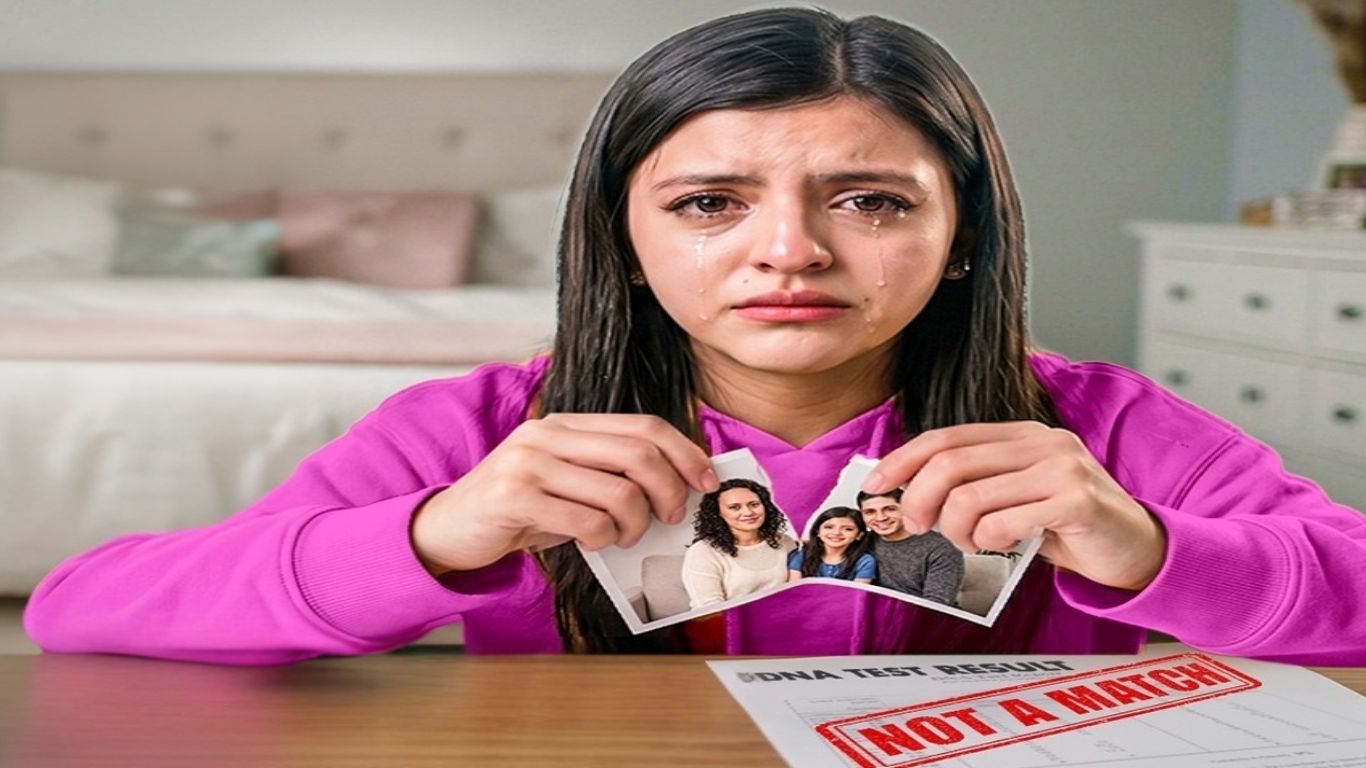
 Maya first noticed something strange on a Tuesday afternoon when the results came back.
She almost didn’t open the email.
It was just one of those curiosity purchases people make late at night—spit in a tube, send it off, wait for science to tell you a story about yourself you never asked to hear.
Her friends had done it. One found out she had Viking ancestry. Another discovered a distant cousin living in Sweden who sent her Christmas cookies every year now.
Maya expected something boring.
Eastern European, maybe a little South Asian mixed in from some forgotten branch of her family tree.
Instead, the screen loaded a sentence that didn’t make sense at first.
4.4% Egyptian.
She blinked.
That was oddly specific. Oddly beautiful, even. She almost smiled, imagining some ancient ancestor crossing deserts, leaving traces in her blood.
Then she scrolled down.
And the smile disappeared.
Parental match: inconclusive.
She refreshed the page. Once. Twice. Three times.
The number didn’t change.
She checked the raw data, thinking maybe she had misread something. But the system wasn’t vague. It was precise in the way only machines can be when they deliver something human beings aren’t ready to hear.
Her DNA didn’t match either of her parents.
Not slightly off. Not borderline.
Completely inconsistent.
For a moment, she just sat there, the phone glowing in her hands, the world continuing around her like nothing had shifted.
Her mother was in the kitchen humming while chopping vegetables.
Her father was in the garage, fixing something he had been “fixing” for three weeks.
Normal sounds. Normal life.
But something about it suddenly felt staged.
As if she had stepped onto a set without realizing the cameras were always there.
That night, Maya did what anyone would do when reality stopped behaving normally.
She ran the test again.
Different company. Different kit. Different result.
The same answer came back.
No biological match.
She didn’t sleep.
The next morning, she tried to behave like nothing had changed.
Her mother kissed her forehead before work, leaving a faint smell of coffee and lavender.
Her father asked if she needed money for lunch.
She nodded automatically.
Everything was ordinary enough to feel cruel.
But now she was watching them differently.
Not as daughter and parents.
As people who might be acting.
At work, she couldn’t focus. Numbers blurred into each other. Emails felt like noise underwater. Every conversation felt like it was happening behind glass.
By lunchtime, she couldn’t hold it anymore.
She opened her laptop in the office break room and searched quietly:
“Can DNA test be wrong both parents not matching”
The answers were inconsistent. Rare errors. Contamination. Lab mistakes.
But the more she read, the more one truth stayed consistent across everything.
Two independent false negatives were almost impossible.
Which meant one thing she didn’t want to name yet.
When she got home that evening, her parents were already sitting at the table waiting.
Not casually.
Waiting.
Her mother’s hands were folded too tightly. Her father wasn’t pretending to read the newspaper like he usually did.
Something had shifted in the air.
Maya stood near the doorway.
“I think we need to talk,” she said.
Her voice didn’t sound like hers.
Her mother looked up first.
“What kind of talk?”
Maya swallowed.
“I did a DNA test.”
Silence didn’t follow immediately. First came confusion. Then something sharper.
Recognition.
Her father’s jaw tightened.
Her mother’s eyes dropped to the table like she was counting invisible cracks in the wood.
“You shouldn’t have done that,” her father said quietly.
It wasn’t a denial.
It wasn’t even a question.
It was confirmation of something Maya hadn’t fully said out loud yet.
Her heart dropped.
“So it’s true,” she whispered.
Her mother stood up too quickly, chair scraping against the floor.
“Maya—”
“No,” Maya interrupted, her voice rising for the first time. “Don’t. Don’t soften it. Just tell me what this is.”
Her father exhaled slowly, like a man preparing for something he had avoided for years.
And then he said it.
“You’re not biologically ours.”
The words didn’t feel real at first.
They just hung there in the air like they belonged to someone else’s life.
Maya stared at them.
Waiting for the rest.
Waiting for the correction.
Waiting for the joke.
But none came.
Her mother started crying quietly, like she had been holding it back for a decade and finally lost control.
Her father didn’t move.
Maya’s voice came out smaller than she expected.
“Then who am I?”
That question changed everything in the room.
Because now there was no pretending it was just a misunderstanding.
Now there was only truth.
Or what they were willing to say of it.
The story came out in fragments.
Adoption. Private arrangement. Closed records.
No agency. No public paper trail.
Her parents—her adoptive parents, though the word felt wrong in Maya’s mouth—had been approached when she was an infant.
A sealed agreement.
A name they were never allowed to trace.
A condition they were never allowed to break.
Her father’s voice was steady, but hollow.
“They said it was temporary. That it would protect you.”
“Protect me from what?” Maya asked.
Neither of them answered immediately.
That silence was an answer on its own.
Her mother finally whispered, “From them.”
That was the first time the room felt dangerous.
Not emotionally.
Practically.
Like something outside their house could still reach inside it.
Maya stepped back.
“So you just… took me?”
Her father shook his head quickly.
“No. We were chosen. Screened. Vetted. They didn’t want random people raising you.”
“Who is ‘they’?” Maya asked.
But they avoided it again.
Not out of cruelty.
Out of fear.
That was worse.
Because fear meant whatever this was didn’t end with her parents.
It extended outward.
Farther.
Larger.
Hidden in systems she couldn’t see yet.
That night, Maya locked herself in her room and stared at the ceiling until morning.
Her identity felt like it had been quietly rewritten without her consent.
And no one had thought to give her the draft.
The search for answers started carefully.
Too carefully.
She learned quickly that some records didn’t exist not because they were lost, but because they were never meant to be found.
The adoption file she tried to request was flagged.
Access denied.
Legal restriction.
Security classification.
That last one didn’t belong in ordinary family matters.
That was the first crack in the surface.
Then came the second.
A name.
Buried in a sealed court reference linked to the paperwork she was never supposed to see.
Dr. Elias Harrow.
Political advisor. Strategic consultant. Campaign architect for rising national figures.
And suddenly the shape of the silence made more sense.
This wasn’t just a family secret.
It was controlled.
Maya didn’t understand why at first. Not until she followed the trail further and found another name connected to the same file cluster.
A senator.
Then a public figure.
Then a campaign donation record that had been quietly scrubbed from visible archives.
Her stomach turned as the pattern formed.
She wasn’t hidden for her safety.
She was hidden for theirs.
And when she finally found the connection point, everything snapped into place in a way that made her physically cold.
Her biological parents weren’t unknown.
They were powerful.
And actively public.
And her existence didn’t fit their narrative.
When she finally found them, it wasn’t through some dramatic confrontation.
It was through a scheduled “charity event” she wasn’t supposed to attend.
A donor gala.
Glass walls. Soft lighting. Careful smiles.
Her biological mother stood on stage speaking about ethics, legacy, and family values.
The irony almost made Maya laugh.
Almost.
She waited until the speech ended.
Until applause filled the room.
Until people started dispersing into polite conversations.
Then she walked forward.
Straight.
No hesitation.
She didn’t know what she expected. Recognition. Shock. Something human.
But when her biological mother saw her, something colder happened.
Her expression changed not into joy.
But calculation.
“Maya,” she said carefully, like testing a name she hadn’t used in years.
Her biological father approached quickly from the side, lowering his voice.
“You shouldn’t be here.”
That was the first sentence they ever said to her as adults.
Not “who are you.”
Not “we missed you.”
Just correction.
You shouldn’t be here.
Maya looked at them both.
“I found out.”
Silence tightened instantly.
Not confusion.
Not curiosity.
Alarm.
She continued anyway.
“I know I was adopted. I know you arranged it. I know there’s an NDA involved.”
Her biological mother’s eyes flicked toward the crowd immediately.
Already thinking about optics.
Already measuring risk.
“You don’t understand,” her mother said quietly.
Maya let out a short, sharp breath.
“Then explain it.”
Her father stepped closer.
“This is bigger than personal history.”
That was when she understood.
Not fully.
But enough.
Her existence wasn’t being denied because of shame.
It was being denied because of consequences.
Political consequences.
Public perception.
A career built on stability, family image, trust.
A daughter who appeared out of nowhere didn’t fit the brand.
Maya’s voice cracked slightly.
“So I was just… erased for your campaign?”
Her mother’s expression tightened.
“We didn’t erase you. We protected what needed to survive.”
That sentence landed heavier than anything before it.
Because it wasn’t an apology.
It was justification.
And it told Maya everything she needed to know.
She wasn’t a secret they regretted.
She was a risk they had calculated.
Behind them, aides began to notice the tension. Cameras shifted subtly. Conversations paused.
Her mother lowered her voice.
“Please leave before this becomes public.”
Maya stared at her for a long moment.
And something inside her went still.
Not angry anymore.
Just clear.
“You already chose what matters,” she said quietly.
Then she turned and walked out before anyone could stop her.
No scene followed her.
No dramatic collapse of order.
Just silence swallowing her footsteps.
She didn’t go home right away.
She sat in her car outside the venue until the parking lot emptied.
Her phone buzzed repeatedly.
Unknown numbers.
Then one message from a blocked contact she somehow still recognized.
Her mother.
We had no choice.
Maya stared at it for a long time.
Then turned her phone face down.
And drove.
When she finally returned to the house she grew up in, the lights were on.
Her adoptive parents were waiting again.
This time not as strangers hiding something.
But as people who already knew the conversation had reached its end.
Her mother stood first.
Her eyes were red, exhausted, older than they had been two days ago.
“We were told not to tell you anything,” she said softly.
Her father nodded once.
“There was an NDA. Legal. Criminal penalties. We signed it before we ever held you.”
Maya stood frozen.
“You could have told me when I was older.”
“We couldn’t,” her father said. “Not without risking you being taken again.”
That sentence changed the weight of everything.
Because now it wasn’t just secrecy.
It was fear with consequences attached.
Her mother stepped closer.
“We weren’t allowed to say where you came from. Or why. We were only allowed to raise you.”
Her voice broke.
“But we were allowed to love you.”
Silence filled the room again.
Different this time.
Less sharp.
More fragile.
Maya looked at them.
Really looked.
Not through the lens of biology.
Not through betrayal.
But through years she suddenly remembered differently.
School lunches packed exactly how she liked them.
Fever nights spent on the couch with someone holding her hand.
Birthdays that felt too carefully planned to be accidental.
They hadn’t been acting.
They had been protecting something they were never allowed to explain.
Maya’s voice came out barely above a whisper.
“So what am I supposed to believe now?”
Her father stepped forward slightly.
“That DNA tells you where you started,” he said. “Not where you belong.”
Her mother nodded through tears.
“We didn’t give birth to you,” she said. “But we raised you like you were never leaving.”
Maya closed her eyes.
For the first time since the test, the numbers didn’t matter.
The percentages didn’t matter.
Even the lies didn’t fully matter anymore.
Because the truth, complicated as it was, had two sides that refused to cancel each other out.
When she finally spoke, her voice was steady.
“I don’t know what I am to them,” she said quietly.
A pause.
Then:
“But I know what I am to you.”
Her mother exhaled like she had been holding her breath for years.
And for the first time since everything began, the silence in the room didn’t feel like loss.
It felt like survival.
Later that night, Maya looked again at the DNA results on her phone.
4.4% Egyptian.
A fragment of history she might never fully trace.
A biological origin she might never fully understand.
But now it sat beside something else.
Something quieter.
Something lived, not inherited.
Family, she realized, wasn’t a single truth you discover.
It was a series of choices people keep making even when the truth gets complicated.
And sometimes, the people who raised you were not hiding you from the world.
They were holding you together until you were strong enough to see it clearly.
Outside her window, the night stayed still.
But inside, something finally settled.
Not answers.
But understanding.
And for Maya, that was the first time the truth didn’t feel like an ending.