Isaac Newton’s Quest to Build the God Engine: The Hidden Manuscripts That Shattered His Rational Image
On a cold November day in 1936, London’s Sotheby’s auction house was more than a marketplace for rare books and manuscripts—it was a stage for one of the most extraordinary revelations in the history of science. Scholars, collectors, and curious onlookers crowded the hallowed halls to witness the sale of the Portsmouth Papers, a sprawling collection of unpublished manuscripts penned by Sir Isaac Newton, the man universally celebrated as the father of modern physics.
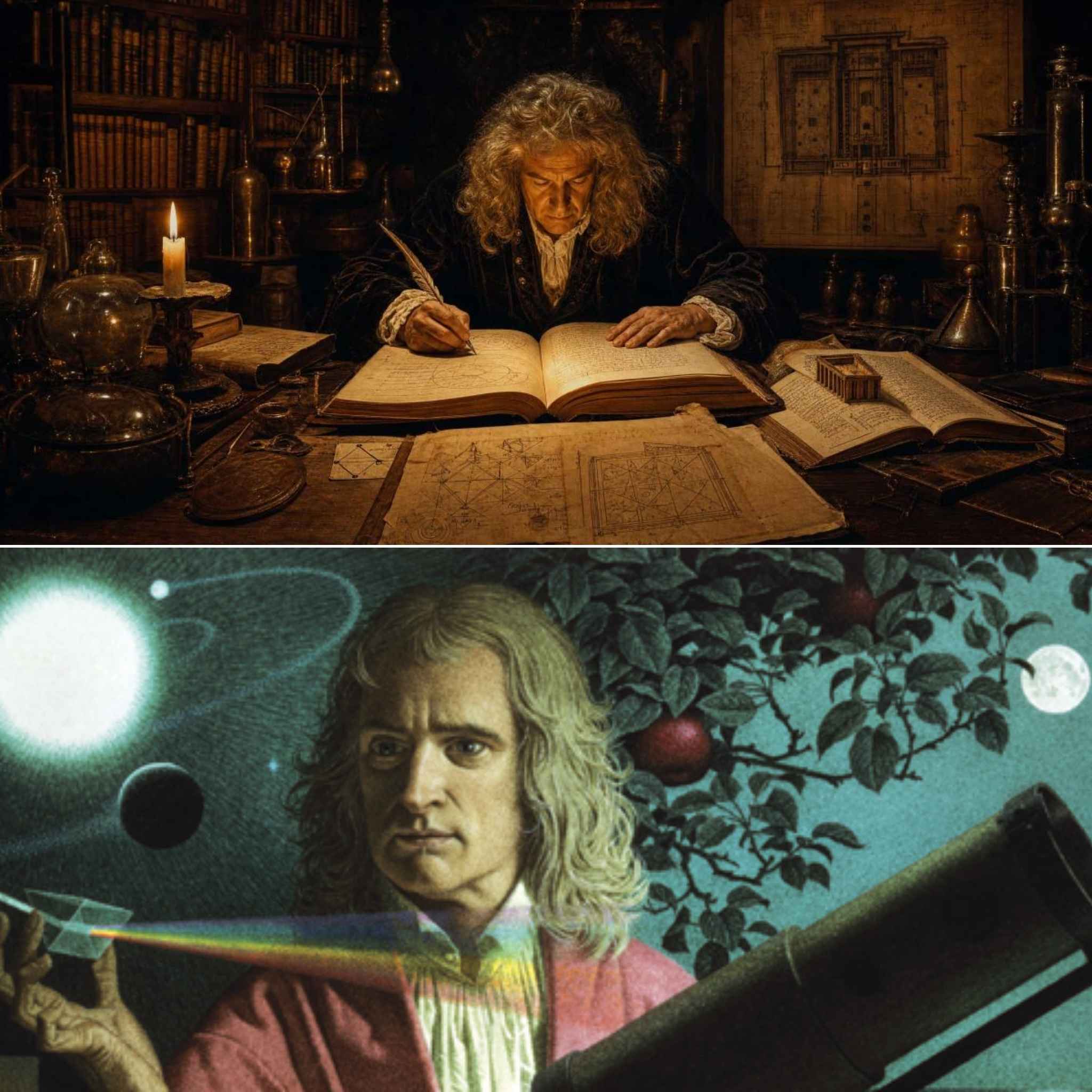
The expectation was simple, if immense: here lay the discarded drafts of the Principia Mathematica, the notebooks in which Newton had first sketched his groundbreaking laws of motion and universal gravitation. Perhaps there would be early calculations in calculus, or previously unrecorded experiments in optics. Scholars braced for a glimpse of a scientific mind at work.
Instead, they found something far stranger. Something that seemed to blur the line between genius and obsession, between science and esoteric mysticism.
The Manuscripts That Shattered the Myth
Among the 329 lots auctioned that day, a staggering number—over one-third—contained material entirely alien to the Newton the world thought it knew. Alchemy, theology, biblical prophecy, and the architecture of sacred temples dominated the pages. Collectively, these manuscripts accounted for more than a million words, exceeding everything Newton had ever published in physics or mathematics combined.
Rather than equations describing the motion of planets or the behavior of light, the pages detailed:
- Obsession with biblical prophecy: Newton meticulously calculated dates for the Apocalypse, interpreted cryptic passages in the Book of Daniel, and theorized hidden timelines that linked ancient kingdoms to divine plans.
- Theological heterodoxy: Contrary to the public image of Newton as a devout Anglican, the manuscripts reveal a secret denial of the Holy Trinity, a heretical position that he guarded zealously.
- Alchemical experimentation: Newton’s fascination with the transmutation of metals and the elusive Philosopher’s Stone rivaled, if not exceeded, his work on calculus and optics.
- Architectural reconstruction of Solomon’s Temple: One of the most extraordinary endeavors recorded in the papers is Newton’s decades-long attempt to reverse-engineer the blueprints of the biblical Temple of Solomon, including detailed diagrams, measurements, and numerical symmetries.
For many in the audience that day, it was as though a veil had been lifted. The rational scientist of Cambridge fame was, in these pages, a figure reminiscent of the ancient magi, blending mathematics, mysticism, and the study of divine order into a single, relentless pursuit.
Keynes and the Last Magician
Among the attendees was John Maynard Keynes, the economist whose own intellect had already revolutionized financial theory. Keynes purchased many of these manuscripts, and upon reading them, delivered a lecture to the Royal Society that would echo through the decades:
“Newton was not the first of the age of reason,” Keynes declared, “He was the last of the magicians, the last of the Babylonians and Sumerians, the last great mind which looked out on the visible and intellectual world with the same eyes as those who began to build our intellectual inheritance rather less than 10,000 years ago.”
Keynes’ observation was as poetic as it was shocking. Here was a man whose public persona was a beacon of rational thought, yet in private, Newton’s mind roamed the shadowy realms of alchemy, prophecy, and esoteric numerology.
What Keynes recognized was that Newton’s brilliance was not confined to the physical world. The same mind that could calculate the trajectory of a comet or the force of gravity also believed in the divine architecture of the cosmos, a universe where God’s hand could be understood through mathematics and hidden symbols.
Alchemy: The Obsession That Never Left
Newton’s engagement with alchemy is well-documented but often glossed over in textbooks. The Portsmouth Papers reveal thousands of pages dedicated to chemical experiments, mystical diagrams, and transmutation processes. Some documents include detailed instructions for preparing powders and elixirs, while others speculate on the spiritual properties of metals.
Far from idle curiosity, Newton approached alchemy with the rigor of a mathematician. He recorded precise weights, temperatures, and reaction times, seeking patterns that could unlock the secrets of transformation—both physical and spiritual.
Remarkably, Newton sometimes linked alchemical work to his cosmological theories, hypothesizing that the divine plan could be decoded through elemental changes and universal laws. In this sense, the pursuit of gold and the search for universal principles were two sides of the same quest.
Biblical Prophecy and the God Engine
Perhaps the most astonishing aspect of the manuscripts is Newton’s obsession with apocalyptic prophecy. He meticulously calculated timelines for the end of the world based on a combination of biblical texts, historical events, and numerology. His notebooks contain hand-drawn charts linking ancient empires to specific scriptural verses, mapping events in Assyria, Babylon, and Rome to the divine calendar.
Newton’s goal was not mere prediction; he sought to understand the mechanics of divine history, a system in which events unfolded according to fixed, rational principles—much like the laws of physics. Keynes and later scholars have referred to this as the search for a “God Engine”, an intellectual framework in which Newton hoped to unify natural law and divine providence.
This pursuit helps explain why he spent decades on the Temple of Solomon. The temple, for Newton, was not merely a religious structure, but a blueprint of cosmic and divine order. By decoding its measurements and proportions, he believed he could gain insight into the hidden structure of the universe—and the timing of God’s final plans.
The Shadow of Heresy
Newton’s rejection of the Holy Trinity, concealed for centuries, adds another layer to the mystery. The Portsmouth Papers reveal painstaking arguments against orthodox interpretations, showing Newton’s deep engagement with biblical text in ways that were considered dangerous if revealed.
In private, Newton corresponded with like-minded theologians and scribes, carefully avoiding public scrutiny. His heretical beliefs coexisted with a devotion to scriptural study, demonstrating the duality of a mind both radical and reverent.
Some historians have argued that this heresy informed Newton’s scientific work. By seeking universal principles in nature and scripture, he approached physics and theology with a similar methodology: observation, deduction, and the search for underlying order.
The Hidden Manuscripts Today
After Keynes’ acquisition, many of the Portsmouth Papers eventually found their way into Cambridge University’s Wren Library, where they remain a treasure trove for scholars. Despite decades of study, new technologies—including digital imaging, AI-assisted textual analysis, and high-resolution spectroscopy—continue to reveal nuances in Newton’s writings that had gone unnoticed.
Recent examinations have uncovered previously invisible diagrams, faint marginalia, and intricate alchemical notations that further illustrate the breadth of his intellectual pursuits. Scholars now argue that Newton’s work represents one of the earliest examples of interdisciplinary thought, bridging mathematics, physics, theology, and proto-chemistry.
Newton’s Legacy Reconsidered
For centuries, Isaac Newton has been celebrated as a symbol of rationality, an emblem of the Scientific Revolution. His laws of motion, universal gravitation, and contributions to optics and calculus have cemented his place in history. Yet the Portsmouth Papers remind us that Newton’s genius was inseparable from his obsession, his mysticism, and his relentless quest to decode the divine.
Far from diminishing his achievements, these manuscripts enrich our understanding of the man behind the myth. Newton was not a cold rationalist; he was a seeker of ultimate truth, willing to venture into realms others dismissed as superstition or folly. In his hands, alchemy became experimentation, prophecy became calculation, and the architecture of an ancient temple became a model for understanding the cosmos itself.
“Newton was the last of the magicians,” Keynes had said. “He looked at the world as both a laboratory and a divine puzzle.”
The Portsmouth Papers continue to inspire, provoke, and challenge our assumptions about what it means to pursue knowledge. They reveal that science and spirituality, logic and mysticism, reason and obsession can coexist in the mind of a single individual—and perhaps, that is the true measure of genius.