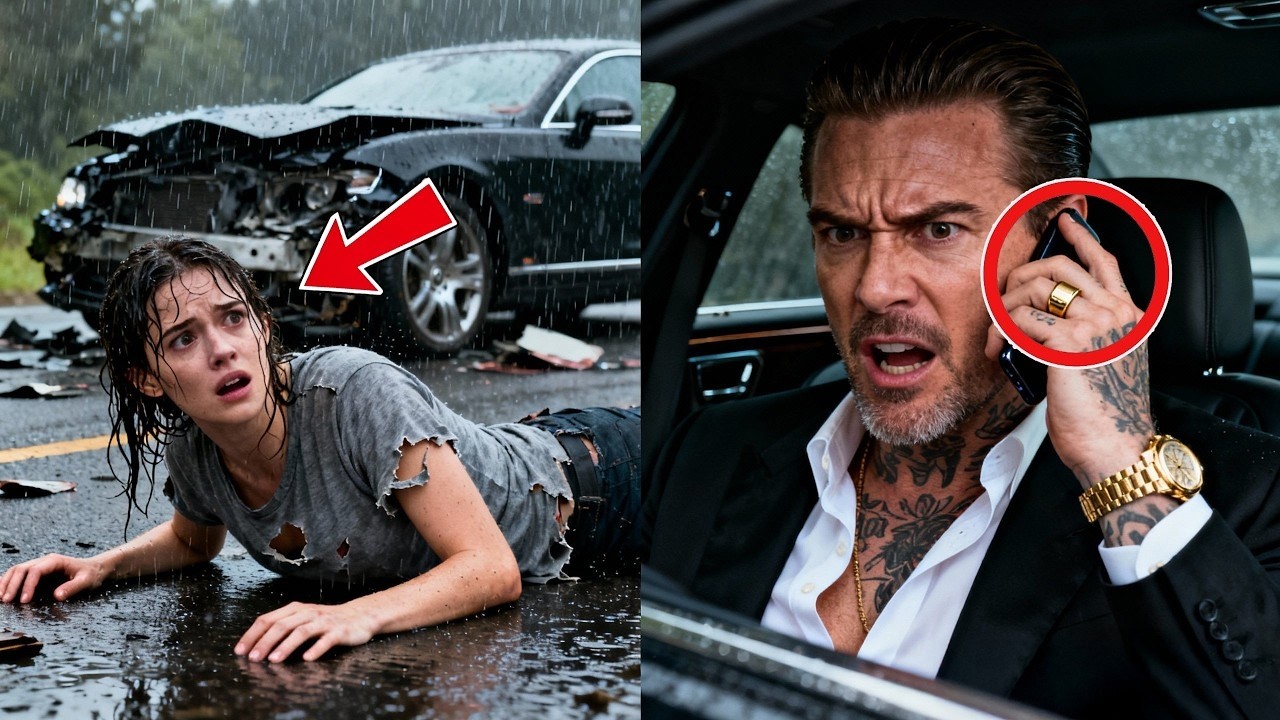
The rain didn’t fall in New York that night—it attacked.
It came down in thick sheets, hammering the glass towers of Manhattan like it wanted answers from the city itself. Cars moved slower, headlights blurred into long trembling streaks, and the wind cut between buildings with a sound that almost resembled warning sirens.
Inside Carver International, the top floor was the opposite of the storm outside: silent, controlled, surgical.
Emma Callahan stood in front of a wall of monitors, her reflection fractured across twenty different financial dashboards. Thirty-two years old. Senior risk analyst. The kind of person who could look at ten thousand transactions and immediately feel when one of them didn’t belong.
And tonight, something didn’t belong.
It started as a mismatch in offshore transfers—too small to notice, too precise to ignore. Then it became a pattern. Then a system. Then a structure hidden inside the structure.
By midnight, Emma wasn’t looking at an anomaly anymore.
She was looking at a theft map.
Carver International’s logistics arm was quietly bleeding millions into accounts that didn’t officially exist. Shell companies layered like Russian dolls. Contract adjustments timed with board approvals. Insurance payouts that never reached their destinations.
And at the center of it all, one signature kept appearing in the approval chain.
Marcus Hale.
Chief operating officer. Trusted friend of CEO Nicholas Carver. A man who had shaken Emma’s hand at her hiring, smiled like someone who believed in order, and once told her, “Numbers never lie. People do.”
Emma leaned closer to the screen.
The numbers weren’t lying.
But someone inside Carver International was.
She exported the data to a secured drive. Then another backup. Then a third.
Not because she was paranoid.
Because people who see too much in corporations like this don’t stay seen for long.
She had just clicked through the final ledger when the office lights shifted.
Not off.
Dimmed.
Like the building itself had inhaled.
Emma turned.
The executive floor was no longer empty.
Nicholas Carver was standing at the end of the glass corridor.
He didn’t wear his presence like most CEOs did—loud, performative, exaggerated. Instead, he carried stillness. Expensive suit. Calm expression. Eyes that didn’t waste movement.
Behind him, two security officers.
Emma’s stomach tightened before anyone spoke.
Nicholas walked slowly, his footsteps muted on the marble.
“You’re still here,” he said.
It wasn’t a question.
Emma straightened. “I found something.”
“I know.”
That answer landed too cleanly.
Too rehearsed.
Emma held up her tablet. “There’s a coordinated embezzlement operation routed through your logistics subsidiaries. It’s been running for at least eighteen months. Marcus Hale is embedded in every approval chain.”
The air changed.
Not dramatically.
Subtly.
Like pressure dropping before a storm breaks glass.
One of the security officers shifted his weight.
Nicholas didn’t look at the tablet.
He looked at her.
“Do you understand what you’re saying?” he asked.
“Yes.”
“No,” he corrected quietly. “You understand the data. Not the situation.”
Emma’s voice sharpened. “Millions have been diverted. Shareholders are being—”
“Silenced,” Nicholas finished. Then he took a step closer. “Yes. I’m aware.”
That sentence shouldn’t have been possible.
Emma blinked. “You’re aware?”
Nicholas exhaled slowly, almost tired. “Emma Callahan, senior analyst, recently promoted, no ties to internal politics. You were chosen because you don’t belong to any faction.”
Her grip on the tablet tightened. “Chosen for what?”
A pause.
Then Nicholas said something that made the room feel smaller.
“To see it.”
The security officer behind him spoke for the first time. “Sir, we should proceed with removal protocol.”
Emma’s head snapped slightly. “Removal?”
Nicholas raised a hand. Not in dismissal. In control.
The officer stopped.
And that was when Emma realized something she hadn’t noticed before.
The security wasn’t here to protect him.
It was here to follow him.
Nicholas finally pointed at her screen.
“Marcus didn’t build that system,” he said. “He completed it.”
Emma frowned. “Completed it?”
Nicholas’s gaze didn’t move. “There’s something you’re missing. And if you walk out of this building right now, you’ll become a problem for someone who prefers problems… erased.”
Emma’s pulse quickened. “Are you threatening me?”
“No.”
The word was immediate.
Too immediate.
Then softer.
“I’m telling you you’ve already been noticed.”
Silence spread between them.
Outside the glass, lightning split the sky.
Inside, Emma realized her hands were slightly cold.
Nicholas turned to the security officer. “Execute the public termination protocol.”
Emma’s breath caught. “What?”
The officer hesitated.
Nicholas didn’t.
“Now.”
The office doors opened behind Emma before she could step back.
Employees on the night shift—cleaners, assistants, late analysts—looked up as she was escorted into the main executive floor.
And then Nicholas Carver did something calculated.
He ended her career in front of everyone.
“Emma Callahan is being dismissed effective immediately due to breach of internal protocol and unauthorized data extraction.”
Whispers spread instantly.
Emma stood frozen as her access badge was deactivated in real time.
Red light.
Then nothing.
Security guided her toward the elevator.
She turned once.
Nicholas was still watching her.
Not cold.
Not satisfied.
Focused.
Like she was part of something she hadn’t been told the shape of yet.
The elevator doors closed.
And Emma Callahan, who had just uncovered a multi-million-dollar embezzlement network, was pushed out of the building and into the storm.
The rain hit her like impact.
Cold, violent, disorienting.
Her badge wouldn’t open doors anymore. Her phone lost internal signal. Even the building behind her looked different now—less like an office, more like a fortress that had decided she no longer belonged inside it.
She walked.
Not because she had somewhere to go.
But because standing still felt worse.
Two blocks down, her phone vibrated.
Unknown number.
She answered.
A voice came through immediately.
Male.
Low.
Controlled panic disguised as calm.
“Emma Callahan?”
“Yes.”
“You need to run.”
She stopped walking. “Who is this?”
A pause.
Then—
A sound like tires hitting wet pavement too fast.
A horn.
A second of silence.
And then a violent crash so loud she pulled the phone away from her ear instinctively.
The line didn’t disconnect.
But there was no voice after that.
Just rain.
And something that sounded like glass settling into the street.
Emma stood frozen.
Her breath caught in her throat.
“What was that?” she whispered.
Nothing answered.
Then the call ended.
The official report the next morning called it a “traffic accident involving an unidentified vehicle and a late-night pedestrian incident.”
Emma wasn’t found.
Which was strange.
Because she had been standing in the middle of a monitored intersection with cameras on all four corners.
Except later, those same cameras were “temporarily offline due to maintenance review.”
Carver International released a statement expressing regret.
No mention of Emma Callahan.
No mention of her termination.
Just silence polished into corporate language.
But Emma was not dead.
She woke up in a secure medical room she didn’t recognize.
White walls. Controlled lighting. No windows.
A single man sat near the door.
Not a doctor.
Security.
When she tried to move, pain shot through her ribs.
“You were hit,” the man said calmly. “You’re alive because we intervened quickly.”
Emma’s voice was rough. “Who is ‘we’?”
The door opened.
Nicholas Carver entered.
Still immaculate.
Still composed.
As if he hadn’t just publicly destroyed her life hours earlier.
Emma stared at him. “You staged it.”
Nicholas didn’t deny it.
He stepped closer. “You were never fired, Emma.”
Her jaw tightened. “You humiliated me in front of the entire company.”
“Yes.”
“That’s not protection.”
Nicholas’s expression shifted slightly.
“It is when the room is full of predators.”
Emma tried to sit up and immediately regretted it. “Someone tried to run me down.”
Nicholas nodded once.
“Yes.”
“Because I found Marcus.”
Nicholas paused.
Then corrected softly.
“Because Marcus thinks you found something that matters.”
Emma’s eyes narrowed. “Explain.”
Nicholas turned slightly toward the glass wall.
Outside it, security teams moved like shadows.
“Marcus has been inside my company for eight years,” he said. “He didn’t steal money. He redirected influence. Contracts. Supply chains. Entire divisions of operational control.”
Emma forced herself to focus through the pain. “So he’s a traitor.”
“Yes.”
“And I was just… bait?”
Silence.
That was the answer.
Nicholas didn’t look at her when he spoke again.
“You were the only analyst who would notice the pattern without being part of the pattern.”
Emma’s voice dropped. “And the hit-and-run?”
A flicker.
Not guilt.
Calculation.
“That wasn’t us,” Nicholas said.
Emma froze.
Nicholas continued.
“That was Marcus trying to confirm whether you survived your termination.”
The room felt colder.
Emma stared at him. “So when you threw me out—”
“I exposed you.”
“To who?”
Nicholas turned back to her.
“To him.”
The realization didn’t come gently.
It came like pressure breaking.
Emma’s dismissal wasn’t rejection.
It was bait.
Her “death” wasn’t an accident.
It was a signal.
And somewhere in the middle of it all, Marcus had believed she was gone.
Until she wasn’t.
Emma whispered, “You could have told me.”
Nicholas’s voice was quieter now.
“If I told you, you’d be predictable.”
“That’s not an answer.”
“It is the only one that keeps you alive.”
Silence stretched.
Emma looked down at her hands.
They were shaking slightly.
Not from fear.
From anger.
“You used me,” she said.
Nicholas didn’t deny it.
Then he added something that changed the weight of the room.
“And I protected you.”
Emma looked up sharply.
He continued.
“Because now Marcus knows someone inside his system is still moving. And he thinks it’s me.”
Emma’s breath slowed.
“And it’s not?”
Nicholas looked at her for a long moment.
“No.”
That single word carried more danger than everything else said that night.
The truth unfolded in fragments over the next forty-eight hours.
Emma, now “off the grid” officially dead to the company, was moved between secure locations controlled by Nicholas’s private operations team.
Each time she asked questions, she received partial answers.
Marcus wasn’t just embezzling funds.
He was restructuring control of Carver International from within—turning departments against each other, redirecting dependencies, building a shadow authority that would survive even if Nicholas remained CEO.
And Emma’s discovery had accelerated his timeline.
Which meant one thing.
He would escalate.
The turning point came when a second analyst—someone Emma had worked with—was found locked out of systems permanently.
No injury.
Just silence.
A warning.
Emma stared at the report.
“They’re removing anyone who gets close,” she said.
Nicholas nodded. “Which is why you don’t get close. You get final.”
Emma looked at him. “Final what?”
Nicholas met her gaze.
“Final confirmation.”
That night, Emma was given access to the deepest layer of Carver International’s network.
Not financial.
Structural.
What she saw there made her stop speaking for nearly a full minute.
Entire departments rerouted under invisible authority lines.
Emergency protocols rewritten.
Board voting weights quietly adjusted over time.
Marcus wasn’t stealing from the company.
He was becoming the company.
Emma whispered, “He’s already inside everything.”
Nicholas replied, “Yes.”
“And you let it get this far?”
A pause.
Then Nicholas said, “No. I let him think it got this far.”
That was when Emma finally understood.
Nicholas Carver wasn’t reacting to Marcus.
He had been building a containment for him.
And Emma Callahan wasn’t discarded.
She was the missing variable that made the containment visible.
The trap only worked if Marcus believed she was dead.
Because the moment he relaxed…
He would expose himself completely.
The confrontation didn’t happen in a boardroom.
It happened in the system.
Emma initiated the final audit trigger under Nicholas’s instruction.
Every hidden transaction Marcus had touched lit up across the network like veins under glass.
Within minutes, internal factions split.
Within an hour, Marcus attempted emergency override.
And failed.
Because Emma had already removed his access pathways without him realizing.
When Marcus realized what was happening, it wasn’t rage that came first.
It was disbelief.
That someone he considered irrelevant had become the axis of his collapse.
The last message he sent before his access was fully revoked was simple:
I should have finished her.
But by then, it was too late.
Security teams moved in.
Quiet.
Precise.
Controlled.
Marcus Hale was removed from the system he thought he owned.
Not with violence.
With absence.
The absence of authority.
The absence of influence.
The absence of control.
Later, in the quiet aftermath, Emma stood again in the glass corridor where she had been fired.
Only this time, she wasn’t being escorted out.
Nicholas stood beside her.
The storm outside had passed.
The city below looked unchanged, but something underneath it had shifted.
Emma said quietly, “So this is what you do.”
Nicholas glanced at her. “What do you think I do?”
“Break people to catch one.”
A pause.
Then he corrected her.
“I remove illusions so the truth can breathe.”
Emma looked out at the skyline.
“I didn’t think I would survive that night.”
Nicholas answered without hesitation.
“You weren’t supposed to survive alone.”
That stayed in the air longer than anything else.
Not romantic.
Not dramatic.
Just real.
Weeks later, Carver International announced a restructuring initiative focused on internal transparency and ethical operational reform.
No mention of Marcus Hale.
No mention of Emma Callahan’s termination.
Only a quiet line in the press release about “internal security modernization.”
Inside the company, things changed in ways employees could feel but not fully explain.
Systems became cleaner.
Corruption pathways disappeared.
And decisions that once took days were now traced, verified, and corrected in hours.
Emma stayed.
Not as a victim.
Not as a symbol.
But as part of the architecture that prevented silence from becoming power again.
And Nicholas never called her collateral again.
Because she had become something else entirely.
The variable that survived the storm.
One evening, long after everything settled, Emma stood beside him again in the executive corridor.
No emergency.
No collapse.
Just quiet.
She said, “You still gamble with people’s lives.”
Nicholas replied, “No.”
He looked at her.
“I gamble with outcomes.”
Emma studied him for a long moment.
Then said, “You should stop doing that alone.”
Nicholas didn’t answer immediately.
Outside, the city moved like it always had—unaware of how close it had come to collapsing inside one company’s silence.
Finally, he said, “That depends.”
“On what?”
“On whether you trust me enough to stay when it’s dangerous.”
Emma didn’t hesitate this time.
“I already did.”
And for the first time, Nicholas Carver didn’t look like a man controlling a system.
He looked like someone building one that could finally hold more than just him.