The rain in Seoul always felt louder when you were hungry.
It didn’t just fall—it hammered the tin roof of a basement kitchen in Mapo District where the air smelled like burnt oil, bleach, and exhaustion that never left.
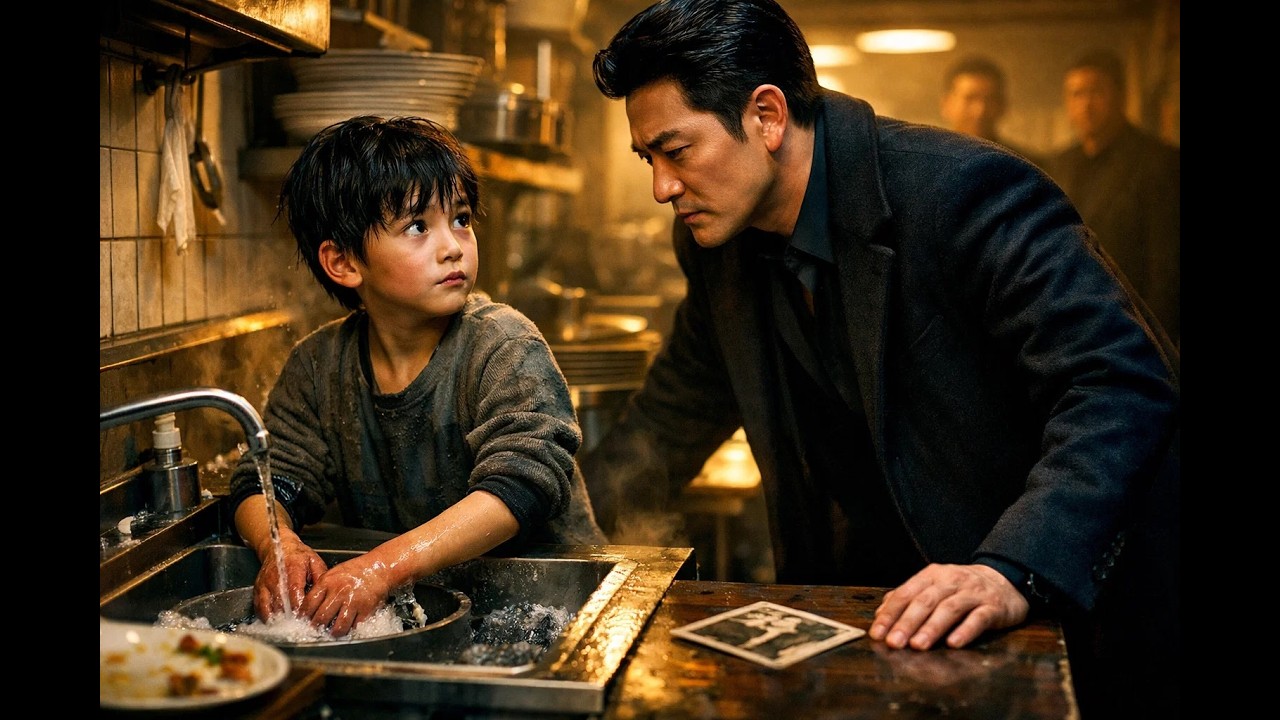
Inside, a boy no one bothered to properly name anymore stood over a sink stacked higher than his chest.
His hands were red. Not from cold, but from chemicals and scrubbing until fingerprints blurred into nothing.
“Faster,” the kitchen supervisor barked without looking up. “If you’re slow, you eat less. If you complain, you don’t eat at all.”
The boy didn’t answer.
He never did.
Because answers cost food. And food was the only thing keeping him upright.
His name was Seo-jun. At least, that’s what his mother used to call him before everything collapsed.
Now he was just “dish kid” to the staff—and worse things to the men who came looking for money.
In the pocket of his soaked apron, hidden inside a plastic wrap to protect it from grease and water, was a faded photograph.
A woman smiling in front of a small bakery. A soft light in her eyes that looked like it had no idea what would come later.
He touched it every time his hands stopped moving.
Like a promise. Or a curse.
Because the debt tied to that smile was still alive.
Golden Dragon Gang.
Even the name sounded like something mythical—until you owed them money.
Then it became very real.
Very human.
And very cruel.
Seo-jun’s mother had borrowed from them to keep the bakery alive during its final year. When she died, the debt didn’t.
Debt never mourns.
It only collects.
Now, every month, men in black jackets came to the kitchen asking for payment that never shrank. Interest that grew faster than he could scrub plates. Threats that didn’t need shouting anymore.
They had already taken everything else.
The bakery.
The house.
Even her name off official records.
All that remained was him—and the dishes.
“Hey,” the supervisor snapped again, throwing a tray into the sink so hard water splashed his face. “You think staring at water makes it clean faster?”
A few workers laughed.
Seo-jun kept scrubbing.
Because silence was cheaper than pride.
Outside, footsteps approached. Different from the usual rhythm of cooks and delivery men.
He felt it before he heard it.
The kitchen door opened.
And the temperature of the room changed.
Three men entered first. Not customers. Not staff.
They didn’t wear uniforms. They didn’t need them.
Their presence made it clear enough.
Golden Dragon.
The supervisor immediately straightened his posture, bowing too quickly, too eagerly.
“Welcome, gentlemen. Everything is ready as always.”
But they weren’t looking at him.
They were looking past him.
At the boy by the sink.
Seo-jun didn’t move. Didn’t look up. But his fingers tightened slightly around the sponge.
One of the gang members smirked. “Still here?”
Another chuckled. “Debt never runs out of dishes, I guess.”
Then the last man stepped aside.
And the room went silent.
Because the real presence had arrived.
He didn’t walk like someone who owned the room.
He walked like the room already belonged to him and he was just confirming the details.
Jang Tae-sang.
The name wasn’t spoken in kitchens. It was whispered in boardrooms, feared in alleys, and avoided in police reports.
They called him the Dragon King.
But he didn’t look like a myth.
He looked like a man who had stopped asking for permission a long time ago.
His eyes scanned the kitchen once.
Then stopped.
On Seo-jun.
Not on the boy’s face.
On the photograph that slipped slightly from his pocket as he reached for another plate.
Jang Tae-sang didn’t move for a long moment.
Just stared.
Like something buried under years of silence had just started breathing again.
“Where did you get that?” he asked quietly.
The kitchen froze.
Even the boiling water seemed to hesitate.
Seo-jun blinked. Slowly, he pulled the photo back into his pocket.
“It’s mine,” he said.
The supervisor laughed nervously. “Sir, it’s just some orphan kid—”
“Quiet,” Jang said.
One word.
The supervisor stopped breathing mid-sentence.
Jang stepped forward.
Slowly.
Not toward authority.
Toward recognition.
“You didn’t answer my question,” he said again, softer this time. “Where did you get that photo?”
Seo-jun hesitated.
Something about the man’s voice didn’t feel like threat.
It felt like memory trying to surface through concrete.
“My mother,” Seo-jun said finally. “It’s all I have left of her.”
Something shifted in Jang’s expression.
Not anger.
Not surprise.
Something deeper.
Like gravity changing direction.
He looked at the boy’s face properly now.
Really looked.
And the kitchen—loud, greasy, chaotic—felt suddenly like it had been built around this exact moment.
Jang’s voice dropped.
“Tell me your mother’s name.”
Seo-jun swallowed. “Min-ji.”
The room didn’t react.
But Jang Tae-sang did.
Very slightly.
His jaw tightened.
His hand moved to his side pocket, pulling out something he hadn’t touched in years.
A black-and-gold ring.
Old. Worn. Familiar.
The Golden Dragon insignia—but not the one the gang used now.
The original.
Before it became corrupted.
Before it became what it was today.
The supervisor finally spoke again, voice shaking. “Sir, if this boy owes something—”
“He doesn’t owe anything,” Jang said without looking at him.
Silence again.
But this time it wasn’t confusion.
It was fear.
Because no one had ever heard Jang Tae-sang say that about a debt.
Ever.
The air tightened.
Jang stepped closer to Seo-jun until only the sink separated them.
Then he did something no one expected.
He lowered himself slightly.
To the boy’s eye level.
“What’s your father’s name?” he asked.
Seo-jun frowned. “I never had one.”
A long pause.
Then Jang exhaled slowly, like something heavy had finally found its place.
“And where did the Golden Dragon debt come from?”
“My mother,” Seo-jun said. “Before she died. They said she couldn’t pay. So I inherited it.”
A faint sound came from one of the gang members.
Not laughter.
Discomfort.
Jang Tae-sang closed his eyes for a brief moment.
When he opened them again, something had changed.
He turned slightly toward the supervisor.
“Who signed off on this debt transfer?”
The supervisor stammered. “It was… standard procedure. After her passing—”
Jang didn’t let him finish.
“Show me the file.”
One of the gang members hesitated. “Boss, it’s just paperwork—”
“Show. Me. The file.”
Now the room moved.
Phones came out. Calls were made. A folder was pulled up on a tablet and handed over with shaking hands.
Jang scanned it.
Once.
Twice.
Then stopped.
His expression didn’t break.
But something inside it did.
“Min-ji Jang,” he read quietly.
Seo-jun blinked. “Jang?”
The supervisor went pale.
One of the gang members dropped his cigarette.
Because that name wasn’t supposed to be on any debt file.
Jang Tae-sang lowered the tablet.
And looked at Seo-jun again.
Longer this time.
Like seeing both past and present collide in one fragile frame.
“She was my sister,” he said.
The kitchen didn’t breathe.
Even the water stopped sounding like water.
Seo-jun froze. “What?”
Jang’s voice remained steady, but lower now.
“My younger sister. She left home years ago. We lost contact after…” He paused. “After she chose a different life.”
He looked at the photo again.
The bakery behind her.
“I thought she was gone without leaving anything behind.”
A beat.
Then the truth landed fully.
“You’re her son.”
It wasn’t a question.
Seo-jun stepped back instinctively.
“No,” he whispered. “That’s impossible.”
But Jang didn’t move.
Instead, he turned his head slightly toward the gang members.
And something in his eyes changed from recognition to calculation.
Cold. Precise.
“You put my nephew in a debt kitchen,” he said quietly.
No one answered.
Because there was no correct answer.
The silence stretched until it cracked.
Then Jang Tae-sang stood up.
And the room finally understood what danger actually meant.
What happened next was not loud.
It didn’t need to be.
Within ten minutes, calls were made that erased names from systems. Phones rang in panic. Doors locked from the outside instead of the inside. The Golden Dragon members who had entered confidently now stood like men realizing they had walked into the wrong memory.
The supervisor tried to run.
He didn’t make it to the door.
He was stopped—not violently, but completely.
Like the idea of escape itself had been deleted.
Jang didn’t raise his voice.
He didn’t need to.
“I built this organization,” he said, almost to himself. “And you turned it into a parasite.”
One of the gang members finally spoke. “Boss… we didn’t know—”
“You didn’t care,” Jang interrupted.
A long silence followed.
Then he turned back to Seo-jun.
The boy was still standing by the sink, wet hands trembling slightly now—not from cold, but from the sudden collapse of everything he thought was real.
Jang walked to him and gently took the plastic-wrapped photo from his pocket.
Carefully.
Like it mattered more than anything else in the room.
“She used to stand in that bakery every morning before school,” Jang said quietly. “She wanted something simple. A life that didn’t belong to gangs or debts.”
He looked at Seo-jun.
“And they turned her son into a slave for dishes.”
The room felt smaller.
Not because it had changed.
Because truth had entered it.
Jang turned slightly.
“Erase every trace of his debt,” he said. “Every record. Every name. Every claim.”
A pause.
“And shut this kitchen down.”
The supervisor collapsed to his knees.
Not from force.
From realization.
By the time the sun rose the next morning, the Golden Dragon’s records had been rewritten.
Not erased.
Rewritten.
Because men like Jang Tae-sang didn’t just remove problems.
They corrected histories.
Seo-jun was no longer a debtor.
No longer a kitchen worker.
He was something else entirely.
Something he didn’t understand yet.
Ten years passed like water over stone.
Slow.
Unstoppable.
And quietly transformative.
The old bakery in Mapo District reopened under a new name: Min-ji Bread House.
People said it was funded by a mysterious investor who never showed his face.
But every morning at 5:30 a.m., a young man in a simple black coat would unlock the door before the staff arrived.
He didn’t speak much.
But he always checked the oven first.
Then the shelves.
Then the photo on the wall of a smiling woman in front of a bakery.
Seo-jun never removed the apron stains from his memory, even if he no longer wore one.
The Golden Dragon ring sat on his desk—not as a symbol of ownership.
But of inheritance.
And responsibility.
He had refused to take control of the entire organization at first.
Until Jang Tae-sang said something simple:
“Power means nothing if you don’t know what it feels like to have none.”
Now Seo-jun understood.
One afternoon, a delivery arrived.
No sender name.
Inside was a single note:
“You didn’t just survive what they did to you. You changed what they couldn’t control.
— Uncle”
Seo-jun folded the note slowly.
Looked out the bakery window.
Children were laughing outside.
The smell of fresh bread filled the air.
And for the first time in his life, the past didn’t feel like a weight.
It felt like a foundation.
Because some empires are built with fear.
Others are built with money.
But the ones that last—
are built by people who remember exactly what it felt like to be invisible.
And refuse to let the next generation stay that way.
In the quiet hum of a bakery that once belonged to a broken woman’s dream, a former starving boy finally understood something simple:
Blood doesn’t make a family.
Choice does.
And when power finally bows to truth, even the deepest debt can be rewritten into legacy.
If you’ve ever been underestimated by the world—this is the kind of ending you don’t forget.