 The laugh started quietly.
Not because it was funny—but because it was cruel enough to be casual.
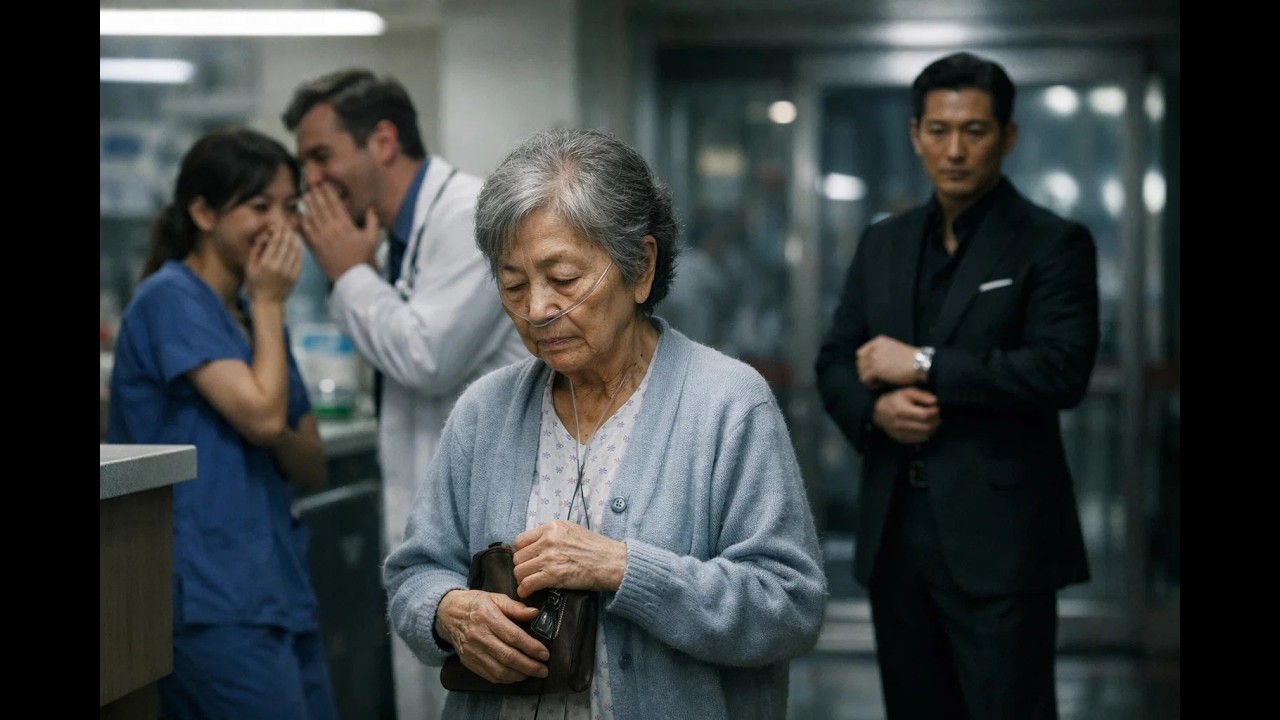
Inside the Emergency Room of Seoul Central General Hospital, the kind of place that never truly sleeps, a frail elderly woman sat on a plastic wheelchair near the triage desk. Her cardigan was faded, stretched at the sleeves, as if it had survived more winters than anyone wanted to count.
A nurse had asked her name twice.
She answered softly both times.
But no one wrote it down.
Because Dr. Park was already watching.
And Dr. Park didn’t believe in wasting time on people who didn’t look like they mattered.
“She looks like… furniture,” he said under his breath, not even trying to hide it.
A junior resident hesitated. “Sir?”
Dr. Park tilted his head slightly, eyes still on the woman. “Old upholstery left too long in the sun. Why is she even here?”
A few staff members heard it.
One nurse looked down immediately.
Another turned away, pretending to check a monitor that didn’t need checking.
But someone laughed.
Just one.
And that was enough.
The sound spread like permission.
The elderly woman didn’t react. She just adjusted her hands on the armrest, as if she had heard worse things before and had long stopped keeping score.
That was when the door opened.
And everything in the room shifted without anyone knowing why.
He didn’t rush in.
He never did.
Kang Jae Hyuk walked into the ER like a man who had already read the outcome and was only confirming the details.
Black coat. No visible security. No entourage that screamed power.
But power didn’t need noise.
It needed recognition.
And in that hospital, people recognized him immediately.
Not as a patient.
Not as a visitor.
But as something closer to consequence.
A nurse near the entrance straightened instinctively.
A resident froze mid-step.
Even the air felt like it stopped arguing.
Dr. Park noticed none of this at first.
He was still smiling at his own joke.
Until he saw who the elderly woman was looking at.
And her expression changed.
Not fear.
Relief.
“Excuse me,” Jae Hyuk said calmly, walking straight past triage.
No one stopped him.
No one wanted to.
He stopped in front of the wheelchair.
Only then did he look down at her.
And his voice softened.
“Why didn’t you call me sooner?”
The woman shook her head slightly. “You were busy.”
It was not a complaint.
It was a habit.
A lifetime of minimizing herself so others could stand taller.
That was when Dr. Park finally spoke.
“And who are you?” he asked, annoyed at the interruption.
Jae Hyuk turned his head slightly.
Just enough.
Not enough to show emotion.
But enough to show control.
“I’m her son,” he said.
A pause.
Then Dr. Park smirked.
“Oh,” he said. “So this is family drama hour. We don’t do reunions in the ER, sir. Take her to a clinic if it’s—”
He stopped.
Because Jae Hyuk took one step closer.
Not threatening.
Not loud.
Just close enough for the temperature in the room to drop by a few degrees.
“My mother,” Jae Hyuk said quietly, “was just called furniture.”
The ER went silent.
Even the monitors seemed less interested in making noise.
Dr. Park shrugged. “It was a joke. You people are too sensitive—”
“You people.”
That phrase landed differently than he intended.
Not because of what it meant.
But because of who heard it.
Jae Hyuk nodded slowly, as if filing it away.
Then he looked at the nurse beside the wheelchair.
“Has she been triaged?”
The nurse hesitated.
“No, sir… Dr. Park said it wasn’t urgent.”
Jae Hyuk turned back.
And smiled once.
Not warmly.
Not angrily.
Just understanding something fully.
“I see.”
That was the first dangerous moment.
Because understanding is what comes right before decisions are made.
The escalation didn’t happen loudly.
It happened systematically.
Within twenty minutes, every ER file tied to Dr. Park’s name was being quietly pulled into a secondary review system.
Within forty minutes, hospital procurement received a freeze notice on pending medical supply shipments.
Within an hour, three board members were on emergency calls they were not prepared for.
But inside the ER, only Dr. Park noticed something was wrong.
Because suddenly, no one was backing him.
A nurse whispered something to another nurse.
A resident avoided eye contact entirely.
Even the security guard near the door was standing in a different posture.
As if waiting for instruction from someone else.
Dr. Park scoffed. “What is this? Who authorized interference with my department?”
No answer.
Then Jae Hyuk spoke again.
“I did.”
Dr. Park turned fully now. “You? You think you can just walk into my hospital and—”
“It’s not your hospital,” Jae Hyuk interrupted softly.
That silence again.
This time heavier.
Dr. Park laughed, but it sounded forced now. “Do you even know who I am? I’ve been here fifteen years. I run this ER. I decide who gets treated and when—”
“That’s what I’m afraid of,” Jae Hyuk said.
And for the first time, Dr. Park hesitated.
Just for a second.
But enough.
The first twist didn’t come with drama.
It came with paperwork.
A junior auditor arrived carrying a sealed file stamped with the hospital’s internal compliance division.
It was placed directly into Jae Hyuk’s hands.
He opened it without urgency.
Page one: irregular discharge patterns.
Page two: missing ICU logs.
Page three: altered mortality timestamps.
Dr. Park frowned. “What is this nonsense?”
Jae Hyuk flipped another page.
Then another.
“Interesting pattern,” he said calmly.
A pause.
Then he looked up.
“Seventeen patients declared deceased within twelve hours of bed shortages. All under your supervision.”
Dr. Park scoffed again. “That’s hospital turnover. Beds are limited. People die. That’s reality.”
Jae Hyuk nodded slightly.
“Yes,” he said. “But not like this.”
He turned the file so Dr. Park could see one page clearly.
CCTV timestamp. Medication chart. Nurse signature mismatch.
A sedation dosage logged twice.
A patient marked “non-responsive” thirty minutes before cardiac failure.
Dr. Park’s smile faltered.
Just slightly.
“That’s… procedural overlap,” he said quickly.
But his voice had changed.
Because he knew what he was looking at.
And more importantly—
he knew what it meant.
The real silence came when Jae Hyuk spoke the next sentence.
“Do you know who approved the audit?”
No one answered.
Because no one wanted to be wrong.
Jae Hyuk answered himself.
“The Kang Sun Young Foundation.”
The name hit the room differently.
A few nurses straightened.
A senior administrator went pale.
Dr. Park blinked.
“That foundation doesn’t—”
“It does,” Jae Hyuk said. “It funds sixty-two percent of this hospital’s emergency operations.”
A pause.
Then the second twist arrived.
Not with revelation.
But with recognition.
Because the elderly woman in the wheelchair slowly raised her head.
And looked directly at Dr. Park.
For the first time.
Not fragile.
Not confused.
But fully present.
And Dr. Park finally understood why her face had felt familiar.
Because she wasn’t just a patient.
She was the name on the building he had worked in before it was rebuilt.
Kang Sun Young.
Former chief of emergency medicine.
The woman who had exposed illegal triage manipulation ten years ago.
The woman whose findings were buried after she “resigned due to illness.”
The woman everyone assumed had faded into obscurity.
Except she hadn’t.
She had been watching.
Quietly.
Patiently.
Until now.
Dr. Park took a step back without realizing it.
“No,” he said quietly. “That report was discredited. She was unstable—”
The woman spoke for the first time that day.
Her voice was weak.
But precise.
“I remember every patient you told me to remove from the list.”
The air left the room.
Jae Hyuk didn’t look at Dr. Park.
He didn’t need to.
Because everything was already decided.
The consequence unfolded without violence.
But it was absolute.
Hospital security was reallocated within minutes.
Medical licenses were suspended pending federal review.
Digital logs were sealed.
And external regulators arrived before sunset.
Dr. Park was not dragged out.
He was escorted.
That mattered more.
Because people only resist force.
But they collapse under certainty.
As he passed the ER exit, he looked back.
Not at Jae Hyuk.
Not at the investigators.
But at the elderly woman still sitting in the wheelchair.
For a brief moment, something flickered in his expression.
Not anger.
Not denial.
Recognition.
The realization that power had never been his.
He had only been borrowing space inside a system he misunderstood.
And now the system had corrected itself.
Weeks later, the hospital no longer carried his name.
It no longer carried the old board’s influence either.
The entrance sign was replaced quietly one morning.
No ceremony.
No press conference.
Just new letters installed over old history:
Kang Sun Young Center for Community Healing
Inside, the ER was reorganized.
Triage protocols rewritten.
Oversight automated.
Human bias reduced where possible.
And for the first time in years, patients were called by names before numbers.
On the day of the reopening, Kang Jae Hyuk stood outside the entrance with his mother.
She looked at the sign for a long time.
Then she spoke softly.
“I never wanted a building named after me.”
He nodded. “I know.”
A pause.
Then she added, “I just wanted them to stop laughing.”
Jae Hyuk looked at her.
And for the first time that day, his expression softened.
“They won’t,” he said. “Not anymore.”
Behind them, staff moved through the ER with a different rhythm now.
Less fear.
More attention.
More time.
And somewhere inside the system, Dr. Park’s name no longer existed in authority databases.
Only in archived records.
A reminder of what happens when arrogance forgets who built the room it stands in.
Power, in the end, was never loud.
It didn’t need to insult to prove itself.
It didn’t need to destroy to correct.
It simply exposed what was already there—and removed everything that didn’t belong.
And as the morning shift began under a new name, one quiet truth settled over the hospital like sunlight through glass:
The most dangerous force in any system is not anger.
It is dignity restored after being taken for granted too long.
And anyone who mistakes kindness for weakness will eventually learn what it feels like when the system stops laughing with them—and starts listening to the truth instead.