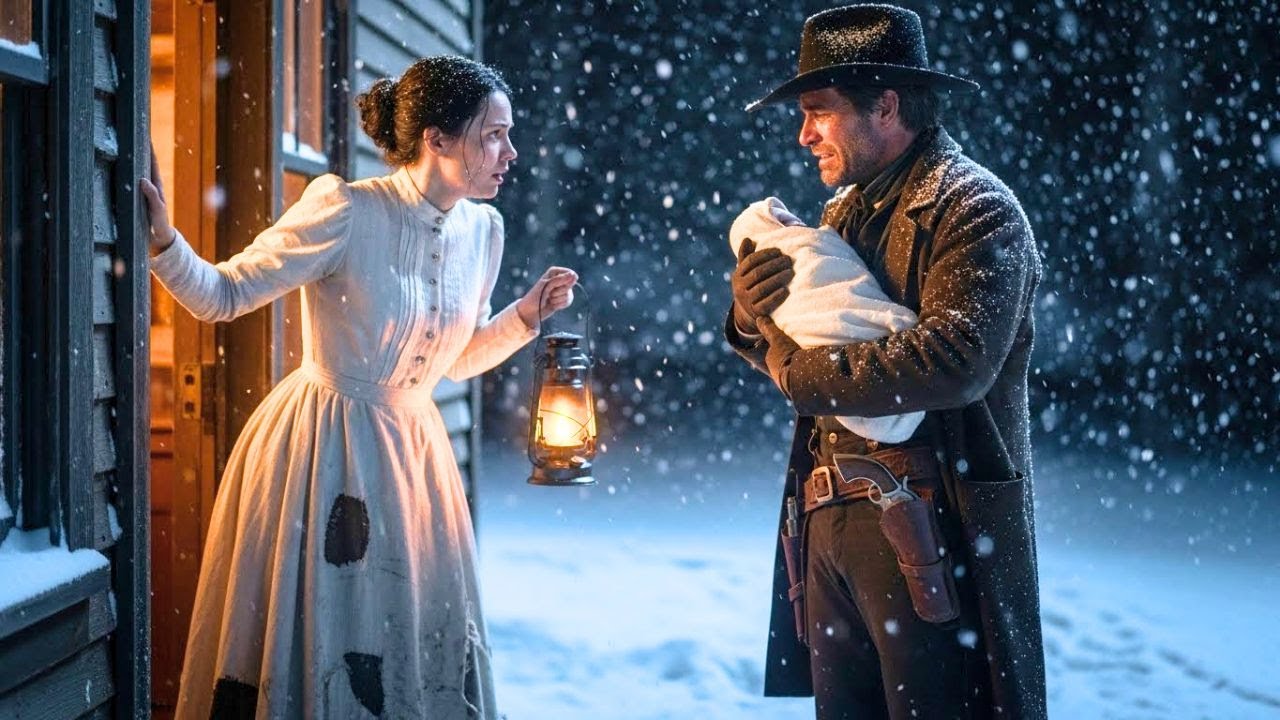
The knock came just before midnight.
Not the polite kind.
Not the kind that belonged to neighbors or travelers or men who respected the cold.
It was desperate.
Three sharp hits against wood that sounded more like a refusal to give up than a request to enter.
Inside the small cabin at the edge of the Colorado timberline, Clara Hayes froze.
She had learned to recognize that kind of sound.
It was how trouble announced itself when it didn’t care whether you were ready.
Another knock followed.
Then a voice.
“Please… if anyone’s in there… I need help.”
Clara didn’t answer immediately.
The fire behind her cracked softly, throwing light across a room that still felt too large for one person. Too empty for someone who had once been preparing for a life that never arrived.
She had lost her baby six months ago.
The town had stopped visiting after that.
Stopped calling her name in the same tone.
Stopped believing she had anything left to offer.
And yet, she stood.
Because that voice outside wasn’t leaving.
She walked to the door and opened it.
Cold air rushed in like it had been waiting.
A man stood there, snow clinging to his coat, his face pale with exhaustion. In his arms, wrapped in layers that were already too thin for the weather, was a newborn baby.
The child wasn’t crying.
That was the worst part.
The silence of a baby too weak to cry.
“My wife… she didn’t make it,” the man said quickly, breath shaking. “I don’t know what I’m doing. He won’t take anything. I’ve tried everything. Please—”
His voice broke.
“I think he’s dying.”
Clara didn’t move for a second.
Not because she didn’t understand.
Because she understood too well.
Her eyes dropped to the child.
Small. Pale. Still.
Something inside her shifted.
Not decision.
Recognition.
“Come in,” she said.
The cabin warmed slowly, but the child did not.
Clara moved with quiet urgency, taking the baby from the man’s arms with a care that felt instinctive rather than learned. She checked the tiny chest. The shallow breath. The cold skin.
“He hasn’t eaten,” she said.
“I tried,” the man answered immediately. “No one in town would help. I asked every woman I knew. They all said no.”
Clara’s hands paused.
“Why would they refuse?”
The man hesitated.
Then spoke carefully.
“Because they think you’re cursed,” he said. “Because you didn’t bury your own child in the churchyard. Because they say you brought bad luck into the valley.”
Clara didn’t react outwardly.
But something in her expression tightened.
So that was it.
Not grief.
Judgment.
She looked down at the baby again.
“We don’t have time for their stories,” she said quietly.
The man blinked. “What?”
Clara turned slightly toward the fire.
“Warm water. Clean cloths. Sit down.”
She didn’t wait for agreement.
She simply acted.
And for the first time that night, the man obeyed without questioning.
The next hours were not gentle.
They were survival.
Clara worked with a focus that came from somewhere deeper than thought. The baby needed warmth first. Then nourishment. Then time the world had already refused to give.
The man paced near the wall, helpless in a way that made him smaller with every passing minute.
“What’s your name?” Clara asked without looking up.
“Ethan Cole,” he said.
Clara nodded once.
“I’m Clara.”
No last names mattered tonight.
Outside, the wind pressed against the cabin like something testing its strength.
Inside, the child finally stirred.
A faint sound.
Not a cry.
But a beginning.
Ethan stepped forward immediately.
“Is he—?”
“Alive,” Clara said firmly.
The word landed like permission.
But survival wasn’t complete yet.
The baby still needed what Clara had not expected to give again.
What she had buried with her own child.
Ethan watched her carefully as she adjusted the infant in her arms.
Then realization began to form slowly in his eyes.
“You… you’re feeding him,” he said quietly.
Clara didn’t look up.
“Yes.”
Silence followed.
It wasn’t shock.
It was understanding colliding with desperation.
“I didn’t have another choice,” Ethan said quickly, as if explaining himself. “I would never have asked—”
“You didn’t,” Clara interrupted.
A pause.
Then softer:
“I chose.”
That word changed the air.
Not because it explained everything.
But because it removed ownership from suffering.
By morning, the storm outside had not stopped.
But inside the cabin, something had shifted.
The baby was alive.
Still fragile.
But no longer slipping away.
Ethan sat at the table, staring at the floor like he hadn’t slept in days—which he hadn’t.
“I don’t know what this means,” he said quietly.
Clara adjusted the blanket around the child.
“It means he lives,” she replied.
Ethan looked up at her.
“You’re going to be talked about,” he said. “The town already thinks I’m desperate. If they find out what you did…”
Clara didn’t respond immediately.
She had already lived through rumor.
Rumor was just another form of weather in this valley.
Let it come. Let it pass.
But Ethan continued.
“They’ll say things. About you. About us. They’ll twist it.”
Clara finally met his eyes.
“Let them,” she said.
That was the first moment Ethan stopped seeing her as just a stranger.
And started seeing her as something else.
The scandal arrived three days later.
Not in anger.
In whispers.
A widow nursing a child that was not hers.
A rancher bringing a woman into his home under circumstances no one wanted to understand.
The town did what small towns often do when they don’t understand mercy.
They turned it into suspicion.
By the end of the week, Ethan was summoned by the local council.
The language was careful.
Too careful.
“Improper arrangement,” they called it.
“Unstable household conditions.”
“Temporary guardianship concerns.”
What they meant was simpler.
Control.
The solution they offered was worse than anything else.
“Formal marriage,” one council member said. “To stabilize custody and protect the child from… irregular circumstances.”
Clara laughed when Ethan told her.
Not because it was funny.
Because it wasn’t.
“They want us to fix their discomfort,” she said.
Ethan nodded slowly.
“Yes.”
A pause.
Then quieter:
“If we refuse, they’ll take him.”
Silence settled between them.
The baby slept nearby, unaware that his existence had become a negotiation.
Clara looked down at him for a long time.
Then spoke.
“I won’t let them take him,” she said.
Ethan nodded once.
“Then we agree.”
It wasn’t romance.
It wasn’t promise.
It was structure imposed by a world that didn’t know how to handle kindness without labeling it.
So they accepted the label.
The marriage was quiet.
No celebration.
No audience beyond paperwork and cold air outside the courthouse.
But something changed afterward that neither of them expected.
The house didn’t feel like survival anymore.
It felt like continuity.
Clara stopped flinching at silence.
Ethan stopped treating every day like a crisis.
And the baby—small, stubborn, alive—began to grow.
They named him Noah.
Because everything before him had been flood.
But peace never arrives alone.
It brings consequences.
The first came in the form of a man from Ethan’s past.
A land investor with legal claims tied to Ethan’s property.
He arrived not with questions, but accusations.
“You think you can rewrite your situation with paperwork?” the man said.
Ethan didn’t answer.
Clara stood beside him.
And for the first time, she didn’t feel like someone standing outside of life.
She felt like someone standing inside it.
The conflict escalated quickly.
Property disputes.
Custody challenges.
Questioning of Clara’s “fitness.”
Old rumors resurrected and repackaged as legal concern.
But what the town had not expected was evidence.
Ethan had been documenting everything for years—contracts, threats, financial manipulation, letters that revealed pressure tactics aimed at forcing him off his land.
And Clara, once dismissed as a grieving widow, became the unexpected center of stability in every evaluation.
The court hearings dragged on for weeks.
Until the truth began to surface clearly enough that even rumor could not drown it out.
The real instability wasn’t Clara.
It was the system around them.
The final hearing was not dramatic.
It was quiet in the way truth often is when it no longer needs defense.
The judge reviewed the records.
Then looked at the opposing side.
“Your claim rests on presumed moral judgment,” he said. “Not evidence.”
Silence followed.
Then the ruling came.
Custody secured.
Property protected.
No separation mandated.
When Clara stepped outside afterward, she didn’t smile immediately.
She looked at Ethan.
“You knew this would happen?” she asked.
Ethan shook his head.
“No,” he said. “But I knew I couldn’t let fear decide it.”
A pause.
Then Clara finally exhaled.
Like she had been holding breath for months.
The winter passed slowly.
Then broke.
Spring arrived without announcement, as it always does in places that survive without ceremony.
The town didn’t change its opinions overnight.
But it stopped interfering.
Sometimes distance is the closest thing to acceptance.
One evening, Clara stood on the porch watching Noah take his first uneven steps across the wooden floor.
Ethan stood beside her.
“He’s going to remember this place as home,” Clara said quietly.
Ethan nodded.
“I hope so,” he replied.
Clara glanced at him.
“You didn’t have to take us in,” she said.
Ethan looked at the child.
Then at her.
“I know,” he said.
A pause.
Then softer:
“That’s why it meant something.”
Clara didn’t respond immediately.
Because some truths don’t need answering.
Only living.
Years later, Noah would never remember the night of the storm.
But he would grow up in the space it created.
A space built not from obligation.
But from choice repeated often enough to become family.
And in that small cabin where grief once lived alone, something else took root.
Not replacement.
Not forgetting.
But continuity.
Proof that even in the coldest places, warmth is not something you find.
It is something you decide to build—together, when the world says you shouldn’t.


